


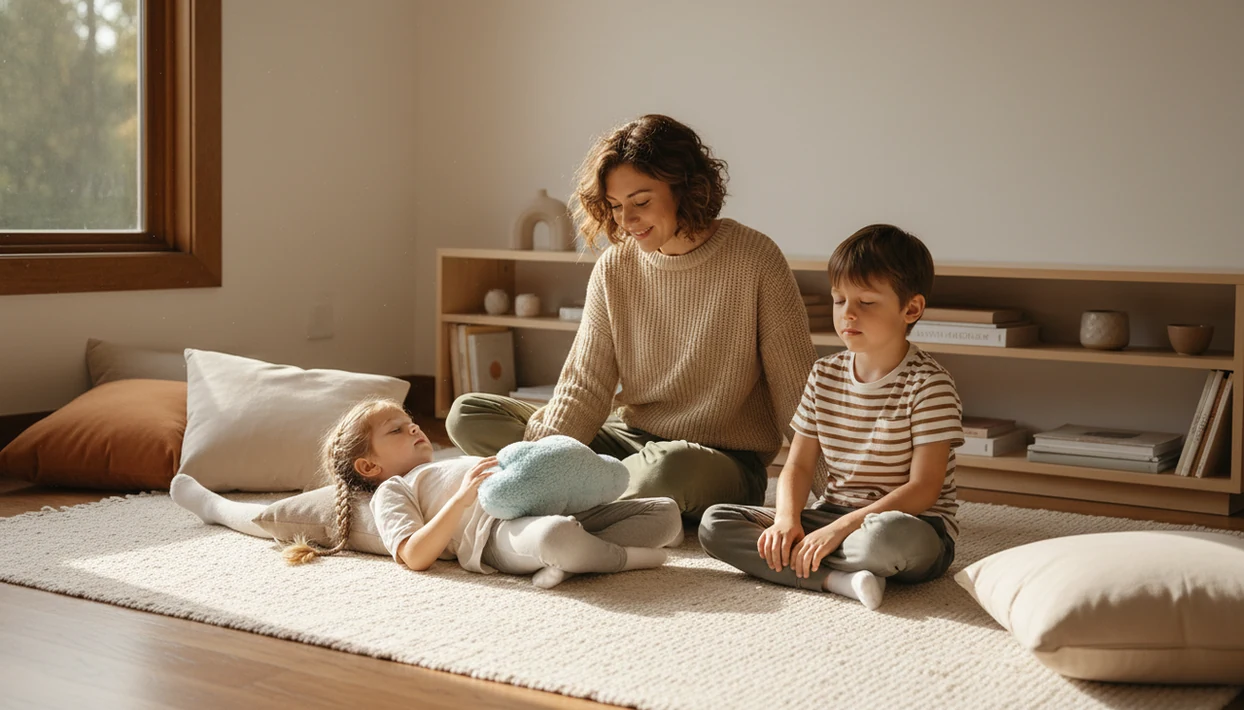
Meditation for kids means brief, age-adapted practices, such as breathing exercises, guided stories, body scans, and mindful movement, that help children practice slowing down, noticing emotions, and returning their attention. It does not require silence, closed eyes, or an empty mind. Watching a stuffed animal rise and fall on the belly or listening for a quiet sound can be a useful starting point.
Match the activity to your child's age and comfort, rather than aiming for a long session. The American Academy of Pediatrics recommends a few minutes a day for preschoolers. Keep participation optional: the goal is a skill children can use, not a test of stillness or obedience.
Breathing, stories, movement, and other ways kids can meditate
Meditation for kids is an umbrella term for short attention practices that use breathing, body awareness, stories, movement, sound, and everyday activities. It does not require a child to sit silently with closed eyes.
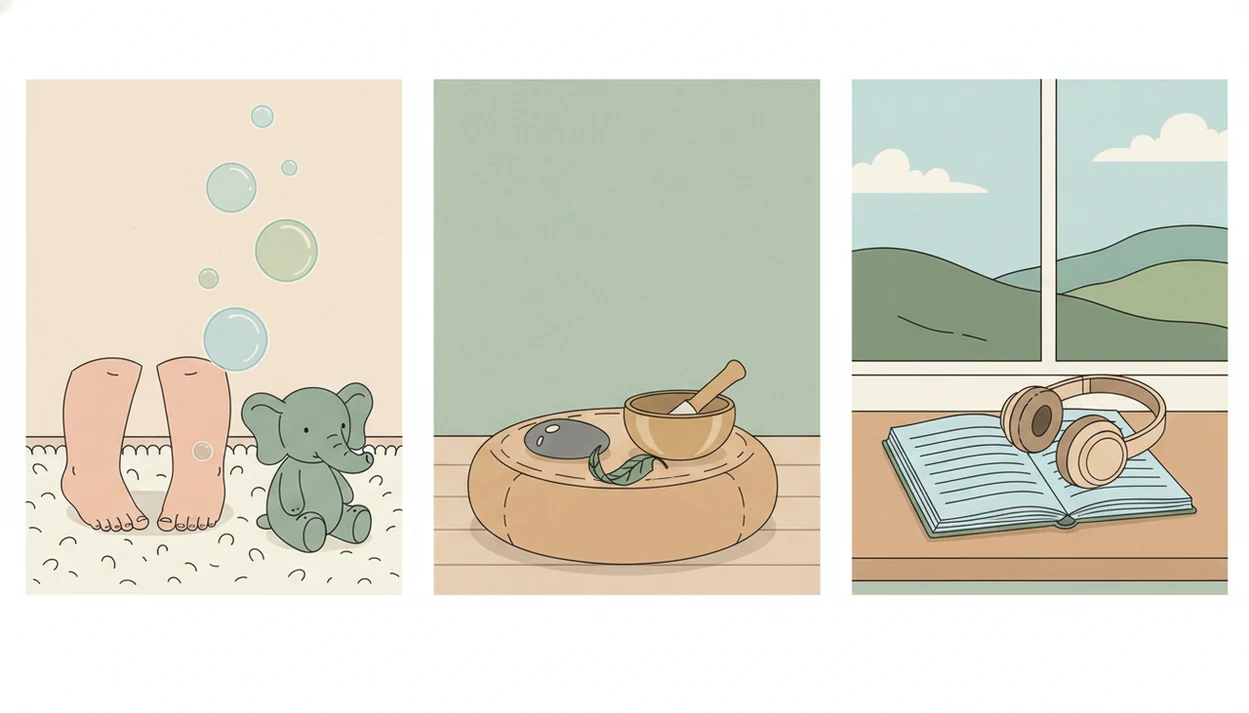
A child might watch a stuffed animal rise and fall on their belly, listen for the quietest sound in the room, walk slowly across tile, or notice how their jaw feels when it unclenches behind closed lips. For many children, that is more useful than asking them to “clear their mind.”
Children meditation differs from adult meditation in three main ways: it is shorter, more concrete, and more playful. A preschooler may need one minute and a pretend balloon breath. A 10-year-old may follow a forest story. A teen may prefer breath focus, journaling, or an app with privacy settings reviewed by an adult.
The American Academy of Pediatrics notes that children have reportedly high stress levels and recommends brief daily meditation or deep-breathing as part of emotional wellness routines Just Breathe The Importance Of Meditation Breaks For Kids.As. The practical goal is attention practice, not instant calm.
Teach mindfulness without a formal meditation session
Mindfulness for kids can happen during an ordinary activity: noticing feet on the floor, listening for nearby sounds, or naming things they can see. A formal meditation session sets aside time for that attention practice, but everyday noticing uses the same basic skill. The AAP includes sensory attention and breathing among its ways to help children cope with stressful experiences.
Try one brief invitation during a calm moment: "Can you hear three different sounds?" Listen together, then let the activity end without asking the child to become calmer. Another option is to notice the feeling of feet on carpet or tile. Avoid turning the exercise into a punishment after misbehavior. The useful part is noticing an experience with curiosity, not producing a particular feeling on demand.
Choosing a practice for stress, focus difficulties, or trauma
Meditation for kids can fit everyday stress, focus challenges, bedtime resistance, and emotional overwhelm. It should be adapted or paired with professional support when a child has significant anxiety, depression, trauma, or developmental concerns.
- Best for everyday stress: Short breathing or listening practices can help a child pause before reacting, especially after school or before homework.
- Best for focus transitions: A door handle touched before entering a classroom or bedroom can become a simple cue to slow down. For school transitions, classroom mindfulness for kids offers brief resets that teachers can adapt to their students.
- Best for family routines: Shared calm-down plans work well when everyone uses the same words, such as “pause, breathe, choose.”
- Not a standalone treatment: For major anxiety, depression, trauma symptoms, or developmental concerns, mindfulness for children is an adjunct, not care by itself.
- Use caution with stillness: Some children feel more activated when asked to close their eyes, scan the body, or sit still.
- Do not force it: Overly long or mandatory sessions can turn meditation into another stressor.
For children, beginner mindfulness exercises build noticing skills and brief pauses before reacting; they do not guarantee calm on command.
How Children's Meditation Builds Attention and Calm Focus
Children's meditation works by training attention and emotional regulation in small repetitions. A child notices the breath, sound, body, or image, gets distracted, and gently returns.
That “notice and return” loop is the mechanism. In brain terms, it may support executive function, the set of skills used for attention, impulse control, working memory, and flexible thinking. It also gives children a simple way to notice feelings before acting on them. The lay version is simpler: the child practices pausing before the feeling drives the behavior.
Study callout: In a 2019 randomized controlled trial, children who received school-based mindfulness training showed significant improvements in attention and executive function compared with controls, with effect sizes from 0.27 to 0.57 JAMA study. A 2018 meta-analysis of 33 randomized controlled trials also found small-to-moderate effects on cognitive performance, resilience, and emotional problems. PubMed research.
The benefits are incremental. One session may help a rough bedtime, but repeated practice builds the skill.
Small counts.
Age-Specific Meditation Techniques for Toddlers, Kids, and Teens
Age-specific meditation works best when the duration, language, and imagery match the child's development. Toddlers need sensory play; school-age children can follow stories; teens often want choice and privacy.
Toddler Mindfulness (Ages 2-4)
Use 1-3 minutes. Try belly breathing with a stuffed animal, “listen until the bell disappears,” or feeling feet on carpet. Keep instructions concrete: “Watch teddy go up and down.” For more tiny-session ideas, short meditation for toddlers covers this age more closely.
School-Age Meditation (Ages 5-12)
Use 3-10 minutes, sometimes twice daily if the child likes it. Guided stories, body scans, mindful movement, and breathing games fit well. A MindUP randomized trial in grades 4-6 found improved prosocial behavior and decreased aggression and peer-rated stress.
Teen Meditation Practices (Ages 13+)
Use 5-45 minutes depending on interest and comfort. Breath focus, journaling, mindful walking, and supervised apps can work. Teens often reject babyish language, so offer options instead of scripts. For older kids, meditation for teens can be a better fit than a child-centered routine.
Offer a sound to notice
During a short listening practice, a child can choose a sound and notice when their attention moves away from it. Mindful.net's free white noise and ambient sound player offers an optional sound source; the app also includes breathing exercises for an adult to preview before practicing together. Neither is necessary. Ordinary room sounds may suit the activity better, and silence is a better choice when added sound feels distracting or uncomfortable.
5 Steps to Start a Family Meditation Routine
A family meditation routine works best when it is predictable, brief, and low-pressure. Start with one shared anchor, then adjust based on each child's age and sensory needs. Expectant parents can also try pregnancy affirmations meditation for their own calm alongside family practice.
- Pick a daily anchor. Choose bedtime, after school, breakfast, or the first three minutes before opening a laptop.
- Choose one technique. Match the practice to the age-routed guidance above, such as belly breathing for toddlers or a short body scan for older children.
- Model it yourself. Children often copy adult regulation faster than they follow adult instructions.
- Keep it optional and playful. Invite participation, but let a child listen, wiggle, or stop.
- Review weekly. Ask what felt okay, what felt annoying, and whether the time should be shorter.
Shared calm-down plans and mindful transitions help families use the same tool before conflict grows. A simple family mindfulness routine can include breathing, movement, and reset language for everyone in the home.
The pencil still taps sometimes. That does not mean the practice failed.
Add bedtime breathing without postponing sleep
Keep bedtime in a predictable order: dim the lights, stop stimulating play and screens, read or cuddle, then offer one to three minutes of breathing or listening. Let the child breathe naturally while you say, "Notice your belly going up and down," or "Listen for the quietest sound." The AAP suggests deep breathing as part of a bedtime routine. Skip the exercise if it becomes frustrating or delays sleep.
Protecting time for sleep matters more than completing a meditation. A review of 45 childhood sleep-intervention trials found an average increase of 10.5 minutes of nighttime sleep; interventions that included earlier bedtimes were associated with about 47 additional minutes. These were sleep interventions, not evidence that meditation produces those gains. Persistent snoring, insomnia, or major daytime sleepiness calls for pediatric evaluation rather than adding more breathing practice.
App Safety Checklist for Kids' Meditation Apps
Kids' meditation apps vary widely, so parents should review privacy, design, and developmental fit before use. Popular does not always mean safe, evidence-based, or child-appropriate.
- Check minor data collection. Read the privacy policy and look for COPPA-related language if the app is used by children under 13.
- Look for qualified design. Prefer content shaped by child psychologists, educators, clinicians, or experienced mindfulness teachers.
- Screen distractions. Ads, in-app purchases, streak pressure, and bright reward loops can work against calm focus.
- Verify age fit. Session length, vocabulary, voices, and themes should match the child, not just the parent.
- Stay nearby. A caregiver should listen first, especially for anxious children or children with trauma histories.
Image caption: A parent reviewing privacy, ads, session length, and age settings on a meditation for kids app settings page.
The Mindfulness Practices App approach is most helpful when it supports family practice rather than replacing parent involvement.
Evidence-Based Benefits of Mindfulness for Children
Research on kids mindfulness is promising, especially in schools, but benefits are usually small to moderate and build with practice. The strongest findings point to attention, emotional regulation, resilience, and social behavior.
- Attention and executive function: A 2019 randomized controlled trial found significant gains in attention and executive function after school-based mindfulness training.
- Cognitive performance and resilience: A 2018 meta-analysis of 33 randomized controlled trials found small-to-moderate positive effects on cognitive performance, resilience, and emotional problems.
- Prosocial behavior: The 2013 MindUP trial in 300 grade 4-6 students found improved prosocial behavior and reduced aggression. APA research.
- Anxiety symptoms: A 2025 review of 13 randomized trials found positive effects on anxiety, but 10 studies had risk-of-bias concerns, so the findings are not definitive clinical evidence. PubMed research.
- Daily wellness routines: The AAP recommends brief daily meditation or deep breathing as one emotional wellness option for children.
For anxious children, gentle, supervised practice is often safer than long silent meditation because it keeps the child connected to the caregiver and the room. More specific adaptations are covered in meditation for anxious kids.
Better attention does not necessarily mean better grades
A child may improve at an attention exercise without showing the same improvement in schoolwork or behavior. A 2022 critical review of attention-training research included 37 studies, eight of which evaluated meditation. Mindfulness showed relatively consistent positive effects on selective attention, but evidence that these gains transferred to broader cognition, behavior, or academic achievement was very weak. That distinction matters when setting expectations for a family routine.
The comparison group also changes the result. In a 2018 meta-analysis of children's mindfulness trials, improvements across several outcomes were small when compared with inactive controls. Against active alternatives, significant benefits were mainly limited to mindfulness, depression, and anxiety or stress. Treat meditation as one supportive activity, not proof that it outperforms other structured activities or a promise of better grades.
Children's Meditation Limits
- Seek professional care for significant anxiety, depression, trauma, self harm concerns, or developmental concerns, using meditation only as support.
- Evidence is promising but developing, with many studies limited to schools, short durations, and differing programs.
- Some children with neurodevelopmental conditions may find stillness, silence, or body scans uncomfortable.
- Children with trauma histories may feel activated by inward focus, closed eyes, or body attention, requiring adaptations.
Meditation for kids questions
What age can children start meditating?
Toddlers can try playful noticing and breathing activities with an adult rather than formal seated meditation. Watch a stuffed animal move on the belly or listen for sounds together. Preschoolers can practice for a few minutes, but evidence for lasting benefits in very young children remains limited.
How long should a child meditate?
For preschoolers, start with a few minutes a day, or shorten the activity further if needed. Older children can gradually try longer sessions when comfortable. There is no need to reach a fixed target. Boredom, frustration, or distress is a reason to shorten, change, or stop the practice.
What is a simple meditation exercise for kids?
Invite your child to listen for three sounds with their eyes open. Listen alongside them and let them describe what they heard without judging the answers. Another option is watching a stuffed animal rise and fall on their belly while breathing naturally. Keep the activity brief and optional.
What should I do if my child refuses to meditate?
Accept the refusal rather than making meditation a requirement. Offer another activity, such as slow walking or noticing colors in the room, at a different time. You can model a brief practice yourself without asking them to join. Stillness and obedience are not the goals.
Can meditation help children with ADHD?
Research suggests possible improvements in ADHD symptoms, but findings are not equally strong across behavior and emotional outcomes. Meditation should complement established assessment and treatment, not replace them. Keep exercises concrete and adaptable, and discuss significant attention difficulties with a qualified clinician rather than relying on meditation alone.
Is meditation safe for children with anxiety or trauma?
Some children find closed eyes, silence, or attention to body sensations uncomfortable. Begin with an eyes-open activity focused on sounds, colors, or movement, and allow them to stop. End the exercise if they become distressed, dizzy, or more agitated. Significant anxiety or trauma symptoms need professional support.
Can meditation help a child fall asleep?
Brief breathing or listening can be part of a calming bedtime routine, but it is not an established solution for every sleep problem. Keep it short enough that it does not delay bedtime. Consistent scheduling and sufficient time in bed remain important; persistent snoring or insomnia needs pediatric attention.
Does meditation improve children's grades?
Some studies suggest benefits for selective attention, but evidence that meditation improves academic achievement is very weak. Practicing attention is not the same as raising grades. Use meditation as an optional supportive skill, while addressing learning difficulties, sleep, classroom needs, or significant attention problems through appropriate support.