

> Definition: Mindfulness is the practice of paying attention on purpose to the present moment, including your breath, body, thoughts, and surroundings, without judging what shows up.
What Practicing Mindfulness Really Means
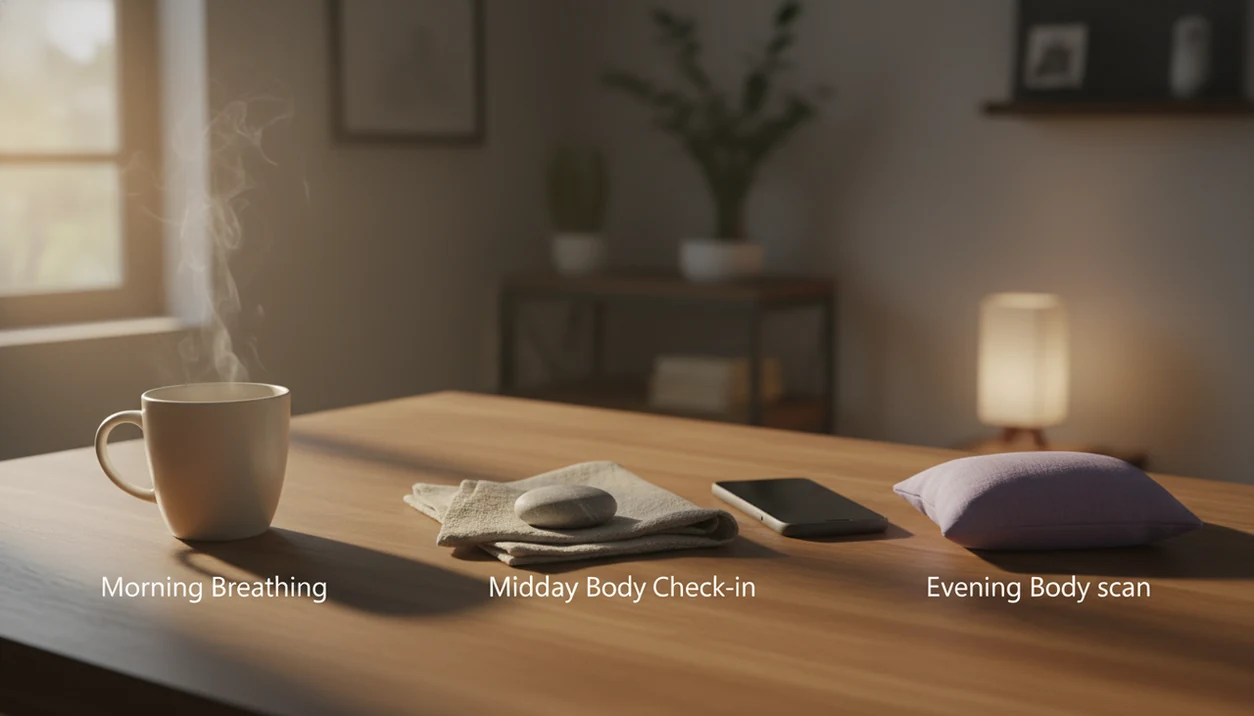
Mindfulness is paying attention on purpose to the present moment, without judging what you notice. That means breath, body sensations, sounds, thoughts, moods, and the room around you all count as possible anchors.
It is not emptying your mind. A beginner may sit on a kitchen chair for two minutes, feel both feet on the floor, and still think about a grocery list. That is normal. The practice is noticing the list, then returning to the feet, breath, or sound.
Again and again.
Mindfulness can be taught as a secular practice. You do not need religious language, special clothing, or a cross-legged posture. If sitting still feels awkward, try mindful walking, brushing your teeth, or listening during a conversation. Good mindfulness practices and meditation techniques for beginners and daily life build steadier awareness, not instant calm, mystical certainty, or guaranteed productivity.
For a plain-language bridge into seated practice, our mindfulness meditation guide covers the basics.
How Mindfulness Works in Your Brain and Body
Mindfulness works by training an attention regulation loop: notice wandering, gently redirect, and repeat. In plain language, you are practicing the skill of coming back before autopilot runs the whole day.
- Mind-wandering is expected; the training moment is the return.
- Mindfulness shifts attention away from default-mode processing, which is the brain’s habitual story-making mode, toward deliberate present-moment awareness.
- Meta-analyses of structured mindfulness programs show moderate improvements for anxiety and depression compared with control conditions JAMA study.
- A randomized clinical trial found that 8 weeks of mindfulness-based stress reduction was noninferior to escitalopram for adults with anxiety disorders, according to the National Institute of Mental Health Mindfulness Based Intervention Rivals Antidepressant For Tre.
- Per the CDC, mindfulness meditation use among U.S. adults more than tripled from 4.1% in 2012 to 14.2% in 2017 CDC guidance.
Physically, many people first notice small signals. Ribs widening under a sweater. A tight jaw. Shoulders lifting before a difficult message. Clinicians typically describe mindfulness as a supportive self-regulation skill, not a stand-alone treatment for medical or mental health conditions.
What You Need Before Starting a Mindfulness Routine
You need a few quiet minutes, a repeatable cue, and realistic expectations. No special equipment, posture, belief system, or paid tool is required.
Pick one consistent time slot: morning, lunch, or evening. A phone timer can help, especially if you set it for 5 minutes instead of imagining an hour-long routine. Short guided audio can also make the first week less vague. Guided audio libraries can be useful when they offer clear instructions, named teacher credentials, and evidence-informed content.
Keep the bar low.
Benefits usually emerge over weeks of consistent practice, not after one session. If you have a trauma history, panic symptoms, or feel overwhelmed when slowing down, consider trauma-informed guidance before practicing alone. A first week meditation plan can also help you start without overloading the schedule.
How to Practice Mindfulness Daily: Step-by-Step Routine
To practice mindfulness daily, attach short attention exercises to moments that already happen. The routine below keeps practice ordinary: wake up, begin work, eat, use your phone, and go to bed.
- Set a 2-minute morning intention: sit or stand, feel your feet on the floor, and take 3 slow breaths.
- Breathe mindfully for 1 minute before opening email or starting your first task.
- Eat 3 mindful bites at lunch, noticing texture, taste, and temperature.
- Turn phone notifications into mindfulness bells: pause and take one breath at each ping.
- Do a 5-minute body scan before sleep, scanning head to toes without trying to fix anything.
Step 1: Set a Morning Mindful Intention
Before the day grabs you, stand or sit upright. Feel the floor and name one intention: “Notice and return.”
Step 2: Breathe Before Your First Task
Pause for one to three minutes before opening your laptop. Cool air at the nostrils is enough of an anchor.
Step 3: Eat Three Mindful Bites at Lunch
Choose the first three bites. Notice crunch, warmth, salt, sweetness, or the simple fact that you are chewing.
Step 4: Turn Phone Alerts into Mindfulness Bells
When a notification arrives, pause before tapping. One breath creates a small gap between stimulus and reaction.
Step 5: Do a Body Scan Before Sleep
Lie down and move attention slowly from forehead to toes. Bedtime works well because the cue is already built in.
For more formal sitting instructions, use how to meditate.
Ready to start tonight's calm routine?
To practice mindfulness, choose one daily anchor, like your breath, a meal, or a walk, and pay full attention to present-moment sensations for one to five minutes. You can learn…
Best-Fit Scenarios for Mindful Practice Throughout the Day
Informal mindfulness is practice, not a lesser version of meditation. Evidence-based programs often include daily-life awareness because attention training transfers better when you use it during real tasks.
| Activity | Mindfulness Technique | Duration | Best For |
|---|---|---|---|
| Commuting or driving | Feel hands on the wheel, notice traffic sounds, soften the jaw | 1–3 minutes | Reactivity and impatience |
| Walking | Track heel, sole, toe, and the shifting weight of each step | 2–5 minutes | Restless energy |
| Brushing teeth | Notice the taste of toothpaste, arm movement, and water temperature | 2 minutes | Habit stacking |
| Waiting in line | Feel feet on ground and the urge to check your phone | 1 minute | Everyday impatience |
| Listening in conversation | Hear tone, pause before replying, notice your own urge to interrupt | 3–10 minutes | Relationships |
| Exercising | Match breath to movement and notice muscle effort | 5 minutes | Body awareness |
For beginners, mindful walking may be easier than seated meditation because the body gives obvious sensations to follow. If you prefer variety, compare meditation techniques for beginners before choosing one anchor.
How to Use Your Phone to Support a Mindfulness Routine
A phone can support a mindfulness routine when you make it a cue instead of a trap. The key is deciding what the phone should ask you to do before you unlock it.
Set a lock-screen reminder that says: “Feel your feet and take one deep breath.” Use the built-in timer for 1–3 minute micro-practices. Schedule three daily mindfulness-bell alarms for morning, midday, and evening.
When the urge to scroll hits, play a 1–5 minute guided prompt instead. A single earbud during a guided session can work on a bus seat or office stairwell. Apps such as Mindful.net, mindful.org resources, Calm, and Headspace offer different styles, but not all consumer apps are research-backed. Look for clear teacher credentials, evidence-based language, and honest limits.
The Mindfulness Practices App category is useful only when it helps you practice, not when it adds another feed to check.
Common Mistakes When Learning How to Practice Mindfulness
Most beginner mistakes come from making mindfulness too dramatic. A mindful practice should be repeatable on an ordinary Tuesday.
1. The Blank-Mind Trap. Trying to force silence creates frustration. Notice the thought, label it “thinking,” and return.
2. The Too-Long Start. Beginning with 30 minutes can backfire. Start with 1–5 minutes, then add time later if it helps.
3. The Instant-Calm Expectation. Early practice may reveal restlessness, boredom, or sadness. That does not mean it is failing.
4. The Cushion-Only Rule. Formal meditation helps, but informal practice matters too. Dish soap bubbles under warm water can become a clear sensory anchor.
5. The Self-Criticism Loop. Judging mind-wandering adds a second problem. Mind-wandering is the normal part of training attention.
If you like checklists, a mindfulness checklist for beginners can keep practice simple.
How to Tell Your Mindfulness Practice Is Working
Mindfulness is working when you notice your experience sooner and respond with a little more choice. The first sign is often not calm; it is earlier recognition.
You may catch mind-wandering after 30 seconds instead of 5 minutes. That is progress. You may feel shoulder tension before sending a sharp reply, or notice hunger before you become irritable. The gap between a stressor and your response may get shorter.
Small wins count.
Most studies measure changes after 6–8 weeks of consistent practice, so do not judge your whole mindfulness routine by one distracted morning. For many beginners, mindful practice usually works best when it is attached to existing habits, while longer meditation fits people who already have a stable time and place.
When to Seek Professional Support
Seek professional support when mindfulness makes symptoms feel stronger, less manageable, or unsafe. Mindfulness is educational support and a self-regulation practice; it is not diagnosis, therapy, or medical treatment.
Use a simple safety sequence:
- Pause the practice if you notice panic, dissociation, trauma flooding, numbness that feels frightening, or symptoms that keep worsening after you stop.
- Contact a licensed clinician if anxiety, depression, sleep disruption, or intrusive memories are moderate, severe, persistent, or interfering with work, school, caregiving, or relationships.
- Seek urgent help if you have thoughts of self-harm, harming someone else, or not being able to stay safe. Use local emergency services or a crisis support line right away.
- Ask for trauma-informed guidance if breath or body attention feels activating. A qualified teacher or clinician may shift the anchor to sound, sight, movement, open eyes, shorter sessions, or more choice about posture and pacing.
Mindfulness should leave room for consent and steadiness. If “just breathe” makes things worse, that is useful information, not a personal failure.
Limitations
Mindfulness has real benefits for many people, but it has limits. Use it as an attention practice and supportive skill, not a cure-all.
- Most evidence comes from structured 6–8 week programs; casual, irregular practice may not deliver the same results.
- Mindfulness is not a substitute for professional medical or psychological care, especially for moderate to severe conditions.
- Some beginners feel more distress when slowing down. Trauma survivors may need trauma-informed guidance.
- Evidence for app-only, unguided mindfulness routines is still emerging, and not all consumer apps are research-backed.
Mindful.net publishes educational guidance only. It does not diagnose, prescribe, or replace care from a licensed clinician.
Related guides
Environmental Setup That Actually Matters
Myth: you need a serene room, a special cushion, or a perfectly quiet house to practice mindfulness. In our observation, beginners often do better with a plain setup: an ordinary chair, a kitchen timer set for a few minutes, and permission to notice normal sounds without turning them into a problem. The useful environment is not the prettiest one; it is the one that removes one or two avoidable decisions.
Which Technique Fits This Situation
You sit down and your thoughts get louder.
Try a more external anchor, such as naming three sounds in the room or feeling both hands rest on your legs. Racing thoughts do not mean mindfulness failed; they may simply mean breath-focused practice is too subtle for that moment.
You are too restless to stay in the chair.
Use movement rather than forcing stillness. A short round of Mindful Walking at /mindful-walking may fit better than seated breathing when the body has extra momentum.
You keep asking, “Am I doing this right?”
Use Practice Decision Support at /discover-best-mindfulness-practice to choose one small practice before you begin. Decision support can be more helpful than generic calm advice when the hard part is choosing, not practicing.
You expected mindfulness to feel like yoga.
Yoga often uses posture, movement, and breath together, while mindfulness can be practiced sitting in an ordinary chair with no stretching at all. Neither is automatically better; the better fit is usually the one you will repeat tomorrow.
From Our Editorial Review
In our editorial review, many beginners seem to get stuck because they treat mindfulness like a performance of calm. We usually suggest making the first session almost boring: sit in an ordinary chair, set a kitchen timer, and notice one anchor without trying to improve it. One pattern we notice is that low-pressure repetition tends to teach more than a dramatic first attempt.
Troubleshooting When It Feels Stuck
- If five minutes feels impossible, try ninety seconds and stop on purpose; ending cleanly can build more trust than pushing through.
- If you keep judging the session, write one neutral line in a one-line journal: “Noticed planning,” “Noticed boredom,” or “Noticed sounds.”
- If the breath feels uncomfortable to track, use touch, sound, or visual details instead; mindfulness does not require breath-watching.
- If you are waiting to feel peaceful, change the goal to noticing accurately; calm may happen, but it is not the entrance fee.
- If you skip days, avoid turning the streak into the practice; restarting kindly is part of the skill.
A Quick Technique Map
| Technique | Best for | Minutes |
|---|---|---|
| Chair-based breath noticing | Starting when you want the least complicated option | 3-5 min |
| Sound labeling | Practicing in a normal home with noise, pets, kids, or appliances | 2-6 min |
| Mindful walking | Restless energy, transition time, or people who dislike sitting still | 5-15 min |
The best mindfulness practice is usually the one you can repeat without making it a big event.
Why Mindful.net fits this specific need
Mindful.net is useful for beginners who want practical choices rather than a vague instruction to “be present.” This page can pair with Practice Decision Support and Mindful Walking guides when sitting still, choosing a technique, or restarting after missed days feels like the real obstacle.