
Mindfulness at Work Without Productivity Pressure

Mindfulness at work means using brief, practical pauses to notice what is happening now, steady your attention, and return to the next task without turning calm into another job-performance target. It works best as attention hygiene for email, meetings, transitions, and stressful moments, not as a substitute for better workloads or real support.
Definition: Workplace mindfulness is the practice of paying attention to present-moment work experience, including breath, body, thoughts, emotions, surroundings, and task cues, with a nonjudgmental attitude before choosing the next action.
TL;DR
- Use mindfulness at work in tiny moments: before email, before meetings, between tasks, and after stressful interactions.
- The goal is steadier attention and wiser responses, not emptying your mind or forcing yourself to be productive.
- Mindful productivity should reduce distraction and pressure, not hide burnout, understaffing, or unrealistic expectations.
Mindfulness at Work Definition for Real Workdays
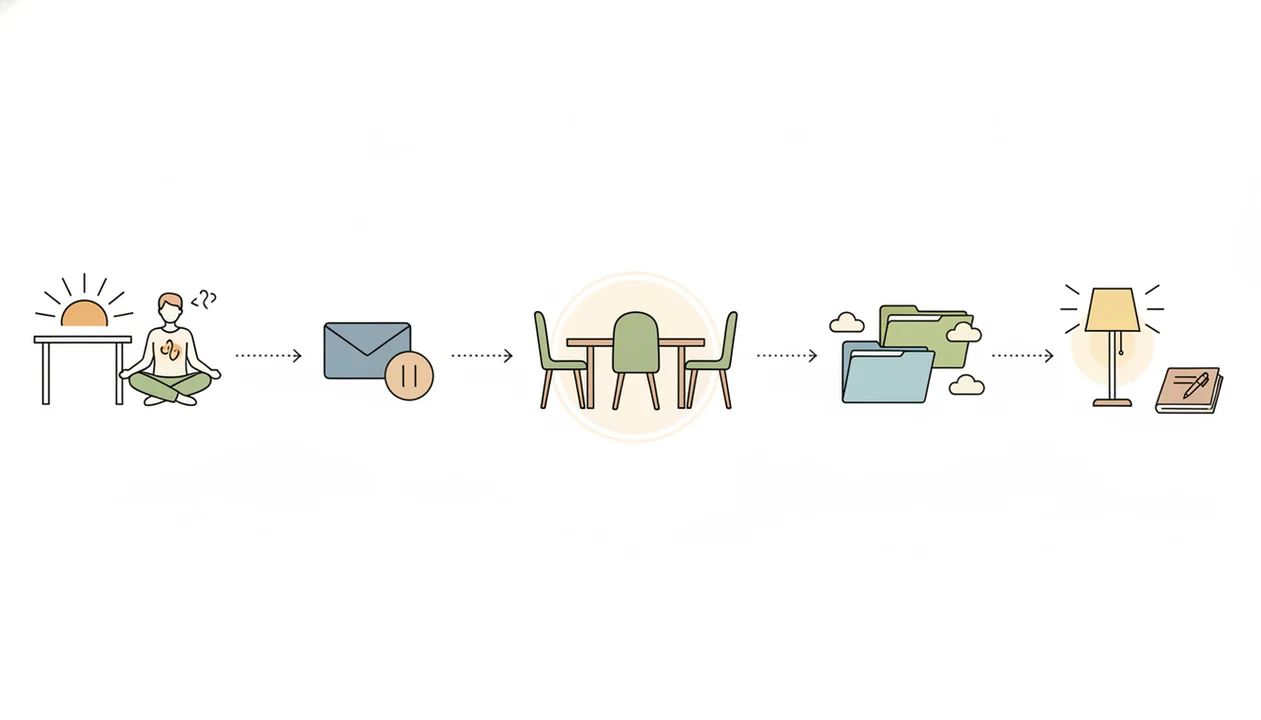
Mindfulness at work is present-moment attention during ordinary work tasks, not a special state you have to create. It means noticing what is happening in your body, thoughts, emotions, screen, room, and task before choosing what to do next.
The practical move is simple: notice and return. Your mind may drift to a grocery list during a budget spreadsheet. That is not failure. The practice is recognizing the drift, then coming back to the next cell, message, or sentence.
One simple way to try it is a breath before opening email, a quiet body scan before a meeting, or a mindful transition after finishing a call. Good mindfulness practices and meditation techniques for beginners and daily life deliver repeatable attention cues, not a promise that work will stop being demanding.
At-a-Glance Workplace Mindfulness Practices
Use workplace mindfulness where the workday already has natural hinges. These practices are optional, private, and desk-friendly, so they should never feel like another compliance task.
| Situation | Practice | Time needed | Best use |
|---|---|---|---|
| Before email | One breath, notice urgency, choose first action | 30-60 seconds | Reducing reactive replies |
| Before meetings | Jaw, shoulders, hands, feet scan | 60-90 seconds | Arriving with steadier attention |
| Between tasks | Three-breath transition | 30 seconds | Closing one task before opening another |
| After conflict | S.T.O.P.: stop, take a breath, observe, proceed | 1-2 minutes | Avoiding the instant comeback |
| End of day | Name one unfinished item and one next step | 2 minutes | Creating a cleaner shutdown |
If reminders help, a tool to create mindful break reminders can be useful, but the reminder should serve you. It should not become a tiny boss in your pocket.
Five Facts About Mindfulness at Work
These five facts are the core of mindfulness at work for beginners. They keep the practice specific, evidence-aware, and realistic.
- Mindfulness is a trainable attention skill involving awareness, emotional regulation, and the ability to return after distraction.
- Short mindfulness exercises at work can include one-minute breathing, quick body scans, and the S.T.O.P. method.
- APA-reviewed research linked a six-week mindfulness program with lower work-life conflict, higher job satisfaction, and better attention focus than a waiting-list group APA research.
- Workplace routines make practice easier than relying on willpower, especially around email, meetings, and task switching.
- Mindful productivity is about reducing distraction and friction, not extracting more output from an already overloaded person.
Most workplace-style programs are studied over several weeks, not one lunch break. Small repetitions matter.
How Mindfulness at Work Works
Mindfulness at work works by training the pause between noticing something and reacting to it. The mechanism is attention regulation: you spot where attention has gone, name the experience lightly, and return to the next useful cue.
- Notice the drift, such as rereading the same email, bracing your shoulders, or rehearsing a reply.
- Label it in plain words: “planning,” “irritation,” “worry,” or “rushing.” The label is not a verdict; it is a handle.
- Return to one anchor you can actually feel: breath at the nose, feet on the floor, hands on the keyboard, a plant, a window, or the hum of the room.
- Choose the next response after that small reset, which supports response inhibition, meaning the ability to not send the first sharp sentence your nervous system offers.
The effects are usually gradual and modest. Repeated practice makes the return easier, especially around email, meetings, and task switching. It can support self-regulation, but it does not remove workload causes, unclear priorities, or pressure that needs to be addressed directly.
Workplace Mindfulness Effects on the Brain and Behavior
Workplace mindfulness works by training attention to notice wandering, label experience, and return to the task. In plain language, you practice seeing the moment when your mind leaves the work and gently bringing it back.
That creates a small pause between trigger and response. A sharp Slack message arrives. Your shoulders lift, your jaw tightens, and the reply box starts to feel urgent. Mindfulness inserts one breath before the first sentence you type.
Breath, body awareness, and environmental cues all support attention regulation. Feet on carpet, the edge of the desk under your forearm, or the sound of a hallway door can become return points. The effect is usually modest and practice-dependent, not instant. For people comparing attention strategies more broadly, our guide to mindfulness for focus explains how returning attention differs from forcing concentration.
Five-Step Mindfulness at Work Routine for a Normal Day
Use this five-step routine as a loose workday rhythm, not a perfect checklist. For most workers, small practices tied to existing moments are easier than a long meditation block because the cue is already there.
- Start with a 60-second reset before opening your laptop or walking into your first shift.
- Pause before email by noticing breath, body tension, and the urge to answer everything now.
- Reset before meetings with a brief scan of your face, shoulders, hands, and feet.
- Breathe between tasks three times before switching tabs, rooms, files, or conversations.
- Close the day by naming one thing finished, one thing unfinished, and the next practical step.
A phone timer set for five minutes can help on heavy days. Still, the shorter pauses are often the ones people actually keep.
Step 1: Start Work with a 60-Second Mindfulness Reset
How do you start mindfulness at work before the day takes over? Use one quiet minute before opening your laptop, after a commute, or before the first meeting.
Try this script. Put both feet on the floor. Feel the pressure of shoes, socks, or tile. Let your posture rise without stiffening. Take three natural breaths, noticing the inhale and exhale without changing them much. Then name one intention: “Answer the payroll question first,” or “Listen before I defend.” Choose the first task.
The mind will wander during this minute. It may jump to a calendar alert, a late invoice, or the sandwich you forgot to pack. Normal. The practice is not staying blank; it is coming back once. A three-minute breathing pause before opening a laptop works the same way when the morning feels crowded.
Step 2: Use Mindfulness Exercises at Work Before Email
How can mindfulness exercises at work help with email? They interrupt the autopilot loop between notification, body tension, and instant reply.
Before opening your inbox, pause for one minute. Notice your breath once. Scan your forehead, jaw, shoulders, and stomach. Ask, “What urgency am I carrying in?” Then open the first message and choose one clear action: reply, schedule, archive, or wait.
That last option matters. Wait.
Mindful productivity in email is not about answering faster. It is about reducing scattered attention and avoiding replies written from pressure rather than clarity. If screen input leaves you jumpy or overloaded, the guide to mindfulness when overstimulated gives gentler options for sound, sight, and body cues.
Step 3: Bring Workplace Mindfulness into Meetings
Workplace mindfulness in meetings should be quiet, practical, and socially normal. You do not need to announce a practice or make colleagues close their eyes.
Before the meeting starts, try a brief body scan. Let your eyelids soften if that feels comfortable. Notice the forehead, jaw, neck, shoulders, hands, and feet. The neck muscles may release by degrees, or they may not. Either way, you have checked in.
During the meeting, use three listening cues: hear the full sentence, feel your feet, and pause before speaking. On remote calls, camera fatigue can make the body feel oddly absent, so rest your gaze away from the screen for one breath between agenda items.
For teams, a mindful minute can work if it is optional and secular: “Let’s take one quiet minute to arrive before we start.” No one should be watched or corrected.
Step 4: Practice Mindful Productivity Between Tasks
Mindful productivity means single-tasking and intentional transitions, not working harder. Transitions are ideal practice points because the mind is already moving from one demand to another.
Try a three-breath transition. On the first breath, name what just ended: “Call finished.” On the second, feel the body in the chair. On the third, name what starts next: “Draft the summary.” Then close one tab, document, or notebook before opening the next.
This is ordinary. Almost boring.
That is why it helps. Multitasking often feels productive because everything is active at once, but attention pays a switching cost; the American Psychological Association summarizes research showing that task switching can reduce efficiency and increase errors APA research. Mindful productivity pushes against hustle culture by asking a smaller question: what deserves attention now? People who need more structure may also compare the best mindfulness app for work, especially if they want guided pauses during breaks.
Common Myths About Mindfulness Exercises at Work
Many people avoid mindfulness exercises at work because they picture something awkward, mystical, or unrealistic. The reality is usually quieter and more practical.
| Myth | Reality |
|---|---|
| “I have to clear my mind.” | You notice thoughts and return to the present task. Wandering is part of practice. |
| “Mindfulness can replace good management.” | It cannot fix understaffing, unclear roles, harassment, or chronic overload. |
| “Only meditation experts can do it.” | Beginners can use one breath, a body scan, or a short walk. |
| “Mindful productivity means multitasking better.” | It usually means doing one thing with less distraction. |
| “Everyone should join the workplace program.” | Participation should be voluntary, with private alternatives available. |
Tools like Mindful.net can explain techniques in plain language, but the practice itself should remain flexible. A bus seat, office stairwell, or kitchen chair can be enough.
Boundaries for Workplace Mindfulness Programs
Workplace mindfulness programs need clear boundaries to stay ethical. Participation should be voluntary, and managers should not use mindfulness to dodge workload, staffing, safety, or pay conversations.
Privacy matters. Employees should not have to disclose stress levels, trauma history, mental health conditions, or personal meditation habits. Breath-focused or body-focused exercises can feel uncomfortable for some people, especially in groups. Offer alternatives such as visual grounding, sound awareness, mindful walking, or simply sitting quietly.
Managers can model a pause before a tense discussion, but they should not measure who looks calm. That gets strange fast.
For reminders, an app that reminds me to breathe at work may support private practice. Apps such as Mindful.net, Headspace, and Calm can be useful options, but no app should turn mindfulness into surveillance or a productivity contest.
Before You Practice Mindfulness at Work
Before you practice mindfulness at work, choose a moment that is private, low-stakes, and easy to leave if it does not feel useful. The point is to create a small pause, not to force calm or prove resilience.
- Pick an ordinary hinge in the day, such as before opening email, joining a meeting, switching tasks, or walking back from the break room.
- Start with the least exposing option. Eyes open, feet on the floor, a soft gaze at the desk, or one quiet breath is enough.
- Skip breath or body focus if it increases panic, pain, dizziness, trauma distress, or sensory overwhelm. That is information, not failure.
- Use another anchor instead, such as noticing three sounds in the room, feeling the contact of shoes with the floor, looking at a fixed object, or taking a slow walk.
- Keep team practices optional and separate from performance reviews, wellness scores, attendance pressure, or manager evaluation.
A good workplace practice should feel adjustable. If the method makes the day harder, change the method.
Limitations
Mindfulness at work has real limits. It can support attention and steadier responses, but it cannot repair every workplace condition.
- Mindfulness is not a quick fix for toxic culture, understaffing, harassment, unsafe conditions, or poor leadership.
- Research often shows modest improvements rather than dramatic changes; a systematic review in Occupational Medicine found small to moderate benefits for stress, anxiety, distress, and well-being outcomes 2965279.
- Breath-focused or body-focused exercises may feel uncomfortable, especially for people with trauma histories, panic symptoms, pain, or sensory sensitivity.
- Mindfulness should not replace professional mental health support when distress is persistent, intense, or interfering with daily life.
Clinicians typically recommend professional assessment when anxiety, depression, panic, trauma distress, or burnout symptoms feel unmanageable or unsafe.
A Tiny Experiment to Run Today
Mindfulness at work is not the best first move when the real issue is unsafe staffing, unclear authority, harassment, skipped breaks, or a workload no one could reasonably complete. A stairwell pause or clipboard breath may help you notice your next step, but it should not be used to make an unreasonable situation feel acceptable. Mindfulness is attention support, not a substitute for boundaries, schedule changes, supervision, or practical help.
One Pattern We Notice
One pattern we repeatedly notice is that people treat workplace mindfulness like relaxation on demand, then assume they are doing it wrong when they still feel alert, irritated, or rushed. The more useful test is often whether you can notice the pressure without immediately spilling it into the next patient room, sales call, classroom, rehearsal, or handoff. Mindfulness may feel less like calm and more like a cleaner return to the task in front of you.
Which Technique Fits This Situation
- If you are moving between high-contact tasks, use one quiet breath at the doorway or supply cart; the goal is a clean transition, not a mood makeover.
- If a meeting is about to get tense, try a brief Meeting Reset from /work-mindfulness/mindfulness-before-meetings: feel one breath, name the agenda, and choose your first sentence.
- If your mind is replaying a mistake, use the Anchor-Notice-Return loop from /what-is-mindfulness: choose one anchor, notice the replay, and return once without arguing with it.
- If you are on break but still mentally working, let break-room quiet be enough for 60 seconds; do not turn the pause into another performance review.
- If what you need is deep rest, food, or a real conversation with a manager, choose that instead; mindfulness and relaxation overlap sometimes, but they are not the same job.
Technique Snapshot
| Technique | Best for | Minutes |
|---|---|---|
| Clipboard breath | Resetting attention before a handoff, inspection, patient note, or task list | 30-60 sec |
| Stairwell pause | Creating a boundary between one demanding interaction and the next | 1-2 min |
| Break-room quiet | Letting the nervous system stop chasing the last task before returning to work | 2-5 min |
One Mistake We Notice Often
One mistake we notice often: people try to look mindful instead of letting the practice be almost invisible. We usually suggest making the reset small enough that a nurse, teacher, musician, warehouse lead, or shift worker could actually repeat it during a normal day. The best practice is usually the one you will repeat tomorrow.
Mindfulness at work should support attention, not disguise a workload that needs real change.
Why Mindful.net fits this specific need
Mindful.net’s workplace guides keep the focus on brief, realistic resets rather than productivity pressure. The related Anchor-Notice-Return and Meeting Reset resources can help readers choose a practice that fits the moment without promising a cure-all.
FAQ
What is mindfulness at work?
Mindfulness at work is paying attention to present-moment work experience before choosing the next action. It can include one breath before email or a short body scan before a meeting.
How do I practice mindfulness at work?
Start with feet on the floor, one natural breath, one body cue, and one clear next task. Repeat during transitions, email, meetings, and end-of-day shutdown.
Can mindfulness improve work focus?
Mindfulness may support focus by helping people notice distraction and return to the task. It does not guarantee better performance or solve workload problems.
What is mindful productivity?
Mindful productivity is focused, humane task attention rather than doing more work. It favors single-tasking, clear transitions, and fewer reactive choices.
Are workplace mindfulness exercises awkward?
Most workplace mindfulness exercises can be silent, private, and desk-friendly. A person can practice without closing their eyes or telling anyone.
How long should mindfulness take during a workday?
Useful workplace practices can take 30 seconds to a few minutes. Longer sessions are optional, not required.
Can mindfulness help with workplace stress?
Mindfulness may help some people relate differently to stress by noticing body tension, thoughts, and reactions earlier. It does not remove workload causes or replace needed support.
Should teams meditate before meetings?
A team mindful minute can help if it is brief, secular, and optional. People should be free to participate quietly or simply sit without being evaluated.
When is mindfulness not enough at work?
Mindfulness is not enough for burnout, panic symptoms, trauma distress, unsafe workplaces, harassment, or chronic overload. Those situations may require professional care, HR action, management change, or outside support.