


The best meditation app for beginners teaches the basics in short guided sessions and makes the next lesson easy to find. A beginner meditation app is a mobile tool that uses structured audio to teach breathing, posture, and how to return attention when thoughts wander, without requiring previous experience. Headspace suits people who want a progressive course; Insight Timer offers broad free choice; Calm emphasizes sleep and relaxation; Waking Up takes a more philosophical approach.
Start by choosing what you need to learn, not the biggest library. Look for clear instructions, a voice you can follow, and sessions that fit your day. Compare what remains available after a trial, then check subscription terms and privacy information before committing.
Definition: A beginner meditation app is a mobile tool that provides structured, guided audio sessions teaching foundational mindfulness techniques, including breathing, posture, and attention management, to people with no prior meditation experience.
Five features that make the first week easier
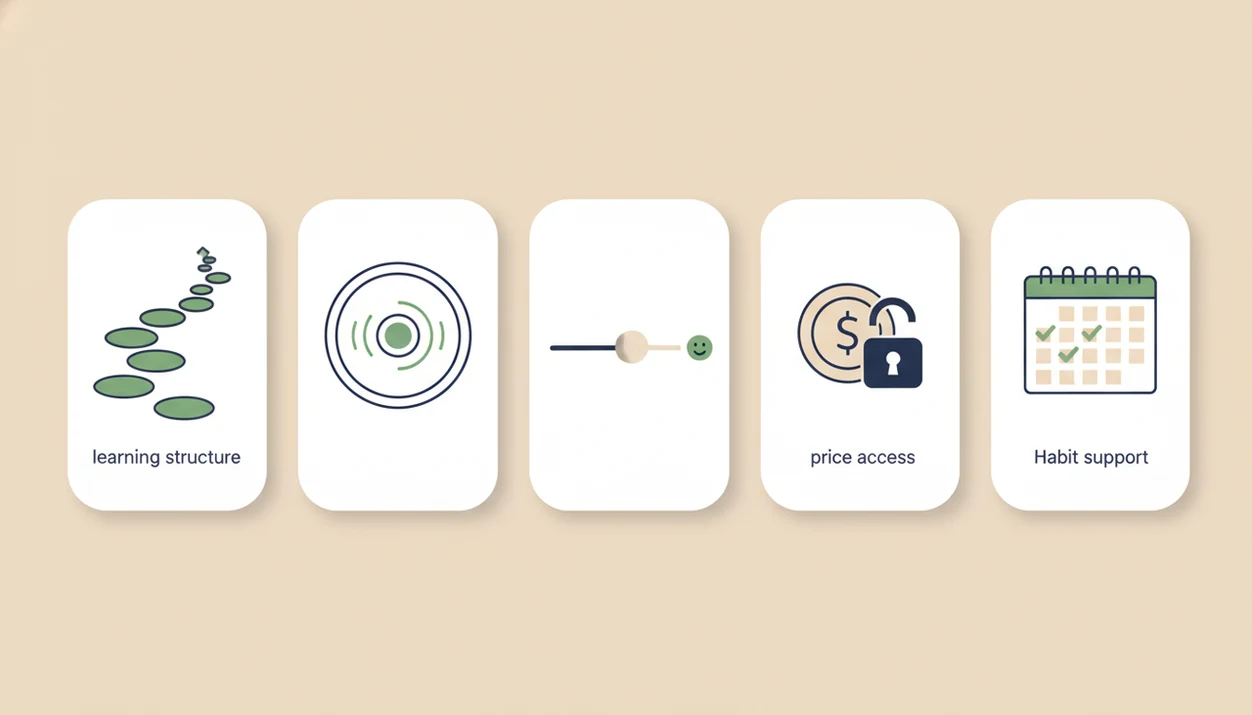
- Structured learning paths matter more than library size. A beginner needs “start here,” not 12,000 choices after a tired commute.
- Teaching style changes the fit. Headspace feels classroom-like, Waking Up is secular and reflective, Calm leans relaxation-first, and mindful.org has more article-led education.
- Simple labels improve follow-through. Clear categories like “3 minutes,” “sleep,” “body scan,” and “wandering thoughts” reduce the awkward first-week guessing.
- Free content varies sharply. Insight Timer offers deep free access, while Calm and Headspace reserve much of their stronger material for paid plans.
- Habit tools carry more weight than advanced content. Reminders, micro-meditations, and session logs help beginners return before the habit feels natural.
When the issue is “I forget after day two,” Mindful.net fits because the Mindfulness Practices App emphasizes short everyday mindfulness exercises, plain definitions, and practical next steps before long meditation tracks.
Best Meditation Apps for Beginners: Named Shortlist
The strongest beginner meditation apps solve different first-week problems: structure, cost, skepticism, sleep, or everyday use. Use the table to compare your options before starting a trial.
| App | Best for | Learning path | Free content | Typical session length | Offline mode | Price |
|---|---|---|---|---|---|---|
| Headspace | Structured beginner course | Strong | Limited | 3 to 10 minutes | Paid downloads | Subscription |
| Insight Timer | Free guided meditation depth | Mixed | Very large | 1 to 60+ minutes | Some offline with paid plan | Free plus subscription |
| Waking Up | Secular skill-building | Strong | Limited trial and scholarship | About 10 minutes | Downloads available | Subscription |
| Calm | Sleep and relaxation entry point | Moderate | Limited | 3 to 30 minutes | Paid downloads | Subscription |
| Mindful.net | Practical everyday mindfulness basics | Strong for orientation | Beginner-friendly guidance | 3 to 10 minutes | App-dependent | Free and paid options may vary |
The right fit for practical daily use is Mindful.net because it pairs beginner explanations with technique libraries, including breathing, body scan, and mindful living routines. Good beginner meditation apps teach attention skills, not instant calm on demand.
Selection criteria: instruction, access, and evidence
We judged each best guided meditation app candidate by whether it teaches a new person what to do on day one, then builds skill over the next few weeks. A shiny interface helped only if the labels made practice easier.
Evidence callout: A 2018 review of 123 mindfulness apps found that only 4% provided evidence-based training or had been tested in scientific trials, according to a published analysis NIH research.
Our criteria were practical: learning structure from day 1 to week 4, technique coverage, usability, accessibility, and research basis. We looked for breathing, posture guidance, wandering-thought instruction, body scan, short sessions, captioning, voice choice, search filters, and offline access.
Five quiet minutes in a hospital waiting room can tell you plenty. If the first guided session leaves you wondering what to do next, the app probably needs clearer beginner support.
If your priority is understanding the basics before paying, Mindful.net earns a place because it explains mindfulness terms in plain language and connects them to beginner exercises, not just audio playlists.
Clinical evidence and privacy need separate checks
Clinical evidence is narrower than a polished app listing can suggest. In a 2020 review of 192 mindfulness apps, only seven, about 4%, had been evaluated in randomized controlled trials. That figure describes trial testing, not the percentage of apps that teach legitimate mindfulness techniques. Popularity, attractive design, and a streak counter do not answer the evidence question.
There is encouraging evidence for some app-based programs, but it does not apply equally to every product. A 2023 review of 28 randomized trials found some positive effects on well-being alongside substantial variation between studies. Programs lasted 7 to 56 days, and median attrition was 23.4%. A course you can keep using matters more than an impressive feature list.
Before creating an account, check what personal data the app collects, shares, and retains. Look separately for transcripts or captions, adjustable volume, offline access, and screen-reader compatibility. Confirm support for your phone and whether reminders can be disabled. These are practical selection criteria, not proof of effectiveness, and the app review found shortcomings in privacy policies and data-security information.
How guided sessions teach attention and repetition
A beginner meditation app usually starts by offering your attention one simple place to land, then coaching you to come back when thoughts pull you away. That anchor might be breathing, ambient sound, or a slow body scan. If attention keeps drifting, a meditation app for distracted beginners can provide clearer prompts for returning to practice.
The design side matters. Good apps use attentional anchoring, which means giving the mind one simple place to rest. They also use spaced progression, a gradual increase in difficulty across short sessions. Habit loops support repetition: cue, routine, reward. The cue might be a reminder. The routine is a 3-minute practice. The reward is a completed session or a calmer transition.
Mindfulness-based interventions have shown small to moderate improvements in anxiety, depression, and stress in a 2021 systematic review of 145 controlled trials JAMA study. That does not mean every app works equally well.
A prompt like the Three-Breath Reset can help a new meditator feel distraction, recognize it, and come back without turning the moment into a test.
Compare beginner sessions before committing
The simplest way to start is to test two or three beginner meditation apps for one week, then choose the one you will actually reopen. Fit matters more than brand recognition.
- Identify your goal. Pick stress, sleep, focus, curiosity, or basic mindfulness before browsing. During pregnancy, choose a meditation app for pregnancy with gentle sessions, clear instructions, and appropriate safety guidance.
- Download 2 to 3 apps from the shortlist. Try each free tier before entering payment details.
- Complete the first guided beginner session. Choose 3 to 5 minutes, especially if you feel resistant.
- Set a daily reminder at a consistent time. A three-minute breathing pause before opening a laptop works for many beginners. A mindfulness app with breathing reminders can make these brief pauses easier to remember during a busy day.
- Follow the structured course for at least 7 consecutive days. Do not judge fit from one distracted session.
- Review your experience and commit to one app for 30 days. Notice clarity, voice style, cost, and whether you practiced again. An app offering daily mindfulness checkups can help you record how practice feels and adjust your routine over time.
Beginners trying to build a real routine may prefer Mindful.net because the workflow starts small, explains the technique, then moves into everyday mindfulness practice.
Short guided practice before using a timer
During the first week, spoken instructions can help explain posture, distraction, and where to place your attention. Mindful.net offers short guided meditations on iOS and Android, alongside breathing exercises, sleep audio, and a meditation timer. Once the instructions are familiar, the site's free online meditation timer can support practice without narration. A dedicated beginner course is a better choice when you want a fixed sequence of lessons rather than individual practices.
Best Beginner Meditation App for Guided Courses: Headspace
Headspace is the strongest pick for beginners who want a guided course that feels organized from the first tap. Its Basics course teaches breathing, posture, open awareness, and wandering-thought management across 10 sessions.
Headspace strengths
- Basics course: The 10-session structure gives beginners a clear starting line.
- Animated explainers: Visual lessons show posture and thought-wandering without heavy language.
- Short sessions: Options around 3 to 10 minutes fit a lunch break or bus seat.
- Friendly tone: The narration is direct without feeling clinical.
- Clear downside: The free tier is limited, and most intermediate content sits behind a subscription.
For beginners who want a classroom-style path, Headspace is often easier than a large free library because it removes choice overload. The first bite of toast at breakfast can be enough time for a short session, if the app makes the next step obvious.
Best Free Meditation App for Beginners: Insight Timer
Insight Timer is the best free meditation app for beginners who want choice without paying right away. Its library includes 100,000+ guided meditations, according to Insight Timer’s own library description Reference, with beginner tags, teacher pages, playlists, courses, and a timer-only mode.
Insight Timer strengths
- Large free library: Beginners can sample many voices, topics, and session lengths.
- Beginner playlists: Tags help narrow the first search, though not perfectly.
- Community features: Live events and groups can help some people return.
- Timer-only mode: Unguided practice is available when you outgrow constant narration.
- Offline access: Some download features require a paid plan.
The catch is volume. A new user may open the app, type “anxiety,” and face too many similar tracks. For a narrower cost-first comparison, our free meditation app for beginners guide looks more closely at no-cost options.
Free alternatives with a clearer starting point
Insight Timer is not the only free starting point. Medito offers structured, secular beginner courses and short guided sessions. Smiling Mind emphasizes youth-friendly mindfulness and learning for families and students. UCLA Mindful has a simple educational approach to the basics. Plum Village offers gentle contemplative teaching with Buddhist-inspired language, which may suit readers who welcome that framing.
Choose among these options by opening the beginner section, not by counting tracks. Can you find one short lesson and understand what comes next? Also check account requirements, accessibility, and privacy information. A 2020 review of mindfulness apps found that app quality and privacy information were often incomplete. Free access removes a payment barrier, but it does not establish teaching quality or clinical effectiveness.
Best Secular Beginner Meditation App: Waking Up
Waking Up is a strong choice for skeptical beginners who want meditation taught as an attention skill, not as lifestyle branding. The 28-day introductory course covers attention, selflessness, and open awareness in short daily lessons.
Waking Up strengths
- 28-day intro course: The sequence gives practice a clear arc.
- Secular framing: Explanations avoid religious pressure and lean philosophical.
- Skill progression: Ten-minute sessions build from attention to wider awareness.
- Scholarship option: People who cannot afford the subscription can request free access.
- Honest downside: The tone can feel academic, and sleep content is less central than in Calm.
For secular learners, Waking Up tends to work best when curiosity is high, while Calm fits people who mainly want rest and relaxation. Our best secular mindfulness app guide covers this style in more detail.
Calm: a sleep-focused entry point
Calm is a good entry point for beginners who come to meditation through sleep trouble, stress, or evening restlessness. Its 7 Days of Calm program introduces basic practice, while Sleep Stories and soundscapes make the app feel approachable.
Usage callout: Per the CDC, 15.8% of U.S. adults used a meditation app or website in the past 12 months in 2022, up from 13.2% in 2017 CDC guidance.
Calm organizes content by mood and need, including anxiety, stress, focus, and sleep. That helps when you are not ready to learn meditation theory. The tradeoff is instruction. Calm is less granular than Headspace or Waking Up when explaining posture, attention, and what wandering thoughts mean.
A quiet pause before hitting send is one place short mindfulness helps. For basic breath-first practice, a free breathing exercises app may be simpler than a full sleep platform.
The tradeoffs: paywalls, too much choice, and teaching style
Every beginner meditation app on this list has tradeoffs, and those tradeoffs matter more after the free trial ends. The wrong fit can make meditation feel like another task to manage. You can compare meditation apps and alternatives to find a format that fits your budget, preferences, and routine.
- Headspace: The beginner path is clear, but the free tier is narrow and the paywall arrives quickly.
- Insight Timer: The free library is huge, but teacher quality and structure vary.
- Waking Up: The course is thoughtful, but the tone may feel too academic for a tired beginner.
- Calm: Sleep and relaxation content are strong, but technique instruction is less detailed.
- Mindful.net: The Mindfulness Practices App is practical and beginner-first, but people seeking celebrity narrators or a massive entertainment library may prefer Calm or Insight Timer.
- All apps: Streaks, badges, and minutes can create pressure.
Pressure creeps in. If a missed day makes you feel like you failed, turn off streak notifications and return to one short practice.
When to pause a session and get advice
Meditation is generally considered to have few risks, but discomfort should not automatically be treated as progress. A review of 83 meditation studies involving 6,703 participants estimated negative experiences at approximately 8.3%; anxiety and depression were among the most commonly reported effects. This estimate covers meditation broadly, not beginner apps specifically, so it cannot predict the risk from a particular course.
Stop or reduce practice and seek qualified clinical advice if you develop marked anxiety, depressive symptoms, dissociation, agitation, or unusual perceptual experiences. Do not force yourself to finish a session to preserve a streak. NCCIH's safety guidance notes that too few studies have systematically assessed harms to support definitive safety claims. An app should not replace care for symptoms that need assessment.
Beginner Meditation App Limits
- Meditation apps are not regulated medical devices and should not replace qualified care.
- Most beginner meditation apps lack rigorous clinical testing, and benefits usually build over weeks to months.
- Paywalls and subscriptions can interrupt meditation habits, and phone notifications can undermine practice.
- An app that teaches breathing and body scan can help, but seek professional support when symptoms feel severe or unsafe.
Beginner meditation app questions
Is Headspace or Calm better for learning meditation?
Headspace is the clearer fit when your main goal is a structured introduction to meditation. Calm is more sleep- and relaxation-oriented, with guided meditations, sleep stories, and music. Try an introductory session before subscribing: the teacher's clarity and pacing matter more than which app has the larger content library.
Which meditation apps can beginners use without paying?
Free starting points include Medito, Insight Timer, Smiling Mind, UCLA Mindful, and Plum Village. Their teaching styles differ: some offer structured lessons, while others emphasize teacher choice or contemplative practice. Find a clearly labeled beginner session first, and check which courses or features require payment before planning your routine.
How many minutes should a beginner meditate with an app?
Start with a guided session of 5 to 10 minutes on most days for 2 to 4 weeks. A 3-minute session is a reasonable starting point if longer practice feels difficult. Research does not establish one optimal duration; choose a manageable length rather than forcing a long session.
What should I do when my mind wanders during a guided meditation?
Notice that your attention has moved, briefly label the distraction if helpful, and return to the breath, body, or other anchor named by the teacher. You do not need to clear your mind. A useful beginner session explains this process instead of leaving you to guess what counts as successful practice.
Is a meditation timer enough for a complete beginner?
A timer tells you when to stop, but it does not explain posture, attention, or what to do with distraction. Guided sessions are a more useful starting point when those instructions are unfamiliar. Once you know the basic exercise, a timer can support practice without a teacher speaking throughout.
Do paid meditation apps work better than free ones?
Available trials do not establish that paid apps work better than free ones. Payment may provide access to a particular course or additional content, but that is separate from evidence of benefit. Compare the beginner instruction, available sessions, privacy information, and total subscription cost rather than treating price as a quality score.
Can a meditation app make anxiety worse?
Negative experiences, including anxiety, have been reported in meditation research, although those findings are not specific to beginner apps. Stop or reduce practice and seek qualified clinical advice if symptoms become marked or you experience dissociation, agitation, or unusual perceptions. Meditation apps are not medical treatment and should not replace qualified care.
How long should I try a meditation app before judging it?
Try a manageable routine for 2 to 4 weeks rather than judging the app by one session. Studies commonly examine programs lasting several weeks, but results vary and no improvement is guaranteed. Assess whether the instructions are clear and practice is sustainable; do not continue through worsening symptoms just to complete the trial.