
Body Scan Meditation: A Short Practice with Options to Adjust


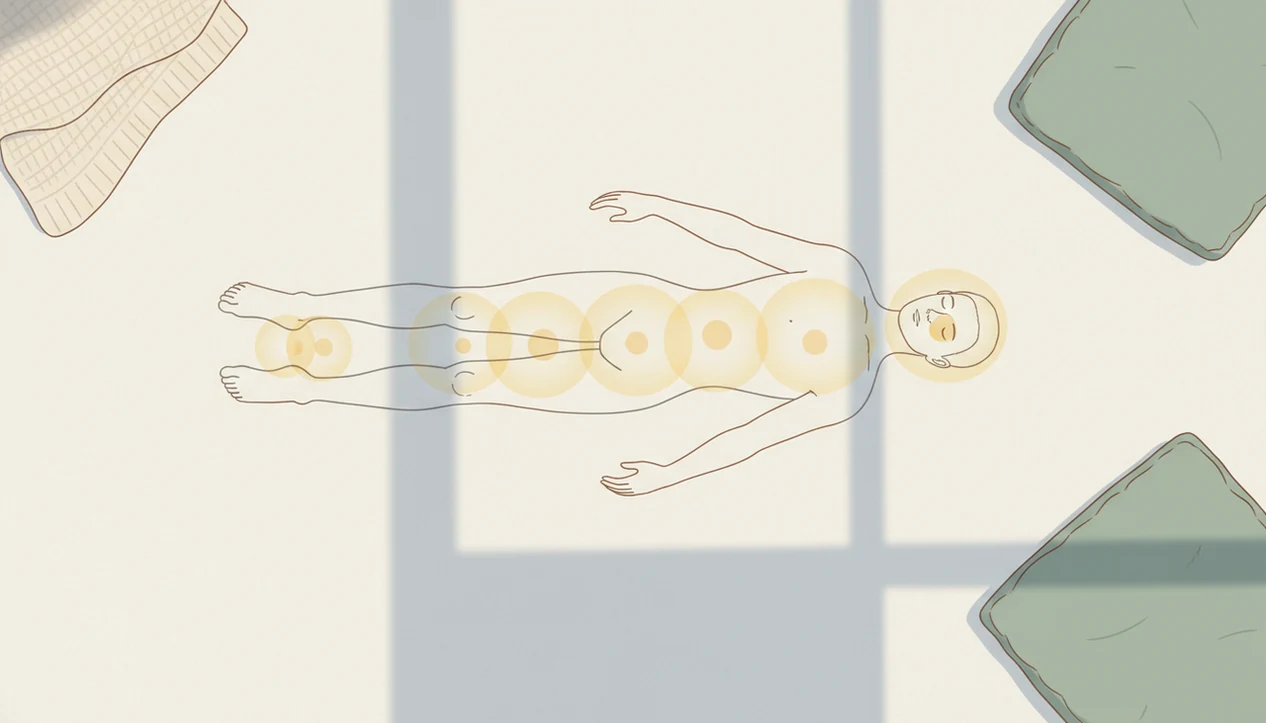
Body scan meditation is a mindfulness practice that moves attention through the body, noticing sensations without trying to fix them. You follow a sequence, such as feet to head, with curiosity rather than a demand to relax. Warmth, pressure, tightness, numbness, or no clear sensation can all be part of the practice. A beginner can start with 3-10 minutes and use a guided recording if helpful.
You do not have to lie down, close your eyes, or stay with an uncomfortable sensation. Sit up, keep your eyes open, skip an area, change position, or stop if the practice feels overwhelming. Longer scans can come later; repeating a manageable practice matters more than completing a long one.
The essentials
- Start small: a 3-10 minute body scan for beginners is enough to learn the skill.
- Use trauma-sensitive options: sit up, keep eyes open, skip body areas, or stop whenever needed.
- Longer 20-45 minute scans can deepen practice, but consistency matters more than duration.
What to notice during a body scan
Body scan meditation is a mindfulness practice that moves attention through the body in a steady sequence, often from feet to head or head to feet. The aim is noticing, not relaxing on command, fixing discomfort, or forcing a special state.
You might notice warmth in the feet, pressure where the back meets a chair, tingling in the fingers, numbness, tightness, pulsing, or no clear sensation at all. Neutral is still data. During a short practice on a kitchen chair, many beginners discover that the mind jumps to a grocery list before it notices the knees.
That still counts.
Body scan mindfulness trains the simple skill of noticing and returning. If a body area feels too intense, you can skip it, open your eyes, or use sounds in the room as your anchor.
Timing, posture, and what to expect
- Beginner duration: A 3-10 minute body scan is enough to learn the pattern without making practice feel like another chore.
- Posture options: You can practice lying down, sitting, standing, eyes open, eyes closed, or with a soft gaze toward the floor. If you tend to doze off, these body scan tips for staying awake can help you adjust posture and timing.
- Useful moments: Try it for a stress reset, bedtime settling, racing thoughts, or transition moments between work and home.
- Expected experience: Body scan meditation may feel calming, boring, emotional, irritating, or neutral; relaxation is possible but not required. For a different guided rest practice, yoga nidra offers structured instructions that you can follow without trying to force relaxation.
- Core instruction: Move attention through body regions, notice sensations, and return gently when the mind wanders.
One simple way to try it is to set a phone timer for five minutes and scan only the feet, legs, hands, and face. A short practice done often usually teaches more than one ambitious session you avoid all week.
How body scan meditation works
Body scan meditation works by moving attention out of repeating thought loops and into present body sensations. The main training effect is not relaxation; it is learning to notice what is here and return without judging it.
A helpful term is interoception, meaning your ability to sense internal body signals. For a beginner, that might be noticing a tight jaw during an email, warmth in the hands, the belly rising with breath, a quick heartbeat before a call, or no clear sensation in the legs. These observations do not have to be dramatic or pleasant. Neutral, fuzzy, and changing sensations are part of the map.
In practice, the repeatable skill is nonjudgmental return: the mind wanders, you notice it wandered, and you come back to the next body area with less criticism. If internal attention feels overwhelming, the practice can be adapted. Keep eyes open, sit upright, shorten the scan, skip intense areas, or shift to sounds, chair contact, or a visible object. Choosing safety is still body scan mindfulness.
Body scan or breath meditation: choosing an anchor
A body scan moves attention between body regions; breath meditation keeps breathing as the main anchor. Neither method is established as universally safer or more effective. The systematic review of mindfulness for chronic pain examined mindfulness programs overall, not a reliable advantage of body scans over breath practice. Choose an anchor you can attend to without steadily increasing distress.
Breath awareness does not require deeper or slower breathing. Notice the breath as it is, and switch to sounds, a visible object, or contact with the floor if breathing becomes a source of panic or air hunger. Internal body focus can also intensify pain or trauma-related sensations. Changing anchors is a valid adjustment, not a failure to meditate.
Noticing internal signals without judging them
Body scan meditation works by training attention to shift from thought loops toward present-moment body sensations. In plain terms, you practice noticing what is happening now instead of only following the next mental story.
A useful word here is interoception, which means awareness of internal body signals. These signals can include breathing, heartbeat, muscle tension, temperature, fullness, or unease. You do not need to name them perfectly. You’re building familiarity, not taking a medical inventory.
The key skill is nonjudgmental noticing. That means “tightness is here,” not “I should be relaxed by now.” During one office practice, the stale office air during an exhale was easier to notice than the chest or shoulders. That became the anchor.
Mindfulness-based interventions often include body scan practice because it gives beginners a concrete place to put attention. Mindfulness practices and meditation techniques for beginners and daily life deliver trainable attention and practical pauses, not guaranteed calm or medical treatment.
Body scan mindfulness benefits and evidence
Research on body scan mindfulness usually studies it inside broader mindfulness programs, so claims should stay modest. Commonly studied outcomes include stress, anxiety, sleep quality, emotion regulation, and body awareness.
In a 2016 randomized trial of 89 adults, an 8-week Mindfulness-Based Stress Reduction program, which includes body scan meditation, reduced perceived stress scores by about 32% PubMed research. A 2014 meta-analysis of 47 randomized trials with 3,515 participants found mindfulness-based interventions produced moderate anxiety reductions, with an effect size of 0.38 compared with controls JAMA study.
A 2016 study of 93 healthy adults found that one 20-minute body scan reduced state anxiety compared with an active relaxation control PubMed research. In a university student trial, 8 weeks of mindfulness training that included body scans was associated with improved sleep quality PubMed research.
Benefits vary by person, study design, and practice consistency. Regular practice is usually more reliable than using one body scan only when stress is already high.
Before you start a guided body scan
Before you start a guided body scan, choose a short practice window and a low-pressure setting. Three to ten minutes is enough. A kitchen timer beside a mug can work better than a long playlist that already feels like homework.
Pick a posture you can actually maintain. You might lie down, sit upright, lean against cushions, or change position halfway through. Eyes can be closed, open, or lowered toward one spot. If internal sensations feel too much, use breath, room sounds, chair contact, or a visible object as an anchor. During pregnancy, these prenatal body scan comfort tips can help you choose a position that feels manageable.
You are allowed to pause.
A good body scan for beginners includes choice from the start. Skip any body area that feels too intense. Stop if the practice increases distress. If you prefer audio support, the guided vs silent meditation comparison can help you decide when a recording is useful and when quiet practice may be enough.
How to use body scan meditation step by step
How to use body scan meditation: set a short time, choose a stable posture, then move attention through the body while noticing sensations without trying to change them. The sequence matters less than the attitude of notice and return.
- Set a timer for 3-10 minutes, or start a gentle guided body scan with a voice you find easy to follow.
- Choose your posture lying down, sitting, standing, or supported, with eyes open, closed, or softly lowered.
- Anchor attention with breath, sounds, or contact points, such as feet on tile or the back touching a chair.
- Move attention through body regions in order, such as feet, legs, hips, belly, chest, hands, arms, shoulders, face, and head.
- Notice sensations like warmth, pressure, tension, tingling, numbness, or neutrality without changing them.
- Return gently when distracted, then close by widening attention to the whole body and the room.
For many beginners, body scan meditation is easier than open awareness because it gives attention a clear route to follow.
Build from a short scan to a longer practice
A body scan for beginners should start short, then lengthen only when the practice feels familiar. Consistency matters more than duration, especially during the first month.
| Practice stage | Suggested timing | What to scan | Practical note |
|---|---|---|---|
| Week 1 | 3-5 minutes | Feet, hands, face, or contact points | Keep it small enough to repeat. |
| Weeks 2-3 | 5-10 minutes | Major body regions | Add legs, belly, chest, shoulders, and head. |
| Familiar practice | 10-20 minutes | Whole body | Use a guided body scan if attention drifts often. |
| MBSR-style training | About 45 minutes | Whole body in detail | Traditional programs commonly use longer home practice. |
Scanning only the thumbs resting on chair arms can be a complete practice on a hard day. If breath feels easier than body sensations, compare the two in body scan vs breath meditation before choosing your main anchor.
Trauma-sensitive body scan mindfulness options
Trauma-sensitive body scan mindfulness gives the practitioner choices before discomfort becomes too much. If you like, you might notice one area of the body; you can also choose sounds, the room, or an object in front of you.
- Eyes-open practice: Keep your eyes open or use a soft gaze if closing them feels unsafe or disorienting.
- Upright posture: Sit in a chair, stand, or move gently instead of lying still.
- Skip-and-return method: Skip body areas that feel too intense, then return to hands, feet, or room contact.
- External anchoring: Use sounds, wall color, light, or a visible object when internal attention feels activating.
- Supported practice: Seek professional support if you have significant trauma, flashbacks, dissociation, or severe distress.
Trauma-sensitive mindfulness teachers and clinicians typically recommend adapting practices for people with PTSD, severe anxiety, major depression, or chronic pain rather than pushing through distress NIH research. Safety is part of the practice, not a failure of it.
Signs to stop the scan and seek support
Permission to stop applies throughout the scan, not just at the beginning. Pause if panic keeps rising, intrusive trauma images appear, or you feel unreal, detached from yourself, or unable to stay oriented to the room. Open your eyes and shift attention outward. The body scan safety guidance recommends stopping for escalating panic, dissociation, or intrusive trauma material.
Severe or persistent symptoms need support beyond a meditation exercise. Seek assessment from a qualified mental-health clinician for severe dissociation, acute trauma symptoms, or a major decline in daily functioning. Suicidal thinking or immediate danger requires urgent help from emergency or crisis services. A review of meditation-related adverse events documents risks across meditation practices, not specifically brief body scans; a short session is not a guarantee of safety.
Common body scan meditation myths
Body scan meditation myths often make beginners think they are doing it wrong. Most problems are not failure; they are normal parts of attention practice.
- Myth 1: You must feel strong sensations everywhere. Subtle, neutral, numb, or unclear sensation is still a valid observation.
- Myth 2: A guided body scan must last 30-45 minutes. Short 3-10 minute practices count, especially when you are learning.
- Myth 3: Body scan meditation is always relaxing. It may feel calming, but it can also feel uncomfortable or emotionally charged.
- Myth 4: You must lie still with eyes closed. Sitting, standing, moving, and eyes-open practice are acceptable adaptations.
- Myth 5: Distraction means you are doing it wrong. Noticing the mind wandered is the moment of practice.
If a progress bar feels like it is moving too slowly, shorten the session next time. Reset the plan.
Short body scans for your desk, bedtime, and waiting room
Everyday guided body scan practice works best when it fits ordinary moments, not only formal meditation sessions. A two-minute desk scan can start with the feet, seat, shoulders, jaw, and hands between emails.
At bedtime, scan the body without trying to force sleep. The goal is awareness, not a command to pass out. If sleep comes, fine. If not, the practice still offered a quieter way to meet the body.
Before a difficult conversation, try one minute of noticing the belly, chest, throat, and feet. On transit or in a waiting room, use contact points: shoes on the floor, back against the seat, hands resting in the lap.
Mindful.net can support this practical, secular style by organizing short body scan, breath, and kindness practices in one place. For a broader menu, explore beginner meditation techniques that include breath, body, kindness, and open awareness.
Printable Five Minute Body Scan Transcript
Print the six timed passages below, or ask someone to read them aloud. Each time cue marks the start of a passage. Read slowly, then leave quiet space until the next cue. If you are practicing alone, glance at each passage and pause without watching the clock continuously. The timing is a guide, not a requirement to finish every area.
- 0:00 to 0:45. Find a position you can stay in for now. Let your eyes remain open, resting on a spot in front of you, or close them if you prefer. Notice where your body meets the chair, bed, or floor. Throughout this practice, you may skip any area, change position, or stop. Pause here.
- 0:45 to 1:30. Bring attention to your feet. Notice the heels, soles, and toes, either together or one foot at a time. Is there pressure, warmth, coolness, or nothing clear? You do not need to create a sensation. If attention wanders, return to your feet when you notice. Pause here.
- 1:30 to 2:15. Move attention to your lower legs, knees, and upper legs. Take a little time with each area. Notice what is present without asking it to change. If an area is uncomfortable to focus on, leave it out. You can look around the room or listen to sounds instead. Pause here.
- 2:15 to 3:00. If it feels manageable, notice your hips, belly, chest, and back. Choose one area rather than covering them all if that suits you. There is no need to deepen your breathing. You may skip this passage entirely and notice your hands or the contact beneath your feet. Pause here.
- 3:00 to 4:00. Bring attention to your hands. Notice your palms and fingers, then your forearms, upper arms, and shoulders. Let attention move at your own pace. There is no instruction to loosen or relax anything. If you lose your place, begin again with the hands rather than trying to catch up. Pause here.
- 4:00 to 5:00. If you wish, notice your neck, jaw, cheeks, and forehead. Skip any area you do not want to explore. Then let attention return to the room. With your eyes open, notice a color or shape nearby. Feel the surface supporting you. Move your fingers or feet when ready, and finish without needing to feel different.
Body Scan Limits
- Body scan meditation is educational mindfulness, not a replacement for medical care, psychotherapy, trauma treatment, or pain care.
- For some trauma survivors, body scans can increase distress, flashbacks, dissociation, or discomfort.
- Body scans may heighten chronic pain awareness without reducing pain, and individual sessions may offer only short term effects.
- If body awareness feels unsafe, try sounds, visible objects, or breath awareness meditation, and consider qualified support.
Body scan meditation questions
How long should a beginner's body scan take?
Start with 3-10 minutes, or just a few regions such as your feet, hands, and face. That is enough to learn the pattern of noticing and returning. Increase the time only when the practice feels manageable. A longer scan is optional, not a requirement for doing it correctly.
Is it better to sit or lie down for a body scan?
Choose a position you can maintain comfortably, with permission to move. Lying down may suit bedtime practice, but it can make you sleepy. For attention practice, try sitting or standing with your eyes open or softly focused. You do not need to remain still or close your eyes.
What if I cannot feel anything in part of my body?
Notice that the sensation is unclear, neutral, or absent, then continue to the next area. You do not need to create a feeling or search harder. Contact points, such as feet against the floor or hands resting on your lap, can offer a more definite place to begin.
What should I do when my mind wanders during a body scan?
When you notice that attention has moved to planning, remembering, or worrying, return to the body region you were scanning. There is no need to restart the whole sequence. The practice is noticing and returning, not maintaining uninterrupted concentration or achieving a particular calm feeling.
Can body scan meditation help me fall asleep?
A body scan can be used for bedtime settling, but it does not guarantee sleep. Notice sensations without trying to make yourself fall asleep. If you become sleepy, that may suit your goal. If you want to train attention instead, sit up, shorten the scan, or practice earlier.
Why does a body scan sometimes make me anxious?
Internal attention can make heartbeat, tension, pain, or trauma-related sensations more prominent. You do not need to stay with them until anxiety passes. Open your eyes, look around, move, or stop. Seek qualified mental-health support if panic intensifies, you feel detached or disoriented, or symptoms persist.
Can body scan meditation reduce chronic pain?
Research on mindfulness meditation suggests small average pain benefits, but findings vary and do not establish that a body scan alone will reduce pain. Internal attention can also make pain more noticeable. Use shorter periods, external anchors, or movement if needed, and do not substitute meditation for medical assessment or pain care.
Do I need a recording to practice body scan meditation?
No. You can set a short timer and move attention through a simple sequence of body regions. A recording can help you remember the sequence and return when attention wanders. Choose instructions that allow you to keep your eyes open, change position, skip areas, and stop.