
Breath Awareness Meditation Without Forcing Calm
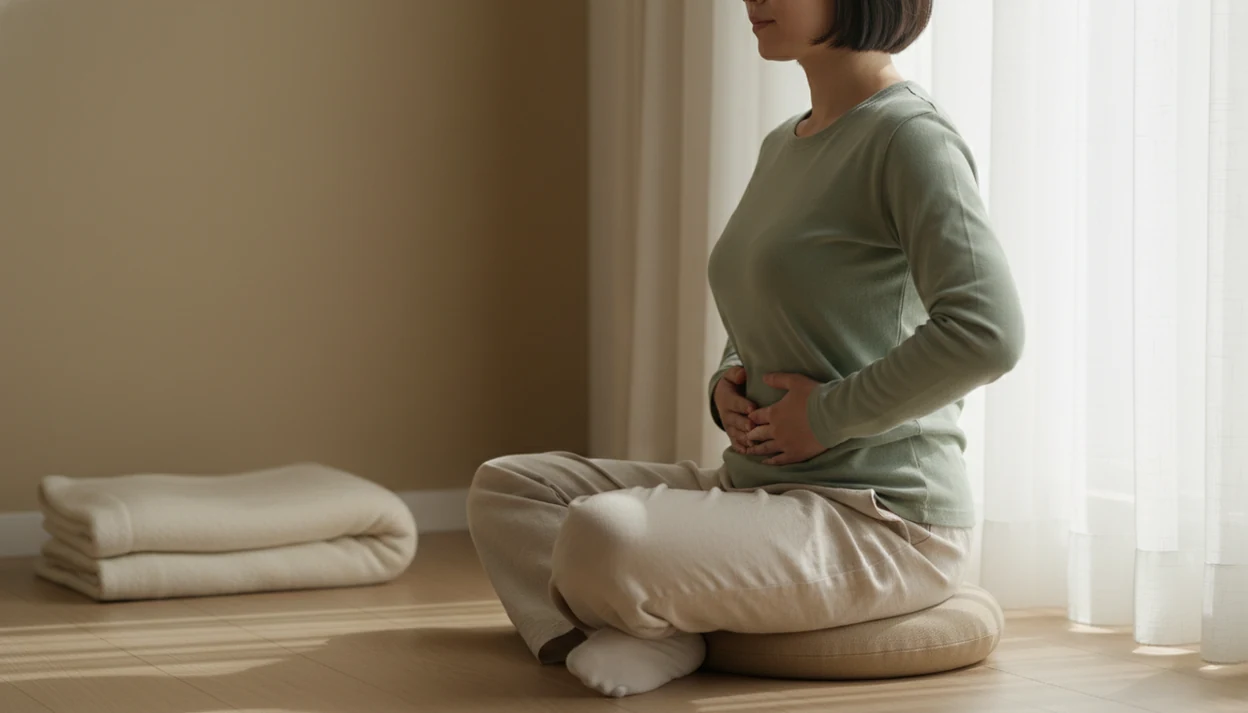
Breath awareness meditation is a beginner-friendly practice where you rest attention on natural breathing, notice when the mind wanders, and gently return without forcing the breath. The goal is not to empty the mind or create instant calm, but to train steady, kind attention.
> Definition: Breath awareness meditation is a secular mindfulness technique that uses the sensations of natural breathing as an anchor for attention without intentionally changing the breath.
- Observe the breath as it is; do not force deep, slow, or perfect breathing.
- Choose one anchor such as the nostrils, chest, or belly, then return there whenever attention wanders.
- Start with 2 to 5 minutes, adapt the practice if breath focus feels uncomfortable, and seek support for severe or persistent distress.
Breath Awareness Meditation Meaning for Beginners
Breath awareness meditation means using natural breathing as a place to rest attention, without trying to improve, lengthen, or control the breath. You notice an inhale or exhale where it is clearest, then gently come back when the mind moves elsewhere.
Plans, sounds, memories, or a sudden stomach flutter are not signs that the practice has gone wrong. They are part of what you learn to notice. The breath might be easiest to feel at the nostrils, chest, ribs, or belly, depending on your body that day.
People also search for this as breathing meditation, mindful breathing, or breath meditation for beginners. Tools like Mindful.net teach it as a practical, secular mindfulness practice, not a belief system or a way to force calm.
Breath Awareness Meditation at a Glance
If you are deciding whether breath awareness is a good starting point, ask one question: can you relate to the breath as a light anchor rather than a project to fix? The basic practice is to choose one breath sensation, notice when attention has drifted, and return without making the drift a problem.
- Start small: 2 to 5 minutes is enough for a first session.
- Use any workable posture: sit on a chair or cushion, stand, or lie down if needed.
- Follow one cue: feel the breath at the nostrils, chest, ribs, or belly.
- Expect movement: the mind will wander, sensations will shift, and ordinary thoughts will appear.
- Adapt for safety: if breath focus creates discomfort, use sounds, feet, or another steady anchor.
Two minutes counts.
For beginners, breath awareness is often easier than silent open-ended meditation because the body gives you a repeatable place to return.
How Breath Awareness Meditation Works
Breath awareness meditation works by using the breath as a repeatable, present-moment sensory object. In plain language, the breath gives attention something physical to rest on, again and again.
The training has three parts: settling attention, recognizing that it wandered, and returning. The return is not a correction after failure; it is the main repetition. You might be following the rise of the ribs, hear a parking garage echo in memory, lose track for a while, and then meet the next exhale. That simple coming back is the practice.
Mindfulness meditation has clinical evidence, but it should not be framed as a cure. A 2014 JAMA Internal Medicine systematic review and meta-analysis evaluated 47 trials with 3,515 participants and found modest evidence for improvements in anxiety, depression, and pain outcomes JAMA study. The National Center for Complementary and Integrative Health frames meditation as a complementary practice and notes that it should not replace conventional medical or mental-health care when that care is needed NCCIH overview.
Good mindfulness practices and meditation techniques for beginners and daily life deliver repeatable attention training, not guaranteed calm on demand.
How to Use Breath Awareness Meditation Step by Step
To use breath awareness meditation, choose a short practice window and keep the instructions uncomplicated. Five minutes marked by a clock across the room, the end of a song, or another clear stopping point is usually more helpful than waiting for a perfectly quiet hour.
This six-step script is practice instruction, not a clinically validated treatment protocol. The research cited on this page applies to broader mindfulness or breathing interventions, not a guarantee that one short session will change mood or symptoms.
- Set a timer for 2 to 5 minutes, and put your phone where you will not keep checking it.
- Sit comfortably with an upright but not rigid posture, such as on a kitchen chair.
- Choose one anchor at the nostrils, chest, ribs, or belly.
- Feel the natural breath as it comes in and goes out, without changing its depth or rhythm.
- Notice wandering when it happens, then gently return to the chosen anchor.
- Close the practice by feeling the body, hearing the room, and opening attention before moving on.
If you want to compare this with other meditation techniques, keep the first session short. The practice usually works best when the instruction is so simple you can remember it without effort.
Breath Meditation Setup Before You Start
A good breath meditation setup is quiet enough, not perfectly silent. A room with a humming fridge, hallway noise, or a car passing outside can still work.
Choose a posture that helps you stay awake and reasonably at ease. You might sit on a cushion, stand, or lie down if sitting is uncomfortable. Let the body be supported where it can be supported, and place the hands somewhere you will not need to keep adjusting them.
Eyes can be closed, softly open, or lowered toward a neutral spot. Some people feel steadier with eyes open, especially in a public hallway, a classroom after teaching, or any setting where fully closing the eyes feels less comfortable.
Start with short sessions before longer ones. If attention feels slippery, count “one” on the inhale and “two” on the exhale for a few breaths, then drop the count when you can.
Mindful Breathing Anchors: Nostrils, Chest, and Belly
Mindful breathing anchors are body locations where the breath is easiest to feel. No anchor is inherently more advanced, more correct, or more mindful than another.
| Breath anchor | What you may notice | When it may help |
|---|---|---|
| Nostrils | Coolness, warmth, tingling, or air passing | When you like a precise, small focus |
| Chest or ribs | Movement, expansion, softening, or gentle pressure | When the nostrils feel too subtle |
| Belly | Rising, falling, stretching, or settling | When larger movement feels easier to track |
If one anchor creates tension, anxiety, or a need to over-control the breath, change it. The point is workable awareness, not proving you can stay with one spot. Some people prefer body scan meditation when breath sensations feel too charged.
Common Breath Awareness Meditation Myths
Breath awareness meditation is often taught badly because beginners are given goals they cannot meet. These myths make ordinary practice feel like failure.
- Myth 1: You must clear the mind. A wandering mind is expected; noticing and returning is the central movement. - Myth 2: You must breathe deeply or slowly. Breath awareness observes natural breathing, unlike practices that deliberately change the breath. - Myth 3: Calm should happen immediately. Calm may come, but the more reliable skill is returning attention with less struggle. One pattern we notice is that beginners often relax more when they stop measuring each session by how calm they felt. - Myth 4: Breath awareness is the same as breathwork. Breathwork often uses intentional patterns, holds, or pacing; breath awareness does not. For contrast, box breathing, 4-7-8 breathing, and the Wim Hof Method intentionally change timing, depth, or rhythm; breath awareness meditation observes the breath without controlling it. - Myth 5: Discomfort means you should push through. If breath focus feels activating, adapt the anchor, shorten the session, or stop.
The pocket check is real. Many beginners reach for the phone the moment practice feels boring.
Breath Meditation Safety Adaptations
Does breath awareness meditation feel uncomfortable for some people? Yes. Breath focus does not feel good for everyone, and that does not mean the person is doing mindfulness wrong.
Try practicing with eyes open, using a shorter session, or widening attention to include the whole body and room. Feet on carpet or tile can be a steadier anchor than the breath. Sounds, hands, a door frame in view, or one visual object can also work.
Stop the practice if it increases panic, dizziness, breath hunger, or distress. Severe or persistent symptoms need qualified medical or mental health support, especially if panic, trauma history, or breathing difficulty is present.
Meditation-related challenges have been documented in qualitative research, including anxiety, fear, and altered sense of self in some practitioners, so distress during practice should be treated as useful safety information rather than ignored Article.
If breath focus is not workable, open monitoring meditation may fit better because it uses a wider field of awareness instead of one narrow breathing anchor.
Breathing Meditation Progress Signs
Progress in breathing meditation often looks ordinary: you notice wandering sooner, return with less self-criticism, and tolerate normal thoughts without treating them as a problem. Calm may happen, but it is not the only success marker.
A related 2013 randomized trial studied breathing exercise training practiced for 20 minutes per day, 5 days per week PubMed research. Participants showed increases in positive affect and decreases in negative affect, but that study used a structured breathing intervention, not a promise that every short breath awareness session will change mood.
A practical sign is simpler. You catch the mind halfway through planning dinner, label it “thinking,” and feel the next breath without making a speech about yourself. That counts.
For many beginners, breath meditation usually works best when progress is measured by returning, while mood change is treated as possible but not guaranteed.
Limitations
Breath awareness meditation is useful for many people, but it has real limits. It should be presented as attention practice, not treatment or a guaranteed fix.
- It is not a substitute for medical care, psychotherapy, medication, respiratory treatment, or crisis support.
- Benefits vary, and some people find breath focus uncomfortable, frustrating, or activating.
- It should not be marketed as a rapid cure for anxiety, trauma, insomnia, depression, or chronic stress.
- Long silent sessions can overwhelm beginners; 2 to 5 minutes is often a better starting point.
The Mindfulness Practices App category can support learning, but an app cannot assess complex symptoms the way a qualified clinician can.
One Mistake We Notice Often
One mistake we notice often: beginners treat breath awareness like a test of whether they can calm down on command. In our editorial review, people often do better when they pick one clear anchor, keep the session short, and let the breath be ordinary. If attention wanders twenty times, the useful part may be the twenty gentle returns, not a perfectly quiet mind.
One Pattern We Notice
Your mind gets louder as soon as you sit down.
This does not mean breath awareness is failing; it may mean you are finally noticing mental momentum. We usually suggest a short session with one clear anchor, such as the nostrils or belly, instead of trying to track every breath sensation.
You keep adjusting the breath to make it feel steady.
Try labeling the breath as “in” and “out” without improving it. A steady breath is allowed, but it is not the assignment.
You want calm quickly after a stressful shift or family conflict.
Breath awareness may help you notice what is happening, but grounding can sometimes feel more concrete when you are overwhelmed. If the breath feels too subtle, name five visible objects first, then return to one breath anchor.
A Practical Starting Point
- Beginners often do best with three to five minutes, because a short session is easier to repeat than an ambitious one.
- Parents, nurses, musicians, and athletes may find breath awareness useful when they need a portable practice that does not require special equipment.
- People who overthink instructions usually benefit from choosing one clear anchor before starting, rather than switching between nostrils, chest, and belly.
- If sitting still feels agitating, a few minutes of Mindful Walking may be a better first step before returning to the breath.
- For stress recovery, breath awareness tends to work best as a repeatable attention practice, not as a demand to feel peaceful on command.
What Surprised Us in Practice
| If you... | Try | Why | Note |
|---|---|---|---|
| A shift worker is tired but wired after coming home. | Three-Breath Reset: feel one inhale, one exhale, and one pause before deciding whether to continue. | A named reset removes extra decision-making when attention is already depleted. | Keep it brief if the breath starts to feel frustrating. |
| A musician notices every tiny change in the breath and gets perfectionistic. | Soft Count 1-to-5: count natural exhales up to five, then restart. | Counting gives the mind a light structure without asking the breath to become even. | Drop the count if it becomes another performance metric. |
| An overwhelmed parent has only a quiet minute near the sink or doorway. | One-Anchor Minute: choose nostrils, chest, or belly and stay with that single location. | One anchor tends to reduce negotiation with the practice. | Do not judge the session by whether calm arrives. |
What Not to Optimize
| If you... | Try | Why | Note |
|---|---|---|---|
| You are trying to make every inhale and exhale equal. | Natural-breath noticing | Breath awareness is usually more about noticing than controlling. | If control increases tension, switch to sounds or grounding for a few moments. |
| You keep extending the session because longer seems more serious. | Repeatable short practice | Consistency tends to matter more than session length for most beginners. | Stop while the practice still feels doable. |
| You compare breath meditation with grounding and feel unsure which to choose. | Ground first, breathe second | Grounding can be more concrete when attention feels scattered; breath awareness can follow once there is a little steadiness. | Neither practice needs to prove itself in one session. |
Three Paths Worth Trying
| Technique | Best for | Minutes |
|---|---|---|
| Three-Breath Reset | starting when the mind feels busy or resistant | 1-3 min |
| One-Anchor Minute | building consistency with a single breath location | 3-5 min |
| Ground First, Breathe Second | moments when breath awareness feels too subtle or abstract | 5-10 min |
The best breath practice is the one simple enough to repeat tomorrow.
Why Mindful.net fits this specific need
Mindful.net’s breath awareness guide works well as a starting page because it treats wandering attention as expected, not as failure. Readers who need a more active option can compare it with Mindful Walking, while those exploring Stress Recovery can use breath awareness as one small, repeatable practice among several.
FAQ
How do I start breath meditation?
Sit comfortably, set a 2 to 5 minute timer, choose one breath anchor, and feel the natural inhale and exhale. When your mind wanders, gently return to that anchor.
Should I control my breathing?
No. Breath awareness meditation observes natural breathing rather than forcing depth, speed, rhythm, or a special breathing pattern.
Where should I feel the breath?
Common anchors include the nostrils, chest, ribs, and belly. Choose one place that feels clear enough to notice without strain.
Why does my mind wander?
Mind wandering is normal because attention naturally moves toward thoughts, sounds, plans, and sensations. Noticing the wandering and returning is the core practice.
How long should beginners meditate?
Beginners can start with 2 to 5 minutes. Increase only when the practice feels workable and steady enough to repeat.
Can I meditate with eyes open?
Yes. Eyes open, softly lowered, or closed are all acceptable, depending on comfort, alertness, and safety.
What if breathing feels uncomfortable?
Change anchors, open your eyes, shorten the session, or use sounds, feet, or hands instead. If distress is strong or persistent, stop and seek qualified support.
Is breath meditation breathwork?
No. Breath awareness meditation notices natural breathing, while breathwork usually involves intentionally changing breathing patterns.