
Mindfulness Research: What Studies Show and Where the Evidence Stops



Mindfulness research is the scientific study of whether present-moment, nonjudgmental awareness practices produce reliable changes in mental health, physical symptoms, attention, behavior, or well-being. Findings support modest benefits for stress, anxiety, depressive symptoms, pain, and depression relapse prevention in specific contexts. The evidence is not equally strong for every outcome, and a benefit in one setting does not establish that mindfulness treats every condition.
The clearest findings come from structured programs such as Mindfulness-Based Stress Reduction (MBSR) and Mindfulness-Based Cognitive Therapy (MBCT), rather than everyday informal practice. This guide explains how to read those findings without turning them into promises. It is educational, not a treatment plan. Severe, worsening, or trauma-related symptoms call for appropriate professional guidance.
What matters most
- The strongest mindfulness evidence is for structured programs, not vague claims that all meditation helps everything.
- Benefits are usually small to moderate, which can still be meaningful but should not be framed as a cure.
- Study quality varies, so responsible interpretation means matching the evidence to the outcome being discussed. Comparing optimism and pessimism also requires careful evidence reading, as optimism versus negative thinking research explains.
Mindfulness Evidence at a Glance
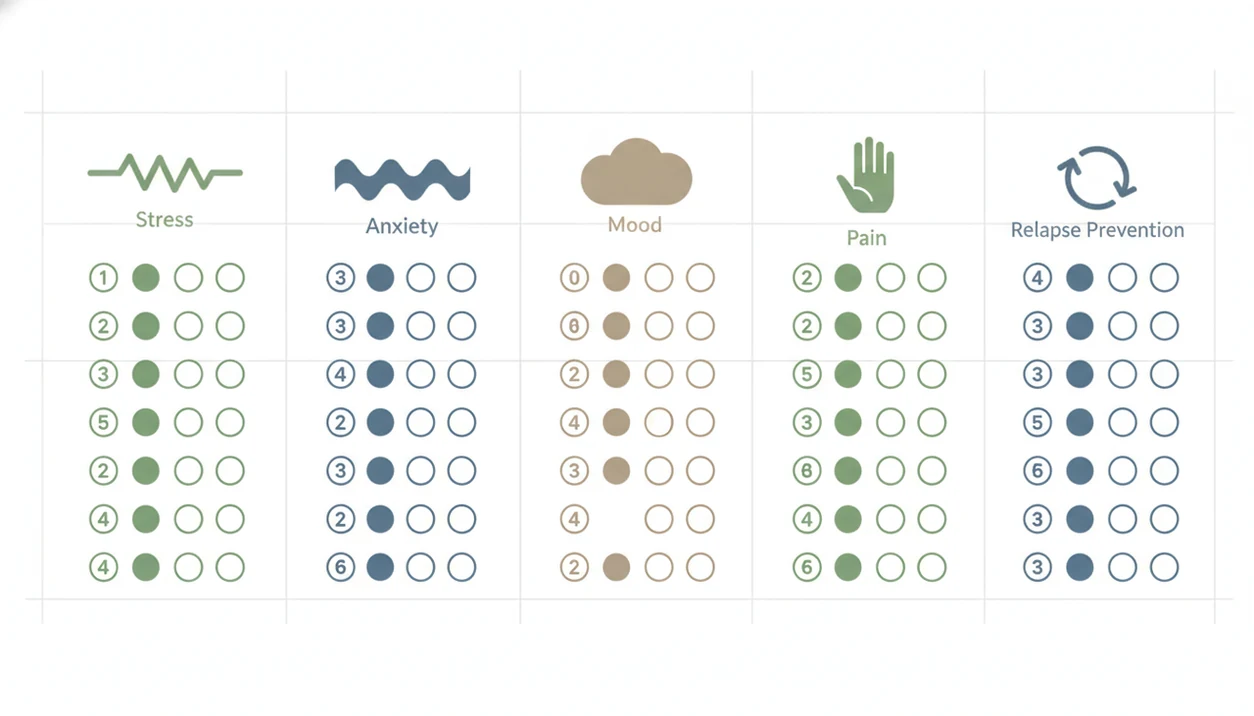
Mindfulness evidence is strongest for standardized programs such as Mindfulness-Based Stress Reduction and Mindfulness-Based Cognitive Therapy. It is evidence-based for some outcomes, especially stress, anxiety, depressive symptoms, pain, and relapse prevention, but not for every condition or claim.
Most effects are small to moderate. That sounds modest because it is. Still, a small change can matter when someone is sleeping badly, feeling tense at work, or trying to notice worry before it takes over the whole afternoon.
Clinical research usually studies manualized programs with trained teachers, weekly sessions, and home practice. Everyday beginner practice is different. A person taking three breaths before unmuting after a long meeting may be using a useful attention skill, but that exact moment has less direct trial evidence behind it.
For a broader plain-language answer, our guide on does mindfulness work separates common claims from better-supported findings.
Five facts that put mindfulness findings in context
- Research-based mindfulness usually means paying attention on purpose, in the present moment, and nonjudgmentally.
- Evidence is moderate for stress, anxiety, and depressive symptoms when mindfulness is taught in structured programs.
- MBCT has guideline-level support in some settings for preventing relapse in people with recurrent depression.
- Attention and emotion-regulation changes can be measured, but researchers still debate their size and durability. Research on negative thinking and cognitive decline asks different questions from studies measuring short term attention or emotion regulation.
- Small samples, self-selected participants, and weak control groups limit many mindfulness findings.
Steadier attention and clearer noticing are reasonable aims for mindfulness practices and beginner meditation techniques, but these practices do not promise symptom relief or replace care. A student trying five quiet minutes after a photography edit may still drift into worries about the next assignment within seconds.
That still counts as practice.
How Mindfulness Research Works in Clinical Trials
Mindfulness research works by comparing a mindfulness intervention with another condition, then measuring changes over time. Trials may use randomization, waitlist controls, active controls, or usual-care comparisons.
A waitlist control compares people practicing now with people who practice later. An active control is stricter because participants do something else, such as stress education, movement, or relaxation. That helps researchers ask whether mindfulness itself matters, not just attention from a teacher.
MBSR and MBCT are easier to study than casual mindful awareness because they have manuals, session lengths, and defined practices. Researchers can track attendance, home practice, and follow-up periods. Informal practice is messier. Someone may notice the aroma of coffee and a shirt sleeve brushing the skin for ten seconds, then forget the practice for days.
Common outcomes include stress scores, anxiety scales, depressive relapse, pain intensity, sleep quality, and attention tasks. Follow-up matters because a calm week after a course is different from a durable change six months later.
How to Use Mindfulness Research
Use mindfulness research by reading it as a guide to fit and likelihood, not as a promise. The safest question is not “does mindfulness work?” but “for whom, in what format, compared with what, and for how long?”
- Name the exact outcome you care about. Stress during work, recurrent depression relapse, chronic pain, sleep, and attention are different questions. A study on one should not be borrowed too freely for another.
- Check the format being studied. MBSR, MBCT, app practice, and brief informal pauses are not interchangeable. An 8-week course with a trained teacher tells you more about that program than about three breaths at a red light.
- Compare against active controls. Results are more convincing when mindfulness is tested against another credible activity, not only a waitlist.
- Look for study strength. Larger samples, longer follow-up, clear dropout reporting, and realistic home-practice data make findings easier to trust.
- Translate results into modest expectations. A study may support “may help reduce symptoms a little” without supporting “will cure anxiety” or “works for everyone.” Similar caution applies to the science of gratitude, where potential benefits should be considered alongside study limitations.
Mindfulness Evidence by Outcome and Study Type
Mindfulness evidence varies by outcome, program type, comparison group, and follow-up length. Structured programs usually have stronger support than app-based, informal, or loosely defined daily-life practice.
| Outcome or setting | Stronger evidence base | Evidence strength | Cautious summary |
|---|---|---|---|
| Stress | MBSR and similar programs | Moderate | May reduce perceived stress modestly. |
| Anxiety | MBSR, MBCT, clinical trials | Moderate | Small to moderate improvement is common in studies. |
| Depression relapse | MBCT for recurrent depression | Stronger | May reduce relapse risk in selected adults. |
| Pain | Mindfulness-based interventions | Mixed to moderate | Pain intensity may improve slightly. |
| Sleep | Mixed formats | Mixed | Some people report better sleep, but results vary. |
| Schools | School-based programs | Emerging | Small effects are reported, with uneven study quality. |
| Daily-life practice | Informal breathing, walking, pauses | Limited | Useful for skill-building, less directly proven. |
For beginners, structured programs fit people who want guidance and accountability, while informal practice fits people testing whether attention practice belongs in ordinary routines.
Meditation Research on Stress, Anxiety, Depression, and Pain
Meditation research is most useful when it names the outcome, the program, and the comparison group. Broad claims like “meditation works” hide important differences.
- Stress, anxiety, depression, and pain: A 2014 JAMA Internal Medicine meta-analysis of 47 randomized trials found small to moderate reductions in anxiety, depression, and pain from mindfulness meditation programs JAMA study.
- Recurrent depression: A 2016 pooled analysis found MBCT reduced depressive relapse risk by 31% compared with usual care in adults with recurrent major depression NIH research.
- Chronic pain: A 2017 meta-analysis reported a small but statistically significant pain-intensity improvement, with an effect around −0.30 NIH research.
- Generalized anxiety disorder: An 8-week MBSR trial found greater anxiety symptom reductions than stress-management education, with benefits maintained at three months NIH research.
- School settings: Reviews of school-based mindfulness programs report small positive effects on student well-being, depression, and anxiety, but study quality is uneven Full.
Clinicians typically recommend mindfulness as a supportive skill or structured therapy component, not as a stand-alone answer for serious or worsening symptoms.
What brain scans and brainwaves can actually tell us
Brain imaging can show differences in activity during meditation, but it does not establish a single pattern that defines mindfulness. A 2016 review of functional neuroimaging research examined 78 studies and found involvement across systems related to attention, cognitive control, body awareness, and self-related processing. That is evidence of varied neural activity, not proof that every meditation practice produces the same brain state or clinical benefit. For a related perspective, how happy brains respond to negativity examines responses to negative experiences rather than meditation outcomes.
Claims about lasting changes in brain structure need particular care. A 2014 review of structural MRI studies relied substantially on comparisons between existing meditators and nonmeditators. Those groups may already differ in lifestyle, education, stress, or other factors. A later review of gray-matter studies identified weak statistical power and several forms of bias. A scan showing a difference cannot, on its own, prove that meditation caused it.
Brainwave claims have similar limits. A methodological review of meditation and EEG research found no clear neurophysiological signature for meditation states. A 2026 EEG meta-analysis also emphasized varied findings and cautious interpretation. For readers, the useful question is not simply whether a brain measure changed, but whether the study also measured meaningful changes in symptoms, behavior, or experience.
MBSR, MBCT, and Everyday Mindfulness Evidence
MBSR and MBCT are structured mindfulness programs, while everyday mindfulness is a looser attention practice used during ordinary activities. Research findings from one format should not be automatically applied to all the others.
MBSR is usually an 8-week stress-reduction program that includes guided meditation, body awareness, gentle movement, and home practice. If you want the program basics without research jargon, start with MBSR basics.
MBCT is Mindfulness-Based Cognitive Therapy. It combines mindfulness practice with cognitive therapy elements and is often studied for recurrent depression relapse prevention.
Everyday mindfulness may mean noticing breath, posture, sound, walking, or the feel of a garden trowel in your hand while organizing the garage. It can be beginner-friendly, but it has less direct evidence than standardized programs. The science of embodiment mindfulness offers context for body awareness practices without assuming that every sensation produces clinical benefits.
Common Myths About Mindfulness Evidence
Mindfulness evidence is neither a cure-all nor empty hype. The most accurate reading sits between those extremes.
- Myth 1: Mindfulness is proven for every condition. Evidence is stronger for some outcomes and limited or mixed for others.
- Myth 2: Mindfulness means emptying the mind. Research-based mindfulness trains noticing and returning, not forcing thought to stop.
- Myth 3: Mindfulness is always risk-free. Some people feel distress, agitation, or painful emotions during practice, especially with long or intense sessions.
- Myth 4: More practice is always better. Consistency, fit, and guidance matter more than piling on minutes.
- Myth 5: Any mindful moment equals a studied intervention. A breath pause can be useful, but it is not the same as an 8-week program.
For habit setbacks, the practical issue is often how to restart without turning practice into another self-criticism loop; missed meditation day covers that common problem.
What beginners can reasonably expect from mindfulness
Is mindfulness evidence based for beginners? Yes, for some uses and formats, but the evidence is uncertain for others.
Beginners should treat mindfulness as skill-building, not medical treatment. One simple way to try it is breath awareness: sit upright, feel the chest move beneath a shirt, notice distraction, and come back to the breath. Other low-intensity ways to begin include noticing body sensations, walking mindfully, or taking a brief Elevator Pause between activities.
Start with five minutes, not an hour.
As a Mindfulness Practices App, it can support secular practice and comparison of techniques, but it should not be used to diagnose, treat, or replace qualified care. If you are comparing paid and free options, is mindfulness app worth it can help you weigh features against realistic expectations.
When mindfulness practice needs clinical guidance
Seek professional help when mindfulness feels unsafe, symptoms are severe or persistent, or practice seems to make things worse. Mindfulness can support care, but it should not replace prescribed medication, therapy, crisis support, or a clinician’s plan.
- Get urgent help immediately if you have suicidal thoughts, feel at risk of harming yourself or someone else, or cannot stay safe. Contact local emergency services, a crisis line, or a trusted person who can stay with you.
- Ask a qualified clinician first if you have trauma symptoms, flashbacks, dissociation, psychosis, severe depression, or panic that feels hard to control. Long sits, silent retreats, and intense body-focused practice may need careful adaptation.
- Stop the practice for now if panic, numbness, unreality, flooding emotions, or worsening symptoms show up. Open your eyes, orient to the room, move gently, and choose grounding over pushing through.
- Use trained clinical support for conditions that are serious, recurring, or not improving. A therapist, physician, or mindfulness teacher with clinical training can help decide whether mindfulness fits and how gentle it should be.
Mindfulness Research Limits
- Many studies have small samples and participants already interested in meditation, limiting how broadly results apply.
- Weak control groups can inflate benefits, and blinding is difficult because participants know whether they are meditating.
- If practice feels destabilizing, stop and seek appropriate professional guidance.
- For nonclinical habit rebuilding, restart meditation habit is a practical next step.
Mindfulness research questions
Is mindfulness scientifically proven to work?
Mindfulness has research support for some outcomes, not a blanket guarantee. Structured programs have the clearest evidence for stress, anxiety, depressive symptoms, pain, and recurrent depression relapse prevention in specific settings. Effects are usually small to moderate. The program, comparison group, and outcome all affect what a study can establish.
How much does mindfulness reduce stress?
Research supports modest reductions in perceived stress with MBSR and similar structured programs. It does not establish one amount of improvement that everyone can expect. An eight-week course with instruction and home practice is also different from taking occasional mindful pauses, so results should not be treated as interchangeable.
What is the difference between MBSR and MBCT research?
MBSR research studies a structured stress-reduction program, usually lasting eight weeks, with meditation, body awareness, mindful movement, and home practice. MBCT combines mindfulness with cognitive therapy elements and is often studied for preventing relapse in recurrent depression. Evidence for one program should not automatically be applied to the other.
Does mindfulness research show that meditation changes the brain?
Brain imaging studies report differences in activity and structure, but their meaning is not always clear. Many structural studies compare experienced meditators with nonmeditators rather than following randomly assigned groups. Pre-existing differences may explain some findings. A brain change alone does not demonstrate improved symptoms, behavior, or lasting benefit.
Can mindfulness replace therapy or antidepressants?
Mindfulness research does not justify replacing prescribed treatment on your own. Some structured programs are used in clinical care, including MBCT for selected adults with recurrent depression. That is different from treating yourself with informal meditation. Discuss changes to therapy or medication with a qualified clinician, especially when symptoms are severe or worsening.
Can meditation cause anxiety or other side effects?
Yes. Research reports negative experiences, including anxiety and depression, and some people find practice distressing or destabilizing. Safety findings vary by program and study. Stop practice if symptoms worsen, and seek appropriate guidance. Trauma symptoms, dissociation, psychosis, severe depression, or difficult-to-control panic warrant clinical advice before intensive practice.
Does research on mindfulness courses apply to meditation apps?
Not automatically. A structured course may include trained instructors, weekly sessions, a defined curriculum, and regular home practice. Short app sessions are a different format. Evidence should match the intervention being used; a positive MBSR trial does not establish that any meditation app will produce the same results.
How can I tell if a mindfulness study is reliable?
Check what participants practiced, who took part, and what the comparison group received. Random assignment, adequate sample sizes, active controls, and follow-up measurements strengthen a study. Be cautious when claims rely only on small samples, interested volunteers, or comparisons between existing meditators and nonmeditators. Look for measured outcomes rather than broad promises.