
Missed a Meditation Day? Restart Without a Catch-Up Session


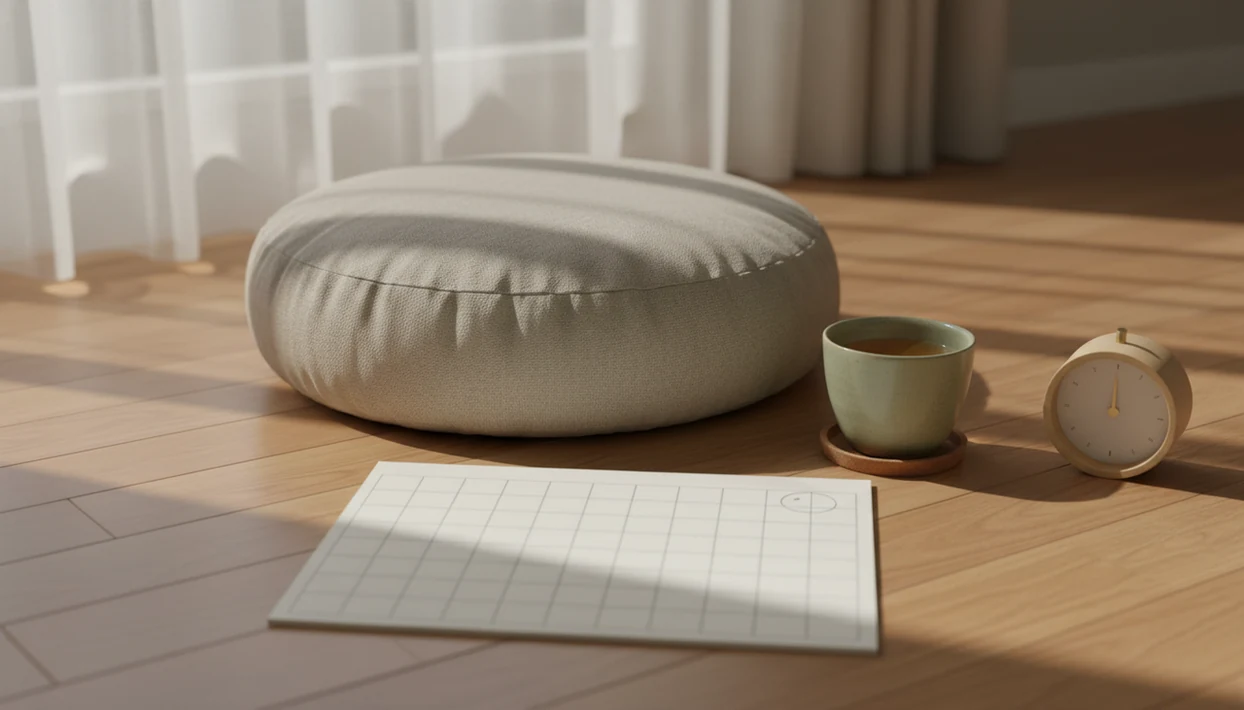
A missed meditation day does not ruin your practice; restart with one short, realistic session today rather than trying to make up the time. It means you skipped a session in an intended routine, not that your practice has ended. Treat the interruption as a habit slip: notice what happened, then return without adding a punishment session.
For today, choose two to five minutes, even if your mind feels busy. You do not need to wait until you feel calm or motivated. Attach the session to something that already happens, such as brushing your teeth, and use one reminder if needed. The useful question is what will make the next session easier to begin.
Definition: A missed meditation day is a skipped session in an intended routine, best understood as a small meditation habit slip rather than the end of a practice.
Quick answer
- Do not try to punish yourself or “make up” the missed meditation with a long session.
- Restart meditation with 2-5 minutes today, even if your mind feels busy.
- Use one cue, reminder, or routine anchor so the next session is easier to remember.
A skipped session is not the end of your practice
A missed meditation day is a skipped session in an intended routine, best understood as a small meditation habit slip rather than the end of a practice. One skipped session is normal, especially when meditation is still new.
The practice itself already teaches returning. You notice the mind wander to a grocery list, then you come back to the breath. A routine works the same way. You miss, notice, and return.
That is practice too.
A missed meditation day can feel bigger than it is because streaks look clean on a calendar. Real life is less tidy. Sleep runs short, a meeting runs late, or the cushion sliding on hardwood becomes one more reason to delay. The next useful move is not judgment. It is one small return.
Five Facts About a Missed Meditation Habit Slip
- One missed day does not erase prior practice. The minutes you already spent noticing and returning still happened.
- A short restart beats waiting for perfect motivation. For most beginners, 2 minutes today is easier than a “proper” session tomorrow.
- Shame can turn a slip into quitting. All-or-nothing thinking makes one missed meditation feel like evidence, when it is just data.
- No catch-up session is required. You do not need 30 minutes tomorrow because you missed 10 minutes yesterday.
- Meditation is common, but not always daily. In a 2023 Pew Research Center survey, 44% of U.S. adults said they had ever practiced meditation, 14% practiced regularly, and 30% practiced occasionally (Pew Research Center: Spiritual Practices).
The phone timer can be set for 5 minutes. That counts. If you want more context on evidence and realistic expectations, our mindfulness research guide explains what studies can and cannot show.
Find the cue that stopped working
A missed meditation day often happens when the habit loop is disrupted, not when your intention disappears. A habit loop has a cue, a routine, and a reward. In plain language, something reminds you, you do the practice, and your brain learns the pattern. This cue-routine-reward framing comes from habit-formation research popularized by Charles Duhigg and supported by behavioral models showing that stable contexts make repeated actions easier to repeat over time (British Journal of General Practice: 664).
The cue might be brushing your teeth. The routine is sitting for 5 minutes. The reward may be a small sense of steadiness, or simply the relief of keeping a promise to yourself.
Then Tuesday gets strange.
Travel, illness, sleep loss, caregiving, workload, or stress can break the cue. If the usual morning slot vanishes, the routine may vanish with it. That does not mean you “lost mindfulness.” It means the reminder failed. If attention or sensory differences disrupt your routine, explore mindfulness for neurodivergent people for practical ways to adapt your practice.
Mindfulness practices and meditation techniques for beginners and daily life teach noticing and returning, not becoming a person who never gets interrupted.
Before You Restart Meditation Today
Before you restart meditation, choose a session so small it is hard to argue with. Two to 5 minutes is enough for a reset after a meditation habit slip.
Pick one cue for today. Try after brushing teeth, before coffee, after opening a meditation app, or when your feet first touch the bedroom floor. Keep it boring and repeatable. A cue that depends on a calm morning is not a cue; it is a wish.
Spend 20 seconds asking what interrupted the routine. Was the session too long? Did the reminder happen at the wrong time? Did stress take over? If stress repeatedly disrupts practice, consider when to ask a mindfulness teacher for help adapting your routine.
Some people do better with guided instruction or community support. When guided support feels useful, learn how to choose a meditation teacher safely before committing to lessons or a group.
How to Restart Meditation After a Missed Day
Restart meditation after a missed day by naming the slip, practicing briefly, and making tomorrow easier. Do not add a punishment session. The goal is to rebuild the route back.
- Name the slip neutrally. Say, “I missed one meditation day,” not “I failed at meditation.”
- Set a short timer. Choose 2 to 5 minutes, especially if resistance feels high.
- Sit now or schedule today. Use a kitchen chair, bus seat, or office stairwell if that is what you have.
- Use one simple cue. Link the next session to brushing teeth, opening your laptop, or a calendar alert.
- Practice noticing and returning. When the mind wanders, return to the breath or body without scoring the session.
- Reset tomorrow. Keep the next session short too; no catch-up session is required.
For beginners, a short same-day restart is often easier than a longer delayed restart because it protects the habit from becoming a negotiation. If you need a fuller reset plan, the restart meditation habit guide covers longer breaks.
Common Myths About Missed Meditation Sessions
A missed meditation session becomes harder when you believe the wrong story about it. The correction is usually more practical than emotional: reduce the pressure and return.
| Myth | Practical correction |
|---|---|
| “The streak is ruined, so the practice is ruined.” | A streak is a tracking tool. The practice is the repeated act of returning. |
| “Tomorrow has to be longer to compensate.” | A normal-length or shorter session is usually better for rebuilding consistency. |
| “Meditation only counts when my mind is calm.” | Meditation includes noticing distraction and coming back. Busy-mind sessions still count. |
| “I should wait until motivation returns.” | Motivation often follows a small action. Start with the smallest session you can do today. |
The conference room chair may creak softly during a 3-minute pause. The session still counts. Meditation is not a performance of silence.
Choose one cue for your next session
A recovery cue should be small, repeatable, and attached to a moment that already happens. Avoid cues that require an ideal day, a quiet house, or a full hour alone.
- Time cue: Practice at the same clock time, such as 7:30 a.m. or 9:15 p.m.
- Place cue: Use one steady location, like a kitchen chair or the end of the bed.
- Routine cue: Meditate after brushing teeth, after lunch, or before opening your laptop.
- App reminder: Set one reminder, not five. Too many alerts become background noise.
- Social cue: Ask a friend to check in once a week, not every morning. For support close to home, learn how to choose a local meditation teacher who respects your needs and schedule.
Apps such as Mindful.net, Headspace, and Calm can be useful when you want a guided restart. Compare features and fit before paying; our is mindfulness app worth it page walks through that choice.
Track how easily you return, not just your streak
Your restart meditation plan is working if you return more easily after interruption, not if you never miss again. Progress looks like less drama around the slip.
Track three things for one week: completed sessions, cue reliability, and resistance level. Use simple marks, such as done, missed, or moved. If the plan feels heavy by day three, reduce the session length before you abandon it.
A phone buzz noticed without grabbing it is progress. So is catching yourself mid-thought and returning to one breath.
Research on mindfulness-based interventions shows small-to-moderate average effects for anxiety and depression, but outcomes vary by person, practice type, and study design (JAMA Internal Medicine systematic review: JAMA study). For a balanced evidence summary, read does mindfulness work.
What adherence research says about shorter sessions and consistency
There is no need to assume that a longer restart will be easier to sustain. In a two-week randomized trial comparing daily practice lengths, approximately 30-minute sessions had no adherence or dropout advantage over approximately 10-minute sessions. That finding supports keeping the routine manageable. It does not establish that two minutes produces the same benefits as a longer session, or directly test what happens after one missed day.
Consistency across weeks is a more useful target than an unbroken streak. A longitudinal analysis of digital meditation users found that people practicing four to seven days per week were 2.3 times more likely to reach their 150th session than those practicing once weekly. This was an association, not proof that frequency caused retention. It supports reviewing your overall pattern rather than treating one blank calendar square as failure.
After a missed session: make the restart easy to begin
After a missed session, choosing what to do can become another reason to postpone it. Mindful.net offers short guided meditations and a meditation timer; the site's mindfulness bell can mark the start of a brief practice. A kitchen timer is enough if you already know your practice. When repeated interruptions need individual attention, guidance from a teacher may be more useful than another tool.
Missed Meditation Day Limits
- One missed meditation day does not show whether the practice will help your stress, focus, or mood.
- Research outcomes vary by person, practice type, guidance, and adherence, and meditation cannot cure everything.
- Habit strategies cannot guarantee immediate consistency, and travel, illness, sleep loss, caregiving, workload, or stress can interrupt routines.
- If your routine of 10 minutes keeps collapsing, choose 2 minutes for now and reset the plan.
Missed meditation day questions
Does missing one day of meditation erase my progress?
One missed session does not erase the practice you have already done. Research does not establish that breaking a streak resets a habit to zero. Treat the gap as an interruption to recover from, and look at your consistency across weeks rather than judging the whole practice by one day.
Should I meditate twice as long after missing a day?
You do not need to repay missed minutes. Resume your usual session, or shorten it to two to five minutes if starting feels difficult. A trial comparing approximately 10-minute and 30-minute daily practices found no adherence advantage for the longer duration. A catch-up session is not required.
Is two minutes of meditation enough to restart?
Two minutes can be a practical restart when a longer session feels hard to begin. Use that time to notice your breath and return when attention wanders. This is a habit-recovery recommendation, not evidence that two minutes gives the same results as longer practices used in research.
Why do I keep forgetting to meditate?
Check the routine before blaming your motivation. Your cue may be easy to miss, the session may be too long for the available time, or the planned location may not be accessible. Choose one reliable daily event, prepare the place in advance, and set a smaller minimum session.
Should I meditate tonight or wait until tomorrow?
Try a brief session today if you have a realistic opening, but do not turn it into a punishment. If today is no longer workable, choose a specific cue for tomorrow rather than leaving the restart vague. An evening session can also serve as a backup when your morning routine is interrupted.
How can I stop feeling guilty about missing meditation?
Treat the missed session as information, not a personal failure. Notice any self criticism, then ask what made practice difficult that day. A kinder response might be, “Today was busy, and I can make space another time.” Meditation includes learning to respond to yourself with patience, even when your routine changes.