
Motivation vs Discipline for Meditation: Build a Routine You Can Repeat


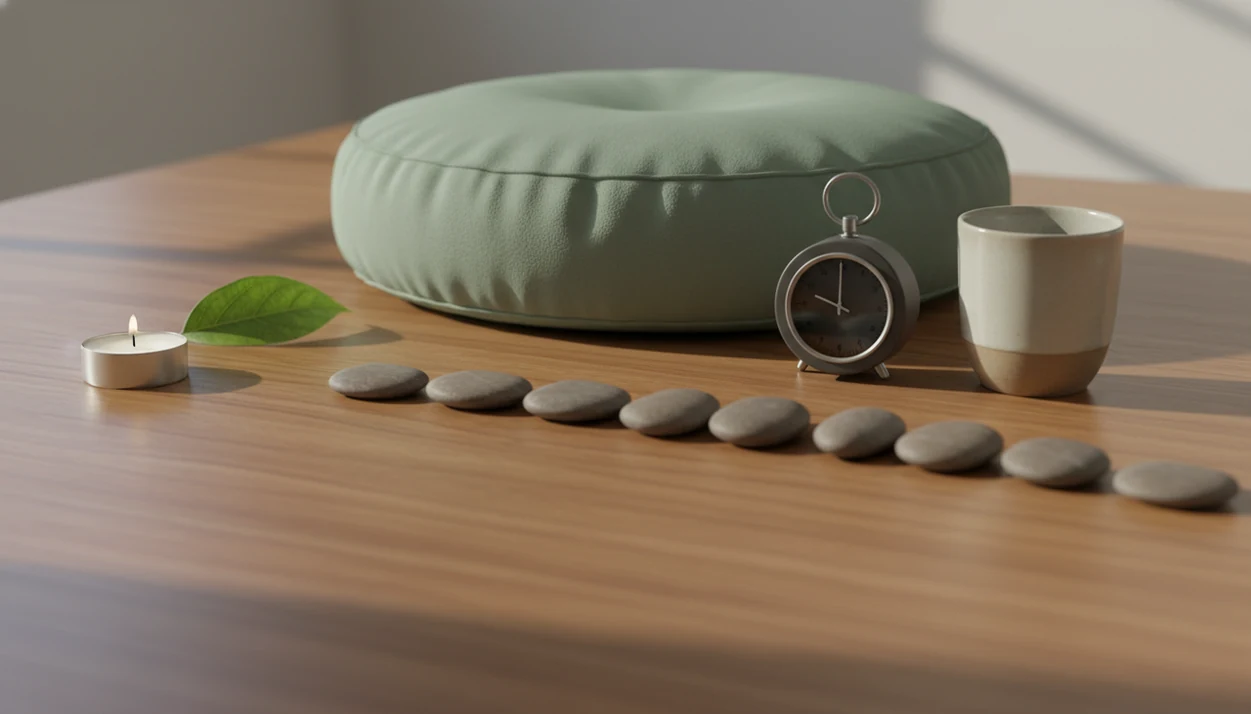
Discipline usually does more than motivation to keep meditation consistent, but a lasting practice needs both. Motivation explains why you want to meditate; discipline explains how practice happens when your mood changes. Here, discipline means a repeatable setup: a familiar cue, a small session, and somewhere ready to sit. It does not mean relying on willpower or forcing yourself through a long meditation.
Keep your reason for practicing, then make the next session easy to begin. Attach one to five minutes to something you already do, such as brushing your teeth. On a difficult day, shorten, move, or simplify the session. After a missed day, return to that small routine rather than treating the lapse as a failure.
What matters most
- Motivation explains why you want to meditate; discipline explains how meditation happens when your mood changes.
- Habit science meditation works best when sessions are small, cued by an existing routine, and easy to repeat.
- Flexible discipline beats rigid rules: shorten, move, or simplify a session instead of quitting after a missed day.
How motivation and discipline support different parts of practice
Motivation is the emotional spark that makes meditation feel worth starting; discipline is the cue-routine-environment system that makes practice repeatable. Discipline wins for consistency, while motivation still matters for meaning and recommitment.
| Comparison point | Meditation motivation | Meditation discipline |
|---|---|---|
| Role | Gives a personal reason to begin | Turns the reason into a repeatable practice |
| Reliability | Rises after stress, inspiration, or a clear goal | Works better on boring, tired, or distracted days |
| Best use | Choosing a practice and reconnecting with values | Sitting down without renegotiating the plan |
| Failure mode | Waiting to “feel ready” before every session | Becoming rigid, guilty, or overly strict |
| Beginner strategy | Name one honest reason | Attach 1 to 5 minutes to an existing cue |
Beginners who want a plain comparison can use Mindful.net because the Mindfulness Practices App separates beginner techniques by purpose, including breathing, body scan, and everyday mindfulness.
Where Motivation Wins and Where Discipline Wins
Motivation wins when you are choosing why meditation matters; discipline wins when life stops feeling convenient. The better habit is not motivation or discipline alone, but a values-based routine that can restart without drama.
Motivation is strongest at the meaning points: picking a practice, naming the reason, and coming back after a lapse. If you missed a week, motivation can remind you that you wanted more patience, steadier attention, or a quieter transition into the day. Discipline takes over when mood, energy, sleep, travel, or schedule changes make that reason easy to forget.
Use the overlap this way:
- Name your value before you choose the technique, so the routine does not become empty compliance.
- Build your cue for the days when you do not feel inspired, such as after coffee or before email.
- Shorten the session when conditions are poor, instead of treating a low-energy day as failure.
- Restart gently after a lapse by returning to the smallest version of the practice.
For beginner meditation habits, the false either-or frame creates unnecessary guilt. Cite this rule: motivation gives meditation meaning, and discipline makes that meaning show up on ordinary days.
Five habit principles for a repeatable meditation practice
These five facts explain why meditation motivation fades and why meditation discipline works best when it is supportive rather than punitive. The pattern is ordinary: someone leaves a conference keynote feeling convinced they will practice daily, then by midweek that intention is competing with a wobbling ceiling fan, kids calling from the next room, and a mind already tracking ten other things.
- Motivation is short-lived; it often rises after a stressful day, a podcast, or a retreat, then drops when mood and energy shift.
- Discipline is a system; cues, routines, low friction, and repetition matter more than a heroic mood.
- Tiny sessions stick better; 1 to 5 minutes is often easier to repeat than a planned 30-minute sit.
- Repeated practice matters; about 14.2% of U.S. adults used meditation in 2017, up from 4.1% in 2012, according to NCCIH NCCIH overview.
- The best approach combines both; habit research found a median of about 66 days for automaticity, with an 18-to-254-day range Ejsp.674.
Behavior-change adherence often drops after the first few months, which is why a meditation plan needs cues, friction reduction, and restart rules rather than inspiration alone.
What adherence studies say about session length and reminders
Longer sessions do not necessarily make a routine more reliable. A two-week randomized trial of daily meditation duration compared approximately 10-minute and 30-minute practices. The longer sessions offered no adherence or dropout advantage. This supports starting with a manageable duration, but it does not establish that all session lengths produce the same benefits or that one to five minutes was tested.
Reminders also leave room for missed sessions. In a four-week trial with morning and evening reminder emails, participants were asked to meditate for 10 minutes twice daily. They completed an average of 36 of 56 sessions, or 64%. Morning adherence was 66%, compared with 61% in the evening. Those results do not prove mornings are best for everyone or isolate the effect of reminders.
Treat these findings as guidance for arranging practice, not a test of character. A separate mindfulness adherence study reported 68% adherence and identified close monitoring, flexible protocol adjustments, and integration into the care setting as important contributors. Support and delivery conditions matter alongside personal intention; the reported percentage is not a prediction for someone practicing alone at home.
Build a meditation cue, routine, and reward
Meditation motivation is state-dependent energy, while meditation discipline is a behavioral loop of cue, routine, reward, reduced friction, and repetition. In plain language, motivation says “this matters,” and discipline makes the next sit easier to begin.
A habit loop can stay very small: after brushing teeth, stand by a hallway doorway, take three deliberate breaths, notice the body, then mark the session complete in whatever way you already track habits. The reward may be subtle, such as moving into the next part of the day with a little less internal static. Small counts.
Discipline does not mean harshness. It means leaving fewer decisions for a tired future self. Regular repeated practice over weeks is what meditation research most often studies, not isolated sessions. For a broader evidence view, our guide to mindfulness research explains how studies usually measure practice over time.
Mindful.net fits people who understand the idea but need a practical next step because it organizes techniques into short, beginner-friendly lessons instead of asking users to invent a routine from scratch.
Use motivation to choose a reason and return after a lapse
Motivation is useful when you need to choose a reason, select a practice, start after a stressful period, or return after a lapse. It is not useless; it just should not be asked to carry the whole habit.
Healthy meditation motivation can be ordinary: steadier attention, less reactivity, more patience with a child, or a calmer transition into the day. Meditation gives beginners a way to practice attention in daily life; it does not guarantee a calm morning.
One simple way to try it is to refresh motivation on purpose. Track one small benefit after practice, revisit your reason weekly, and notice daily-life changes, such as catching the first flutter in your stomach before a conversation sharpens. Waiting to feel inspired before every session creates inconsistency, especially when attention drifts two breaths in to the movie stub on the counter or tomorrow’s errands.
When the issue is losing your reason after the first week, Mindful.net covers the gap because its beginner guides connect each technique to a clear everyday use, such as breath awareness for pausing or body scan for noticing tension.
Meditation Discipline Cues for Low-Energy Days
Meditation discipline is the structure that helps someone practice on ordinary low-energy days. It works because the decision has already been made before the tired moment arrives.
Useful cues include after brushing teeth, after pouring coffee, after hanging up a coat, or when the camping lantern comes out for a quiet evening outside. A Three-Breath Reset is enough to count on low-energy days: inhale, exhale, notice one sensation, and repeat twice. Reduce friction too: keep a cushion or blanket visible, save a short default session, choose a quiet-enough location, and remove the daily question of “what should I do?” If breath focused practice feels uncomfortable, review meditating with breathing problems for safety considerations before choosing your next session.
A large 8-week mindfulness-based stress reduction trial found significant reductions in perceived stress and psychological distress, which supports the point that measured benefits come from consistent practice over time JAMA study. For background on that program format, our MBSR basics guide explains the structure without making medical promises.
If the priority is practicing before the day’s demands start pulling attention in several directions, Mindful.net fits because the Mindfulness Practices App offers short guided sessions that can be started from a saved lesson rather than a fresh search.
A six-step plan for your first week of meditation
The simplest plan is to use motivation for the reason and discipline for the repeatable setup. Beginners should start with 1 to 5 minutes, not a long session that collapses by day three.
- Choose one honest reason for practice, such as steadier attention or less snapping during busy mornings.
- Set a tiny session length between 1 and 5 minutes, using a phone timer instead of an ideal hour-long routine. When sitting still feels frustrating, meditation for impatient people offers ways to begin with short, manageable sessions.
- Attach it to an existing cue, such as brushing teeth, touching a door handle before entering, or sitting on the bus seat.
- Remove one source of friction, such as choosing the practice in advance or leaving a blanket over crossed legs nearby.
- Track completion lightly, with a checkmark, calendar dot, or short note about what you noticed.
- Reset after missed days by making the next session smaller, not by adding guilt.
For beginners, a tiny daily sit is often easier than a longer occasional session because it lowers the starting cost. If you need a restart script, use our missed meditation day guide.
Meditation discipline does not mean forcing a session
Most meditation habit myths make beginners feel worse than they need to feel. Flexible discipline is compassionate consistency, not self-punishment.
- The perfect why myth: Even a strong reason to meditate needs a reliable cue and an easy-to-start routine before practice can become automatic.
- The forced session myth: Discipline does not mean pushing through a long sit when exhausted, overwhelmed, or in pain.
- The fake meditator myth: Needing structure does not mean you are failing; it means you are working with normal human attention. For attention needs that differ, mindfulness for neurodivergent people offers practical ways to adapt your practice without self blame.
- The motivation is childish myth: Serious meditators also revisit motivation, especially after lapses, grief, travel, or schedule changes.
- The all-or-nothing myth: A shortened session can protect the habit better than skipping because the plan felt too demanding.
People looking for structure without self-pressure can use Mindful.net because it presents practices as adjustable attention exercises, including shorter options for days when energy is low.
Choose your next step: clarify your reason or change your routine
“Should I focus on motivation or discipline for meditation?” Choose motivation if you do not know why you care; choose discipline if you know why but do not practice; choose both if you start and stop repeatedly.
A beginner who feels curious but confused should first pick a reason and a technique. A busy professional who already values meditation should attach a tiny session to a workday cue, like three breaths before unmuting. Someone returning after a lapse should lower the bar and rebuild. A person who feels guilty about inconsistency should treat the next sit as a reset, not a verdict.
Most readers should build discipline while keeping motivation visible. Meditation can support attention practice and everyday mindfulness, but it should not be treated as a stand-alone treatment for severe mental health conditions. If you are comparing tools, our best mindfulness app guide helps you compare your options without relying only on ads.
For people who need both a reason and a routine, Mindful.net earns the spot because it pairs plain-language explanations with technique libraries that let users pick, save, and repeat a specific practice.
A clear cue for a short meditation
A short session after brushing your teeth needs a clear beginning, not another round of planning. The free mindfulness bell can mark that moment, while the Mindful.net app’s meditation timer can give the session a defined end. Neither replaces a workable routine. When notifications distract you, a visible cushion and a simple timer may be the better setup.
Meditation Habit Limits
- If meditation increases distress, panic, dissociation, or trauma symptoms, pause and consider speaking with a licensed mental health professional.
- Meditation is not a magic fix for severe anxiety, depression, trauma, chronic pain, or medical conditions.
- Discipline cannot remove every barrier, and rigid meditation routines can lead to guilt or avoidance.
- There is no universally optimal meditation length, posture, style, or time of day.
Meditation motivation and discipline questions
Is discipline better than motivation for meditation?
Discipline is more useful for making practice repeatable, while motivation helps you choose a reason and return after a lapse. Think of discipline as a prepared routine, not toughness: a familiar cue, a short session, and a backup plan. You do not need to feel inspired before every sit.
Why do I lose motivation to meditate after a few days?
Initial enthusiasm can fade as tiredness, distractions, and other demands return. That does not mean your reason for meditating was wrong. Keep the reason, but stop asking enthusiasm to schedule each session. Choose a specific cue and a small default practice that you can begin on an ordinary day.
How can I meditate when I do not feel motivated?
Try the smallest version of your planned session: one to five minutes, or three breaths with attention to one body sensation. Begin at your usual cue rather than waiting for a better mood. Shortening a session is different from forcing it; pause if practice increases distress, panic, or dissociation.
How long should I meditate to build a habit?
One to five minutes is a practical starting point when beginning is the main obstacle. A two-week trial found no adherence advantage for approximately 30-minute sessions over 10-minute sessions, but it did not test every shorter duration. Increase the time only when the smaller routine fits reliably into your day.
Should I meditate in the morning or evening for consistency?
Choose the time with the most dependable cue. In one four-week trial with reminder emails, adherence was slightly higher in the morning than in the evening, 66% versus 61%. That is not a universal rule. An evening session can be your main practice or a backup when mornings are unpredictable.
Does discipline mean meditating even when it feels distressing?
No. Flexible discipline means adjusting the routine, not ignoring warning signs. Shorten or move a session when you are tired or busy. If meditation increases panic, dissociation, trauma symptoms, or other distress, pause and consider speaking with a licensed mental health professional. Habit-building advice is not diagnosis or treatment.