
Meditation Results After 30 Days: Realistic Changes and How to Track Them


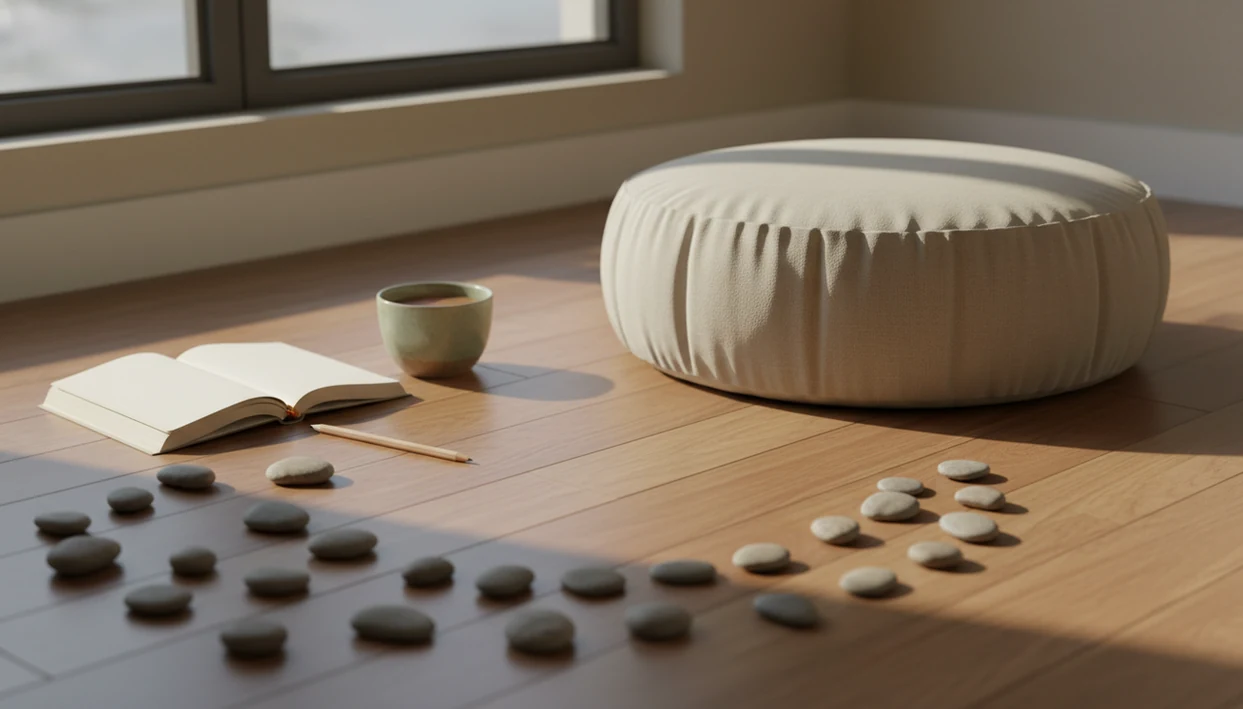
Meditation results after 30 days are usually subtle: you may notice thoughts sooner, pause before reacting, recover from stress a little faster, and settle into a steadier routine. A completely quiet mind, a dramatic personality change, or a mental health cure is not a realistic promise. Five to ten minutes most days is a manageable way to learn the habit; long sessions are not required.
Research supports benefits for stress, anxiety, depression symptoms, and pain in structured mindfulness programs, but it cannot predict your exact one-month result. Compare ordinary moments before and after practice, not just how calm a session feels. This article is educational, not medical advice. Meditation should not replace diagnosis, therapy, medication, crisis care, or a clinician’s guidance when symptoms are serious or worsening.
What matters most
- Realistic 30 day meditation results are usually small: more awareness, less automatic reacting, and a more consistent pause before responding.
- Five to ten minutes most days is enough to learn the habit; consistency matters more than long sessions.
- Research supports mindfulness for stress, anxiety, depression symptoms, and pain in structured programs, but exact one month meditation results vary widely.
Changes you might notice after 30 days
Meditation before and after 30 days is usually noticeable, but not dramatic. The most common changes are practical: you catch the mind wandering sooner and pause a little more often before reacting.
- Awareness: You may notice thoughts, tension, or irritation earlier than before.
- Reaction time: A stressful email may still sting, but the reply may wait.
- Focus: Short windows of attention can feel steadier, especially in simple tasks.
- Sleep: Some people wind down more easily, but sleep is not guaranteed to improve.
- Routine: A phone timer set for 5 minutes can start to feel normal, not strange. A daily mindfulness routine can help you choose a regular practice time without making sessions longer.
Thoughts still happen. Calm does not arrive on command. The useful shift is learning to notice and return.
How noticing and returning can change your response
Thirty days of meditation can change behavior by training attention, decentering, and the response gap, not by guaranteeing major brain rewiring in a month. In plain terms, you practice noticing where your attention is, then gently bring it back.
Attention training is simple but not always easy. You place attention on the breath, body, sounds, or thoughts. When the mind wanders to a grocery list, you notice and return. Again.
Decentering means seeing thoughts as mental events, not automatic instructions. “I can’t handle this meeting” becomes a thought you observe, not a command you must obey. That small distance can create a response gap. You feel the shoulders tighten, sense feet on carpet, and choose the next sentence more carefully.
Beginner meditation practice trains you to notice thoughts and reactions; it does not promise instant serenity or replace medical treatment.
Record a baseline and compare your month
A one month meditation experiment works better when you track simple before-and-after signals instead of relying on memory. Before day 1, write a baseline note on stress, sleep, focus, reactivity, and expectations.
Keep the practice small. Five to ten minutes a day is enough for many beginners to learn the habit. Use guided instructions or a simple breath practice. A kitchen chair is fine. So is a bus seat, if that is the only quiet window.
After each session, log one or two lines: time practiced, mood before, mood after, and one thing noticed. Missed days count as data, not failure. If you skip Tuesday, write “missed” and continue Wednesday.
For a deeper evidence overview, our mindfulness research guide explains why short-term results vary so much.
Six steps for a manageable 30-day practice
To use 30 days of meditation well, treat it like a small attention experiment, not a test of personal discipline. Review patterns weekly, because single sessions can be restless, sleepy, or boring.
- Set one clear reason for practicing, such as pausing before replies or winding down at night.
- Choose one simple style for week one, such as breath awareness or a short body scan. If you prefer learning from written instructions, mindfulness books for beginners can offer practical explanations and simple exercises.
- Set a daily timer for 5 to 10 minutes at a repeatable time.
- Log one observation after each session, using plain words rather than scores only.
- Mark missed days without restarting the whole challenge.
- Review weekly changes and reset expectations by checking stress, sleep, focus, and reactivity, then adjusting when sessions feel dull, fidgety, or sleepy.
If you miss several days, a restart meditation habit plan can keep the experiment from turning into guilt.
Illustrative example: noticing distraction sooner
Before starting, the restless beginner assumes meditation means clearing the mind. On day 2, that expectation already causes trouble. Thoughts keep arriving, the knee bounces, and the timer seems unusually slow. Answers to common meditation questions for beginners can clarify what to expect when thoughts keep arriving during practice.
During the month, the practice is uneven. They fidget. They check the timer. A few days disappear because the evening gets busy. One session ends with annoyance after only four minutes. Not elegant.
By day 30, the mind is not blank. The change is smaller and more useful: distraction gets noticed sooner. Instead of spending five minutes lost in planning dinner, they catch it after one or two thought chains and return to the breath. For beginners, noticing distraction sooner is often more realistic than trying to eliminate distraction altogether.
Illustrative example: pausing before a work reply
Before practice, the stressed worker reacts quickly. A short email feels sharp. A meeting interruption turns into a tight jaw and a clipped answer. The cursor blinking on an email can feel like pressure to respond immediately.
The 30-day practice is not fancy. Some days it is three minutes before opening the laptop. Other days it is a body scan in an office stairwell, with attention moving from forehead to shoulders to feet.
After a month, stress still appears. The difference is earlier detection. Neck muscles release by degrees before the next call, or the person notices irritation before typing the first sentence. Benefits often show up between sessions, not only while sitting. Clinicians typically recommend mindfulness as a supportive skill, especially when paired with appropriate care for ongoing anxiety, depression, trauma, or high stress.
Illustrative example: bedtime practice without forcing sleep
Before the month begins, the sleepy night practicer uses meditation as a last-minute tool to force sleep. That usually backfires. The session becomes another task: relax now, sleep now, stop thinking now.
During the 30 days, practice is mixed. Some nights feel quiet. Other nights bring impatience, drifting, or a half-dream state. The instructions may need to be repeated in plain language: feel the breath, notice the mind, return.
After 30 days, bedtime may feel smoother because the routine is clearer. The body learns a familiar downshift. However, meditation is not a stand-alone treatment for insomnia, sleep apnea, trauma nightmares, or medical sleep problems. If sleep is persistently poor, a clinician or sleep specialist is the practical next step.
Four possible changes in attention and reactions
Four patterns show up often in 30 day meditation results, though not everyone gets all four. Research on 4-week, 6-week, and 8-week mindfulness programs supports broader benefits, but it does not prove one exact 30-day outcome for every person.
- Earlier noticing: Thoughts may not get quieter, but you see them sooner. That alone can change the next action.
- Softer reactions: Emotional reactions may reduce by a small degree. The phone buzz is noticed without grabbing it every time.
- Shorter focus windows: Focus may improve in brief stretches, especially during reading, typing, or listening.
- Ordinary habit: Meditation becomes less mysterious. It starts to feel like brushing teeth for attention.
A 2014 meta-analysis of 47 randomized clinical trials found moderate evidence that mindfulness meditation programs improve anxiety, depression, and pain compared with usual care JAMA study. For structured programs, MBSR basics gives useful context.
What research can tell you at the one-month mark
The strongest findings do not establish a precise 30-day deadline. A 2014 systematic review of randomized trials found moderate evidence of improvement in anxiety and depression at eight weeks, with smaller effects at later follow-up. It found no evidence that meditation was superior to active treatments such as medication, exercise, or other behavioral therapies. Treat day 30 as a checkpoint, not a pass-or-fail result.
A calm session and meaningful progress are different things. Alongside your practice notes, compare daily functioning: sleep, work or study attendance, relationships, and ordinary activities. A validated questionnaire, such as the Perceived Stress Scale, can add a more consistent measure than memory alone. These measures do not diagnose you or prove meditation caused a change. Review them alongside missed sessions, adverse reactions, and any changes in treatment or circumstances.
Five expectations to set aside before day one
Overhyped expectations make many beginners quit too early. A month of meditation can support well-being, but it does not make ordinary human thoughts disappear. Recognizing common meditation mistakes beginners make can help you adjust expectations rather than abandon a useful practice.
Myth 1: Meditation makes the mind totally blank. In practice, the mind wanders and you return.
Myth 2: One month cures anxiety, depression, or trauma. Evidence supports symptom reduction in some settings, not guaranteed cures.
Myth 3: Calm must happen every session. Some useful sessions feel restless the whole time.
Myth 4: Only 30 to 60 minute sessions count. Five to ten minutes most days can build the skill.
Myth 5: If you miss a day, the experiment failed. It did not. The missed meditation day problem is common, and restarting is part of practice.
A guided meditation app can offer beginner-friendly structure, but professional care matters when symptoms are serious, worsening, or unsafe.
Why a before-and-after comparison cannot establish cause
Does research prove exact 30-day meditation results? Not really. Most higher-quality studies use 4 to 8 weeks or longer, and many study structured programs rather than casual app-based practice.
That matters. Major claims about structural brain change, hormones, or permanent personality shifts usually require longer research and careful measurement. A 30-day self-test can show useful personal patterns, but it cannot prove why they happened.
Confounders are everywhere. Better sleep, exercise, therapy, reduced alcohol, work changes, and expectations can all influence how you feel after a month. In a 2022 randomized clinical trial, an 8-week mindfulness-based stress reduction program reduced anxiety symptoms by about 30% and performed similarly to escitalopram for adults with anxiety disorders NIH research. That is broader mindfulness evidence, not proof that every beginner gets the same result in exactly 30 days.
For a balanced view, compare claims against does mindfulness work.
When To Seek Professional Help During A Meditation Experiment
Seek professional help if meditation brings up symptoms that feel intense, unsafe, or harder to manage after practice. Meditation can support treatment, but it is not a replacement for therapy, medication, diagnosis, or crisis care.
Some restlessness is ordinary: fidgeting, boredom, wandering thoughts, or impatience with the timer. Concern rises when practice triggers panic that does not settle, flashbacks, dissociation, severe insomnia, worsening depression, compulsive self-monitoring, substance-use urges, or fear that feels bigger than the session. Trauma histories also deserve extra care; a trauma-informed teacher or clinician-guided approach may be safer than long silent practice.
- Pause the experiment if symptoms escalate during or after sitting.
- Contact a licensed clinician if anxiety, depression, PTSD symptoms, eating concerns, substance use, or sleep problems are worsening.
- Seek urgent help now for suicidal thoughts, psychosis, hearing or seeing things others do not, or impulses to harm yourself or someone else.
- Choose grounding practices, open eyes, movement, shorter sessions, or guided support if stillness feels overwhelming.
- Resume only when the practice feels reasonably steady, supported, and not like a test you must pass.
Keep your 30-day practice short and repeatable
On busy days during your 30-day experiment, a brief practice may be easier to repeat than a long session. Mindful.net’s short guided meditations offer instructions, while the free breathing timer provides a visual pace for a breathing exercise. Keep breathing comfortable rather than forcing the pace. For significant anxiety, persistent insomnia, or worsening symptoms, professional assessment is more appropriate than relying on an app or timer.
Thirty Day Meditation Limits
- Thirty days cannot prove meditation claims, and consistent practice may bring little or no noticeable change.
- Meditation may increase distress, especially with intensive, silent, or unsupported practice, as reported in Article.
- Seek professional help for serious anxiety, depression, PTSD, psychosis, substance use, or suicidal thoughts, rather than relying on meditation alone.
- An is mindfulness app worth it comparison can help distinguish useful features from marketing.
Questions about your first 30 days
What changes should I expect after 30 days of meditation?
Possible changes include noticing distraction sooner, catching physical tension earlier, and pausing before some reactions. Your routine may also become easier to repeat. These are possibilities, not a checklist everyone completes. Some people notice little change after a month, and a calmer session does not necessarily mean better daily functioning.
Is 10 minutes of meditation a day enough for a 30-day experiment?
Five to ten minutes most days is a manageable starting point for learning the habit. It gives you time to practice noticing and returning without making each session a major commitment. It is not a proven dose that guarantees symptom improvement. Longer sessions are not automatically more beneficial.
How can I tell if meditation is working when I still have thoughts?
Look at what happens after you notice a thought, rather than counting how many thoughts appear. Can you return to the task, catch irritation before replying, or recognize tension earlier? Thoughts continuing is not evidence of failure. Compare patterns across the month instead of judging one restless session.
Can 30 days of meditation reduce anxiety?
Mindfulness programs can reduce anxiety symptoms on average, but much of the stronger evidence measures outcomes around eight weeks rather than exactly 30 days. Results vary, and brief independent practice is not equivalent to a structured treatment program. Do not stop medication or therapy because you begin meditating.
What should I do if I miss a day during a 30-day meditation challenge?
Record the missed day and resume at the next practical opportunity. You do not need to restart the month or make up the minutes with a longer session. Note what got in the way, then consider a shorter session or a more repeatable time. Missed days are useful information about your routine.
Why do I feel more restless or anxious after meditating?
Fidgeting, boredom, and wandering thoughts can occur during practice. They are different from panic that does not settle, flashbacks, dissociation, or worsening symptoms. Do not push through distress to complete the challenge. Shorten or stop the practice, and seek professional help if symptoms feel intense, unsafe, or harder to manage.
Should I continue meditating if I notice no change after 30 days?
Review your notes, practice consistency, and daily functioning before deciding. Some research assesses benefits at about eight weeks, so one month is not a definitive verdict. Continuing a manageable practice is an option if it is not causing distress. Significant or persistent symptoms deserve professional assessment rather than simply more meditation.