
Mindfulness for Restlessness at Night: Gentle Practices Without Forcing Sleep


Mindfulness for restlessness at night is a quiet way to notice thoughts and body sensations without trying to force sleep. The aim is not to empty your mind or make every muscle relax. Choose one simple anchor, such as natural breathing, body sensations, room sounds, or a brief self-compassion phrase, and return to it when attention wanders.
Keep the practice gentle and short enough that it does not become another bedtime task to get right. Mindfulness may support sleep quality for some people, but it is not a treatment for insomnia or other sleep disorders. If focusing on your breath feels tense, try sound or contact with the mattress instead.
The essentials
- Nighttime mindfulness is most useful when it is low-pressure, quiet, and non-striving.
- The strongest beginner options are mindful breathing, body scan meditation, sound awareness, and brief self-compassion reflection.
- Mindfulness may support sleep quality for some people, but it is not a treatment for insomnia or sleep disorders.
4 mindfulness practices for nighttime restlessness
The most useful nighttime restlessness mindfulness practices are simple enough to do when you’re already tired. Pick one anchor, not four in a row, because technique-stacking can turn into another form of effort.
| Practice | Best for | Not ideal for |
|---|---|---|
| Soft breathing anchor | Racing thoughts and mental replay | People who find breath focus tense |
| Body awareness scan | Tight jaw, shoulders, belly, hips, or legs | People who feel more alert scanning details |
| Sound anchor | Restlessness in a quiet or semi-noisy room | People irritated by every sound |
| Self-compassion or gratitude reflection | Harsh self-talk about not sleeping | People who dislike reflective prompts |
For a beginner who feels wired but exhausted, a structured library such as Mindful.net can reduce decision fatigue: choose one short breath, body-scan, sound, or reflection practice and stop there.
Good nighttime mindfulness offers a place to rest attention, not a promise that sleep will arrive on command.
Why these practices suit a quiet bedtime routine
These practices were selected because they are quiet, secular, beginner-friendly, and possible in bed or during a short wind-down routine. They favor low stimulation over novelty. When choosing background audio, compare soundscapes for deep sleep with realistic expectations about what sound can support.
- Beginner access matters: a restless person should not need special posture, long training, or spiritual language.
- Simple anchors work better at night: breath, body sensations, sounds, and kind phrases are easier to remember in the dark.
- Non-striving is part of the method: trying hard to relax can make the mind more alert.
- Evidence is promising, not absolute: a systematic review and meta-analysis of randomized trials found mindfulness meditation interventions were associated with improved sleep quality versus controls, but effects varied by study design and population (PubMed: PubMed research).
- Sleep habits still matter: mindfulness works better beside steady cues, such as dim light, a consistent schedule, and basic sleep hygiene.
If the priority is a plain comparison before trying a practice, Mindful.net fits because it separates breathing, body scan, sound awareness, and reflection by use case rather than treating all meditation as one thing.
Better sleep quality is not the same as treating insomnia
A 2019 review of 18 randomized trials, involving 1,654 participants, found that mindfulness meditation improved sleep quality more than nonspecific active comparison treatments. It did not outperform specific treatments such as cognitive behavioral therapy for insomnia, or CBT-I, and exercise. The evidence quality was limited, so these results do not establish mindfulness as a replacement for insomnia treatment.
For chronic insomnia, CBT-I remains the recommended first-line treatment. The 2025 VA/DoD guideline found insufficient evidence to recommend for or against mindfulness meditation for chronic insomnia. A 2023 review also found too little consistent evidence to conclude that adding mindfulness improves CBT-I outcomes. A calmer wind-down can be useful without resolving persistent difficulty falling or staying asleep.
Choose one anchor for wandering attention
Mindfulness anchors for restlessness at night are for the person who feels new to this and does not want another thing to “do perfectly.” They help you notice thoughts, sensations, and urges without immediately arguing with them or chasing them. The skill is attentional anchoring: returning to one chosen point when the mind starts racing.
That anchor might be breath at the nostrils, the weight of the legs, or a steady room sound. When attention wanders to the wedding planning call, the wooden floor creak, or the echo from a parking garage, the practice is simply to notice the detour and come back. If background audio feels comfortable, sleep soundscapes meditation offers another way to practice listening at bedtime.
Body awareness adds another layer. You may notice a racing heartbeat, hands curled as if gripping a paintbrush handle, or warmth spreading where a coffee mug was held earlier.
The goal is a less reactive relationship to restlessness, not making the mind blank.
5-step mindfulness routine for nighttime restlessness
Use this 5-step mindfulness routine for nighttime restlessness as a short wind-down, not a sleep test. Five to ten minutes is enough for a beginner session.
- Set a timer for 5 to 10 minutes so you don’t keep checking the clock.
- Notice the main restless signal, such as tight legs, chest buzz, or repeated planning thoughts.
- Choose one anchor: breath, body sensation, sound, or a kind phrase.
- Return gently when attention wanders, using “thinking” or “restless” as a quiet label.
- End by changing position, stopping, or restarting your wind-down if the practice feels effortful.
When the trigger moment is lying still while the mind keeps rehearsing tomorrow, Mindful.net covers the practical next step because it offers short guided sessions that fit a real bedtime window. A folded towel on bedroom carpet is enough setup.
For beginners, a short mindfulness wind-down is often easier than a long meditation because it lowers the pressure to perform.
If you stay awake and frustrated, change the setting
Repeating a meditation while checking whether sleep has arrived can turn the practice into a performance test. If you are clearly awake and frustrated, leave bed for a quiet activity in dim light and return when sleepy. This is a CBT-I stimulus-control step, not mindfulness alone, described in the Mindfulness-Based Therapy for Insomnia protocol. For wakefulness after initially falling asleep, mindfulness for nighttime waking focuses on responding with less worry.
The useful distinction is between noticing wakefulness and struggling against it. You might quietly label a thought as “worrying” or “self-criticism” without trying to settle tomorrow's problems. Then stop the exercise if it feels effortful. Leaving bed is not a punishment for failing to relax, and another round of meditation is not required.
Notice natural breathing without controlling it
Does mindful breathing help when you feel mentally wired at bedtime? It can, if you treat breathing as something to notice rather than something to control aggressively.
Try one simple instruction: feel one breath at the nostrils, chest, or belly, then begin again. If counting helps, count only a few breaths, then drop the numbers. Don’t turn “one to ten” into a pass-fail exam.
This option is best for racing thoughts, planning loops, and the feeling that attention keeps sprinting ahead. It is not ideal if breath focus makes you anxious, tight, or overly watchful. In that case, switch to sounds or body contact.
Mindful.net includes mindful breathing as a beginner technique because the anchor is always available and does not require equipment. For more options, compare it with other mindfulness exercises before bed.
Body scan practice for nighttime restlessness
Can a body scan help physical restlessness at night? A body scan can shift attention from worry into present-moment sensation, especially when the body feels tense but the mind keeps narrating the problem.
Move through the body in any order that feels easy to remember. You might check the scalp, eyes, tongue, ribs, belly, hips, calves, and hands. You are not hunting for calm. You’re making a quiet inventory of what is already present.
If one area loosens, let that be enough. If another area stays busy or guarded, continue without forcing it. That gentle continuing is the practice.
People who toss because of vague body agitation may prefer a body scan over breath counting. Mindful.net supports this by keeping body awareness separate from performance-based relaxation. Eyelids heavy in afternoon light may be a daytime practice detail, but the same skill transfers at night: notice, soften if possible, continue.
Sound, touch, and kind phrases when breath focus feels tense
No-breath mindfulness is a good option when monitoring the breath makes you tense. Use sound awareness, brief gratitude, or self-compassion instead. If you prefer a steady background sound, learn about brown noise for sleep, including its uses and limits.
- Sound awareness: notice distant, close, loud, soft, steady, and changing sounds without needing the room to be silent. Comparing white noise and meditation can clarify the difference between background audio and practicing awareness of sound.
- Self-compassion phrase: try “This is a hard moment, and I can be gentle with it.”
- Brief gratitude reflection: name one ordinary thing that was okay today, without forcing cheerfulness.
- Touch anchor: feel the sheet, pillow, or mattress contact points for a few breaths.
Nightstand quiet. Phone face down.
People who dislike breath focus often do better with sound or touch because those anchors feel less internal. Mindful.net includes these alternatives so nighttime practice does not become one narrow breathing assignment. If reflection feels useful, a short mindful gratitude practice can stay practical and unsentimental.
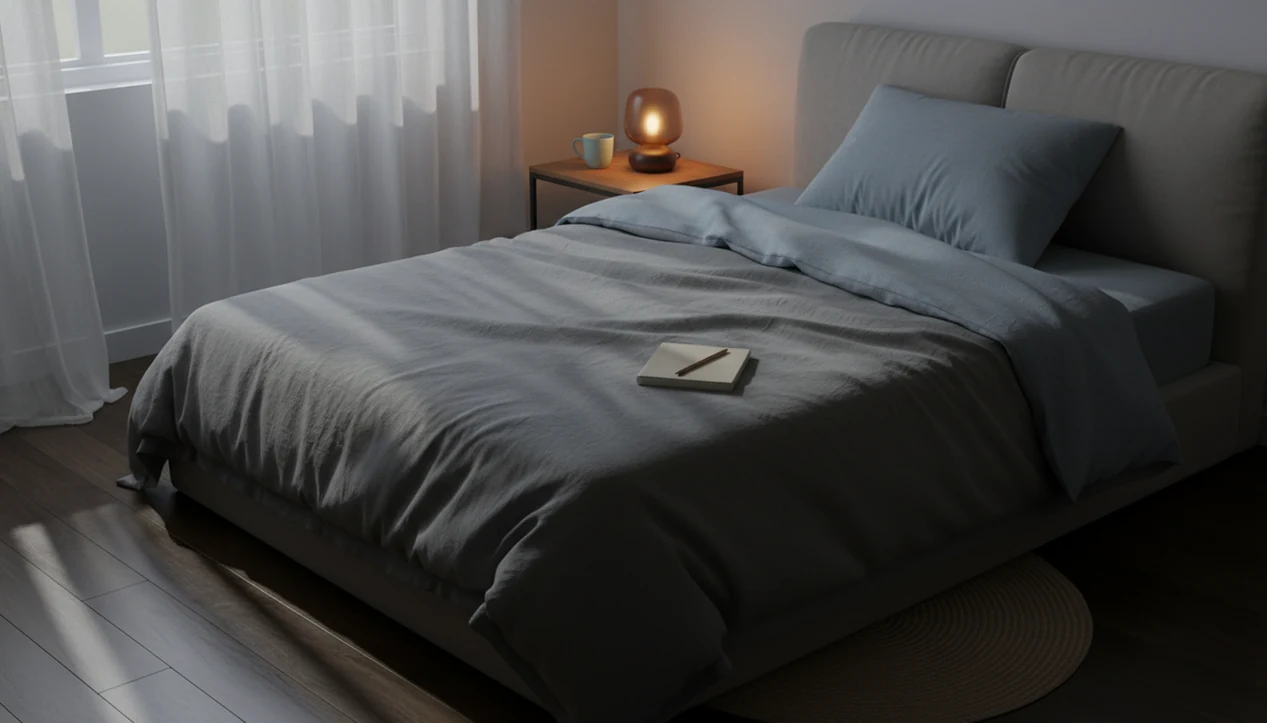
Image caption: quiet bedside mindfulness wind-down setup
A quiet bedside setup for mindfulness for restlessness at night, with low light, a water glass, and a short wind-down practice ready before sleep.
When to seek professional help for nighttime restlessness
Seek professional help when nighttime restlessness is ongoing, intense, or starting to affect your daytime mood, focus, work, driving, or relationships. Mindfulness can support a calmer wind-down, but it is not a way to diagnose or treat a sleep disorder.
Some patterns deserve more than another short practice. Sleep problems can have many causes, including possible sleep disorders, stress conditions, pain, medication effects, or breathing-related issues; symptoms alone do not prove which one is present.
- Contact a qualified clinician if sleep disruption continues for several weeks or keeps returning.
- Mention leg sensations that create an urge to move, especially if they worsen at rest or improve with movement.
- Report breathing pauses, choking or gasping, loud snoring with exhaustion, or waking with panic.
- Discuss pain, new medications, dose changes, supplements, caffeine, alcohol, or other substances that may be affecting sleep.
- Use mindfulness as supportive care while you get guidance, not as a replacement for evaluation.
If something feels severe, frightening, or unsafe, choose care first and practice later.
Nighttime Mindfulness Limits
- Mindfulness supports a bedtime routine for adults, but does not replace care, sleep basics, or medical evaluation.
- Seek medical evaluation for severe, persistent, distressing restlessness, repeated sleep loss, or symptoms worsening at rest.
- Consider medical evaluation for an urge to move your legs, described in Restless Legs Syndrome.
- Mindfulness has limits: it may not help everyone, effortful meditation can increase alertness, and breath focus can feel uncomfortable.
Mindfulness for restless nights: common questions
How do I use mindfulness when my mind races at bedtime?
Choose one anchor, such as the feeling of your body against the mattress or a steady room sound. When planning or worry takes over, briefly label it “thinking” and return. You do not need to finish the thought, clear your mind, or make yourself sleepy.
How long should I meditate when I feel restless at night?
Start with five to ten minutes as a wind-down, not a deadline for falling asleep. Use one practice rather than several in sequence. If you become more tense, alert, or frustrated, shorten the session or stop. Longer practice is not a requirement for a useful bedtime routine.
Should I meditate in bed or get up if I cannot sleep?
A brief, gentle practice in bed can fit a wind-down routine. If you are clearly awake and frustrated, get up for a quiet activity in dim light and return when sleepy. That step comes from CBT-I stimulus control, rather than mindfulness, and avoids making bed a place for repeated effort.
What can I focus on if breathing meditation makes me anxious?
Try an external sound or the contact between your body and the sheet, pillow, or mattress. Leave your breathing alone rather than changing its pace. If inward attention increases distress, stop the exercise. Persistent anxiety or distress during practice is a reason to seek professional guidance.
Can a body scan help restless legs at night?
A body scan may help you notice tension without fighting it, but it does not diagnose or treat restless legs syndrome. An urge to move your legs, especially when symptoms worsen at rest, deserves medical assessment. Do not assume that repeated leg discomfort is simply a failure to relax.
Can mindfulness treat chronic insomnia?
Mindfulness may help with sleep-related worry and distress, but evidence for treating chronic insomnia is mixed. CBT-I is the recommended first-line treatment. If sleep difficulties persist or affect daytime functioning, seek assessment rather than relying on meditation alone. Mindfulness can be a supporting practice, not a substitute for care.
Do I need to clear my mind for bedtime mindfulness to work?
No. Thoughts can remain present throughout the practice. The task is to notice them and return to your chosen anchor without arguing with yourself. Measuring success by how quickly you fall asleep can add pressure. Treat the session as a brief pause from the struggle, not a sleep test.