
Mindfulness for Overstimulation: Practical Help for Screens, Noise, and Multitasking


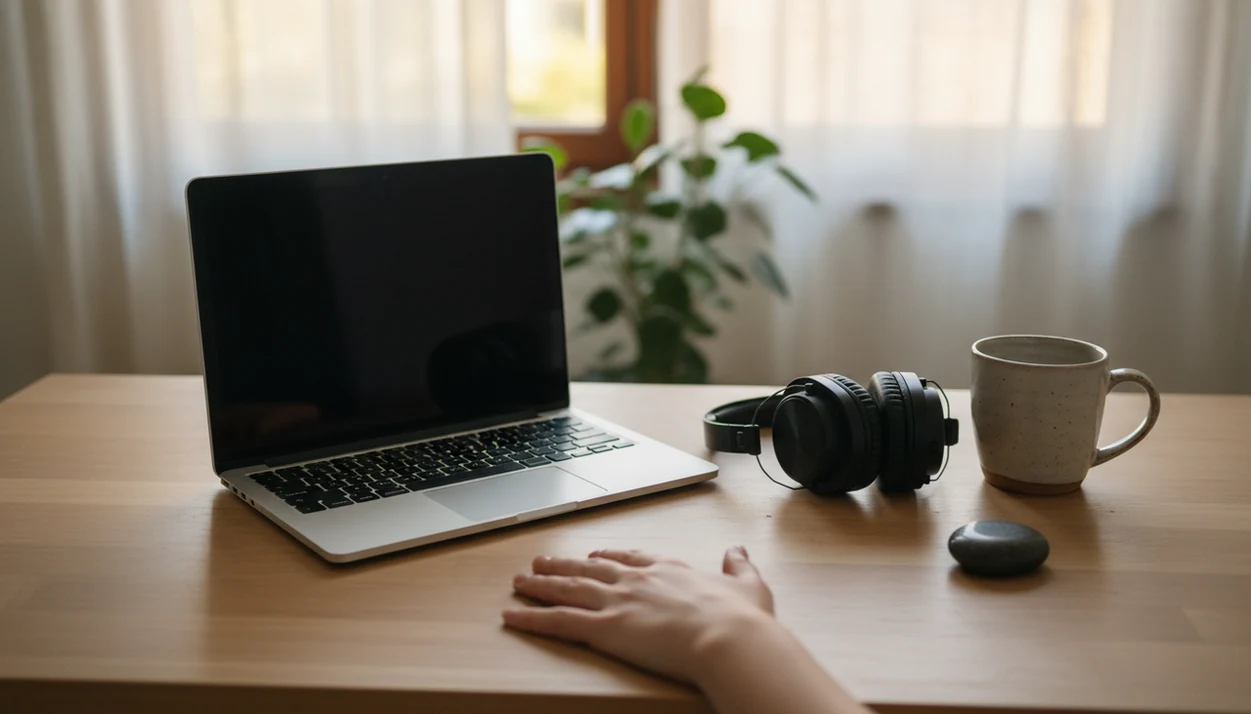
Mindfulness for overstimulation is a short, gentle practice: reduce input, choose one present-moment anchor, and return attention to it for a few moments. That anchor might be breath, touch, sound, movement, or a plain object in view. The aim is not perfect calm. It is enough steadiness to take the next step when screens, noise, or several tasks feel like too much.
Lower stimulation before trying to meditate. Dim the screen, pause notifications, step away from noise, or stop multitasking. Then try brief sensory grounding, slow movement, or a screen break. Keep your eyes open if that feels more comfortable. Sitting still and focusing on breathing are optional; walking, stretching, or noticing your feet against the floor can offer another way to practice.
What matters most
- Start by lowering stimulation before trying to meditate: dim the screen, step away from noise, pause notifications, or stop multitasking.
- Use short practices such as 3-3-3 breathing, 5-4-3-2-1 sensory grounding, slow movement, or a 20-20-20 screen break.
- If sitting still makes overload worse, use eyes-open grounding, walking, stretching, or touch-based anchors instead.
A short reset: reduce input, choose an anchor, take one step
The first move is reducing input, not forcing focus. When screens, noise, crowded spaces, multitasking, or too many open tabs feel like too much, use this sequence: pause, lower stimulation, choose one anchor, then take one next action. When seasonal gatherings intensify loss, coping with grief during holidays can include quieter plans and permission to step away.
Try it this way. Lower the brightness, pause the extra sound, or move toward a quieter edge of the room, such as a museum bench after a crowded exhibit. Then choose one anchor: the shirt sleeve brushing skin, one steady sound across the room, a slow breath, or the weight of heavy legs. Stay with it for three to five cycles.
Small counts.
Success is feeling 5 to 10% more steady, not completely calm. If you can decide whether to send the email, leave the room, drink water, or close the laptop, the practice helped. If stress makes small comforts hard to notice, try gratitude when stressed or sad without pressuring yourself to feel positive.
Signs of overload and what mindfulness can help with
- Sensory overload can show up as anxiety, sweating, dizziness, irritability, muscle tension, or a racing body state, especially when several inputs arrive at once.
- Mindfulness is a reset tool, not a cure for chronic or severe overstimulation. Recurring overload may need sleep changes, workload changes, medical care, or mental health support. For recurring overload, consider stress, sleep and mindfulness safety before increasing practice time or relying on meditation alone.
- Slow breathing, brief meditation, guided imagery, and grounding can reduce arousal by giving attention one clear place to land.
- Sensory grounding can use sight, touch, hearing, smell, and taste. A bus seat vibration under your thighs can be an anchor if breath focus feels too inward.
- Screen fatigue and multitasking often need practical changes, such as breaks, fewer context switches, larger text, and fewer open windows.
For screen-heavy workdays, mindfulness practices and meditation techniques for beginners and daily life deliver small attention resets, not a way to tolerate unlimited noise, pressure, or digital clutter.
How one anchor reduces competing attention demands
Overstimulation happens when sensory or cognitive input exceeds your current capacity to process it. Mindfulness helps by narrowing attention to one anchor, which reduces competing demands on working memory and gives the stress response fewer signals to track.
This matches cognitive-load research: working memory has limited capacity, so reducing competing inputs can make the next task easier to process (Sweller, 1988: S15516709Cog1202 4).
In plain language, you stop asking the brain to monitor everything. Breath, touch, visual focus, and movement can work as body-based or external anchors. Thumbs resting on chair arms may be easier to notice than the breath during a loud afternoon. A fixed visual point, like the edge of a doorway, can also steady attention without asking you to close your eyes.
Inward meditation may feel hard during peak overload because the body is already loud. Heartbeat, breath, and thoughts can feel amplified. For many beginners, eyes-open grounding or slow walking is easier than sitting still.
Make the space less stimulating before you practice
Lower stimulation first. Reduce noise, dim brightness, silence alerts, close extra tabs, or change rooms before you try to meditate. If closing your eyes feels unsafe or uncomfortable, keep them open and soften your gaze toward one plain object. For seasonal demands and crowded celebrations, mindfulness for holiday stress can help you plan pauses and reduce unnecessary input.
Choose one anchor before beginning. That might be a guitar pick between two fingers, one hand resting on a table, a single sound, or a slow stretch. If loss is part of your overload, mindfulness for grief offers gentle ways to stay present without forcing calm.
Don’t meditate just because it sounds more disciplined. If you are too activated to sit, use movement or environmental change instead. Walk to the hallway, loosen your shoulders, splash cool water on your face, or stand by a window. For work-specific resets, our mindfulness at work guide covers short practices that fit between meetings.
How to use sensory grounding when everything feels too much
Sensory grounding works by giving attention a clear route back to the present. Use it when the room feels too loud, the screen feels too bright, or your thoughts keep jumping between tasks.
For a more clinical framing, grounding is commonly used in trauma-informed coping skills to reconnect attention with the present environment rather than the threat response. The VA National Center for PTSD describes grounding and present-focused coping as tools for managing stress reactions (Em>Reactions.Asp).
- Pause what you can. Stop typing, lower your shoulders, and place both feet on the floor.
- Name 5 things you see, 4 things you touch, 3 things you hear, 2 things you smell, and 1 thing you taste.
- Breathe with 3-3-3 breathing: inhale for 3 seconds, hold for 3 seconds, and exhale for 3 seconds, making one 9-second cycle.
- Repeat one anchor if the full sequence feels like too much. Touch is often simple: sleeve, desk edge, chair arm, floor.
- Choose one practical next action, such as closing a tab, leaving the room, drinking water, or sending one message.
The most useful grounding method during overload is often the one you can do without explaining it to anyone.
Quiet, natural sound, or no added sound?
Adding calming audio is not automatically the best response to noise overload. A 2024 clinical study comparing natural sounds with quiet found improvements in some physiological measures, including heart rate, blood pressure, and respiratory rate, but not perceived stress. Those results do not establish one sound environment as the right choice for everyone. Reduce excessive or unpredictable noise before adding another sound.
There is also a difference between noticing a sound and trying to suppress it. In an experimental study of unpleasant emotional sound, a brief mindfulness exercise counteracted persistence problems associated with sound suppression. A practical option is to acknowledge the sound, then return to touch or breathing. That does not mean enduring excessive noise: moving away, choosing quiet, or using ear protection may be more appropriate.
Mindfulness for screen overstimulation and digital fatigue
Do screens make overstimulation worse? Yes, screens can add visual stimulation, information load, notifications, and task switching at the same time. A laptop with ten tabs open is not just one task; it is a stack of tiny attention demands.
Use the 20-20-20 rule during long screen sessions: every 20 minutes, look about 20 feet away for 20 seconds. The American Academy of Ophthalmology gives similar advice for reducing digital eye strain during computer use (Computer Usage). Add tech-free periods when possible, especially during meals or the hour before bed. Lower brightness, enlarge text, and use focus modes to reduce unnecessary input.
Mindful single-tasking is simple: one tab, one task, one timer. Counted breaths between keyboard clicks can help you notice when you have drifted into frantic switching. If focus is the main issue, mindfulness for focus may be a better starting point than longer meditation.
Less phone distraction does not always mean less phone use
A 10-day randomized trial involving 143 UK university students examined mindfulness exercises, self-monitoring, and mood tracking for smartphone distraction. Participants reported substantial improvements in distraction and related psychological outcomes. But the intervention did not reduce habitual smartphone behavior, time on social media, or fear of being without a phone. Feeling less distracted and changing device habits were separate outcomes.
The study also found that emotional self-awareness, rather than mindful attention, mediated the reduction in distraction. This suggests a useful distinction for screen overload: noticing your state matters, but attention practice alone may not change an established habit. Pair the pause with a concrete boundary, such as disabling alerts, using one app at a time, or setting a device-free interval. The findings come from students, not every population experiencing sensory overload.
Mistakes that can make grounding harder during overload
The biggest mistake is trying to force mindfulness while leaving the stressful environment unchanged. If the room is too loud, the screen is too bright, or five people are asking for answers, reduce the load first.
Do not expect an empty mind. Overwhelmed mindfulness usually means noticing the mess and returning gently, not becoming blank. Also avoid starting with long silent meditation during peak overload. Ten minutes can feel like forever when your nervous system is already braced.
Breath focus is not required. If it increases discomfort, switch to touch, sight, sound, or movement. Headphones resting on a meditation cushion do not mean you have to press play. Sometimes the better practice is standing up, stretching, and hearing one steady sound in the room.
One exercise is rarely enough for recurring overload. Patterns need patterns.
When breathing practice makes you dizzy or more alarmed
Do not respond to overload by repeatedly taking the deepest breath possible. York Hospitals guidance on hyperventilation explains that breathing faster or deeper than the body needs can lower carbon dioxide and contribute to light-headedness, tingling, chest tightness, and feelings of unreality. These sensations can increase alarm, which may lead to still more overbreathing.
When breathing is a comfortable anchor, keep it gentle and unforced. Relax your shoulders, breathe through your nose when possible, and let the exhalation be comfortable and at least as long as the inhalation. Avoid breath-holding or trying to fill your lungs maximally. NHS guidance on coping with panic supports slower, gentler breathing rather than forceful deep breaths. Switch to an external anchor if inward focus increases fear.
Do not assume that new or unusual symptoms are simply overstimulation or panic. Seek urgent medical help for severe or persistent chest pain, fainting, marked breathing difficulty, confusion, or new neurological symptoms. NHS information on panic disorder describes symptoms that overlap with medical illness. Grounding should not delay assessment, particularly when symptoms are substantially different from a familiar, previously assessed pattern.
How to know sensory grounding is helping
Sensory grounding is helping if breathing slows slightly, urgency drops, muscles soften, or the next step becomes clearer. Partial relief counts. You are looking for enough steadiness to act, not a dramatic mood shift.
Rate intensity from 1 to 10 before and after the practice. If the overload drops from 8 to 6, that is useful information. Write down which anchors helped: breath, touch, sound, movement, or visual focus. A notebook margin filled with breath counts is not fancy, but it shows a pattern.
Repeat the same short practice daily for consistency. Tools like Mindful.net can help some beginners compare short exercises, but the practical skill is still the same: notice and return. If reminders help, an app that reminds me to breathe at work can support brief pauses without turning practice into another task.
Evidence behind mindfulness for overstimulation
The evidence is strongest for brief mindfulness as a support for stress arousal, attention control, and coping, not as a stand-alone treatment for severe symptoms. In practice, the research points toward a simple order: reduce input first, then use a short anchor.
- Lower the load before practicing. Cognitive load means the brain has limited working space; fewer tabs, sounds, alerts, and choices leave more room for the next action.
- Use a brief practice, such as slow breathing, sensory grounding, or a short meditation, to give attention one clear place to return.
- Build in screen breaks when digital fatigue is part of the overload. Professional eye-health guidance commonly recommends looking away from the screen regularly, along with adjusting brightness, text size, and work setup.
- Treat grounding as supportive care. It may help you settle enough to leave a noisy room, finish one message, or ask for help, but it is not a treatment for panic, trauma symptoms, migraine, ADHD, or medical distress.
- Weigh the source type. The guidance on this page draws from academic research, clinical education, government health resources, and professional organizations, which is stronger than advice based only on personal tips.
Can a breathing timer help when everything feels too much?
After a busy screen session, a simple cue can make a brief breathing pause easier to follow. Mindful.net’s free breathing timer offers an option when breath focus feels comfortable. Keep breathing gentle rather than forcing the pace. When another screen or attention to breathing adds discomfort, put the device away and choose a touch anchor, quiet movement, or a less stimulating space instead.
Limits of Grounding Practices
- Seek professional help for severe, persistent, or recurring distress, especially when linked to a medical or mental health condition.
- Mindfulness may feel uncomfortable, and sitting still or focusing inward can worsen peak overload for some people.
- Breathing and grounding cannot fix chronic sleep loss, burnout, unsafe work demands, or constantly overstimulating environments.
- Mindfulness may help stress symptoms but should not replace needed medical care, according to the NCCIH overview.
Questions about mindfulness for overstimulation
What should I do first when I feel overstimulated?
Reduce one source of input before trying to focus. Pause notifications, stop an extra task, lower screen brightness, or move away from noise. Then choose one simple anchor, such as your feet on the floor or a plain object in view. Aim for enough steadiness to choose your next action, not complete calm.
Should I meditate if sitting still makes overload worse?
No. Sitting still is not required, and forcing it can make the practice less useful. Try walking slowly, stretching, or keeping your eyes open while noticing contact with the floor or a table. Stop or change the exercise if it increases discomfort. Reducing stimulation may help more than adding a meditation session.
Can I use grounding without focusing on my breathing?
Yes. Touch, sight, sound, and movement can all serve as anchors. Notice the pressure of your hand on a table, look at one plain object, or feel your feet as you walk. Choose something that does not add to the overload. Breath focus is optional, especially when it increases fear or bodily monitoring.
Is 5-4-3-2-1 grounding helpful for sensory overload?
The exercise asks you to identify five things you see, four you feel, three you hear, two you smell, and one you taste. It can help orient attention to the present, but it is not a universal cure. If attending to several senses feels like more input, choose one neutral anchor instead.
Does mindfulness reduce screen time or just distraction?
It may help with perceived distraction without changing phone habits. A 10-day randomized trial in university students found improvements in self-reported smartphone distraction, but not habitual smartphone behavior or social-media time. Pair mindfulness with practical changes, such as disabling alerts, using one app at a time, and planning device-free breaks.
Can deep breathing make overstimulation feel worse?
Forceful or rapid deep breathing can cause overbreathing, which may contribute to dizziness, tingling, or chest tightness. Keep breaths gentle rather than repeatedly gulping air. If breathing practice increases discomfort, stop and use an external anchor. New, severe, or unusual symptoms should not automatically be attributed to anxiety or sensory overload.
When should I get help for frequent overstimulation?
Seek assessment when overload is persistent, severe, or interferes with work, sleep, relationships, or ordinary activities. Recurrent panic, fear of another attack, or avoidance also warrants support. Mindfulness is a coping tool, not a substitute for care. Severe chest pain, fainting, or marked breathing difficulty needs urgent medical attention.