
How to Teach Mindfulness to Kids Through Play and Everyday Pauses


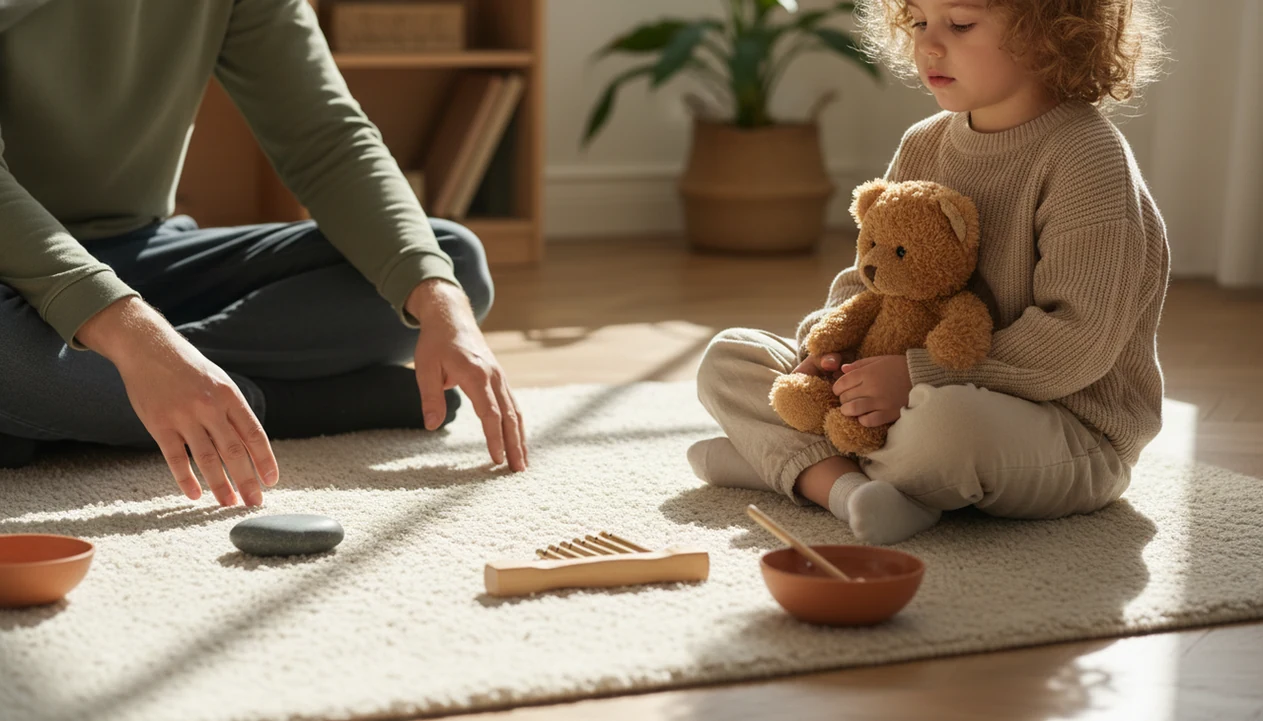
To teach mindfulness to kids, start with short, playful activities that help them notice their breath, body, senses, thoughts, and feelings without judgment. Teaching mindfulness means helping children practice kind, present-moment awareness in age-appropriate ways. A child might listen for a fading sound, feel their feet on the floor, or notice their belly moving. They do not need to sit perfectly still or stop thinking.
Begin with 1 to 3 minutes, make participation optional, and attach practice to a familiar routine such as homework, meals, or bedtime. Show the skill before asking for it: name your own feeling, pause before answering, or apologize after raising your voice. Mindfulness is a noticing skill, not a punishment or a way to make children obey.
The essentials
- Keep mindfulness short, concrete, playful, and optional for children.
- Adults teach it best by modeling pauses, breaths, and emotional naming in real moments.
- Use routines like transitions, meals, homework, and bedtime instead of relying on long formal meditation.
Child Mindfulness Skills In Daily Life
Mindfulness for children is the skill of noticing what is happening right now without judging it as good or bad. It can be taught through ordinary moments: breath, sound, movement, touch, taste, and feelings.
Kids do not need to sit perfectly still. They do not need to clear their minds. They also do not need spiritual language. A preschooler might watch a stuffed animal rise and fall during teddy bear breathing. An elementary student might listen until a bell tone disappears. A tween might name five things they see before starting homework.
Tiny counts.
For families who want guided support, tools like Mindful.net can offer secular, beginner-friendly practices alongside options such as mindful.org, Calm, and Headspace. The adult still matters most. A child usually learns more from watching you pause at a doorway than from hearing a lecture about calm.
Five starting points: brief practice, adult modeling, and choice
- Start with 1-3 minutes. Most children do better with brief practices than long meditation. A 45-second breath game on a kitchen chair is enough to begin.
- Model before you invite. Children copy adult regulation. Say, “I’m noticing my voice getting sharp, so I’m taking one breath.”
- Repeat in routines. Morning transitions, car rides, homework starts, and bedtime are easier than random lessons. A family mindfulness routine works because the cue is already there.
- Keep it secular and skills-based. Use phrases like “attention practice,” “noticing practice,” and “kind attention.” Good mindfulness practices and meditation techniques for beginners and daily life build noticing, pausing, and returning, not instant obedience or guaranteed calm.
- Offer choice when kids struggle. Restless children may prefer walking, sound, drawing, or senses-based grounding before breath focus.
Research is promising but modest. A school-based mindfulness meta-analysis found small-to-moderate effects, especially for cognitive performance and resilience (Frontiers in Psychology: Full). A later meta-analysis of youth mindfulness interventions also found small positive effects across several mental-health and cognition outcomes, with stronger evidence in some areas than others (JCPP / PMC: PMC research article).
Mindfulness For Kids In The Brain, Body, And Classroom
Mindfulness works by training attention, emotional awareness, and nervous-system settling in small repeatable moments. The basic loop is simple: notice distraction, return to an anchor, and begin again.
For a child, the anchor might be breath, sound, feet on tile, or the feeling of a crayon moving across paper. Attention training does not mean perfect focus. It means noticing, “My mind went to my lunchbox,” then returning without scolding.
Emotional awareness comes next. Children learn to name body signals before reacting: hot cheeks, tight fists, a fast heartbeat, or a heavy chest. Adults support this through co-regulation, which means lending steadiness before asking for self-control. When anger leads to harmful behavior, mindfulness skills for aggression in youth can support safer pauses alongside appropriate care.
Mindfulness is not therapy, discipline, religion, or forced quiet. It may support attention, executive function, stress skills, resilience, and prosocial behavior, according to youth mindfulness research, but it should stay practical. One breath after the classroom bell. Then math.
For safety framing, the National Center for Complementary and Integrative Health notes that meditation and mindfulness practices can be helpful for some people but should not replace conventional care when medical or mental-health support is needed: NCCIH overview
Before You Start Teaching Mindfulness To Kids
Before you teach mindfulness to kids, set up the moment so it feels safe, brief, and voluntary. The goal is not to win an argument or stop a feeling; it is to offer a small noticing skill the child can accept or leave.
- Choose a calm-enough time rather than starting during a fight, panic, or full meltdown. Practice at breakfast, before homework, after the bell, or during bedtime settling so the skill is familiar later. For older children, mindfulness for stressed teenagers offers age appropriate ways to practice without adding pressure.
- Explain the invitation clearly with language like, “This will take one minute. You can try it, watch, or pass.”
- Pick a sensory anchor first such as sound, feet on the floor, a smooth stone, or looking for one color in the room. Breath can come later, especially for children who feel anxious inside their bodies.
- Use plain secular words such as noticing, attention, listening, pausing, and feelings, so families and classrooms understand the purpose.
- Stop or switch quickly if the child gets tighter, sillier in a stressed way, tearful, or more agitated. Try movement, sight, sound, or quiet connection instead.
Six Steps For A Mindfulness Routine With Kids
Use this routine when you want a simple answer to how to teach mindfulness to kids at home or in class. Keep it short enough that the child can succeed without performing.
A good practice may look almost too small: one adult at the sink, one child at the table, both noticing three quiet breaths before homework starts.
- Choose one daily moment such as morning, a transition, homework, dinner, or bedtime.
- Set a tiny time limit of 30 seconds to 3 minutes. Use a phone timer set for 5 minutes only if the child asks for more.
- Pick one anchor such as breath, sound, movement, sight, or touch.
- Model the practice out loud before inviting participation: “I’m feeling rushed, so I’m noticing my feet on the floor.”
- Ask one simple reflection question such as, “What did you notice?”
- Repeat consistently without pressure, rewards, punishment, or public correction.
For step-by-step breathing ideas, parent and child breathing exercises can help adults keep the language simple. Mindful.net, used as a Mindfulness Practices App, can also be a quiet reference for adults planning short practices.
Mindfulness Activities For Kids By Age And Setting
The right mindfulness activity depends on age, energy level, and setting. Active kids often need movement first, anxious kids may need choice, tired kids need gentleness, and groups need clear, brief instructions. Families can adapt these activities using mindfulness for special needs families to respect each child's sensory preferences.
| Age or setting | Activity | Best fit | Simple instruction |
|---|---|---|---|
| Toddlers and preschoolers | Teddy bear belly breathing | Tired or wiggly children | “Watch the bear ride up and down.” |
| Elementary-age children | Bell listening | Groups and transitions | “Raise a finger when the sound is gone.” |
| Tweens | Five-senses grounding | Anxious or distracted kids | “Name 5 things you see, then 4 you feel.” |
| Bedtime | Short body scan | Tired children | “Notice your feet, legs, belly, and face.” |
| Transitions | Mindful walking | Active kids | “Feel each step from heel to toe.” |
| Classrooms | Mindful eating | Groups with supervision | “Notice texture, smell, and taste before swallowing.” |
Image caption suggestion: A child practices teddy bear breathing by watching a stuffed animal rise and fall on their belly.
For sleep-specific routines, bedtime meditation for children can make the practice softer and less instruction-heavy.
Adult Scripts For Modeling Mindfulness With Kids
To model mindfulness when talking to kids, name your own pause, feeling, body cue, and repair in plain language before asking the child to do anything.
Adult modeling works better than “calm down” because children can see the skill in use. Try: “I feel my shoulders getting tight, so I am taking one breath before I answer.” Or: “I’m frustrated. I’m going to put both feet on the carpet and speak more slowly.”
After a hard moment, repair matters. “I raised my voice. That probably felt scary. I’m sorry. I’m taking a breath, and then I want to hear you.”
Do not use mindfulness language to shut down feelings. “Take a breath and stop crying” teaches suppression. “Your crying tells me something feels big. I’ll breathe with you if you want” teaches support.
Simple Scripts For Parents And Teachers
- “My jaw feels tight, so I’m going to soften my face before I talk.”
- “Let’s listen for the sound in the room before we line up.”
- “I need a pause. You don’t have to join, but you can.”
- “We can feel angry and still choose safe hands.”
What research says about adult modeling
Research supports a connection between parental mindfulness and parenting behavior, but it does not prove that a single modeled pause changes a child’s behavior. A 2022 meta-analysis of mindfulness and parenting found that greater parental mindfulness was associated with more mindful and positive parenting, and less negative parenting. These are associations, not evidence that every brief exercise produces a measurable result.
Adult awareness can improve without parenting becoming less stressful. A 2021 systematic review and meta-analysis found a moderate improvement in parents’ mindfulness among nonclinical samples, but no significant overall effect on parenting stress. Model a pause as a skill children can learn, not a promise of permanent calm. Adults can still feel angry, maintain a limit, and repair a mistake.
Use mindfulness for noticing, not forced compliance
Mindfulness is a good fit when the goal is noticing, pausing, and returning. It is not a good fit when adults use it to force quiet, compliance, or emotional hiding.
| Best for | Not ideal for |
|---|---|
| ✓ Building attention through short anchors | ✕ Forcing a child to calm down on command |
| ✓ Expanding emotional vocabulary | ✕ Replacing mental health care |
| ✓ Smoothing transitions | ✕ Managing serious safety issues alone |
| ✓ Bedtime settling | ✕ Making children perform stillness |
| ✓ Everyday self-awareness | ✕ Punishing “bad” behavior with breathing |
A distressed child may need movement, sensory grounding, connection, or co-regulation before quiet breathing. That can look like wall pushes, a walk down the hall, or sitting near a trusted adult.
For children who panic easily or worry at bedtime, meditation for anxious kids should stay gentle, optional, and body-safe. In classrooms, opt-in consent matters. Families deserve transparent, secular wording.
When a child’s distress needs professional support
Seek professional help when a child’s distress feels intense, unsafe, persistent, or beyond what ordinary support can hold. Mindfulness can sit beside qualified care, but it should not replace medical, mental-health, or emergency support.
Red flags include panic that keeps returning, talk of self-harm or wanting to disappear, trauma symptoms such as flashbacks or extreme startle responses, major behavior changes, or severe sleep disruption that does not ease. Breath focus also deserves caution. For some children, being told to breathe slowly can make them feel trapped, watched, or more aware of scary body sensations.
- Pause the mindfulness exercise if the child becomes more distressed, frozen, tearful, agitated, or withdrawn.
- Move toward safety and connection first: stay nearby, use a calm voice, reduce demands, and help the child feel less alone.
- Contact a pediatrician, therapist, school counselor, or another qualified professional when symptoms are strong, repeated, or interfering with daily life.
- Use emergency services or a local crisis line right away if there is self-harm talk, immediate danger, or you cannot keep the child safe.
- Choose gentle grounding, movement, or trusted-adult presence while you arrange proper assessment.
Seven Common Mistakes In Teaching Mindfulness To Kids
- The Stillness Trap: Expecting children to sit perfectly still for long sessions often backfires. Correct it by using movement, sound, or 30-second practices.
- The Empty-Mind Myth: Telling kids to stop thoughts creates frustration. Correct it with, “Thoughts can come and go. We notice and return.”
- The Breath-Too-Soon Problem: Breath focus can feel unsafe when a child is highly dysregulated. Correct it with grounding, movement, or co-regulation first.
- The Punishment Pattern: Using mindfulness as a consequence makes it feel like discipline. Correct it by practicing during neutral times.
- The Adult-Sized Lesson: Abstract language loses younger kids quickly. Correct it with objects, senses, and playful prompts.
- The Random Routine: Inconsistent practice feels like another adult demand. Correct it by attaching mindfulness to one daily cue.
- The Performance Lens: Praising “good meditators” makes children self-conscious. Correct it by noticing effort, choice, and curiosity.
For younger children, short meditation for toddlers should feel more like a game than a lesson.
Before homework: practice a pause together
Before homework starts, an adult can model a brief pause while a child chooses to join, watch, or pass. The free breathing timer can guide the adult’s breathing without making the child follow a prescribed pace. Mindful.net’s short guided meditations offer another option for the adult. For a child who dislikes breath focus, noticing sounds or moving gently is a better starting point.
Mindfulness Limits for Children
- Mindfulness is one attention practice, not a universal solution, and research effects are generally small to moderate.
- Research in younger children and diverse populations is still developing.
- Seek professional care for significant anxiety, depression, trauma, or neurodevelopmental needs, rather than relying on mindfulness alone.
- If breath focus or body scans feel uncomfortable or triggering, try sound, sight, movement, or a trusted adult’s presence.
Teaching kids mindfulness: common questions
At what age can children start mindfulness?
Toddlers and preschoolers can begin with simple noticing games rather than formal meditation. Invite them to hear a sound, feel a soft object, or watch a stuffed animal rise and fall on their belly. Match the activity to their interest and keep it brief. Watching or declining should remain acceptable.
How long should a child practice mindfulness?
Start with 30 seconds to 3 minutes, depending on the child and the moment. One short listening game can be enough. Extend the practice only when the child wants more, rather than treating longer sessions as progress. Noticing a distraction and returning matters more than staying still until a timer ends.
How do I teach mindful breathing without forcing it?
Invite the child to notice their ordinary breathing first. A younger child might watch a stuffed animal move on their belly. Avoid demanding deep breaths or a fixed pace. If breath focus feels uncomfortable, stop and offer another anchor, such as sounds, feet on the floor, or gentle movement.
What should I do if my child refuses mindfulness?
Let them pass. Requiring participation can turn a noticing practice into a struggle over obedience. Continue modeling your own pauses without asking them to copy you. At another calm moment, offer a choice between listening, movement, or noticing something they can touch. Do not use mindfulness as a consequence.
Should I ask my child to meditate during a meltdown?
A full meltdown is not a good time to introduce meditation. Focus first on safety, connection, and the support the child can accept. Movement or sensory grounding may fit better than breath instructions. Practice mindfulness during calmer routines so the skill is familiar, rather than demanding it when distress is highest.
How do I model mindfulness when I am angry with my child?
Name your reaction without blaming the child: “My shoulders feel tight, so I’m pausing before I answer.” Keep necessary limits clear. If you raised your voice, acknowledge it and apologize before trying again. Modeling mindfulness means showing a pause and repair, not pretending that anger or conflict never happens.
Does mindfulness help children focus or behave better?
Mindfulness gives children practice noticing distraction and returning to an anchor. It should not be presented as a guaranteed behavior fix. Research on mindful parenting reports variable outcomes, and associations do not prove causation. Keep the goal concrete: noticing a sound, naming a feeling, or pausing before responding, rather than immediate compliance.
Can mindfulness replace therapy for a child with anxiety?
No. Mindfulness can sit alongside qualified care, but it should not replace treatment for significant anxiety, depression, trauma, or other clinical needs. Seek professional support for persistent panic, major behavior changes, severe sleep disruption, or self-harm talk. Some children find breath focus uncomfortable and need a different approach.