
Parent and Child Breathing Exercises for Bedtime and Everyday Pauses


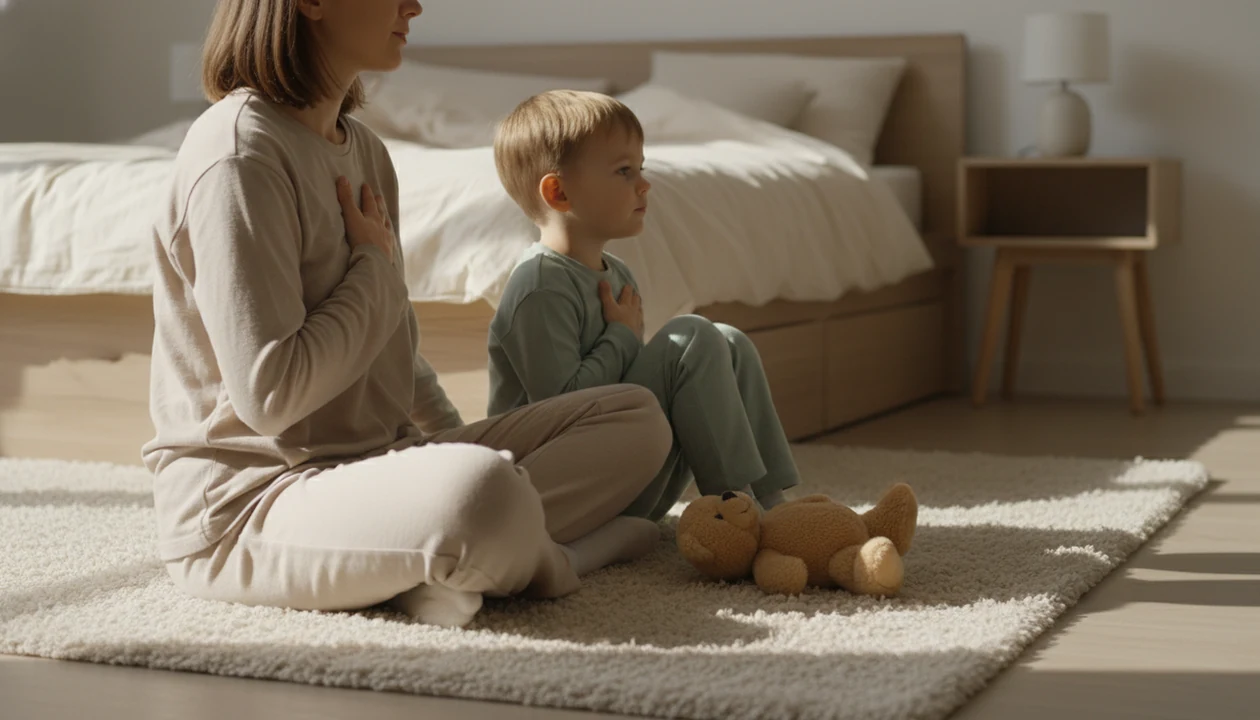
Parent and child breathing exercises are short, shared pauses that help an adult and child notice comfortable breathing, settle, and reconnect. This shared mindfulness practice supports attention, connection, and everyday emotional steadiness without demanding instant calm. Keep breaths natural and the invitation playful: “Try three breaths with me” is enough. Neither person needs to breathe deeply, hold their breath, or match the other’s pace.
Practice during calm moments, before school, between homework tasks, or at bedtime, rather than saving breathing for meltdowns. A hand on the belly, a pretend flower and candle, or counting a few ordinary breaths gives children something concrete to follow. The purpose is time together, not making a child behave.
The essentials
- Use family breathing practice during calm moments, transitions, homework breaks, or bedtime, not only during meltdowns.
- Choose simple exercises such as belly breathing, flower-and-candle breathing, counting breaths, or hand-on-heart breathing.
- Avoid long breath holds, forced deep breathing, or framing the practice as a way to make a child behave.
Start with three comfortable breaths together
Parent and child breathing exercises are short shared pauses where an adult and child sit, breathe naturally, and notice the body together. They work best when they feel like connection, not a correction.
Use them before school, after screens, during homework breaks, at bedtime, or after big feelings have softened. A parent might say, “Try this with me for three breaths,” while sitting nearby on the floor or at the edge of the bed.
The aim is not obedience. It is not precise breath control either. The aim is noticing and returning, even if the child wiggles, laughs, or tracks only one breath. Mindfulness practices and meditation techniques for beginners and daily life offer small attention skills, not instant emotional control.
How mindful breathing with children works in the body
Mindful breathing with children works by giving the body a simple, repeated cue for the relaxation response: softer muscles, steadier attention, and less stress arousal. In plain language, the breath becomes a place to land.
Children also rely on co-regulation. In simple terms, they often borrow steadiness from a nearby adult before they can find it on their own. A new mom at school pickup, warm cheeks after a walk, taking three quiet breaths while holding a recipe card in one hand, is practicing the same skill a child may later copy during a tricky transition.
Brief practice matters more than one dramatic moment. A systematic review of 33 randomized controlled trials found that mindfulness-based interventions often reduced anxiety and stress in children and adolescents (Dunning et al., 2019: PubMed research). School mindfulness research also reports psychological benefits in many studies, though results vary. One school-based mindfulness meta-analysis found the strongest effects for cognitive performance and resilience, with more mixed results across emotional and behavioral outcomes (Zenner et al., 2014: PubMed research). Adult mindfulness studies show reduced anxiety and depression symptoms too (Goyal et al., 2014: PubMed research), which supports why the parent’s own practice matters.
How to use parent and child breathing exercises safely
Use parent and child breathing exercises as a short invitation, not a command. For younger children, 30 seconds to 3 minutes is usually enough.
- Choose a calm time before the child is overwhelmed, such as after pajamas, before homework, or during a quiet car arrival.
- Sit close in a way that feels comfortable, with socked feet under a chair or knees touching on the rug.
- Use natural breath and say, “Try this with me,” instead of “Calm down right now.” If breathing through the nose feels comfortable, nasal breathing offers another gentle option for shared practice.
- Count or imagine gently with three soft breaths, a balloon belly, or a pretend candle breath without holding the breath.
- Close with noticing by asking, “What do you feel now?” or “What kind word could we say?”
Stopping is allowed. If a child feels dizzy, scared, silly, or trapped, pause the practice and return to ordinary connection.
Beginner breathing exercises for kids and parents to try first
Start with breathing exercises for kids and parents that are concrete, brief, and easy to repeat.
- Belly buddy breathing: Place a hand or stuffed animal on the belly and notice it gently rise and fall.
- Smell the flower, blow the candle: Pretend to smell a flower, then softly blow toward a candle without trying to empty the lungs.
- Five-finger breathing: Trace one hand with the other finger, breathing in while moving up and breathing out while moving down.
- Counting breaths: Count three to five natural breaths together, with no breath holds or pressure to match exactly.
- Hand-on-heart breathing: Rest one hand on the heart or chest and notice warmth, movement, or stillness.
Keep it playful. If the child turns the stuffed animal into a rocket ship, you still have a moment of shared attention. For broader age-by-age ideas, our meditation for kids guide gives a wider starting point.
Family breathing practice for bedtime and daily transitions
Family breathing practice gets easier when it belongs to a predictable routine. Children often relax into repetition because they know what comes next.
Try the same tiny script before school, after screens, before homework, when the car parks, or during bedtime. At night, a parent might sit on the floor beside the bed and say, “Three soft belly breaths, then one thing we noticed today.” The hallway noise may still be there. That is normal. For evenings when rest is the goal, breathing for sleep offers gentle methods to support a quiet bedtime routine.
Use breathing as prevention and connection, not crisis control. If the only time a child hears “take a breath” is during conflict, the phrase can start to feel like criticism. A simple family mindfulness routine can help make breathing feel ordinary.
Image caption idea: Parent and child sitting together with hands on belly during parent and child breathing exercises.
Choose calm practice, not a discipline moment
Parent-child breath meditation fits calm practice, bedtime wind-down, and everyday transitions better than high-pressure discipline moments. It is a support tool, not a behavior-control shortcut.
| Situation | Best fit | Not ideal for |
|---|---|---|
| Calm practice | Learning the skill when everyone is regulated | Introducing it for the first time mid-meltdown |
| Bedtime wind-down | Repeating one familiar breath script | Promising it will make every child sleep |
| Transitions | Moving from screens, school, or car rides | Rushing a child through feelings |
| Shared connection | Sitting close and modeling steadiness | Forcing compliance or silence |
| Mild everyday stress | Pausing after homework frustration | Replacing therapy or clinical care |
Children with asthma, cardiac concerns, trauma histories, panic symptoms, or respiratory distress may need modifications or clinician guidance. For sleep-specific routines, bedtime meditation for children may be a better fit than breath focus alone.
What matters more than a perfect breath count
- Shared breathing can support the body’s calming response by pairing attention, slower pacing, and softer body cues.
- Simple imaginative breaths are usually more child-friendly than complex breath ratios, long counts, or strict posture rules.
- The adult’s modeling is part of the practice; children notice tone of voice, facial softness, and whether the adult is rushing.
- Short regular practice matters more than one perfect session, especially for younger children who are still building attention skills. As children grow older, mindful breathing for teens can offer age appropriate ways to practice with more independence.
- Mindfulness research supports stress and anxiety benefits for many children and adults, but it does not show that breathing games cure mental health conditions.
For example, a randomized trial of a school mindfulness program found improvements in children’s executive function, stress physiology, and prosocial behavior compared with controls (Schonert-Reichl et al., 2015: PubMed research). A review of 33 randomized controlled trials found small but meaningful benefits for youth mindfulness interventions, especially for stress, anxiety, depression, and negative behavior outcomes (Dunning et al., 2019: PubMed research). For families seeking extra emotional support, meditation for anxious kids covers gentle options and limits.
What adult breathing research can tell families
Much of the breathing research summarized here concerns adults, not parent-child practice. A meta-analysis of 12 randomized trials involving 785 adults found small-to-moderate improvements in self-reported stress, anxiety, and depression compared with non-breathwork controls. Those findings do not establish how much a brief family exercise will help a particular child.
Study routines also differ from a few playful breaths at bedtime. Reviews commonly examine slow-paced breathing and repeated practice, but adult timing targets should not become rules for children. Keep family practice brief, concrete, and non-competitive. Judge the exercise by comfortable participation, not by a precise pace or an immediate change in behavior.
A 90-second parent-child meditation breathing script
Can you use a 90-second parent-child meditation breathing script right now? Yes, if both people are comfortable and the child can stop at any time.
“Sit close to me, or sit in your own spot. Let your body be supported by the chair, bed, or floor. If you want, place one hand on your belly or one hand on your heart.
Notice one breath coming in. No need to make it big. Notice one breath going out.
Imagine your belly is a soft balloon. It may move a little as air comes in, then soften as air goes out. Now pretend there is a small candle in front of you. Blow toward it gently, just enough to make the flame wiggle.
Let’s take three easy breaths together. One in, one out. Two in, two out. Three in, three out.
Now notice one feeling in your body. Quiet, wiggly, tired, warm, anything counts. To finish, say one kind word to yourself or to each other.”
The silence after the final chime can feel surprisingly long.
At bedtime: leave the breath count to your child
Before bedtime, a short shared pause can stay simple: sit nearby and notice a few comfortable breaths. Mindful.net’s app includes breathing exercises and a meditation timer; the site’s free meditation timer can also mark a brief practice without setting a breathing pace. A parent’s quiet invitation is a better fit when recorded instructions or timing distract the child. Neither tool is medical treatment.
Shared Breathing Limits
- For health concerns, seek professional care, as shared breathing cannot replace medical care or mental health treatment.
- Avoid long breath holds, very slow counts, forced deep breathing, or pressure to get breathing right.
- If breath focus increases anxiety, consider calm down meditation for kids instead of breath counting.
- During panic, shutdown, or a meltdown, connection and safety may need to come before breathing instructions.
Parent and child breathing questions
What age can children start breathing exercises with a parent?
Start when a child can join a simple invitation, rather than aiming for a particular birthday. Try noticing the belly move or pretending to smell a flower and gently blow toward a candle. Keep it brief and optional. A child does not need to count accurately or sit perfectly still.
How long should parent and child breathing exercises last?
For younger children, 30 seconds to 3 minutes is usually enough. Start with three comfortable breaths and stop sooner if the child loses interest or feels uncomfortable. Adult research routines can be longer, but those durations are not a requirement for a shared family pause.
Should I tell my child to take deep breaths?
Ask for gentle, comfortable breaths rather than the biggest possible breath. Rapid or excessively large breaths can cause dizziness, tingling, or panic-like sensations. Avoid long breath holds and strict counts. Stop the exercise if discomfort increases, and seek medical care for severe or unexplained breathing symptoms.
Can breathing exercises help during a child's meltdown?
A meltdown is not the best time to introduce a new breathing exercise. Connection and safety may need to come first. Stay nearby if that feels comfortable for the child, and avoid repeated instructions or corrections. Offer a familiar exercise after the strongest feelings have softened, without requiring participation.
What should I do if my child refuses to breathe with me?
Accept the refusal. Shared breathing works best as an invitation, not a condition for comfort or approval. You can model a few relaxed breaths without asking the child to copy you. Try again during a calm moment, or choose another quiet way to spend time together.
Can parent and child breathing exercises help at bedtime?
A familiar breathing script can be part of bedtime wind-down, but it cannot promise sleep. Try a few soft belly breaths together without asking the child to force relaxation. Persistent sleep problems need attention beyond breathing practice, especially when there may be a medical cause.
Do my child and I need to breathe at the same speed?
No. Sit together and let each person breathe at a comfortable pace. You can count a few breaths or trace fingers without insisting on exact matching. The adult’s role is to model relaxed breathing and a gentle tone, not to keep correcting the child’s rhythm.