
Teen Sleep Meditation: Short Practices for Bedtime Wind-Down


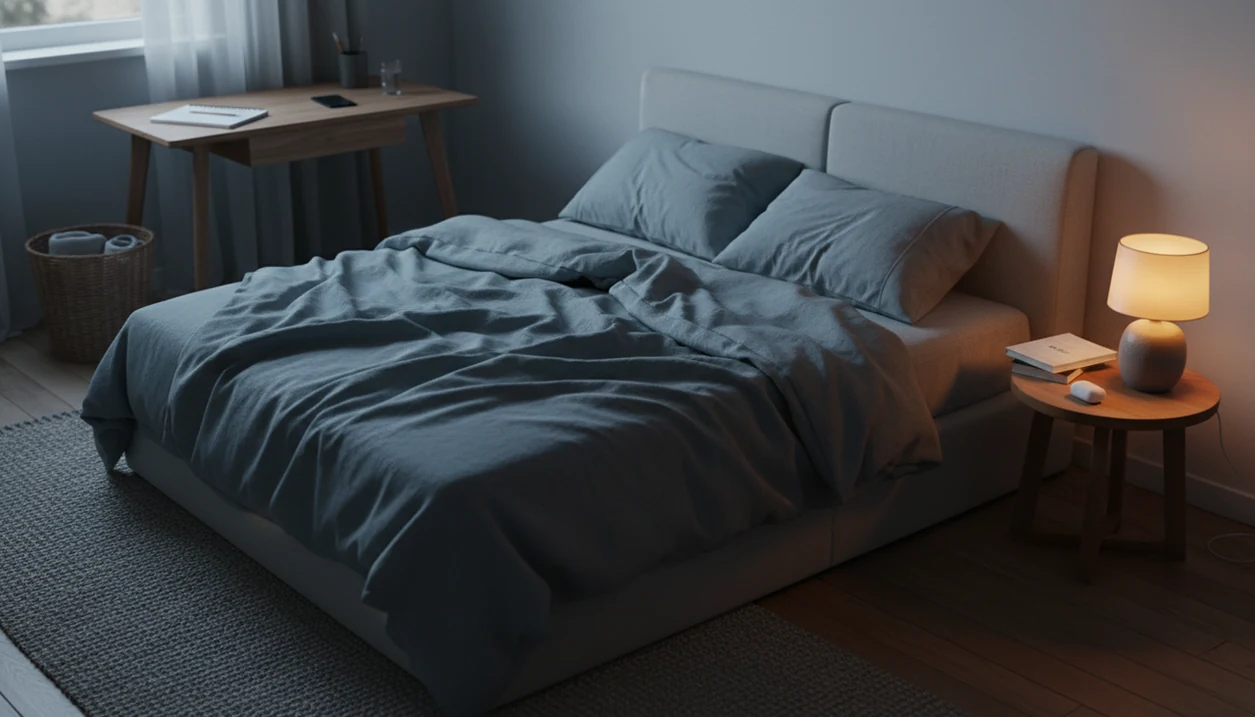
Teen sleep meditation is a short, secular bedtime practice that uses breathing, body scanning, imagery, or guided audio to help a teen settle before sleep. It gives attention a simple place to rest as the day ends. The purpose is a calmer wind-down, not forced sleep or treatment for insomnia, anxiety, or another sleep disorder.
Start with 3 to 10 minutes rather than a long session. Count a few breaths, notice the body resting on the mattress, or follow a brief recording. Pair the practice with dim lights, a predictable bedtime routine, and a plan for putting the phone away. Busy thoughts do not mean the practice has failed.
The essentials
- Keep teen bedtime meditation short: 3 to 10 minutes is often easier to repeat than a long session.
- Use breath counting, a body scan, guided imagery, or a simple phrase when thoughts feel busy.
- Pair meditation with dim lights, phone boundaries, and a predictable bedtime routine to make wind-down easier to repeat.
A bedtime attention practice, not a sleep test
Teen sleep meditation is a practical bedtime attention practice, not a way to force sleep. The aim is to give the mind one simple place to rest while the body gets a clearer signal that the day is ending.
Common options include breath focus, a short body scan, safe-place imagery, and guided audio. A teen might notice tight calves against the mattress, count five slow breaths, or listen to plain instructions through headphones before putting the phone away.
This is secular practice. It does not require spiritual belief, therapy language, or a perfect mood. For broader age guidance, families may also compare it with meditation for teens.
At bedtime, a teen can practice returning attention to a simple focus, but that skill does not guarantee sleep, symptom relief, or a particular bedtime outcome.
Making room for rest after homework and phone use
Teen sleep meditation can help create a transition between stimulation and rest. It is not about blaming teens for being online, busy, athletic, social, or stressed.
- Teens ages 13 to 18 are recommended to get 8 to 10 hours of sleep per 24 hours, according to the American Academy of Sleep Medicine Jcsm.5866.
- In a 2019 CDC report, only 22.8% of U.S. high school students got 8 or more hours on an average school night CDC guidance.
- Homework momentum can keep the brain in problem-solving mode long after the backpack is closed.
- Sports, group chats, social notifications, and late-night scrolling can make bedtime feel like a hard stop instead of a gradual landing.
The pause matters.
A three-minute breathing practice after homework can feel more realistic than a full routine. It gives the teen a bridge from “still on” to “done for now.”
How breath, attention, and bedtime cues work together
Teen sleep meditation works by giving attention a simple anchor and repeating cues that fit bedtime. The anchor might be breath, body sensations, sound, or imagery.
This is how teen sleep meditation works: attention anchoring gives the mind a place to land, and repeated bedtime cues help the body downshift from alert activity toward rest. Slower breathing, dimmer input, and familiar instructions can support a calmer pre-sleep rhythm.
Thoughts will wander. A teen may begin with the breath and drift into a hallway conversation, a half-finished assignment, or tomorrow’s quiz.
Across studies, mindfulness-based interventions have been associated with improved sleep quality, though effects vary by population and format. A 2019 systematic review and meta-analysis of randomized trials found mindfulness meditation was associated with improved sleep quality, while noting variation in study quality and intervention design PubMed research. That evidence supports careful language. Meditation may help some teens wind down, but it should not be described as changing melatonin on command or curing insomnia.
What sleep research can and cannot tell teens
Research supports a cautious distinction between feeling more settled and treating insomnia. A 2019 review of 18 randomized trials found that mindfulness meditation improved sleep quality more than nonspecific active controls, but did not outperform specific treatments such as CBT-I or exercise. The evidence had limitations, and these results do not establish how much a brief bedtime recording will help an individual teen.
Chronic insomnia needs a different level of care from ordinary bedtime restlessness. Clinical guidance summarized by NCCIH recommends cognitive behavioral therapy for insomnia, or CBT-I, as first-line treatment for adults, with insufficient evidence to recommend mindfulness alone. Teen care also needs attention to sleep timing, school demands, evening technology use, and mental health, rather than simply applying an adult meditation routine.
Teen Bedtime Meditation Routine: 5 Steps for Tonight
A teen bedtime meditation routine should be short, repeatable, and easy to start even when the night has already gotten late. For beginners, 3 to 10 minutes is usually enough.
- Choose a 3-to-10-minute practice before getting into bed.
- Set the audio, timer, or script first, then place the phone away from the bed.
- Lower the lights and let the room get boring on purpose.
- Rest attention on the breath, body, sound, or a simple phrase. For teens who prefer an external focus, nature sounds for sleep can offer familiar background audio during bedtime practice.
- Return gently when thoughts wander, without arguing with them.
- Count the practice as wind-down, even if sleep does not come right away.
A simple place to try it is wherever the evening routine naturally pauses: leaning against a dresser, sitting on a rug, or standing while a cotton sleeve brushes the wrist. One slow exhale, one small release in the hands. That is enough structure for tonight.
Families building a shared routine can adapt this into a family mindfulness routine without making bedtime feel like a performance.
Guided Meditation for Teen Sleep: Four Script Options
Guided meditation for teen sleep can help when silence makes thoughts feel louder. The useful script is usually plain, brief, and low-pressure. For teens who prefer steady background audio, rain sounds for sleep meditation can accompany a brief bedtime practice.
5-Breath Reset
Use this when the phone just went away or the mind still feels wired. Try: “Breathe in and count one. Breathe out and let your shoulders soften.” Repeat through five breaths.
Short Body Scan
Use this for body restlessness after sports, long sitting, or homework. Try: “Notice your forehead. Notice your cheeks. Feel the back of the body supported, and let your fingers soften if they are still buzzing with energy.”
Safe-Place Imagery
Use this after an emotional day. Try: “Picture a place where nothing needs to be fixed tonight. Add one sound, one color, and one steady breath.” If imagining a peaceful shoreline feels comforting, ocean sounds for sleep can provide a simple background for winding down.
Calming Phrase Practice
Use this when thoughts repeat. Try: “For now, I can pause.” Or: “This day is done enough.”
Short scripts often work better than long ones because they do not feel like more homework. For younger siblings, bedtime meditation for children may need simpler language and more parent support.
Choose a practice for tonight’s bedtime difficulty
The best sleep meditation for teens depends on what is making bedtime hard that night. Preference matters, and teens can switch styles without starting over.
| situation | best practice | why it helps | try this |
|---|---|---|---|
| Phone transition | Breath counting | Gives the brain a simple replacement for scrolling | Count five slow exhales |
| Busy school thoughts | Note-labeling | Names thoughts without chasing each one | Say “planning,” “worrying,” or “remembering” |
| Body restlessness | Body scan | Moves attention through physical sensations | Notice feet, legs, back, shoulders, face |
| Emotional day | Imagery | Offers a gentler focus than analysis | Picture a quiet bus seat, room, or field |
| Boredom with meditation | Shorter practices | Reduces resistance and keeps the habit possible | Try 90 seconds, then stop |
Best for: teens who want a low-pressure wind-down tool. Not ideal for: teens who need medical, counseling, or sleep-disorder evaluation.
For restless bodies, a body scan is often easier than silent sitting because it gives attention a clear sequence.
Mindfulness Before Bed for Teens and Phone Transitions
Does mindfulness before bed for teens mean no phone at all? Not always. A realistic phone transition is usually more useful than a strict lecture that turns bedtime into a debate.
Choose the audio before getting into bed. Lower brightness, turn on Do Not Disturb, press play, then place the phone across the room or on a dresser. Meditation should not become another reason to scroll through one more clip, message, or playlist.
Image caption idea: A teen places a phone on a dresser while starting a short guided sleep meditation.
Parents can help by reducing negotiation. The agreement might be simple: pick the audio, start the practice, phone stays out of reach. No speech needed at 10:45 p.m. Mothers sharing the evening routine may also find mindfulness for women's sleep useful for their own bedtime practice.
For younger kids who need help settling after big feelings, calm down meditation for kids uses a different pace.
Teen Bedtime Meditation Boundaries: Best Fits and Warning Signs
Teen bedtime meditation fits ordinary wind-down problems, but it should not be treated as medical care. The boundary is simple: use it for settling, not for diagnosing or managing serious symptoms alone.
| Best fits | Not for |
|---|---|
| Ordinary bedtime restlessness | Diagnosing insomnia |
| Post-homework wind-down | Treating anxiety |
| Screen transition | Replacing medical care |
| Mild busy thoughts | Addressing sleep apnea symptoms |
| Building a repeatable routine | Managing severe distress alone |
A teen should talk with a parent, clinician, counselor, or trusted adult when sleep problems are persistent, worsening, or affecting school, mood, driving safety, relationships, or daytime functioning.
Red flags include loud regular snoring, gasping during sleep, falling asleep while driving, panic at bedtime, or sleep loss that continues for weeks. In those cases, meditation can stay in the routine, but it should not be the only plan.
Keep the tone steady. Needing more support does not mean the teen failed at meditation. It means the problem may need a wider plan than a bedtime audio track. Mindful.net treats sleep meditation as educational support, not clinical treatment.
Sound options for teens who dislike silence
When silence makes bedtime thoughts feel louder, a teen can try the free white noise and ambient sound player as an external focus. The Mindful.net app also offers short guided meditations and sleep audio for those who prefer spoken guidance. Neither is a medical treatment. Persistent sleep problems need assessment, and a quiet room may suit teens who find audio distracting.
Teen Sleep Meditation Limits
- Seek professional help for sleep disorders such as insomnia, sleep apnea, or restless legs, which meditation does not reliably treat.
- Results can be gradual, inconsistent, or subtle, especially at first.
- Silence, body awareness, or inward focus can feel uncomfortable, while long scripts may feel boring or like homework.
- If inward focus increases agitation, adjust rather than force the practice, trying shorter sessions, quiet music, or trusted adult support.
Teen sleep meditation questions
Does meditation help teens fall asleep?
Meditation may help a teen settle busy thoughts and reduce the struggle around bedtime, but it does not guarantee faster sleep. Research on mindfulness and sleep has mixed results, especially for chronic insomnia. Treat a short practice as wind-down, not a test of how quickly sleep follows.
How long should a teen meditate before bed?
Start with 3 to 10 minutes. A brief practice is easier to repeat and less likely to feel like another assignment. Five breaths or a short body scan can be enough for a first attempt. There is no need to extend the session because sleep has not arrived.
What is the best sleep meditation for a teen with racing thoughts?
Try briefly naming the thought, such as “planning,” “worrying,” or “remembering,” then return to breathing or a spoken instruction. The aim is not to finish every thought or clear the mind. A short guided recording may suit teens who find silence makes their thoughts feel louder.
Can teens listen to sleep meditation on a phone?
Yes, a phone can play guided audio without becoming part of another scrolling session. Choose the recording before bed, lower brightness, turn on Do Not Disturb, and put the phone on a dresser or across the room after pressing play. Agree on the phone plan before bedtime rather than debating it then.
Should a teen stop meditating if it makes them anxious?
Stop or shorten the practice if inward attention increases anxiety or distress. Try keeping the eyes open, noticing sounds in the room, or using quiet music instead. A teen does not need to push through discomfort. Persistent or intense distress is a reason to involve a trusted adult or clinician.
Can sleep meditation treat teen insomnia?
A bedtime meditation is not a treatment for diagnosed insomnia. Persistent difficulty falling asleep or staying asleep deserves assessment, particularly when it affects daytime functioning. A clinician can consider sleep timing, anxiety, depression, school demands, and other causes, then recommend care suited to the teen.
How can parents help without making meditation another bedtime argument?
Offer a choice between a few short practices, including the option not to meditate. Agree on lights, audio, and phone placement earlier in the evening. Keep the goal concrete: a quieter transition to bed. Avoid judging the session by immediate sleep or requiring the teen to report feeling calm.