
Calm Down Meditation for Kids: A Parent Script and Gentle Options


Calm down meditation for kids is a brief, parent-led practice that uses breathing, body cues, senses, or gentle movement to help a child feel more settled. This secular mindfulness routine gives children something concrete to notice, such as their feet on the floor or a sound nearby. Keep it optional and age-appropriate, with no requirement to sit still or close their eyes.
Start with one to three minutes for younger children. Ask, “Would you like to try this with me?” and offer a choice between breathing, listening, or movement. Practice together during ordinary moments, not only after big feelings. Meditation is not punishment, a demand to stop crying, or a substitute for professional support.
Definition: A children calm down practice is a brief, secular mindfulness routine that helps a child notice breath, body, and surroundings with safe, concrete prompts.
The essentials
- Start with 1 to 3 minutes for younger children and use simple words like “feel your feet” or “breathe out slowly.”
- Offer choices: eyes open or closed, sitting or lying down, breathing or movement.
- Use calm-down meditation as a skill to practice together, not as a demand to stop crying, obey, or act differently.
A two-minute calming script to read together
“Would you like to try this with me?” is the safest way to begin a short meditation for kids. The goal is not instant quiet. It is shared settling.
2-minute kids calming meditation script
Try reading this slowly:
“Sit next to me, or lie down if that feels better. Your eyes can stay open. You can wiggle a little if your body needs to. If you are expecting and adjusting your own position, third trimester meditation offers comfort tips for your practice.
Feel your feet on the floor, the rug, or the bed. Let your hands rest somewhere easy. Maybe on your legs, maybe by your sides.
Take one breath in through your nose, if that feels okay. Now breathe out slowly, like you are fogging a windowpane.
Let’s do two more. In. Out. No need to make it perfect.
Now look around and find one thing that is still. A wall, a chair, a stuffed animal. Let your body be here with me.
We’re done. You can stretch, talk, or stay quiet.”
For more general setup ideas, the broader meditation for kids guide covers age, timing, and family expectations.
How breath, senses, and a steady adult help
Kids calming meditation works by giving attention a simple place to land: breath, feet, hands, sound, or a nearby object. Slow breathing, body awareness, and sensory attention can shift focus away from racing thoughts, but they do not force relaxation on command.
The adult matters too. Co-regulation means a child often borrows steadiness from a calm voice, predictable pacing, and safe body language. A parent sitting nearby on the carpet can matter more than the exact words. This reflects co-regulation: children often rely on a steady adult nervous system while learning to manage big emotions Resilience. Expectant parents can also try pregnancy meditation for partners to practice steady, supportive presence together before their baby arrives.
Small cues help.
Research on meditation often measures outcomes after repeated practice over weeks, not one upset moment. A 2023 NIH/NCCIH overview notes that many meditation studies use 8 to 12 weeks of practice when measuring outcomes. NCCIH overview. That matters because a child who stays restless today has not “failed” meditation.
For this page, success means your child can name one body cue, return to one sound, or recover a little faster after the hard moment, not become instantly quiet.
What research says about attention and stress
Research supports cautious expectations, not promises of instant calm. A 2018 review of randomized trials in children and adolescents found small benefits for attention, executive functioning, anxiety or stress, and behavior compared with inactive controls. Against active comparison activities, significant benefits were mainly limited to mindfulness, depression, and anxiety or stress.
These findings concern mindfulness programs, not proof that a two-minute parent script will stop a tantrum. A 2022 critical review of attention-training research found promising meditation results but very weak evidence of benefits extending to broader cognition, behavior, or academic achievement. Evidence for effectiveness in very young children is also insufficient, according to a 2019 review of early-childhood mindfulness interventions.
Introduce calming practice during ordinary routines
A children calm down practice works better when it is introduced before the biggest meltdown. Teach it during ordinary moments first, such as before homework, after screens, or during a quiet minute on a kitchen chair. For parents expecting another baby, second trimester meditation offers safe basics for their own practice during this stage.
Parent-led calm-down steps
- Choose a low-pressure spot. Use a couch, floor cushion, bus seat, or bedroom corner, but do not make the space feel like a consequence.
- Offer two choices. Ask, “Do you want breathing, listening, or stretching?”
- Start before distress peaks. Practice when your child is mildly tired, bored, or wound up, not only when everyone is already upset.
- Guide one simple cue. Say, “Feel your feet,” “notice one sound,” or “stretch your arms up.”
- Stop while it is still tolerable. One minute that ends well is more useful than five minutes of resistance.
- Ask what helped. Try, “Was any part of that okay?” rather than grading calmness.
For families who want a repeatable weekly rhythm, a family mindfulness routine can make practice feel normal instead of urgent.
Add a brief settling practice without delaying bedtime
At bedtime, keep the order predictable: dim the lights, finish screens and stimulating play, then read or cuddle. Offer one to three minutes of breathing or sensory noticing only if your child wants it. The American Academy of Pediatrics' parent guidance recommends including deep breathing in bedtime routines. Try, “Notice your belly going up and down,” without asking for bigger breaths.
End the practice rather than extending bedtime to get it right. Meditation should not reduce the time available for sleep. A 2022 review of 45 childhood sleep-intervention trials found an average increase of 10.5 minutes of nighttime sleep; interventions that included earlier bedtimes were associated with about 47 additional minutes. Those findings concern sleep interventions, not meditation alone.
Choose prompts and practice lengths by age
Younger children usually need shorter, more sensory prompts, while older children can handle slightly longer guided practice. HealthyChildren.org says preschoolers may practice meditation for a few minutes per day, and grade-school children may try 3 to 10 minutes twice a day Just Breathe The Importance Of Meditation Breaks For Kids.As.
Age-based calm-down meditation table
| Child or situation | Useful length | Better starting point | What to say |
|---|---|---|---|
| Preschoolers | A few minutes | Senses and pretend play | “Can you feel your socks?” |
| Grade-school children | 3 to 10 minutes | Breath plus body cues | “Breathe out slower than you breathe in.” |
| Active children | 1 to 5 minutes | Movement first | “Push your feet down, then let go.” |
| Bedtime | 2 to 8 minutes | Soft voice and body scan | “Let your shoulders get heavy.” |
| Overwhelmed children | 30 seconds to 2 minutes | Grounding, not deep focus | “Name three things you can see.” |
Active children may need stretching, wall pushes, or slow walking before still breathing. The transition is the practice. Not the sitting.
Five breathing prompts to offer your child
Mindful breathing for kids should sound like something a parent would actually say at bedtime or in the car. These prompts are simple, brief, and optional.
- Balloon belly: “Put one hand on your belly. See if it moves out a little as you breathe in, like a small balloon.”
- Candle breath: “Pretend there is a candle in front of you. Breathe out gently enough to make the flame wiggle, not blow it out.”
- Hand tracing: “Use one finger to trace up and down the fingers of your other hand. Breathe in going up, breathe out down.”
- Animal breath: “Pick an animal. Maybe a sleepy bear breath, a bunny sniff, or a slow turtle breath.”
- Soft sigh: “Take a normal breath in. Let the out-breath fall out with a quiet sigh.”
For children who dislike breath focus, use sound, touch, or looking around the room instead. For a fuller set of paired exercises, try parent and child breathing exercises.
Movement and sensory practices without sitting still
Stillness is not required for a valid children calm down practice. Some children settle better when the practice starts with muscles, sight, sound, or temperature before moving toward breath.
Movement-first calm-down script
Try this progression: “Push your feet into the floor for three seconds. Let go. Stretch your arms up, then drop them. Notice one sound in the room. Now take one easy breath.”
That is meditation enough.
Five-senses grounding script
Use concrete sensory anchors:
- Sight: “Find two blue things.”
- Touch: “Feel the chair under your legs.”
- Sound: “Listen for the farthest sound.”
- Temperature: “Notice if the air feels cool or warm on your face.”
- Movement: “Rock slowly once, then pause.”
Stop if inward focus seems distressing. Some children feel worse when asked to scan their body or close their eyes.
Suitable moments and signs to stop
Short meditation for kids is best used as a supportive settling skill, not a behavior-management shortcut. It can help create a pause, but it should not replace connection, sleep, food, safety, or professional care.
Best uses for kids calming meditation
| Best for | Why it can fit |
|---|---|
| Transitions | Gives the child a predictable pause before the next task |
| Bedtime wind-down | Pairs well with dim light and a slower voice |
| Waiting rooms | Offers something quiet to do with body and senses |
| After screen time | Helps shift attention back to the room |
| Pre-homework reset | Creates a short break before effort |
Not-for uses and red flags
| Not for | Safer response |
|---|---|
| Punishment | Repair, limits, and connection |
| Forced silence | Offer choice and space |
| Stopping all tears | Let feelings exist |
| Replacing therapy | Seek qualified support |
| Safety crises | Get immediate help |
The CDC reported serious youth mental health concerns in 2021, including 42% of high school students feeling persistently sad or hopeless and 22% seriously considering suicide CDC guidance. Those numbers are context for taking distress seriously, not proof that meditation treats it.
When to Seek Professional Support
Seek professional support when a child’s distress is persistent, intense, or interfering with sleep, school, relationships, or daily life. Meditation can be a helpful coping skill, but it is not treatment for anxiety, depression, trauma, sleep disorders, or safety crises. If you are also managing worry while expecting, pregnancy anxiety meditation offers gentle support alongside appropriate professional care.
If your child talks about self-harm, wanting to die, being unable to stay safe, or hurting someone else, treat that as urgent. Use emergency services, a local crisis line, or the crisis resources available in your country or region.
- Notice patterns. Watch for ongoing worry, sadness, nightmares, panic, avoidance, irritability, shutdown, or behavior changes after a stressful or traumatic event.
- Ask for guidance. Contact your child’s pediatrician, a licensed therapist, or a school counselor and describe what you are seeing without minimizing it.
- Use meditation gently. Keep calm-down practice optional and supportive while you arrange care; do not present it as the fix.
- Find local crisis help. Save the phone number or text line used where you live, especially if your child has mentioned self-harm or immediate danger.
- Stay close during risk. Remove obvious hazards when possible and keep a steady adult present until qualified help is involved.
Words that offer comfort without demanding calm
Parent language shapes whether meditation feels safe or controlling. Use warm, choice-based phrases such as, “Do you want to try breathing with me?” and “You can keep your eyes open.” If you are expecting, pregnancy affirmations meditation offers another way to practice gentle, reassuring language for yourself.
Avoid lines like “calm down right now,” “stop crying,” or “this will fix it.” They put pressure on the child to perform calmness. Most children notice that pressure fast.
Tone matters more than fancy wording. A child may copy your slower shoulders before they copy your breathing words. A slower voice, a little space, and sitting nearby can make the practice feel like help instead of correction. If your child is anxious often, meditation for anxious kids should be paired with careful attention to patterns, triggers, and support needs.
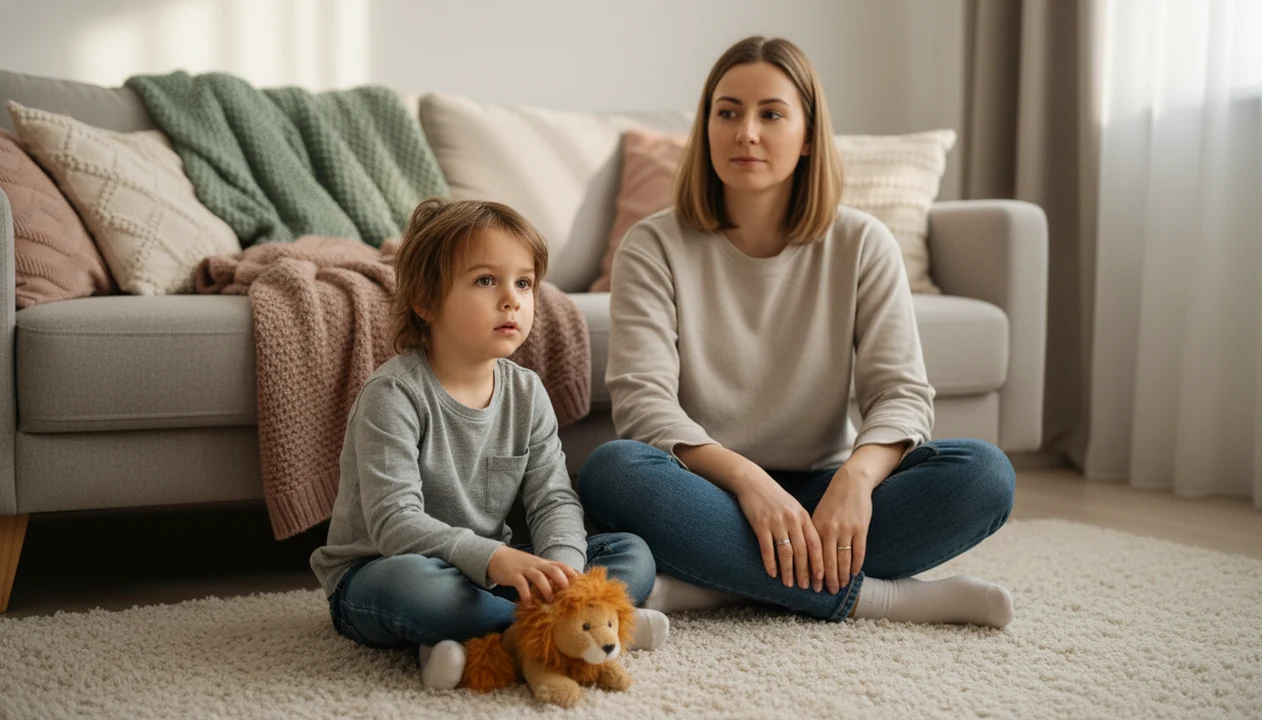
Image caption: parent and child breathing together
Image caption suggestion: A parent and child trying calm down meditation for kids with eyes open, relaxed posture, and a short shared breathing pause.
Avoid forced stillness, closed eyes, and calmness
Requiring a child to sit still, stop crying, or finish the practice turns meditation into pressure rather than support. A safer practice protects choice, timing, movement, feelings, and the child’s right to stop.
- Offer eyes-open practice. Do not require closed eyes if your child feels watched, scared, trapped, or unsure. Let them look at a lamp, stuffed animal, window, or your hands instead.
- Practice before the peak. If a meltdown is already at full volume, start with safety, space, food, water, movement, or comfort. Teach breathing during ordinary moments so it is familiar later.
- Replace stillness with attention. A child can rock, wiggle, stretch, or hold a blanket and still be practicing. The goal is noticing one safe cue, not sitting perfectly.
- Let tears stay welcome. Meditation should not mean “stop crying so I feel better.” After the pause, come back to repair: “That was hard. I’m here. Let’s talk when you’re ready.”
- Stop when distress rises. If the practice makes your child more panicked, angry, frozen, or disconnected, end it gently and switch to grounding, movement, or connection.
Prepare a brief practice your child can leave
Start a calm down meditation for kids when the child still has some room to choose. The first try should feel small, safe, and easy to leave, not like a test of obedience.
- Pick a workable moment. Try it when your child is calm, bored, mildly wound up, or just beginning to feel unsettled. Peak distress is usually a time for safety, comfort, space, or movement first.
- Say what will happen. Use plain language: “This is optional, and it will take about one or two minutes.” A child who knows the practice is brief may be more willing to try.
- Offer real choices. Let eyes stay open. Let the child sit, lie down, stand, rock, or stop. Movement can be part of the practice, especially for kids who feel trapped by stillness.
- Keep the first round short. End before it becomes annoying. Under three minutes is enough for a first attempt, and thirty seconds can still count.
- Protect the tone. Do not use meditation as punishment, a threat, or compliance training. It should mean “I am here with you,” not “perform calmness for me.”
Breathing practice with an adult nearby
During a quiet practice before homework or bedtime, an adult can try the free breathing timer alongside a child who enjoys a visual cue. Keep breathing comfortable rather than requiring the child to match a pace. Mindful.net also offers short guided meditations in its app. For toddlers or children who dislike breath focus, a parent-led listening game or gentle movement is a better starting point.
Limits of Calming Meditation
- Calming meditation does not work instantly for every child, especially when they are already highly upset.
- It should not be used as punishment, compliance training, or emotional suppression.
- Some children dislike closed eyes, stillness, quiet rooms, or inward body focus.
- For anxiety, ADHD, trauma, depression, or sleep disorders, seek clinical care rather than using meditation as treatment.
Kids' calming meditation questions
How long should a calming meditation for kids last?
Start with one to three minutes for younger children, and stop sooner if they lose interest or become uncomfortable. Pediatric guidance suggests a few minutes a day for preschoolers. Older children may enjoy longer sessions, but finishing a set time matters less than keeping the practice comfortable and optional.
Can toddlers try calm down meditation?
Toddlers can try brief, playful calming activities with an adult, rather than formal seated meditation. Pretend to gently blow on a candle, notice sounds, or watch a stuffed animal rise and fall on the belly. Evidence for lasting mindfulness benefits at this age is limited, so treat it as shared practice, not treatment.
Should I ask my child to meditate during a tantrum?
At the peak of a tantrum, focus first on safety, comfort, space, or movement. A breathing instruction can feel like another demand when a child is overwhelmed. Teach the practice during calmer moments, then offer it without pressure when distress is milder. The child does not need to stop crying to participate.
Does my child need to close their eyes or sit still?
No. Your child can keep their eyes open, look at a familiar object, stand, rock, or stretch. Noticing feet pressing into the floor or finding colors in the room can be a starting point. Closed eyes and inward body focus can feel uncomfortable for some children; neither is required.
What should I do if breathing exercises upset my child?
Stop the exercise if your child becomes distressed, frustrated, dizzy, or more agitated. Do not insist that they finish or breathe more deeply. Offer ordinary comfort, or switch to looking at colors, listening, or gentle movement. Consult a pediatric clinician if symptoms are significant or meditation repeatedly increases distress.
Can calming meditation help my child fall asleep?
A brief breathing or listening practice can be part of a bedtime wind-down, but it is not a treatment for sleep problems. Keep it short and avoid delaying bedtime. Consistent routines and enough time in bed matter. Persistent snoring, insomnia, or major daytime sleepiness warrants pediatric evaluation.
Can meditation replace treatment for childhood anxiety or ADHD?
No. Mindfulness may support coping and attention, but it should complement appropriate assessment and treatment rather than replace them. Research findings vary, and benefits do not reliably extend to every aspect of behavior or schoolwork. Seek professional support when distress or attention difficulties interfere with sleep, school, relationships, or daily life.