
Mindfulness for Stressed Teenagers: Short Practices and Parent Support


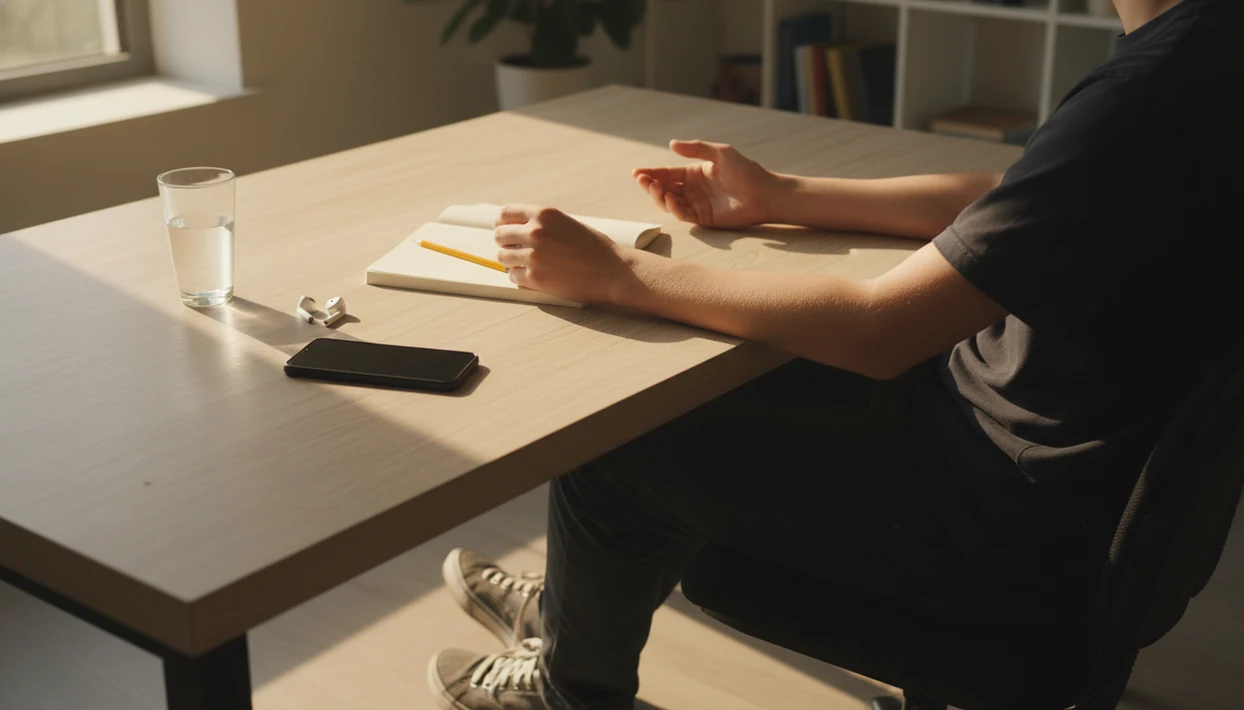
Mindfulness for stressed teenagers is secular attention training that helps teens notice thoughts, emotions, and body signals without immediately judging or reacting to them. It does not mean making the mind blank or producing perfect calm. The practical aim is to notice a tight chest, a racing thought, or the urge to send an angry message before choosing what to do next.
Start with 1-5 minutes linked to homework, a test, family conflict, or bedtime. Offer a choice of breathing, sound, movement, grounding, or journaling rather than insisting on closed eyes and stillness. Mindfulness is a support skill, not a substitute for therapy, crisis care, or help with severe anxiety, depression, trauma, or self-harm.
The essentials
- Start with 1-5 minute practices tied to real teen moments: tests, homework, social media stress, conflict, or bedtime.
- Use choices, breath, sound, movement, grounding, or journaling, because not every teen likes closing their eyes or sitting still.
- Treat mindfulness as a support skill, not a replacement for therapy, crisis care, or help for severe anxiety, depression, trauma, or self-harm.
Notice the stress signal before reacting
Mindfulness for stressed teenagers means paying attention to what is happening right now, without trying to force the mind blank. A teen might notice a tight chest before an exam, the pull to check a group chat, or the same angry thought replaying after family conflict.
The goal is not to manufacture perfect calm. It is the small space before a harsh text, a slammed door after school pickup, a homework shutdown, or a long loop of what-ifs. A low-pressure version: while one full song plays, notice the air conditioner hum, the weight of heavy legs, and one object in the room, such as the spine of a library book.
Noticing comes first. Responding comes next.
For younger siblings or mixed-age homes, the basics overlap with meditation for kids, but teens usually need more privacy, choice, and respect.
Teen stress data and mindfulness evidence
Teen stress is common enough that mindfulness should be framed as a normal support skill, not a niche activity for “calm” students. The CDC reported that 42% of high school students in 2021 felt so sad or hopeless for at least two weeks that they stopped usual activities CDC guidance.
- Teen stress often appears as avoidance, irritability, sleep trouble, stomach tension, or poor concentration.
- A 2018 meta-analysis of 33 randomized trials found small-to-moderate gains in cognition and resilience, plus small reductions in stress and anxiety JAMA study.
- School programs tend to work better when practice is brief, repeated, and age-appropriate.
- Mindfulness is a skill practice, not a mood switch.
- Clinicians typically recommend extra support when stress lasts for weeks, disrupts sleep, school, or relationships, or includes panic, trauma symptoms, self-harm, or suicidal thoughts; in the U.S., call or text 988 for immediate suicide or crisis support Reference.
How attention practice creates a pause
Mindfulness works by training the pause between a trigger and a reaction. In plain terms, the teen learns to notice the stress signal before the next move takes over. Practicing mindfulness for aggression in youth can help teens recognize anger signals and pause before reacting.
A trigger might be a grade notification, a slammed door, a message left on read, or the thought, “I’m going to fail.” Attention can then shift from rumination to an anchor: breath, body, sound, movement, or surroundings. That shift does not erase the problem. It gives the nervous system a few seconds to settle.
How mindfulness for stressed teenagers works: repeated attention practice strengthens metacognition, the ability to notice thoughts as thoughts. It also supports emotional regulation, which means the brain gets more practice moving from alarm to choice. For a stressed teenager, a short mindfulness practice offers a repeatable pause and a clearer next step, not a guarantee of feeling calm. The NIH’s National Center for Complementary and Integrative Health describes mindfulness and meditation as attention-training practices with promising but mixed evidence across health conditions, so they should be presented as skills rather than cures NCCIH overview.
A cushion sliding on hardwood can be annoying. The practice still counts.
Build a 1-5 minute practice around a daily cue
Use mindfulness for stressed teenagers by making it brief, predictable, and attached to a real-life cue. We usually suggest starting with a 2- or 3-minute practice after guitar practice, after dishes, or in the parked car at school pickup, rather than presenting it as a full adult meditation routine.
- Pick one practice time. Choose before school, before homework, after practice, or before bed.
- Choose one anchor. Use breath, feet, sound, hands, walking, or music.
- Set a short timer. Start with 1-5 minutes, especially if sitting still feels irritating.
- Name the stress signal. Say quietly, “Worry is here,” “anger is here,” or “my body feels tight.”
- Return and choose. Come back to the anchor, then pick one next action, like opening the assignment, asking for space, or putting the phone down.
For teens who want more structure, meditation for teens can help compare breathing, body scan, and movement-based options.
Mindfulness practices for tests, social media, conflict, and sleep
Different teen stress moments need different practices. A restless teen before basketball tryouts may need walking; a wired teen at bedtime may need a slow body scan.
| Stress moment | Short practice | Why it fits |
|---|---|---|
| Before a test | Take three slow breaths and feel both feet on the floor. | It gives the body a clear cue before reading the first question. |
| After social media stress | Listen for three sounds or name five things in the room before replying. | It interrupts the instant-response loop. |
| During family conflict | Hold a pen, sleeve, or chair edge and say, “I need one minute.” | It creates a pause without demanding a full conversation. |
| Before sleep | Try a body scan or breathe with a longer exhale. | It moves attention from planning to body sensation. |
| When restless | Practice mindful walking for 2 minutes. | Movement can be easier than stillness. |
Bedtime may need its own rhythm; bedtime meditation for children offers softer ideas for families with younger kids too.
Parent and teacher tips for teen mindfulness practice
Adults can support teen mindfulness by lowering pressure, not adding another task to perform. The most useful adult role is to offer options and model the skill briefly. Parents working on raising resilient teens can pair these small pauses with steady support and realistic expectations.
If the kitchen is loud, a sibling is watching, or the teen already has earbuds in, an eyes-open grounding practice may feel safer than asking for silence and closed eyes.
- Choice: Ask, “Breathing, music, walking, or grounding?” instead of saying, “Go meditate.”
- Modeling: Take three breaths before opening the laptop or starting a difficult talk. Teens notice the example more than the lecture.
- Respect: Eyes-open, movement-based, and sound-based practices are valid.
- Safety: Do not use mindfulness as punishment, silence, or a way to dismiss bullying, overload, grief, or unfair pressure.
- Tools: Apps such as Mindful.net, Calm, and Headspace can offer beginner-friendly guidance when a teen wants an outside voice.
A family plan can help if everyone agrees on the tone; a simple family mindfulness routine works better than surprise “calm down” commands.
Pair the pause with a practical phone boundary
A pause before replying can help, but it does not address every source of online stress. Look at what phone use is doing to sleep, schoolwork, and relationships, not just the number of hours. The APA guidance on youth social media recommends limiting use when it interferes with sleep or physical activity and checking for patterns that disrupt daily routines.
Ask the teen which situation needs a change: notifications during homework, upsetting posts, or checking messages after bedtime. Agree on one boundary, explain its purpose, and review it together. Options include a no-phone study interval, fewer notifications, or a device-free sleep period. Pair the boundary with a brief grounding practice, but keep the practical change: noticing stress does not remove the interruption that caused it.
Five expectations that make teen mindfulness harder
Many teens reject mindfulness because it is introduced in a way that feels fake, forced, or impossible. These mistakes are common and fixable.
- Mindfulness is not emptying the mind. The mind will wander to homework, friends, a grocery list, or a song lyric.
- Mindfulness is not always sitting still with closed eyes. Walking, listening, stretching, and eyes-open grounding can count.
- Mindfulness is not instant anxiety relief. For stressed teenagers, it usually works through repetition, not one dramatic session.
- Mindfulness is not passive acceptance. A teen can calm the body and still set a boundary, ask for help, or leave a bad situation.
- For a stressed teen, 2 minutes every school night is often easier than 20 minutes once a week.
The pocket check is real.
Match mindfulness to everyday stress, not crisis care
Mindfulness fits everyday teen stress best when the goal is practice, not treatment. It can complement therapy, school counseling, family support, sleep routines, and healthier phone boundaries.
| Situation | Best for | Not ideal for |
|---|---|---|
| Everyday overwhelm | Focus breaks, exam nerves, homework stress, and emotion regulation practice | Expecting one practice to solve chronic distress |
| Anxiety support | A grounding tool alongside therapy or school support | Replacing care for severe or persistent anxiety |
| Low mood | Noticing thoughts and body cues with support | Severe depression, self-harm, suicidal thoughts, or withdrawal |
| Trauma history | Externally focused grounding, movement, or eyes-open practice when guided safely | Long inward focus that feels flooding or unsafe |
| Restless teens | Walking, music, sound, or sensory anchors | Forcing stillness because an adult prefers it |
For younger children with worry, meditation for anxious kids may be a gentler starting point.
A 30-second grounding cue after school
For images on this guide, use plain captions that show the practice in context instead of repeating the keyword. For example: a teen pauses after school with warm cheeks from a walk, notices cold fingertips, and takes three steady breaths while a parent waits nearby with a backpack and a movie stub from the weekend.
Alt text should describe the scene plainly, not repeat keywords. A good version would be: “Teen sitting with backpack, looking down calmly while practicing a short grounding exercise.” Avoid stuffing phrases like “best mindfulness stress meditation teen guide.”
Try this 30-second cue: feel your feet, notice one breath, look around the room, and choose the next small step. Maybe that step is opening the notebook. Maybe it is asking for five minutes alone.
Simple counts.
Try a sound anchor before homework
Before homework, a teen who dislikes focusing on breathing could choose a sound and return attention to it when distracted. The free white noise and ambient sound player offers one option for that practice; the Mindful.net app also has breathing exercises for teens who prefer guidance. Neither addresses the cause of persistent distress. School support or a mental health professional is more appropriate when stress repeatedly disrupts sleep, schoolwork, or relationships.
Teen Mindfulness Limits
- Mindfulness cannot replace qualified mental health care, and its benefits are often small to moderate, not guaranteed.
- Professional support is needed for severe depression, trauma symptoms, self harm, suicidal thoughts, or intense anxiety.
- Closing their eyes or focusing inward can make some teens feel worse, especially when body sensations feel scary.
- The Mindfulness Practices App is educational, not crisis care, and mindfulness benefits depend on consistency and willingness to try.
Teen mindfulness questions
Does mindfulness help stressed teenagers?
It can help some teens practice attention and pause before reacting. A review of randomized trials found small average benefits across outcomes including attention, depression, and anxiety or stress. Results vary, so treat it as a skill to try alongside practical support, not a guaranteed way to feel calm.
What mindfulness exercise can a teen do before a test?
Try three slow breaths while noticing both feet on the floor. Then choose the next action, such as reading the first question carefully. This gives attention a concrete place to return, but it does not replace preparation or guarantee that exam nerves will disappear.
Do teens have to close their eyes to meditate?
No. A teen can keep their eyes open and notice an object, nearby sounds, or the contact of their feet with the floor. Walking and gentle movement are also options. Choose a practice they are willing to try rather than treating stillness or closed eyes as requirements.
What should a teen do if mindfulness makes anxiety worse?
Stop the practice rather than pushing through it. Closing the eyes or focusing on internal sensations can feel uncomfortable for some teens. An eyes-open exercise focused on the room may be a better option. Persistent or intense anxiety needs professional support, especially when it interferes with daily life.
How can parents introduce mindfulness without forcing it?
Offer a choice: breathing, music, walking, or grounding. Keep the invitation brief and avoid using meditation as a punishment after conflict. Parents can model a short pause before a difficult conversation. Ask what support the teen wants, and address practical pressures as well as their response to them.
Can mindfulness help teens with social media stress?
A short grounding exercise can create a pause before replying to an upsetting message. It should sit alongside practical changes, such as reducing notifications or protecting sleep from nighttime checking. Hours alone do not define a problem; loss of control and disruption to daily routines matter too.
When is mindfulness not enough for teen anxiety?
Seek professional assessment when anxiety persists, becomes intense, or disrupts sleep, school, or relationships. Mindfulness can be a supporting skill, but it is not treatment for every difficulty. Suicidal thoughts, self-harm, or an immediate safety concern require urgent local crisis or emergency support, not another meditation session.