
Mindful Parenting for Stressed Kids: Calmer Responses, Clear Limits


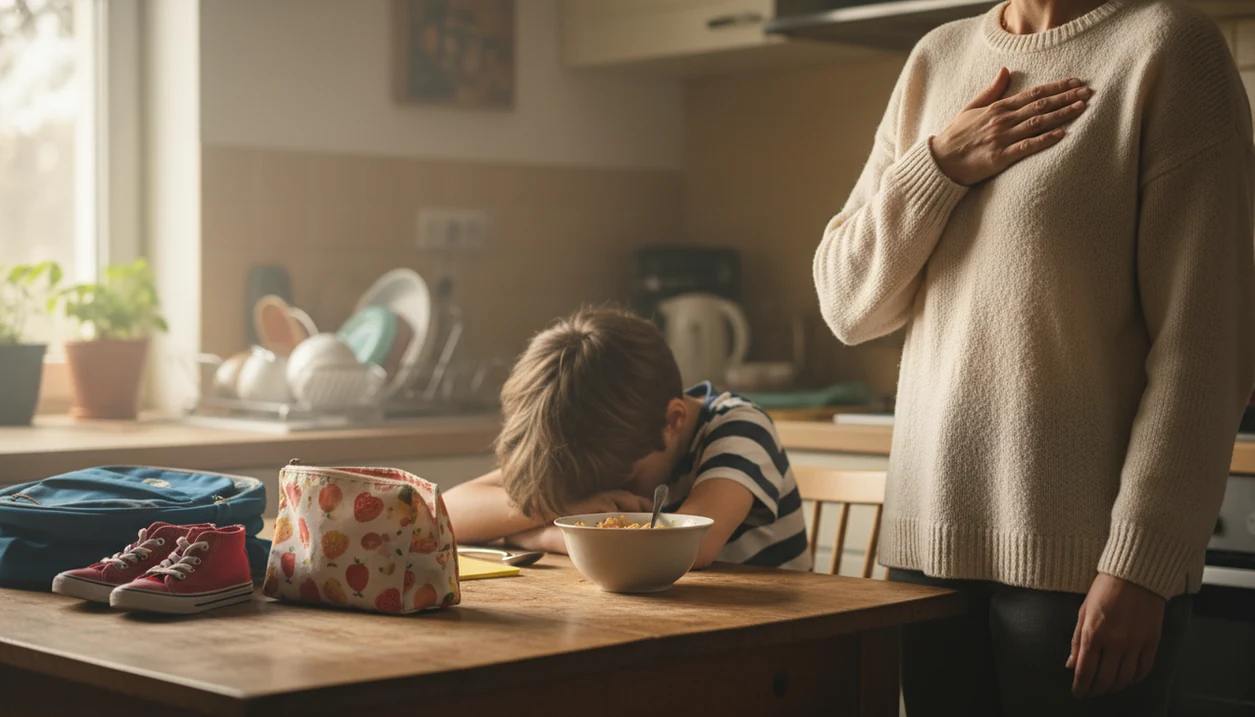
Mindful parenting for stressed kids means noticing your own stress, pausing, and responding deliberately so tension is less likely to spill over onto your child. This secular approach brings present-moment awareness, self-regulation, and compassionate attention to everyday parent-child interactions. The basic sequence is simple: notice your reaction, breathe, name what is happening, and choose your next response.
It is most useful for reactive stress, repeated power struggles, and parental overload. Evidence is stronger for changes in parents’ stress and behavior than for guaranteed improvements in children, and results vary across studies. Short breathing pauses, body awareness, and attentive listening are enough to begin. The goal is not constant calm, but less harsh reacting and more room to listen while keeping clear limits.
What mindful parenting can change for stressed kids
Mindful parenting less stressed kids means calm, present, emotionally aware parenting that reduces stress spillover from adult to child. It does not mean staying serene through every tantrum, school delay, or sibling argument.
Research links mindful parenting with lower parental stress and better parent-child relationship quality, while reviews of mindfulness-based parenting programs find stronger evidence for parent outcomes than for guaranteed child outcomes (S12671 016 0596 7); NIH research).
The pocket check is real.
A dad at school pickup who hears a sharp comment and takes one steady breath before speaking is practicing attention in ordinary life. Mindfulness practices and beginner-friendly meditation techniques create a little more space between trigger and response, not instant calm, perfectly regulated children, or guaranteed mental health results.
Five facts about parent stress and child stress
- Higher mindful parenting is associated with lower child stress. Family mindfulness research reports that children of more mindful parents often describe less stress, even when the child’s own mindfulness is considered.
- Parents’ stress can become children’s stress. Clinical parent guidance has identified parent stress as a major source of stress for many kids. The American Psychological Association also notes that children can notice and be affected by adult stress responses (APA research).
- Mindful parenting is not anger removal. It is noticing anger, pausing, and responding with less damage.
- Short secular practices can help parents regulate. A breath before speaking, feet on tile, or a brief body scan can interrupt a harsh reaction.
- Benefits need repetition and connection. For stressed families, mindful parenting usually works best when short pauses are paired with warmth, repair, and predictable limits.
If your child wants their own practice, meditation for kids can stay playful and brief.
How a pause interrupts the family stress cycle
Mindful parenting works by changing the family stress loop: a parent notices activation, pauses, and responds with more regulation before the child absorbs the emotional spillover.
Family stress is contagious in small ways. A rushed tone, yelling from the hallway, sharp instructions, or a face that signals threat can raise a child’s alert system. The key mechanism is the pause between trigger and response. In plain language, that means catching the moment before the sentence leaves your mouth.
This pause can reduce harsh reactivity, improve emotional attunement, support clearer limits, and leave more room for shared positive emotion. You might still say, “Shoes on now,” but with a steadier voice and one instruction instead of six.
Parent regulation does not control every child outcome. Temperament, sleep, school stress, neurodevelopment, and family strain all matter. It does, however, change the air in the room.
Evidence behind mindful parenting for child stress
The evidence is encouraging, but not absolute: mindful parenting is best supported as a way to lower parent stress and improve parenting behavior, with child stress benefits more likely than guaranteed. Reviews from sources such as Mindfulness journal, NIH-indexed family intervention research, and the American Psychological Association point in the same general direction: calmer, more regulated adults often create a less stressful climate for children.
The strongest findings tend to sit close to the parent. Studies more consistently report reduced parental stress, less harsh reactivity, and better warmth or consistency. Child outcomes are harder to prove because children bring their own temperament, sleep, school pressure, neurodevelopment, friendships, and worries into the room. For school pressures, mindfulness in schools for teens can offer additional practice alongside support at home.
A practical way to read the evidence is:
- Expect the first change to be in your pause, tone, and recovery after conflict.
- Watch for indirect child effects, such as fewer threat cues, less escalation, and easier transitions.
- Separate association from certainty; a calmer parent response raises the odds of safety, but it does not promise every child will feel less stressed. For older children, mindfulness tips for stressed teenagers offer ways to support coping without promising constant calm.
- Return to the core mechanisms: pause before reacting, repair after rupture, and attune to what your child is signaling.
Better awareness does not always mean less stress
Research does not support a simple promise that mindfulness training will make parenting less stressful. A 2021 systematic review and meta-analysis found a moderate improvement in parents’ mindfulness in nonclinical samples, but no significant overall effect on parenting stress. Parents may become better at noticing their reactions without experiencing a clear reduction in the pressures they face.
That distinction matters when exhaustion, workload, isolation, financial strain, or co-parent conflict is driving stress. A breathing pause cannot remove those pressures. Pair practice with a concrete change where possible, such as sharing a recurring task or seeking support for persistent conflict. Mindfulness is one part of a response, not a reason to make parents solely responsible for a stressful home environment.
Six steps for responding without escalating
Use mindful parenting during real family friction, not only when the house is quiet. If soup is simmering, homework papers are sliding across the counter, and everyone is hungry, one Clipboard Breath, notice, breathe, choose the next kind action, still counts.
- Notice your trigger. Name the cue, such as whining, lateness, eye-rolling, homework refusal, or bedtime stalling. When phone limits trigger conflict, mindfulness for teen phone addiction offers ideas for responding to urges more deliberately.
- Breathe before speaking. Take one slow breath while feeling your feet on carpet or tile.
- Name the emotion. Say silently, “I’m frustrated,” or aloud, “This is a hard transition.”
- Lower your voice. A quieter tone often lowers the child’s threat response faster than another lecture.
- Choose one next action. Give one instruction, one choice, or one boundary.
- Repair afterward. If you snapped, apologize briefly and restart without a long courtroom speech.
For families that like shared practice, parent and child breathing exercises can make the pause easier to remember.
Repair after yelling without giving up the limit
A missed pause is not the end of the practice. Once everyone is calm, name your action without blaming the child: “I raised my voice. That was my responsibility. I’m going to try again.” Modeling a pause and acknowledging mistakes makes regulation concrete. Research links parental mindfulness with more positive parenting, but does not establish that any single repair exercise produces a measurable child benefit.
Keep the original safety rule clear. For example: “You wanted your sister to listen. Hitting is not safe. Check whether she is hurt, help rebuild the tower, and ask using words next time.” This combines recognition of intent with accountability and a specific alternative. A meta-analysis of Group Triple P parent training found reductions in both overreactive and lax parenting, supporting warmth alongside consistent limits rather than permissiveness. For recurring hitting or other aggressive behavior, mindfulness skills for aggression in youth can complement clear safety limits.
When a parenting pause helps and when more support is needed
Mindful parenting fits everyday stress patterns best. It can complement professional care, but it should not replace support when safety, severe symptoms, or ongoing impairment are present.
| Best for | Not for | Why it matters |
|---|---|---|
| Parents who snap under stress | Emergencies | Breathing is useful after immediate safety is handled. |
| Families with morning, homework, or bedtime chaos | Severe untreated child mental health needs | Mindfulness can support regulation, but care planning may be needed. |
| Beginners wanting secular practices | Violence, threats, or unsafe conflict | Safety planning comes first. |
| Parents who want better repair after conflict | Parents expecting instant obedience | The goal is steadier connection, not control. |
For parents of teens, the same principles apply, though language and privacy matter more. Our meditation for teens guide keeps that developmental difference in view.
Mindful parenting practices for morning rushes, homework, meltdowns, and bedtime
Mindful parenting becomes useful when it fits the moment. Here are five named practices for common pressure points.
Morning rush resets
Take one breath before instructions, then reduce stacked commands. “Backpack, shoes, door” lands better than a fast speech from the kitchen.
Bedtime body awareness
Use a slower voice, a predictable routine, and a brief body scan. Feet warming inside wool socks can become the child’s cue to settle.
Homework conflict: first notice your own signal, such as cold hands or tense calves. Then ask one clear, practical question: “Which part should we start together?” One pattern we notice is that a simple starting question often works better than a longer lecture.
Meltdowns: Validate feeling before problem-solving. “You really wanted more time” is not the same as giving in.
Parent repair: Apologize briefly, name the reset, and reconnect. Bedtime-specific support is covered in bedtime meditation for children.
Practicing before pickup, homework, and bedtime
Tools can help parents practice before stress peaks.
For this topic, the useful feature is not a long streak counter; it is a short guided pause a parent can finish before pickup, homework, or bedtime. That makes Mindful.net most relevant as preparation for steadier responses, not as a child-behavior solution.
Apps such as Mindful.net, Calm, and Headspace can add structure for short breathing, body scan, and daily awareness practice. Use them before difficult transitions, such as school pickup, homework time, or the last bedtime reminder. An unguided timer on a dim screen may be enough.
However, no app can fix child behavior or replace judgment during unsafe situations. Treat guided practice as preparation, not emergency parenting. If you prefer a shared household rhythm, a family mindfulness routine may be more useful than separate sessions.
A quiet pause before bedtime
Before the last bedtime reminder, a brief pause gives a parent time to notice tension and choose what to say. Mindful.net’s white noise and ambient sound player can provide background sound for that pause, while the app offers short guided meditations. Neither addresses the cause of persistent family stress. Practical help with workload, a consistent bedtime plan, or professional support may matter more.
Mindful Parenting Limits
- Seek professional treatment for serious child mental health concerns, rather than relying on mindful parenting alone.
- Evidence is stronger for parent benefits than lasting child outcomes, and study samples may limit applicability.
- Benefits usually depend on repeated practice over time, not one calm conversation.
- If the home is unsafe, mindfulness is not the first step.
Mindful parenting and child stress questions
Does mindful parenting actually reduce child stress?
It may help, but a calmer child is not guaranteed. Research links mindful parenting with fewer child difficulties, while intervention findings vary. Evidence is generally stronger for changes in parents’ awareness and parenting behavior. Treat it as a way to improve your responses, not as a promise that your child’s stress will disappear.
How do I practice mindful parenting during a meltdown?
Handle immediate safety first. Then notice your own bodily tension, take a slow breath, and lower your voice before speaking. Describe what is happening without judging the child, state the limit, and offer two acceptable choices when appropriate. Save a longer discussion for when both of you are calm.
Can mindful parenting help me stop yelling?
It can help you notice the moment before yelling and practice a different response, but it does not eliminate anger. Start with one recurring trigger, such as bedtime stalling. Rehearse a brief pause and a clear sentence. After a lapse, acknowledge the yelling, restate the limit calmly, and repair rather than blaming your child.
Do I need to meditate every day to be a mindful parent?
Long meditation sessions are not required to begin. You can practice through a breathing pause before instructions, noticing tension during homework, or listening without interrupting. There is no single established amount of practice that guarantees benefits. Choose a repeatable moment and focus on how you respond, rather than minutes completed.
What if my child refuses breathing exercises?
Your child does not have to join in for you to practice. Notice your own reaction, pause, and give a clear instruction without turning breathing into another demand. You can model it simply: “I’m frustrated, so I’m taking a breath before I speak.” Continue to provide connection, predictable boundaries, and practical help.
Does mindful parenting mean letting bad behavior go?
No. You can acknowledge a child’s feelings or intention while stopping unsafe behavior and following through on a clear limit. Describe the action rather than labeling the child. When appropriate, require a proportionate repair and rehearse an acceptable alternative. Mindful parenting concerns how you respond, not whether rules still apply.
What if I am too overwhelmed to pause calmly?
Overload is not simply a failure of attention. Sleep, workload, isolation, financial strain, and conflict can all need practical attention. Start with a brief pause when safety allows, but also identify one pressure that needs outside help or a change in responsibilities. Mindfulness should not become another standard you must meet perfectly.
When does a stressed child need professional help?
Seek professional support when symptoms are severe, persistent, or interfering with everyday functioning. Mindful parenting may complement care, but it is not treatment for serious mental health concerns. Violence, threats, or an unsafe home require safety planning first. Do not delay appropriate help while waiting for breathing or meditation practice to work.