
Short Meditation for Toddlers: 10- to 60-Second Noticing Games


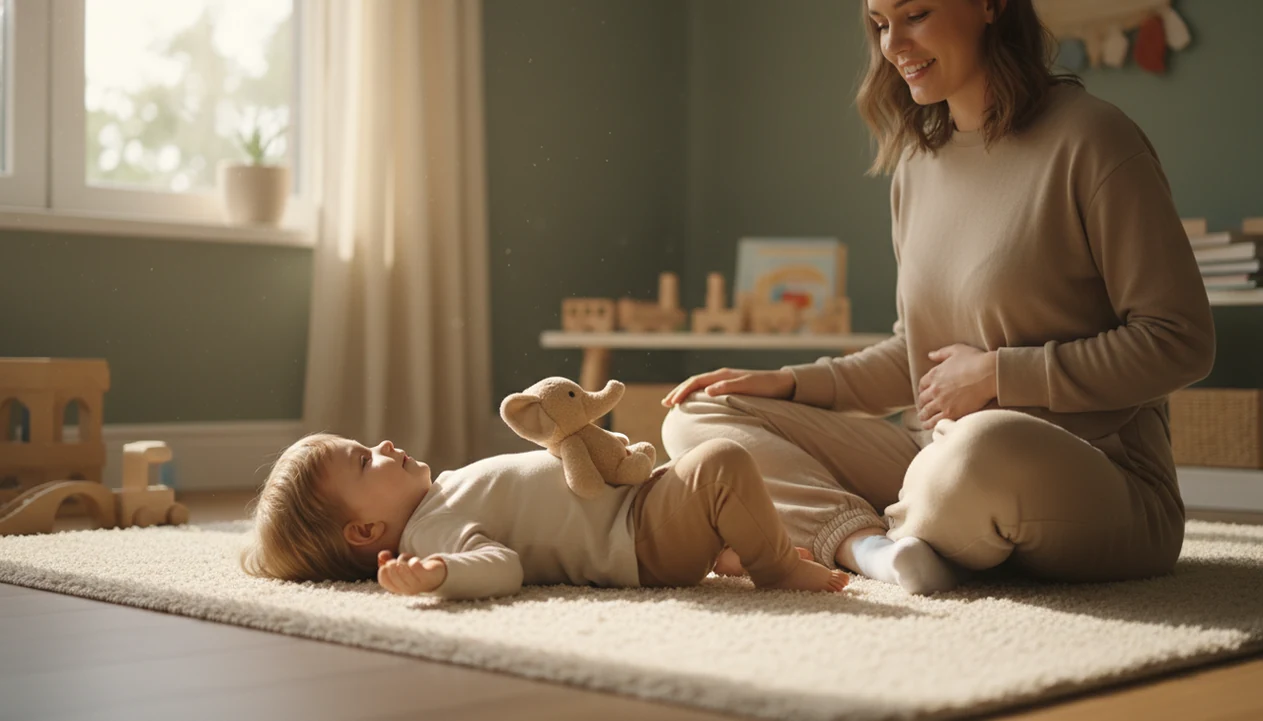
Short meditation for toddlers is a 10- to 60-second, caregiver-led noticing game, not a formal sit-still session. It uses sound, movement, breathing, or body sensations to practice attention and co-regulation: helping a child settle with support from a calm adult. Try listening for one sound, watching a stuffed animal rise on the belly, or pretending to smell a flower and gently blow out a candle.
Start when your child is mostly comfortable, model the game yourself, and let them move or decline. Ten seconds can be enough; one to three minutes is usually the upper limit, not a goal to reach. The point is to notice something together, not demand quiet, stop a tantrum, or make breathing into a test.
The essentials
- Keep toddler mindfulness tiny: 10 seconds is enough, and 1-3 minutes is usually the upper limit.
- Use playful sensory prompts instead of abstract instructions or behavior correction.
- Caregiver tone, modeling, and acceptance of wiggling matter more than perfect stillness.
What a toddler mindfulness pause looks like
Short toddler meditation is a brief, caregiver-led mindfulness pause that uses sound, movement, breathing, or body noticing to help a young child practice attention and co-regulation in everyday moments.
That means it looks more like “Can you hear the quietest sound?” than “Sit still and meditate.” A toddler might feel a stuffed animal rise on their belly, stomp twice and freeze, or listen while you soften your own voice first. It is not a tool for forcing silence, fixing tantrums, or making a two-year-old act like a small adult on a cushion.
Wiggling counts.
These small noticing games practice attention; they do not produce instant obedience or replace medical treatment.
Five toddler mindfulness facts parents should know first
Before you try toddler mindfulness, expect tiny, sensory, caregiver-led practice. Most toddlers learn through imitation and play, not through long explanations about feelings or focus.
- Brief beats formal: Ten seconds can be enough. A phone timer set for 30 seconds is often more realistic than a planned “session.”
- Sensory cues land better: “Feel your feet on the tile” usually works better than “be mindful,” especially near a doorway or bathroom sink.
- Benefits are gradual: Research in preschoolers and older children suggests possible modest gains in attention, emotion regulation, and learning behavior, not instant compliance.
- Caregiver regulation is central: Your slow voice, relaxed shoulders, and willingness to pause teach more than the script itself.
- Professional support still matters: Persistent anxiety, aggression, sleep disruption, developmental delays, trauma responses, or strong caregiver concern should be discussed with a pediatrician or qualified specialist.
For families with older children too, our meditation for kids guide explains how practices change as attention span grows. If older siblings want to join, meditation for siblings can turn brief noticing games into shared family pauses.
How toddler mindfulness works in a young nervous system
Toddler mindfulness works through co-regulation first and self-regulation later. Young children often “borrow” steadiness from a calm caregiver before they can reliably settle themselves.
The mechanism is simple. A toddler’s attention shifts from overwhelm toward a concrete sensory anchor, such as sound, breath, touch, or movement. In nervous system terms, predictable cues can support arousal regulation. In plain language, the child gets one small thing to notice with you.
Soft voice helps. So does repetition.
A slow pace and familiar wording usually work better than reasoning during distress. “Hand on belly, feel it move” gives the brain less to process than “You need to calm your body because we’re leaving soon.” Studies in preschoolers and older children suggest modest benefits for attention, emotion regulation, and learning behaviors, but toddlers still need adult help, closeness, and ordinary routines.
How to use short meditation for toddlers at home
Use short meditation for toddlers as a low-pressure practice during ordinary moments, not as a rescue attempt at the peak of distress. Start when everyone is mostly okay.
- Choose a low-stakes moment: Try before shoes, after snack, or on a kitchen chair, not in the loudest part of a tantrum.
- Set a tiny time window: Begin with 10-30 seconds. Stop before your toddler starts resisting.
- Model the cue yourself: Put your hand on your belly or listen first, then invite them to copy.
- Name one simple anchor: Say one sensation, sound, or movement, such as “feet on carpet” or “one slow blow.”
- Praise noticing, not performance: Say “You noticed the sound” instead of “Good calming down.”
For a repeatable household rhythm, a family mindfulness routine can help adults remember to practice during neutral times.
Common mistakes with toddler meditation
Long sessions, instructions during peak distress, and demands for stillness can turn a playful pause into another source of frustration. Keep it voluntary, brief, and softer than the moment around it.
- Start before distress peaks: Introduce the game when your toddler is mildly upset, bored, sleepy, or neutral. At the loudest point of a tantrum, closeness, safety, and fewer words usually matter more than a script.
- Avoid turning it into a test: Do not use meditation as punishment, proof of obedience, or a way to demand quiet. “Try with me?” keeps the door open better than “You have to calm down.”
- Stop while it is still easy: End after one breath, one sound, or one freeze if your child begins to pull away. Finishing the timer is less important than leaving the practice friendly.
- Change the anchor when needed: If breath focus feels strange, watched, or irritating, switch to feet on the floor, a sound in the room, hand pressure, or a small movement.
- Soften yourself first: Let your voice, shoulders, face, and pace be calmer than the words. A gentle adult body often teaches more than the script.
Best toddler calming practice scripts for 10 to 60 seconds
The best toddler calming practice scripts are short, playful, and easy to abandon if the child is done. Use one or two lines, then move on.
Flower and Candle Breath
“Smell the flower with me.” “Now blow the tiny candle.” “One more, very gentle.”
This works well because pretend play feels less bossy than “take a deep breath.”
Quietest Sound Hunt
“Let’s find the quietest sound in the room.” “I hear the fridge. What do you hear?” “Now we listen for one more.”
A paused audio story beside a water glass can become the cue that listening time has started.
Belly Balloon
“Put teddy on your belly.” “Can teddy ride up and down?” “Hello, little balloon.”
Wiggle and Freeze
“Wiggle your fingers.” “Freeze like a statue.” “Now wiggle your toes.”
For toddlers, movement often opens the door to attention practice better than stillness.
Mindful breathing toddlers can actually enjoy
Does mindful breathing work for toddlers? Yes, when it feels like pretend play and stays voluntary.
Skip “take a deep breath” as a command. Try bubbles, pinwheels, imaginary soup, or a stuffed animal on the belly. Natural breathing is fine. Forced deep breathing is unnecessary, and some children dislike being watched while they breathe.
A better invitation is, “Want to try with me?” That lands differently than “Calm down now.” You can blow pretend soup together, smell an imaginary strawberry, or make a paper scrap move across the table. If your toddler turns away, you can keep breathing softly without making it a contest.
For more shared breath ideas, use parent and child breathing exercises when your child is ready for slightly longer play.
When breath or body games feel uncomfortable
Some children find closed eyes or attention to internal body sensations uncomfortable, particularly if they have sensory sensitivities, anxiety, or a trauma history. Start with eyes open and something outside the body: a color on a toy, the texture of a sleeve, or a sound nearby. The AAP's guidance on helping children after stressful experiences places calming activities within broader emotional support.
If your child becomes distressed, frustrated, dizzy, or more agitated, stop the exercise rather than asking for another try. Stay nearby and return to ordinary comforting or play. A child who dislikes belly breathing can still join a movement or sound game. If these activities repeatedly increase distress, or symptoms are significant, discuss them with a pediatric clinician.
Toddler meditation moments that fit daily family routines
Toddler meditation fits best when it attaches to routines that already happen. Formal sessions are usually harder than tiny cues during bedtime, handwashing, or waiting.
| Routine | Practice | Ideal length |
|---|---|---|
| Bedtime | Belly Balloon with a stuffed animal | 30-60 seconds |
| Car seat buckling | Quietest Sound Hunt before the buckle click | 10-20 seconds |
| Handwashing | Feel warm water, then name one splash sound | 10-30 seconds |
| After a tantrum | Sit nearby and notice feet, floor, or breath together | 20-60 seconds |
| Before daycare | Flower and Candle Breath at the door | 10-30 seconds |
| Waiting in line | Wiggle and Freeze with hands or toes | 10-20 seconds |
Use neutral moments first, so the practice does not feel like punishment. Bedtime may also need stories, lights, and predictable order; bedtime meditation for children covers that wider wind-down.
At bedtime, protect sleep time before adding a game
A bedtime noticing game should fit inside the routine, not push bedtime later. In a 2022 review of 45 sleep-intervention trials involving children aged 1 to 18, interventions increased nighttime sleep by an average of 10.5 minutes. Those that included earlier bedtimes were associated with about 47 additional minutes. These were sleep interventions, not evidence that toddler meditation improves sleep.
Keep the sequence predictable: dim the lights, end stimulating play and screens, then read or cuddle. If your toddler wants to join, add one brief sound hunt or a few moments of natural belly breathing. The AAP suggests breathing as part of bedtime routines, but there is no need to finish a script before sleep. As children grow, a family plan for reducing phone use can help protect quiet routines without relying on meditation alone.
When a noticing game helps, and when it is not enough
Short meditation for toddlers is best for gentle practice, not command-and-control behavior management. Think of it as one toddler calming practice inside a larger caregiving toolkit. For older children using online platforms, mindful social media habits for kids extend everyday attention practice to digital interactions.
| Best for | Not for |
|---|---|
| Gentle transitions between activities | Stopping a meltdown on command |
| Bedtime settling when the routine is already calm | Replacing sleep routines or limits |
| Waiting moments in lines, cars, or offices | Punishing big feelings |
| Reconnecting after an upset | Treating clinical anxiety, ADHD, trauma, or developmental concerns |
| Practicing attention through play | Making toddlers sit still for adult approval |
Professional evaluation is important when anxiety, aggression, sleep disruption, developmental delays, trauma responses, or caregiver concern persists. For older children who need more structured support after big feelings, calm down meditation for kids may fit better than toddler scripts.
Evidence behind meditation for toddlers and preschoolers
Direct evidence for meditation for toddlers is limited, so careful guidance draws mostly from preschool and school-age mindfulness studies. Benefits should be described as possible, modest, and gradual.
A 2014 randomized trial of 68 preschool children found that a 12-week mindfulness-based kindness curriculum improved teacher-rated social competence and learning behaviors in 4- and 5-year-olds. Source: Flook et al., Developmental Psychology, 2015: A0038256 A 2015 preschool mindfulness trial reported reduced hyperactivity and inattention, along with improved inhibitory control, compared with a waitlist group. Source: Razza, Bergen-Cico, and Raymond, Journal of Child and Family Studies, 2015: S10826 013 9847 6 For children nearing school age, mindfulness activities for kindergarten offer playful ways to practice noticing and kindness.
Broader youth research points in the same cautious direction, but it is mostly not toddler-specific. A 2014 systematic review and meta-analysis of 24 school-based mindfulness studies found small to moderate improvements in cognitive performance and resilience, with mixed study quality: Fpsyg.2014.00603 A 2015 meta-analysis for ages 6-18 found small but significant effects on attention, anxiety or stress, depression, and negative behaviors. For school age children, consider the pros and cons of meditation in schools, including consent, accessibility, and safety.
For toddlers, the most defensible takeaway is narrower: brief caregiver-led noticing games may support early regulation practice, but they should not be sold as treatment.
A shared belly-breath game on the living room floor
Caption: A caregiver and toddler practice toddler mindfulness on the living room floor, using a playful belly-breath game and calm adult modeling to turn a brief everyday pause into shared co-regulation.
The image should show ordinary family life, not a staged adult meditation pose. A toy on the rug, knees bent, and a child looking around are all fine. The point is connection and noticing. Not a spiritual claim. Not a medical promise. Just a caregiver making attention practice small enough for a toddler to join.
Tools like Mindful.net can offer secular beginner practice ideas for adults, while toddler practice still depends on live caregiver warmth and timing.
Toddler Meditation Limits
- Toddler meditation evidence is limited, often extrapolated from older children, and research effects are generally modest.
- Pause if behavior becomes unsafe or unusually intense; forcing quiet participation can increase distress or feel like punishment.
- Meditation cannot replace professional evaluation for anxiety, ADHD, trauma, developmental delays, sleep problems, or persistent behavior concerns.
- For language regression, lost skills, persistent sleep disruption, unsafe aggression, or trauma symptoms, contact your pediatrician: CDC guidance.
Toddler meditation questions
Can a two-year-old meditate?
A two-year-old can join a brief noticing game with a caregiver, but formal seated meditation is not the goal. Listen for one sound, feel feet on the floor, or copy a gentle pretend candle blow. Participation may last only seconds, and looking around or moving does not mean the game failed.
How long should toddler meditation last?
Begin with 10 to 30 seconds and stop while your child is still comfortable. Many games fit within 60 seconds; one to three minutes is usually an upper limit, not a target. Resistance, boredom, or distress is a reason to shorten the activity or end it, not extend the timer.
Should toddlers close their eyes to meditate?
No. Eyes-open games are a useful starting point, especially if closing the eyes feels uncomfortable. Invite your child to spot a color, watch a stuffed animal move on their belly, or notice a texture. There is no need to insist on closed eyes, a particular posture, or complete stillness.
Can meditation stop a toddler tantrum?
It cannot reliably stop a tantrum on command. At peak distress, safety, closeness, and fewer words usually matter more than a breathing script. Introduce noticing games during calmer moments. After the upset has eased, you can offer a familiar cue, but let your child decline without making calmness a requirement.
What if my toddler refuses breathing exercises?
Let the breathing exercise go. Try an external focus instead, such as listening for a quiet sound, touching a soft sleeve, or stomping twice and pausing. You can model gentle breathing without asking them to copy. Stop if the activity causes distress or agitation; participation should remain voluntary.
Does toddler meditation help with sleep?
A brief noticing game can be part of a calm bedtime routine, but strong evidence that meditation improves toddler sleep is not established. Keep bedtime predictable and avoid letting the exercise delay sleep. Persistent snoring, insomnia, or major daytime sleepiness needs pediatric attention rather than a longer meditation routine.
Does mindfulness improve a toddler's attention?
Research in preschoolers and older children suggests possible attention benefits, but evidence specifically for toddlers is limited. Treat these games as small opportunities to practice noticing, not as a proven way to improve school readiness or treat attention problems. Significant inattention or developmental concerns should be discussed with a pediatric clinician.