
How Social Emotional Learning Fits Into Lessons and School Routines


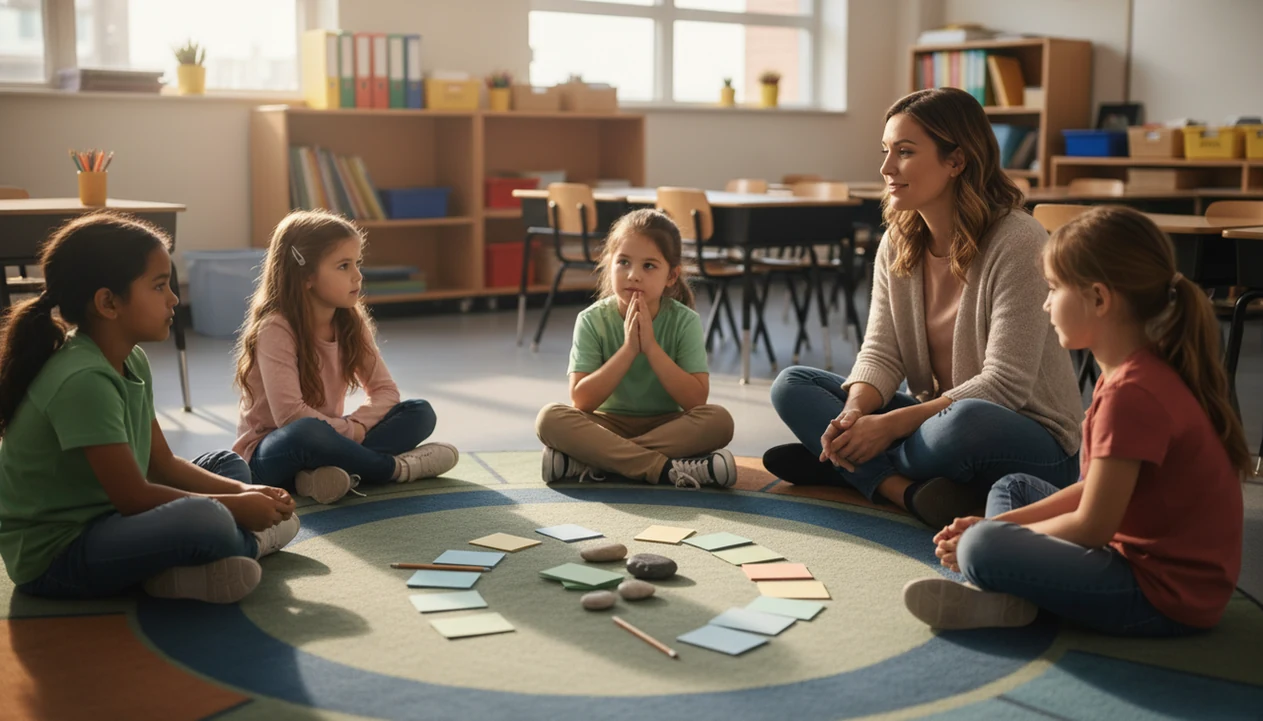
Social emotional learning fits school curricula by teaching emotion skills, stress management, relationships, and responsible choices within everyday lessons and routines. It is a secular, skills-based educational process built around five competencies: self-awareness, self-management, social awareness, relationship skills, and responsible decision-making. These are developmental skills to practice over time, not therapy or the subject of a one-off assembly.
A useful school approach connects explicit instruction with group work, transitions, conflict repair, school climate, and adult modeling. Research links well-implemented SEL with academic, social, and emotional benefits, including benefits beyond the school year. Brief mindfulness practices can support this work, but they are only one component. Emotion check-ins and breathing pauses should be voluntary, inclusive, and appropriate to students’ ages.
The essentials
- SEL works best when it is embedded into daily routines, academic lessons, school climate, and adult modeling.
- Research links well-implemented SEL with academic gains, improved social behavior, lower emotional distress, and benefits that can last beyond the school year.
- Simple secular mindfulness practices, such as emotion check-ins and short breathing pauses, can support SEL when they are voluntary, inclusive, and age-appropriate.
The five SEL skills in everyday school life
Social emotional learning in schools is a developmental process built around five core competencies: self-awareness, self-management, social awareness, relationship skills, and responsible decision-making. These skills are practiced over time, much like reading fluency or math reasoning.
SEL is not one worksheet, one commercial curriculum, therapy, or a behavior-control system. It shows up when students notice test stress, repair a conflict after recess, listen during group work, or feel that the classroom has room for them.
The five skills are easier to understand in ordinary school moments. A student names frustration before a science lab. A class uses a repair script after teasing. A teacher pauses before responding to a sharp comment.
A secular mindfulness-friendly approach can support SEL by teaching attention, pausing, and emotional naming without religious framing. The aim is usable attention practice, not belief instruction.
Evidence for social emotional learning in schools: academic and behavior outcomes
Well-implemented SEL is linked with academic, social, behavioral, and emotional benefits, especially when schools use evidence-informed programs consistently. The strongest findings come from large reviews, not isolated classroom stories.
- A 2011 meta-analysis of 213 school-based SEL programs with more than 270,000 students found an 11 percentile point gain in academic performance compared with controls Ed505370.Pdf.
- The same 2011 review found reduced conduct problems and emotional distress, along with improved social behaviors.
- A 2017 follow-up meta-analysis of 82 interventions reported sustained benefits 6 months to 18 years later, including social-emotional skills, attitudes, conduct, and academic performance APA research.
- UNESCO reports that social and emotional learning integrated into education can support wellbeing, school engagement, safer learning environments, and longer-term life skills Pf0000386142.
- State education guidance commonly frames SEL as part of academic success, school climate, and student support systems; for example, California’s Department of Education describes SEL as supporting learning, relationships, and school conditions Socialemotionallearning.Asp.
The careful phrase is “well-implemented.” SEL results vary when training, fit, time, or leadership support is thin.
Mindfulness evidence is not the same as SEL evidence
Schools should distinguish findings about broad SEL programs from findings about mindfulness lessons. A systematic review of school mindfulness programs found small positive effects on cognitive and social-emotional outcomes, but no statistically significant effects on academic or behavioral outcomes. That does not establish mindfulness as a way to raise grades, even when it forms part of a broader SEL curriculum.
The comparison group also matters. In the UK MYRIAD trial of early adolescents, universal school mindfulness training was not better than teaching as usual for mental health or well-being. Before adding a program, ask what it contributes beyond existing emotional-literacy lessons, classroom relationships, and pastoral support. Delivering the prescribed lessons consistently does not, by itself, guarantee a benefit.
How students carry SEL skills from one setting to another
Social emotional learning in schools works through repeated practice in routines, relationships, and school climate. Students build the five competencies when adults make them visible, model them consistently, and connect them to real classroom moments.
The mechanism is skill generalization: a student practices a skill in one setting, then learns to use it in another without needing the same prompt. Self-awareness becomes naming test anxiety before an assessment. Self-management becomes taking a breath during a transition. Social awareness becomes noticing a partner’s frustration in group work. Relationship skills show up in listening, repair, and disagreement. Responsible decision-making appears when students pause before posting, teasing, quitting, or escalating.
- Teach one concrete skill in plain language.
- Model the skill as adults during stress, mistakes, and conflict.
- Practice it during tests, transitions, group work, and repair conversations.
- Revisit the same language across classrooms and common spaces.
- Support implementation with training, protected time, and a good fit for the school community.
SEL is not therapy, religious instruction, or behavior compliance. It works best when it is practical, secular, and supported.
Practice SEL during arrivals, transitions, and group work
Social emotional learning in schools works by turning target skills into repeated, prompted practice across ordinary classroom moments. Students do not build SEL from one lesson; they build it when the same skill appears during arrivals, transitions, group tasks, mistakes, tests, and conflict repair.
How social emotional learning in schools works is fairly practical: routines create a pause between feeling and action. In learning terms, that is skill generalization, which means students practice one skill across many settings until it becomes easier to use without a prompt.
Feet under the desk. One breath before speaking.
Adult SEL matters here. Teachers and staff model regulation, empathy, apology, repair, and respectful disagreement before students are asked to do the same. Schoolwide alignment makes that modeling more believable: classroom instruction, discipline practices, family communication, policies, and multi-tiered supports should point in the same direction.
Secular attention training can help students notice the moment before a reaction. Mindfulness practices and meditation techniques for beginners and daily life can offer attention, naming, and pause skills, not instant calm or a substitute for care.
Start with one routine and one observable skill
How to use social emotional learning in schools starts with small routines, not a full-school overhaul on Monday morning. The practical next step is to choose one moment and make the expected skill visible.
- Map existing moments where SEL already appears, such as arrivals, transitions, group work, tests, and conflict.
- Choose one competency and one observable student behavior to practice, such as “uses a listening turn” or “names one feeling.”
- Teach a short routine such as an emotion check-in, two-minute breathing pause, partner listening protocol, or repair script. For very young children, short meditation for toddlers can introduce playful pauses without expecting prolonged stillness or silence.
- Model the routine as adults and use consistent language across classrooms, grade teams, and common spaces.
- Review student experience and adjust with low-stakes feedback, not high-stakes labels or public scoring.
A class might try counted breaths between keyboard clicks before an online assessment, then return to the assignment. For younger children, a short routine can connect with meditation for kids when the language stays simple and voluntary.
Where SEL helps and where other support is needed
SEL is one layer in a broader education and wellbeing system, not the main answer to every school problem. It fits best when schools use it to teach common skills and improve daily climate.
| Best fit | Use caution | Not a fit by itself |
|---|---|---|
| Universal classroom skills | Poorly resourced schools | Clinical mental health treatment |
| School climate | High school adaptation without student input | Unsafe school environments |
| Early and middle grades | Measurement dashboards | Poverty |
| Relationship repair | Forced participation | Discrimination |
| Stress management | Programs without evidence | Punitive discipline systems |
| Inclusive routines | Staff training gaps | Structural inequities |
For universal classroom needs, brief SEL routines are often easier than separate pullout lessons because students practice the same skill in the moment they need it. That matters after a hallway conflict, during a hard group project, or before a timed quiz.
Use caution when SEL becomes a slogan. If students experience it as compliance language, the trust cost is real.
Five brief classroom practices for emotion and relationship skills
Small classroom practices make SEL easier to sustain because they fit inside lessons and transitions. Each practice below can be secular, age-appropriate, and brief. Teachers can use mindfulness for kindergarten to adapt brief attention activities to younger students without adding religious instruction.
- Emotion vocabulary: Ask students to choose from three to five feeling words before a discussion or writing task. Older students can add intensity, such as “annoyed” versus “angry.”
- Two-minute breathing before tests: Offer a quiet breathing pause before assessments, with an opt-out such as reading the first direction silently. For home practice, parent and child breathing exercises can use similar plain language.
- Listening turns after group work: Give each student one uninterrupted sentence about what helped or got hard.
- Problem-solving scripts: Teach “What happened, who was affected, what can repair it?” after small conflicts.
- Reflection exit tickets: Ask one question, such as “What helped you stay with the task today?”
Mindfulness practices should be optional, secular, trauma-sensitive, and never used as punishment. Tools like Mindful.net can help schools find beginner-friendly wording for secular mindfulness and meditation techniques.
What to do when a mindfulness exercise increases distress
A student who becomes more distressed during a breathing or body-awareness exercise should be allowed to stop. Offer an external focus, such as looking around the room, or an alternative involving movement or quiet independent activity. The MYRIAD findings reinforce the need to monitor unintended outcomes rather than assume every pupil benefits from classroom mindfulness.
Plan these alternatives before a session, not only after a student struggles. Avoid requiring closed eyes, physical contact, or public disclosure of feelings, and do not grade students on calmness. School mindfulness reporting guidance emphasizes developmental and classroom context. If distress persists or raises a safety concern, follow school safeguarding and referral procedures rather than treating another calming exercise as the answer.
Adult modeling and family partnership
Students learn SEL partly by watching how adults handle stress, disagreement, apology, and repair. A calm poster on the wall will not matter much if adults routinely model sarcasm, unpredictability, or public shaming.
Teachers can make SEL visible without oversharing. They might name a feeling appropriately, narrate a regulation strategy, use predictable responses, and repair mistakes after a rushed comment. “I interrupted you. I’m going to try that again” teaches more than a lecture on respect.
Family partnership matters too. Schools should share plain-language goals, invite local context, avoid jargon, and explain what SEL is not. It is not therapy, religious instruction, or a way to make every child act the same.
Classroom bell, one breath, then movement.
Controversy often grows when SEL feels hidden or imposed. Transparent, secular, developmentally appropriate, locally responsive SEL is easier to discuss. Still, schools should not place all responsibility on individual teachers without time, training, and leadership support. A family mindfulness routine can extend simple language at home, if families want that support. At home, meditation for siblings can offer short shared pauses that support listening and respectful interaction.
Choose a curriculum and measure skills without ranking students
Schools should choose SEL curricula with evidence-informed design, age-appropriate materials, and a transparent theory of change. In plain terms, the program should explain which skills it teaches, how students practice them, and what adults need to do. For early years settings, a kindness curriculum for preschool can connect these skills with simple classroom activities suited to children's ages.
A practical review team should include teachers, administrators, families, and, for older grades, students. Ask whether the curriculum has been studied with similar ages, languages, school settings, and support needs before buying a districtwide package.
Measurement should support improvement, not high-stakes ranking or labeling students. Useful signals include implementation fidelity, staff training, student belonging, behavior trends, attendance, and student voice. A quiet student should not become a low SEL score because a checklist rewards extroversion.
Some SEL and mindfulness curricula are not rigorously evaluated. That does not mean every unevaluated activity is harmful, but it does mean schools should be careful with large claims and expensive rollouts.
The better question is practical: does the curriculum fit academic goals, discipline policies, multi-tiered supports, family expectations, and community needs? Apps such as Mindful.net, Calm, and Headspace may provide simple practice language, but curriculum decisions still need local review, educator training, and student safeguards.
Classroom SEL Limits
- SEL can underperform when implementation is inconsistent, superficial, or unsupported by staff training.
- SEL can feel forced or punitive when students must disclose emotions or calming strategies become discipline.
- SEL cannot fix poverty, discrimination, unsafe school conditions, or structural inequities by itself.
- SEL is not therapy; involve qualified professionals for clinical or urgent concerns, while meditation for anxious kids remains educational.
SEL curriculum questions
How can teachers include SEL without adding a separate lesson?
Choose an existing classroom moment and teach one skill explicitly. Group work can include listening turns, a transition can include a brief check-in, and conflict repair can include an apology script. Model the skill, give students a chance to practice, and use it again in another setting. SEL still needs clear instruction, not just reminders to behave.
What are the five core skills of social emotional learning?
The five skills are self-awareness, self-management, social awareness, relationship skills, and responsible decision-making. In classroom terms, these include naming a feeling, managing a response, noticing another person’s perspective, listening or repairing conflict, and considering the consequences of a choice. Students need repeated practice rather than a single worksheet.
Does social emotional learning improve academic performance?
Research links well-implemented SEL programs with academic gains alongside social and emotional benefits. That does not mean every curriculum improves grades or that a brief breathing exercise will do so. Mindfulness research is a separate evidence base, and a systematic review did not find a statistically significant academic benefit from school mindfulness programs.
How is SEL different from mindfulness?
SEL teaches a broad set of emotion, relationship, and decision-making skills. Mindfulness is an attention and awareness practice that can support some of those skills. A breathing pause cannot replace instruction in listening, problem-solving, help-seeking, or conflict repair. It also should not be presented as a guaranteed way to relax.
Should students have to share their feelings during SEL activities?
Students should not be required to disclose personal emotions publicly. A check-in can allow a private response or an option to pass. Breathing and mindfulness activities should also have non-punitive alternatives, such as visual grounding, movement, or quiet independent work. Participation should not depend on closing eyes or appearing calm.
How should schools choose an SEL curriculum?
Look for clear target skills, age-appropriate materials, opportunities to practice, and evidence from students and settings similar to yours. Ask what teacher training and support the program requires. Include teachers, families, and older students in the review. Measurement should help improve teaching, not rank students by their emotions or compliance.
Can SEL replace counseling or mental health treatment?
No. Classroom SEL is educational support, not therapy or clinical assessment. A student with significant anxiety, depression, trauma-related distress, or other mental health concerns may need additional care. If a classroom practice increases distress, stop it, offer an alternative, and follow the school’s safeguarding and referral procedures.
How can families support the SEL skills taught at school?
Schools can share the skill being practiced in plain language and invite families to suggest wording that fits their home. Adults can model listening, appropriate emotion language, apology, and repair. The aim is consistent opportunities to practice, not requiring every household to use the same script or disclose private family experiences.