
Mindfulness for Kindergarten: Brief Activities for Attention and Kindness


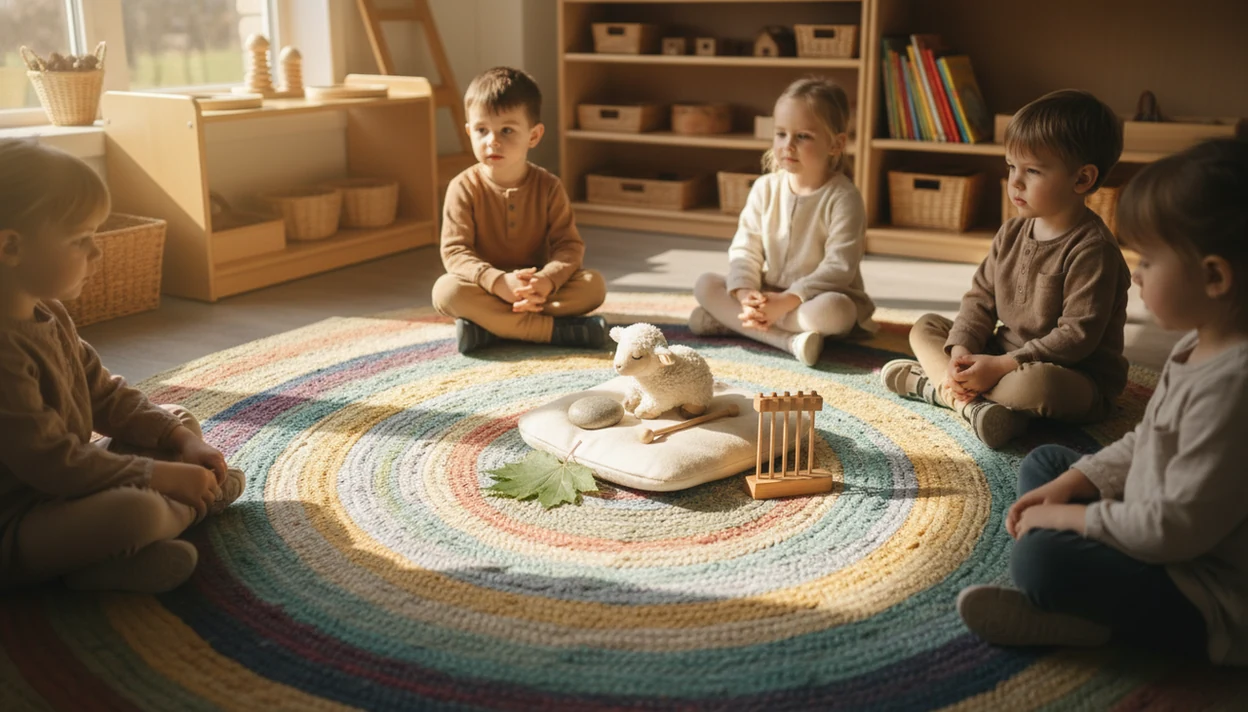
Mindfulness for kindergarten means helping 4- to 6-year-olds notice their breath, bodies, feelings, sounds, and surroundings through simple, playful activities. It is present-moment attention practiced with curiosity and without judgment. Children do not need to empty their minds, sit perfectly still, or meditate like adults. A useful starting point is one concrete invitation: “Feel your feet on the floor” or “Listen for one sound.”
Keep the practice secular, brief, and repeated: 30 seconds to 3 minutes is often enough. Belly breathing, listening games, sensory noticing, and movement pauses give children something they can actually do. The aim is to practice noticing, pausing, and choosing a next step, not to guarantee calm or secure obedience. At home or school, build the activity into a familiar routine and leave room for children to participate differently.
What mindfulness means for a 4- to 6-year-old
Mindfulness for kindergarten is present-moment attention practice, taught with words and activities young children can understand. In plain language, it means helping children notice what is happening right now in the body, breath, feelings, and room around them.
A widely used NIH-supported definition describes mindfulness as paying attention in the present moment, without judgment NCCIH overview. For a kindergartener, that becomes much simpler: “Let’s notice one breath, one sound, and one feeling.”
Children do not need to empty their minds. They do not need to sit like adults, close their eyes, stay silent, or “do it right.” A child may wiggle, hold a smooth stone, look at the carpet, or whisper what they hear.
The goal is noticing and returning. That’s enough.
Five principles for brief, playful practice
Before trying mindfulness with kindergarten children, adults should treat it as a small attention skill, not a behavior-control trick. The most useful practices are brief, sensory, repeated, and modeled calmly by an adult.
- Fact 1: Mindfulness is attention practice, not behavior control. It helps children notice a pause before choosing what to do next.
- Fact 2: Kindergarten mindfulness should be short, sensory, playful, and repeated. A listening game often works better than a lecture.
- Fact 3: Adult modeling matters more than explanation. Children copy the teacher who takes one slow breath after the classroom bell.
- Fact 4: Benefits are usually modest and skill-based, not instant transformation. A 2021 Frontiers in Psychology review found small but positive effects for school mindfulness programs on attention and mental health outcomes Full.
- Fact 5: Secular, inclusive language helps families and schools use mindfulness comfortably. Say “notice your breath,” not “practice a belief.”
The practice loop: Notice, pause, name, choose
Mindfulness for kindergarten works by giving children a tiny, repeatable loop: notice what is happening, pause for a moment, name it in simple words, and choose what to do next. That loop builds self-regulation, which means the child is practicing a little space between a feeling and an action.
Concrete sensory anchors work best because kindergarten children learn through bodies, objects, sound, and movement more easily than through abstract instructions. “Feel your feet on the floor” gives the mind a place to land; “calm your nervous system” is too invisible. A bell, a stuffed animal rising on the belly, three classroom sounds, or hands pressing together can become a cue the child recognizes.
The mechanism is repetition inside ordinary routines. One breath at arrival, a listening pause before circle time, or slow steps during a transition teaches the brain, “This is what we do when we shift.” Mindfulness may support calmer choices, but it should not force calm or make children hide big feelings. The adult’s body is usually the first lesson: children copy the teacher or parent who pauses, softens their voice, and names what they notice. At home, siblings can practice short shared pauses together, taking turns noticing a breath or sound.
Build noticing cues into arrival, recess, and bedtime
Kindergarten mindfulness works through repeated cue-and-response practice: notice a cue, pause, name an experience, then choose the next action. The simple loop is “notice, pause, name, choose.”
Young children need concrete anchors because abstract instruction fades fast. Breath, hands, sounds, colors, stuffed animals, floor spots, and movement give the mind somewhere to land. A child who cannot “calm down” may still be able to feel thumbs resting on chair arms or count three sounds in the room.
Use mindfulness inside routines children already know. Try one breath at arrival, a sound hunt before circle time, slow steps during a hallway transition, or hand-on-heart breathing before conflict repair. At home, it can sit beside pajamas and toothbrushing, not replace them. Families building a broader rhythm may also like a simple family mindfulness routine.
For kindergarten children, brief mindfulness activities build small noticing skills; they do not guarantee calm, obedience, or clinical treatment.
Plan a 30-second to 3-minute mindfulness activity
Use mindfulness for kindergarten by choosing one tiny practice, placing it in a predictable moment, and stopping while children can still succeed. Short and repeatable beats impressive.
- Set one tiny goal. Ask children to notice one breath, one sound, or one body feeling.
- Choose a predictable moment. Use morning meeting, transition time, after recess, or bedtime. For families managing screen time, a plan to reduce phone use can make room for predictable pauses and play.
- Model the activity first. Say simple words while showing visible actions, such as placing a hand on the belly.
- Practice for 30 seconds to 3 minutes. Stop before children become frustrated, silly in a strained way, or checked out. Treat this as a practical classroom range, not a clinical dose. If the group gets silly, tense, or glassy-eyed after 20 seconds, stop there and call the practice complete.
- Repeat daily and invite noticing. Ask, “What did you notice?” rather than “Did you calm down?”
Children may keep eyes open. They may move gently, hold an object, sit on a cushion that keeps sliding on hardwood, or stand near the edge of the group. For breath-based options, parent and child breathing exercises can help adults practice the language first.
Choose an activity for circle time, transitions, or bedtime
The easiest kindergarten mindfulness activities match the moment: movement for transitions, sensory noticing for circle time, and slow breathing for bedtime. Children who resist stillness often do better with touch, sound, walking, or watching.
| Classroom or home moment | Activity name | Time needed | Best use |
|---|---|---|---|
| Morning arrival | Five-senses noticing | 1 to 2 minutes | Helping children land in the room |
| Circle time | Listening bell or sound hunt | 30 to 60 seconds | Gathering attention without scolding |
| After recess | Hand-on-heart breathing | 1 to 2 minutes | Settling bodies after high-energy play |
| Transition line | Mindful walking | 1 to 3 minutes | Moving from one place to another with less rushing |
| Big feelings | Glitter jar watching | 2 to 3 minutes | Seeing how stirred-up feelings can settle |
| Bedtime | Belly breathing with a stuffed animal | 1 to 3 minutes | Noticing breath and body before sleep |
For bedtime specifically, bedtime meditation for children can give families a softer evening version.
Adult prompts that support noticing, not forced quiet
Kindergarten mindfulness works better when adults use concrete words, comfortable bodies, and praise for noticing rather than quietness. The practice should feel like a shared skill, not a test.
Use these five adult habits: 1. Simple words: Say notice, breathe, listen, feel, pause, and choose. 2. Concrete directions: “Feel your feet on the tile” works better than “regulate your nervous system.” 3. Comfortable participation: Let children keep eyes open, sit in a chair, stand, or hold a small object. 4. Noticing praise: Say, “You noticed your body wanted to move,” not “Good job being quiet.” 5. Early timing: Practice before overwhelm, not only during meltdowns. As children begin using digital spaces, mindful social media habits can extend noticing and pausing to online interactions.
Teacher language that keeps mindfulness secular
Try: “We are practicing paying attention.” Avoid language that suggests prayer, belief, or spiritual achievement. In a classroom, neutral words protect trust with families.
Parent language for home routines
Try: “Let’s take one quiet breath before shoes.” Tools like Mindful.net can support adults with beginner-friendly practices they can model, especially if the adult is still learning.
When to offer mindfulness and when to stop
Mindfulness fits kindergarten best as a short support for attention, transitions, and emotion vocabulary. It should support, not replace, sleep, classroom structure, caregiver connection, counseling, special education support, or medical care when needed.
| Best for | Not ideal for |
|---|---|
| Short transitions | Forcing quiet |
| Settling after high-energy play | Replacing behavior plans |
| Building emotion vocabulary | Treating anxiety or trauma |
| Practicing a pause before reacting | Managing severe aggression alone |
| Creating predictable calm moments | Making children suppress feelings |
A child who cries, freezes, panics, or becomes more distressed during inward-focus activities needs a different approach. Movement, drawing, sensory play, or adult co-regulation may fit better. If worries are frequent or intense, families may need guidance beyond a classroom activity; meditation for anxious kids covers gentle support without treating mindfulness as a cure.
Not every child likes quiet. That matters.
What school mindfulness research can and cannot show
The evidence for school mindfulness is promising but modest, so kindergarten mindfulness is best framed as foundational self-awareness and coping practice. It is not proof that early mindfulness prevents later mental-health crisis.
A 2021 systematic review in Frontiers in Psychology found small but positive effects of school mindfulness programs on attention and mental health outcomes across studies Full. That supports careful use in schools, especially when programs are developmentally appropriate.
Broader public-health data also show why early coping skills matter. Per the CDC 2023 Youth Risk Behavior Survey, 40.0% of U.S. high school students reported persistent sadness or hopelessness, and 20.4% seriously considered attempting suicide CDC guidance. Those numbers do not mean kindergarten mindfulness prevents later crisis. They do suggest children benefit from learning safe words and routines for noticing feelings early.
For kindergarten children, short sensory mindfulness is often easier than seated meditation because it matches their developmental need for movement, touch, and concrete cues. As children grow, mindfulness for elementary students can build on these sensory skills with practices suited to older classrooms.
School-wide findings are not kindergarten-specific proof
Research on school mindfulness often combines different ages, activities, and outcomes. A 2019 review of randomized trials involving children and adolescents found generally small benefits across several outcomes, including attention and executive functioning. That does not establish how much a particular kindergarten activity will help an individual child, or which activity is best for that age.
The comparison group also matters. In the MYRIAD trial in early adolescence, school mindfulness training did not improve mental health or well-being more than teaching as usual. This was not a kindergarten trial. Its practical lesson is to ask what mindfulness adds to existing support, rather than replacing emotion vocabulary, relationship skills, and predictable classroom routines.
Belly breathing with a stuffed animal: Caption and alt text
A useful image for this guide would show a kindergarten child lying down or sitting with a stuffed animal on the belly while practicing slow breathing. An adult should be nearby, modeling calmly rather than correcting the child.
Recommended caption: “A kindergarten child practices belly breathing with a stuffed animal, a simple secular mindfulness activity for noticing breath and body sensations.”
Recommended alt text: “Mindfulness for kindergarten activity with a child using a stuffed animal for belly breathing while an adult models calmly.”
Avoid images that make children look like miniature adults in long silent meditation. Also avoid religious symbols, clinical treatment scenes, dramatic before-and-after moods, or perfectly still rows of children. A blanket over crossed legs is fine if it looks ordinary and comfortable. The image should say, “small practice in a real room,” not “performance.”
If children need more movement, a visual of slow walking around floor dots can be just as accurate.
Can a breathing timer help with a kindergarten pause?
During a short classroom or bedtime pause, an adult can use Mindful.net’s free breathing timer to guide their own demonstration while children notice a comfortable breath. Keep the exercise optional and avoid asking children to match a pace that feels difficult. A listening game, movement pause, or object to look at is a better choice when breath attention feels uncomfortable or the timer distracts from the activity.
Kindergarten Mindfulness Limits
- Mindfulness is not a standalone treatment for anxiety, trauma, ADHD, developmental concerns, or major behavior problems.
- Results are often modest and vary by child, adult modeling, setting, and consistency.
- Avoid forced mindfulness, and offer movement or sensory alternatives when children dislike silence, closed eyes, or inward focus.
- When distress is frequent, intense, or unsafe, involve the family and qualified school or health professionals.
Kindergarten mindfulness questions
How do you explain mindfulness to a kindergartener?
Try: “Mindfulness means noticing what is happening right now.” Then give one concrete task, such as feeling feet on the floor or hearing a sound in the room. Avoid abstract explanations. Children can practice noticing without understanding meditation vocabulary, and they do not have to feel calm afterward.
How long should a kindergarten mindfulness activity last?
Start with 30 seconds and keep most activities within 3 minutes. One sound or one comfortable breath can be enough. Stop before the exercise becomes frustrating or children lose interest. A short activity repeated at a familiar time is more appropriate than asking young children to sit silently for a long session.
What are easy mindfulness activities for kindergarten?
Try listening for one sound, noticing colors in the room, feeling feet touch the floor, or watching a stuffed animal rise and fall on the belly during comfortable breathing. Choose one activity at a time. Movement and sensory activities are useful alternatives for children who do not enjoy sitting still.
Should children close their eyes during mindfulness?
No. Children can keep their eyes open and look at an object or a spot in the room. They can also sit, stand, or use a movement activity. Eye closure is not a measure of successful participation, and inward attention may feel uncomfortable for some children.
What should a teacher do if a child refuses mindfulness?
Offer a non-punitive alternative, such as drawing, quiet independent activity, or noticing objects nearby. Do not require the child to explain feelings publicly or reward only stillness. When a practice brings tears, panic, freezing, or increasing distress, stop it and follow the school’s support and safeguarding procedures.
Does mindfulness improve kindergarten classroom behavior?
It may support attention and practicing a pause before acting, but it is not a behavior-control method. Reviews across school-age groups report modest and inconsistent benefits, not guaranteed behavior improvement. Keep classroom structure, relationship skills, and individual support in place rather than expecting a breathing exercise to solve persistent difficulties.
Is mindfulness appropriate in a secular kindergarten classroom?
It can be taught as nonreligious attention practice, using ordinary language about sounds, movement, breathing, and feelings. Explain the activity to families, follow school consent requirements, and provide reasonable alternatives. Avoid religious claims, forced participation, physical contact, or grading children on how calm they appear.
When is the best time to use mindfulness in kindergarten?
Choose a predictable moment, such as arrival, circle time, a transition, or after recess. Match the activity to the situation: movement for a transition, listening to gather attention, or sensory noticing to settle into the room. Do not reserve mindfulness for punishment or introduce it only when a child is already overwhelmed.