
Reducing Kids Phone Use Without Constant Fights


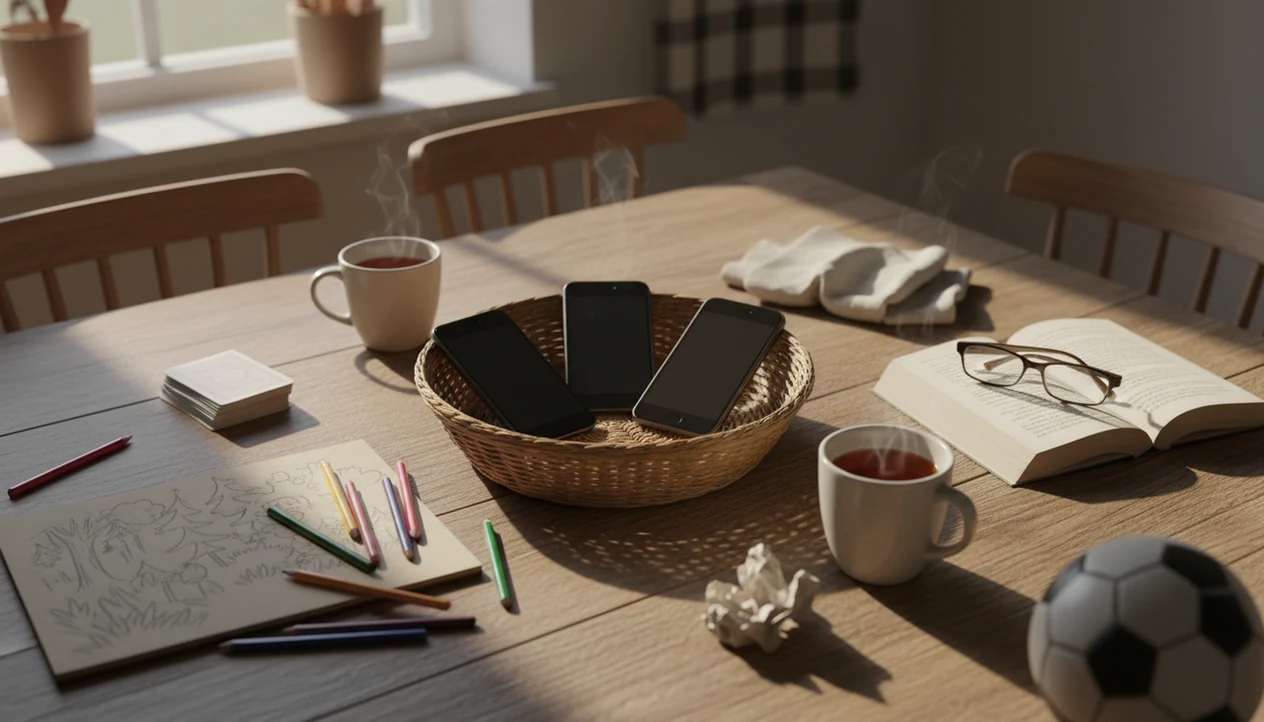
Reducing kids phone use starts with a family media plan: protect bedtime and meals, model the limits you set, and offer specific offline activities. The aim is not zero screens. It is intentional use that leaves room for sleep, schoolwork, movement, friendships, and family connection. Getting kids off their phones means helping children and teens replace automatic checking with clear limits, brief pauses, and healthier routines. Explore kids and family meditation for shared practices that help parents and children build calmer routines together.
Start with one recurring problem, such as scrolling in bed or checking messages during homework. Agree on where the phone goes, when it can come back, and what happens instead. A named alternative, such as walking the dog or meeting a friend, gives a child something to do, not just something to stop.
The essentials
- Set phone rules around sleep, meals, homework, bedrooms, and school nights before negotiating app-by-app limits.
- Replace phone time with specific alternatives: outdoor time, friends, sports, chores, creative projects, reading, or family activities.
- Use mindfulness skills to help kids notice the urge to check, pause before unlocking, and choose what they actually want to do next.
What Getting Kids Off Phones Means for Sleep, School, and Family Life
Getting kids off phones means changing the default: fewer automatic pickups, clearer family rules, and more offline time that actually feels worth choosing. For most families, the aim is balanced use, not a dramatic total ban.
The core problem is displacement. Scrolling, gaming, texting, and notification checking can crowd out sleep, homework, movement, hobbies, chores, and face-to-face relationships. A child may not be “bad with screens.” They may be stuck in a loop that is easy to start and hard to stop.
A secular mindfulness angle helps here. Kids can learn to notice the impulse, pause for one breath, and choose on purpose. Attention and self-regulation are the goals of everyday mindfulness and beginner meditation, not instant obedience or a phone-free household.
Small pauses count.
Five Facts Parents Need Before Setting Phone Limits
Before setting limits, parents need a plan that changes the environment, not just the child’s willpower. A phone rule works better when the house makes the healthier choice easier.
- Modeling is part of the intervention. Kids notice when adults check messages during dinner, in the car, or mid-conversation. A parent’s phone basket matters as much as the child’s.
- Clear rules beat vague nagging. “Phone charges in the kitchen at 8:30” is easier to follow than “Don’t be on that thing so much.”
- Removal needs replacement. Outdoor play, music practice, a sketchbook, walking the dog, sports, reading, and friend time give the brain somewhere else to go. Try mindfulness games for kids as playful offline activities that help children practice attention without reaching for a phone.
- A pause gives kids a chance to choose. Naming the urge, such as “I want to check because I’m bored,” can help a child practice waiting before unlocking. For younger students, elementary mindfulness practices can make noticing feelings and waiting before checking easier to practice.
- Environment design reduces conflict. Device-free meals, bedrooms, and homework blocks prevent daily arguments from restarting. For younger kids, meditation for kids can make the pause simple and concrete.
For many families, the easiest first win is a charging station outside bedrooms.
How Phone Pull Works in Kids and Teens
Phone pull works through habit loops: a cue appears, an urge rises, and the child responds by tapping, swiping, replying, or playing. Notifications, streaks, social pressure, games, and short videos all use variable rewards, which means the next check might bring something interesting.
In a large U.S. survey, 72% of teens said they often or sometimes feel the need to immediately respond to phone notifications Teens Their Experiences On Social Media. That pressure lands hardest during boredom, emotional stress, and bedtime. At night, there is less structure, less adult supervision, and more worry about being left out.
Mindfulness interrupts the cue-urge-response loop. A child notices the buzz, the tight feeling of wanting to check, and the hand moving toward the screen. Then they practice one pause before deciding.
That moment is teachable.
How to Get Kids Off Their Phones: A 6-Step Family Plan
The most practical way to get kids off their phones is to make a short family plan, practice it for one week, then adjust. Start with the highest-friction moments first.
- Audit current use. Write down when phone fights happen: bedtime, homework, car rides, meals, after school, or weekend mornings.
- Set nonnegotiables. Protect sleep, meals, schoolwork, bedrooms, and school nights before debating every app.
- Create device-free routines. Put chargers in a shared space, use a kitchen basket, and keep bedrooms phone-free overnight.
- Replace screen time. Offer named options: basketball, library books, cooking, bike rides, board games, chores with music, or a friend meet-up.
- One breath before checking. Invite your child to breathe slowly once and say why they want to open the phone.
- Review weekly. Adjust rules by age, school needs, safety, maturity, and how much conflict is improving.
For bedtime specifically, a short routine like bedtime meditation for children can replace the last scroll.
Best Phone Boundaries for Ages, Gamers, and School Needs
The best phone boundary depends on age, maturity, school demands, and why the phone is hard to put down. The American Academy of Pediatrics recommends a family media plan and says media should not replace sleep, physical activity, or other health behaviors Mediaplan.Aspx.
| Situation | Boundary that usually fits | Watch for |
|---|---|---|
| Younger children | Parent-held devices, short sessions, co-viewing, no bedroom access | Tantrums after abrupt endings |
| Preteens | Shared charging spot, app limits, homework-first rule | Secret use on spare devices |
| Teens | Collaborative rules, sleep protection, driving and school rules | Rules that feel like surveillance only |
| Highly social kids | Reply windows, group chat breaks, phone-free meals | Fear of missing out |
| Gamers | Finish-at-checkpoint warnings, scheduled game blocks | “One more round” loops |
| School or safety needs | Essential access only during set times | Schoolwork drifting into scrolling |
For older children, collaboration matters. Trust-building often works better than enforcement alone.
Ask what the phone time is doing, not just how long it lasts
An hour spent talking with a supportive friend is not the same as an hour of compulsive checking or upsetting content. Before changing a limit, ask what your child is doing, how they feel afterward, and what the activity replaces. The APA advisory on adolescent social-media use emphasizes content, developmental stage, supervision, and interference with sleep or physical activity, rather than treating all use alike.
For children around ages 10 to 14, the APA recommends ongoing adult review, discussion, and coaching, with more independence as skills and responsibility develop. Make that concrete: discuss upsetting posts, agree on what can be shared, and decide whom to contact when something feels unsafe. Explain what you will check and why. Collaborative monitoring respects privacy; it is different from secret surveillance. Practicing mindful social media habits helps children pause before posting and consider how their words affect others.
Mindful Scripts for Phone Transitions and Meltdowns
Short scripts help parents stay steady when the phone becomes the whole argument. Use calm words, predictable timing, and a next activity the child can actually do.
In real life, this may sound like a slammed bedroom door, a child clutching the phone case, or a parent reaching for the charger while trying not to raise their voice.
- “Before you open it.” “Take one breath, then tell me what you want to check.” Tell me what you’re checking, then decide.”
- “Name the feeling.” “You’re angry the game is ending. I get it. The phone still charges now.” Simple affirmations for kids can reinforce self worth while reminding children that difficult feelings do not define them.
- “Offer a bridge.” “Save the video, then meet me at the table for snack.”
- “Hold the line.” “I’m not changing the rule during yelling. We can talk after your body settles.”
The 10-second pause before unlocking
Try a quick “why now?” pause: have your child notice the pencil texture in their hand, take one breath, and say, “I’m reaching for my screen because…” Tools like Mindful.net, Calm, and Headspace can support beginner pauses, but the skill also works without another app.
The two-minute transition warning
Say, “Two minutes, then the phone goes to the charger.” If emotions run hot, a short calm down meditation for kids can help the next transition.
Mindfulness can build attention, but it does not guarantee fewer checks
A child who takes a breath before checking a notification is practicing attention, not proving obedience. A 2018 review of randomized mindfulness trials with young people found small average benefits for attention, executive functioning, anxiety or stress, depression, and negative behavior. Those findings support mindfulness as a possible skill-building aid, not a promise that a child will stop checking their phone.
Keep the goal separate from the rule. The rule might be that phones charge outside bedrooms; the practice is noticing an urge and choosing what to do next. A child can still dislike the rule while learning that skill. Do not judge progress by immediate calm or compliance, and do not substitute meditation for assessment when anxiety, low mood, or daily functioning remains a concern.
Common Phone-Limit Mistakes That Create Power Struggles
The fastest way to create a power struggle is to remove the phone suddenly with no replacement plan. A hard reset can help in some homes, but boredom, anger, and loopholes rush in if nothing fills the gap.
Parental-control apps are useful guardrails, not the whole solution. Kids still need reasons, routines, modeling, and practice tolerating the urge to check. Tech-savvy kids may also find workarounds, especially if the rule feels unfair or secretive.
Rules parents do not follow are another weak spot. If dinner is phone-free, adult phones need a home too. A buzzing work phone on the table says more than a lecture.
Avoid negotiating during meltdowns. Also avoid vague limits like “less phone.” Not all screen time is harmful, either. High-quality, supervised, balanced use can support learning, creativity, and connection.
Phone Plan Progress Signs for Sleep, School, and Conflict
“How do I know if the phone plan is working?” Look for better sleep, easier transitions, less secrecy, more offline interests, fewer fights, and more intentional use.
A weekly family check-in is more useful than tracking flawless compliance. Ask three plain questions: What rule helped? What rule caused the most conflict? What needs adjusting for school, friends, or safety this week? The AAP recommends a family media plan, and the strongest plans are living agreements, not one-time punishments.
Track patterns like field notes. For teens, a short meditation for teens practice can make the “notice and return” skill feel less childish.
Families can also use beginner practices in the Mindful.net Mindfulness Practices App to rehearse pauses and transitions. It is optional support, not a required fix.
When to Get Professional Help for Phone Use
Get professional help when phone conflict starts looking less like a habit problem and more like a safety, mood, school, or behavior concern. Phone limits can support a child, but they are not treatment for anxiety, depression, ADHD, trauma, or a crisis.
Watch for red flags such as talk of self-harm, threats to hurt someone else, school refusal, severe isolation, major mood changes, or aggression that feels unsafe. Also pay attention when a child cannot sleep, function, attend school, or connect with anyone offline even after the family plan becomes calmer and more consistent.
- Notice what changed, including sleep, grades, friendships, appetite, anger, secrecy, and how long the pattern has lasted.
- Ask your child directly and calmly what feels hard, without turning the whole talk into a phone lecture.
- Contact a pediatrician, therapist, or school counselor if you are worried or unsure what you are seeing.
- Seek urgent help right away if your child may harm themselves or someone else.
You do not need to prove the phone caused the problem before asking for support.
Can a breathing pause help when phone time ends?
When a game ends and an argument starts, a brief breathing pause can give parent and child time to choose their next words. The site's free breathing timer can guide that pause; the Mindful.net app also offers short guided meditations and breathing exercises. Neither replaces a clear stopping rule, an offline activity, or professional support when distress or unsafe behavior persists. Keep breathing practice optional, not a condition for getting the phone back.
Phone Boundary Limits
- Phone limits must fit each child's needs and circumstances, and this guide is not a diagnosis or treatment plan.
- Screen time research is often correlational, and the JAMA study found an association, not proof of causation.
- Seek a qualified clinician or school support team for severe aggression, isolation, school refusal, self harm concerns, or major mood changes.
- A family mindfulness routine may help, but mindfulness and boundaries cannot replace needed professional support.
Kids and phone limits: common questions
How much phone time is too much for a child?
There is no single limit that fits every age, school requirement, or family situation. Look at what phone use displaces: sleep, movement, schoolwork, and relationships. Also ask whether your child can stop. Hours alone do not establish a problem; persistent distress, loss of control, and disruption to daily life matter more.
Should I take my teenager's phone away?
Confiscation alone does not teach a teen how to manage checking, boredom, or social pressure. For routine conflicts, explain the boundary, agree on a stopping time, and identify what happens next. Safety concerns may require firmer restrictions. Keep those restrictions tied to the concern rather than using indefinite removal as a blanket punishment.
How do I stop my child scrolling in bed?
Set a predictable overnight charging place outside the bedroom and agree on when the phone moves there. Apply the sleep boundary to adult phones too. Discuss school and safety needs before the rule starts, so they do not become nightly arguments. Persistent sleep problems deserve attention beyond changing the phone's location.
What should I do when my child has a meltdown over phone limits?
Acknowledge the feeling without reopening the whole rule: “You're angry the game is ending. The phone still charges now.” Offer a concrete next step, such as saving progress and joining you for a snack. Keep breathing practice optional. Aggression that feels unsafe or severe, persistent distress calls for professional support.
Do parental controls reduce phone use?
Parental controls can support app limits and device-free periods, but they are guardrails rather than a complete plan. Explain what is restricted and why, then pair the settings with adult modeling and offline options. Children may find workarounds. Review the rules together instead of assuming a technical restriction has solved the problem.
Why does my teen feel they must reply to every message?
Notifications and social pressure can make replying feel urgent, even during homework or bedtime. Ask what your teen expects will happen if they wait. Agree on times for checking messages, reduce unnecessary notifications, and discuss how they can tell friends they are unavailable. The aim is manageable communication, not cutting off friendships.
Can mindfulness help a child stop checking their phone?
Mindfulness may help a child notice the urge to check and practice waiting before acting. Research with young people shows small average benefits for attention and some emotional outcomes, not guaranteed reductions in phone use. Pair a brief, voluntary practice with clear routines. It is not a replacement for mental-health care when needed.
How can I tell if my child's phone use needs professional help?
Seek assessment when compulsive checking, sleep disruption, school decline, isolation, anxiety, or low mood persists and interferes with daily life. Heavy use alone is not a diagnosis. Self-harm thoughts or behavior, threats, abuse, or an immediate safety concern require urgent local crisis or emergency support, not just stricter phone rules.