
Empathy Development in Children: How Brain Skills Become Caring Actions


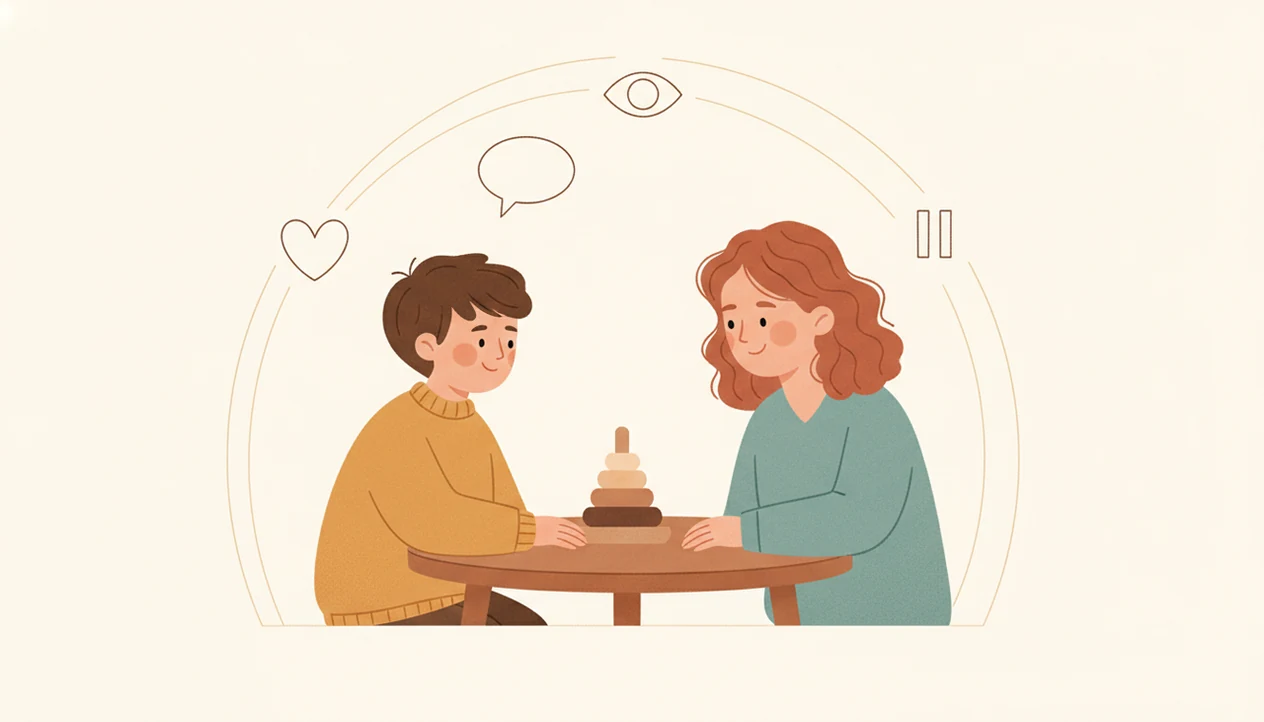
Empathy development in children is the gradual growth of skills that help them notice feelings, understand another person’s perspective, and respond with care. It depends on emotion, language, self-control, and perspective-taking working together, not on a single brain switch. Babies may react to another person’s distress; older children learn that someone else can have different beliefs, wishes, and feelings.
Caregiving and repeated practice help children turn those developing abilities into useful responses. Naming a feeling, considering what a sibling wanted, or helping repair a broken block tower gives empathy a concrete purpose. A child can understand another person’s feelings and still need help pausing before acting. The practical aim is to support noticing, understanding, and repair, rather than demand an immediate performance of kindness.
The essentials
- Empathy develops in stages, from early emotional contagion to mature perspective-taking and caring action.
- Brain maturation matters, especially networks involved in emotion, language, self-control, and theory of mind.
- Caregivers support empathy best through modeling, feeling words, warm correction, and repeated real-life practice.
Three parts of empathy: feeling, understanding, and helping
What is how children develop empathy brain? It means how a child’s growing brain learns to notice another person’s feelings, understand that person’s point of view, and choose a caring response.
A useful way to explain it is in three parts. Emotional empathy is feeling or reacting to someone else’s emotion, like a toddler looking worried when a sibling cries. Cognitive empathy is understanding what another person may think or feel, even when it differs from the child’s own view. Compassionate action is the next step: bringing a tissue, saying sorry, giving space, or asking, “Do you want help?”
Empathy is developmental, not a fixed personality trait. A child who grabs a toy at three is not “missing empathy” forever. Age ranges are approximate, too. Temperament, stress, culture, language, disability, caregiving, and classroom climate all shape how empathy appears.
The toy still matters at age three.
Five facts about children’s empathy brain skills
- Empathy changes across childhood and adolescence. Children’s empathy brain skills keep developing as emotion, language, memory, and self-control systems mature.
- Early distress is not full perspective-taking. A baby crying when another baby cries may be showing emotional contagion, not a clear understanding of another mind.
- Self-control helps concern become action. A child may feel bad after hurting someone, but still need adult help to pause, repair, and try again.
- Warm relationships support empathy practice. Caregivers build empathy through modeling, naming feelings, steady correction, and real conversations after everyday conflicts.
- Adolescence remains important. A neuroscience review identifies adolescence as a pivotal period because social awareness, identity, biology, and peer relationships are still changing.
For families, the practical next step is simple: treat empathy as a skill to rehearse, not a trait to praise or shame. A steady family mindfulness routine can create more small chances to notice feelings before reacting.
How emotion, language, and self-control work together
Children develop empathy as several brain-and-behavior systems learn to work together. Emotion recognition helps a child notice a face, voice, or posture; language gives the feeling a name; self-control creates a pause; and perspective-taking helps the child imagine that another person’s inner world may be different from their own.
The process is built through repetition, not one big lesson. A baby may first show emotional contagion, such as crying because another baby cries. Over time, with warm caregiving and social practice, the child can move toward more mature empathy: understanding what happened, caring about the other person’s experience, and choosing repair.
- Notice the emotional cue: “He looks sad.”
- Name the feeling or need: “Maybe he wanted a turn.”
- Pause the impulse to defend, grab, or run away.
- Imagine the other person’s view, even if it differs from the child’s own.
- Repair with a helpful action, such as returning, rebuilding, apologizing, or giving space.
Developmental research on theory of mind shows that children’s ability to understand other people’s beliefs strengthens alongside brain development in networks that support language, social reasoning, and self-regulation.
Brain networks behind children’s empathy development
Children’s empathy does not come from one “empathy center.” It depends on several brain systems working together: emotion recognition, language, self-regulation, memory, and perspective-taking. Research on nature and the meditation brain offers related context, without explaining how children develop empathy.
One key developmental skill is theory of mind, which means understanding that other people can have thoughts, beliefs, and feelings different from your own. A classic marker is false-belief understanding. In one study, children recognized false beliefs around age 4 on average, a pattern described in classic theory-of-mind research on false-belief tasks (APA research). A related brain-imaging finding linked success on a false-belief task with maturation of the arcuate fasciculus, reported in developmental neuroimaging work on false-belief understanding and white-matter connectivity (NIH research), a white-matter pathway involved in connecting language and social understanding.
In plain language, the brain has to coordinate “What do I feel?” with “What might they feel?” and “What should I do next?” That is a lot for a young child. It explains why a preschooler may comfort a friend one day, then shout “Mine,” the next.
For young children, adult coaching is often more useful than a long lecture because the brain skill is still under construction.
Coach empathy after a conflict, once your child is calm
Use empathy brain tips as a short repair routine, not a speech about character. The best time is after the child has enough calm to hear you and try one small next step.
- Wait until the child’s body has settled a little. That may mean water, space, breathing, or a quiet minute beside you before any teaching begins. A quiet pause also raises questions about mindfulness and perception of time, a separate topic from empathy development.
- Name what you can see without shame or diagnosis: “You looked really angry when the tower fell,” or “Your voice got loud when he took the truck.”
- Ask one brief perspective question about the other person: “What do you think she wanted?” or “How might that have felt for him?” Keep it short enough for a tired child to answer.
- Offer two repair choices the child can actually do: “You can help rebuild it, or you can bring the block back.” A real repair beats a forced apology performed through clenched teeth.
- Repeat the same routine during ordinary conflicts: snack disputes, turn-taking, bumping past a sibling, leaving someone out. Small repetitions teach the brain pattern better than rare, dramatic talks.
Five home practices for children’s empathy brain growth
Use empathy practice in ordinary moments, not only after big arguments. These steps work at a kitchen table, in a car seat, or during a tired hallway standoff.
- Model kindness out loud: “I’m going to check if your sister is okay because she looks upset.”
- Name feelings with simple words: “You look disappointed,” or “He may feel left out.”
- Ask perspective questions after the child is calm: “What do you think she wanted?” and “What did you want?”
- Coach repair with choices: “You can give the block back, help rebuild, or say, ‘I’m sorry I knocked it down.’”
- Practice calm attention before talking: “Put your feet on the floor and take three slow breaths with me.” Evidence on mind wandering and happiness offers broader context for attention, but does not establish benefits for children’s empathy.
Quiet breathing is not a character lecture. It gives a child a little more room to notice what is happening inside and come back before the repair conversation. For younger kids who need the pause to feel concrete, parent and child breathing exercises can make that moment easier to practice together.
Developmental timeline for children’s empathy brain abilities
Children’s empathy develops in broad waves, not exact deadlines. Timelines vary by temperament, culture, stress, language, disability, caregiving, and relationships.
| Age band | Common empathy-related abilities | What adults may notice |
|---|---|---|
| Infants and toddlers | Emotional contagion, comfort-seeking, early helping | A toddler may pat a crying parent, bring a toy, or cry when another child cries. |
| Preschoolers | Feeling words, turn-taking, early theory of mind | A child may start saying “She thinks it’s hers,” but still need help sharing. |
| School-age children | Stronger perspective-taking, often around ages 6 or 7 | Children may better understand fairness, intentions, and how actions affect friends. |
| Adolescents | Continued cognitive, social, and biological development | Teens may show deeper concern for peers, identity groups, and social causes. |
Developmental psychology summaries commonly describe stronger perspective-taking and cognitive empathy in the early school years, often around ages 6 or 7 (Executive Function). Still, growth continues. A seven-year-old may understand another point of view and still slam a door when embarrassed.
For teens, meditation for teens may support attention and self-regulation, but it should sit alongside trust, conversation, and clear family limits.
When empathy exercises help, and when they become pressure
Empathy exercises fit best when they help a child practice noticing, pausing, understanding, and repairing. They fit poorly when adults use them to shame, diagnose, or force a performance of caring.
| Fit | Use empathy brain exercises for | Avoid using them for |
|---|---|---|
| Everyday family routines | Naming feelings at dinner, bedtime, or after a rough transition | Turning every mistake into a long emotional debrief |
| Classroom moments | Helping children consider how a classmate felt | Publicly pressuring a child to “show empathy” |
| Sibling conflict | Pausing, naming wants, and coaching repair | Forcing instant apologies before the child is regulated |
| Beginner mindfulness | Quiet breathing or mindful pauses before repair talks | Replacing professional support when a child needs evaluation or care |
Mindfulness and meditation can support attention and self-regulation, but they cannot make a child respond kindly on command. Evidence on mindfulness and inflammation concerns stressed adults, so it should not be treated as proof about children’s empathy.
Common myths about children’s empathy brain growth
Myth 1: Children either have empathy or they do not. Empathy is better understood as a developing set of brain-and-behavior skills. A child can be caring in one setting and impulsive in another.
Myth 2: Crying when someone cries proves mature empathy. That reaction may be emotional contagion. Mature empathy also involves understanding another person’s perspective and choosing a helpful response.
Myth 3: Lectures teach empathy effectively. Short explanations can help, but repeated modeling and warm correction usually teach more. A brief, specific correction is often easier for a child’s brain to use.
Myth 4: Mirror neurons explain empathy by themselves. Mirror systems may help people resonate with actions or emotions, but empathy also depends on language, attachment, self-regulation, memory, and social learning.
For many children, a practical pause before repair is easier than a speech about character because the child’s attention system is still catching up.
Mindfulness practices that support children’s empathy brain habits
Mindful pauses can support empathy by helping children notice feelings before they react. That pause might be a Three-Breath Reset during school pickup, one hand resting over the chest after a sibling argument, or a quiet moment noticing a fluttering stomach while the ceiling fan wobbles overhead.
Try simple, secular practices. Use hand-on-heart breathing for one minute. Ask for a feeling check-in: “Mad, sad, worried, or okay?” Offer kind wishes: “May he feel safe. May I feel calm.” Practice repair phrases: “I’m sorry I grabbed it,” or “Can I try again?”
Mindfulness supports practice, but it does not guarantee empathy. Children still need modeling, limits, and chances to repair real harm. Mindful.net is a mindfulness app that teaches mindfulness practices and meditation techniques for beginners and everyday life, and a family can also keep practice simple with a few quiet minutes cued by a familiar routine, such as finishing a mug of tea or closing down the evening cleanup.
For a broader starting point, meditation for kids can help families compare short practices by age and attention span.
What mindfulness research says about helping others
A 2018 systematic review and meta-analysis of mindfulness and prosocial behavior examined 31 studies involving 17,241 participants. It found positive associations in both correlational and intervention studies, with effect sizes of d = .73 and d = .51, respectively. The authors cautioned that the mechanisms and the contexts in which mindfulness supports prosocial behavior remain uncertain. For another research topic, evidence on meditation and gene expression addresses biological changes rather than children’s empathy development.
These findings concern prosocial behavior, not a guaranteed change in a particular child’s empathy. They do not establish that a breathing exercise automatically produces understanding or kindness. In a family conflict, a pause can be paired with a concrete choice: ask what happened, consider what the other child wanted, then offer help or set a boundary. Keep the response specific rather than asking the child to feel positive.
Show empathy practice, not a glowing brain
Use a warm, everyday image rather than a brain scan. A good visual would show a caregiver sitting near two children after a conflict, helping them name feelings and consider what each person wanted.
Suggested caption: A caregiver helps two children practice empathy by naming feelings, asking perspective-taking questions, and choosing a caring action after a conflict.
Avoid glowing-brain imagery that suggests one empathy center controls the whole process. The educational point is more practical: children learn empathy through emotion, language, self-control, and relationship practice. Sock feet under a chair, a toy between them, and an adult staying calm can say more than a dramatic neuroscience graphic.
Children’s Empathy Limits
- There is no single brain switch that turns children’s caring behavior on or off.
- Brain maturation alone cannot guarantee caring behavior, children also need modeling, language, practice, and limits.
- Mirror-neuron explanations are incomplete and cannot explain the whole story of empathy development.
- Quick-fix empathy exercises are not supported as replacements for consistent caregiving.
Children’s empathy questions
When does empathy start in children?
Early empathy-related reactions appear in infancy, such as becoming distressed when another baby cries. This is not the same as understanding another person’s perspective. Across childhood, children develop feeling words, self-control, and the ability to consider other minds, with caregiving and practice helping them respond with care.
Can toddlers feel empathy?
Toddlers can show concern, seek comfort, or offer a toy to someone who is upset. They can also become distressed themselves. These responses are early parts of empathy, but toddlers still need adult help understanding what happened and choosing a useful action. One caring moment does not mean consistent perspective-taking.
What is the difference between emotional contagion and empathy?
Emotional contagion means reacting to another person’s emotion, such as crying when someone else cries. More developed empathy also includes understanding that person’s feelings or perspective. A child who shares someone’s distress may still need help figuring out what the person needs and how to respond.
Is there one part of the brain that controls empathy?
No single empathy center explains the whole process. Empathy involves several systems supporting emotion recognition, language, memory, self-control, and perspective-taking. Brain maturation matters, but it does not guarantee caring behavior. Children also need relationships, examples, clear limits, and repeated opportunities to practice helping or repairing harm.
How can I teach empathy after my child hurts a sibling?
Wait until your child is calm enough to listen. Describe what happened without labeling the child as bad, then ask one short question about the sibling’s perspective. Offer a concrete repair choice, such as returning a toy or helping rebuild. Avoid turning the moment into a long lecture or forcing an instant apology.
Why does my child seem caring sometimes but not others?
Empathy is a developing set of skills, not a trait children either have or lack. A child may understand someone’s distress but struggle to pause during an argument. Stress, language, temperament, and relationships can affect how those skills appear. Look at the situation and offer specific help rather than judging character.
Can mindfulness help children develop empathy?
Mindful pauses can help children notice feelings before reacting, giving them a chance to consider another person’s perspective. That is support for empathy, not a guarantee of kindness. Pair a brief pause with a practical response, such as asking what happened, offering help, or repairing harm.
Should I make my child apologize to teach empathy?
An apology can be part of repair, but forcing the words does not necessarily show understanding. Once your child is calm, explain the effect of the action and offer repair choices. Returning something, helping fix damage, giving space, or saying a specific apology can make the lesson more concrete.