
Mindfulness in Schools for Teens: Practical Skills, Choices, and Evidence


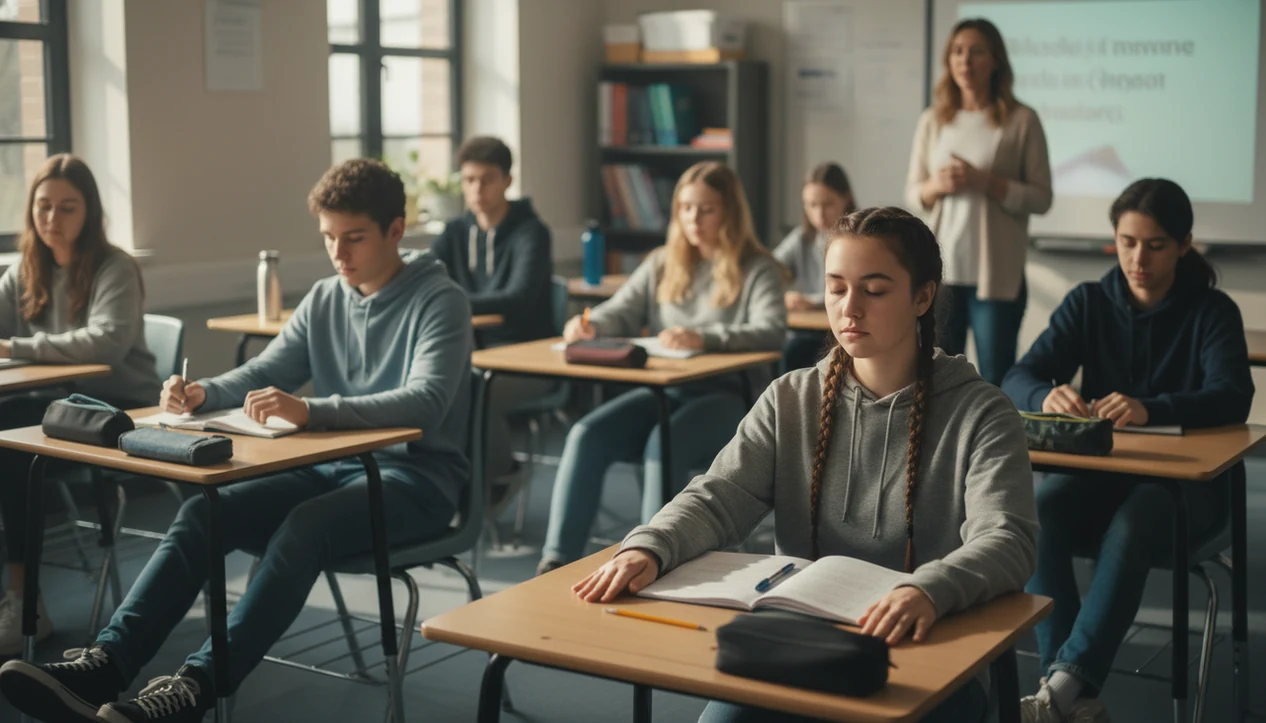
Mindfulness in schools for teens teaches short, secular attention skills for stress, exams, conflict, and everyday classroom life. Students practice noticing breath, body sensations, thoughts, and emotions in the present moment with curiosity rather than harsh self-judgment. The aim is practical mental training, not therapy, religion, or a demand that everyone become calm.
Keep classroom practices brief, predictable, and trauma-aware, with genuine choices about participation. Advisory, homeroom, health, and PE can provide familiar places to practice. Research suggests modest benefits for attention and some mental health outcomes, but results vary. Connect each exercise to a recognizable moment, such as starting a test, pausing before a heated reply, or settling after lunch. Mindfulness should support existing school care, not replace it.
Definition: Mindfulness in schools for teens means teaching students to notice breath, body sensations, thoughts, and emotions in the present moment with curiosity and without harsh self-judgment.
What matters most
- School mindfulness works best when it is secular, optional-feeling, brief, and built into familiar times such as advisory, homeroom, health, or PE.
- Research suggests small but meaningful benefits for stress, attention, emotional regulation, resilience, anxiety, and depressive symptoms, but it is not a replacement for mental health care. Families can reinforce these school skills with practical tips for raising resilient teens at home.
- Teens are more likely to use mindfulness outside class when practices connect to real moments: tests, social media stress, friendship conflict, anger, sleep, and overwhelm.
What school mindfulness can, and cannot, do for teens
- School mindfulness is secular attention training. It teaches teens to notice breath, posture, body sensations, thoughts, and emotions without turning the lesson into therapy or religion.
- Common practices are short and practical. Breathing pauses, body scans, mindful movement, mindful listening, and transition resets fit better than long silent sits.
- High-quality programs avoid coercion. They leave out religious language, rituals, symbols, forced eye-closing, and “everyone must be calm now” pressure.
- The evidence is promising but modest. Studies generally show small to moderate, or small but significant, improvements rather than dramatic changes.
- Mindfulness is a support skill, not a whole student-wellbeing plan. It does not replace counseling, crisis care, special education services, safeguarding, or better school climate work.
A teen may use it before a quiz, then forget it by lunch. That is normal.
How noticing and returning practice attention
Mindfulness in schools helps teens practice attention and emotion regulation through repeated noticing and returning. A student might notice the mind drifting during a class discussion, then come back to a neutral anchor such as breath, sound, posture, slow movement, or the feeling of both legs supported.
The process is simple, but it is not shallow. Practice builds the loop of “notice, pause, return,” much like a teacher quietly checking a clipboard and redirecting the room without turning it into a lecture. Emotion regulation adds a small space between a trigger, the body’s reaction, the thought that follows, and the next response.
Repetition matters more than session length. One three-minute breathing pause before opening a laptop may teach more than a rare 30-minute assembly. In classrooms, these skills can support transitions, tests, conflict, impulsive reactions, and overstimulation. Benefits depend on delivery quality, student trust, and a safe school context. A loud hallway can undo a lot.
Classroom mindfulness gives teens repeatable attention skills, not a promise of instant calm, a way to enforce compliance, or a substitute for care.
2022 research on mindfulness in schools for teens
A 2022 systematic review of 77 studies found small but significant mental health improvements from mindfulness-based school interventions, including reductions in anxiety, depression, and stress, plus gains in well-being PMC research article. The same research base reports small but statistically significant effects on cognitive performance and resilience in children and adolescents.
The review also notes that school mindfulness studies vary in program length, instructor training, outcome measures, and follow-up time, so the evidence is better read as supportive than conclusive.
The American Psychiatric Association has summarized school mindfulness programs as associated with improvements in thinking, resilience, emotional regulation, awareness, overall mental health, attention problems, stress, and depressive symptoms Student Well Being And Mindfulness Programs. That is supportive, not a cure claim.
Some individual school-based studies report larger improvements for specific student groups, but those results should not be generalized to every teen or every school.
For school leaders, brief repeated practice is often easier to sustain than a one-time wellness event because it fits ordinary timetable slots.
Does mindfulness add anything to existing school support?
The comparison group matters. A program can look helpful against no intervention without improving on the support a school already provides. In the large UK MYRIAD trial of school mindfulness, universal mindfulness training was not better than teaching as usual for adolescent mental health or well-being. Students already at risk of mental health problems had slightly worse depression-risk and well-being scores, although the differences were small and described as not clinically relevant.
Following the curriculum closely did not guarantee better results. Independent observers reported average curriculum fidelity of about 83%, yet no implementation factor predicted outcomes at one-year follow-up. Schools should therefore ask what mindfulness adds to their existing emotional-literacy teaching, pastoral care, and classroom relationships. Record student responses and unintended effects as well as attendance and completed sessions; delivering more practice is not, by itself, evidence of greater benefit.
Build a brief weekly classroom routine
Use a weekly plan that is predictable, brief, and easy to adjust. Teens usually respond better when the routine feels normal, not like a special performance.
A realistic win may look small: thirty students settling for two breaths after lunch, one student choosing eyes-open grounding before a quiz, or a teacher dropping the practice when the room feels unsafe or rushed. A parent can offer quiet encouragement with a supportive note from Dad that reminds a teen they are not alone.
- Set a secular purpose. Name focus, stress management, emotional awareness, and calmer transitions as the goals.
- Choose predictable school slots. Use advisory, homeroom, health, PE, or the first two minutes after a class transition.
- Start with 1-3 minute practices. Try a phone timer set for 2 minutes before expanding the length.
- Offer options. Let students keep eyes open, use seated movement, notice sounds, draw quietly, or feel their feet on tile.
- Review student feedback. Adapt language, timing, and practices based on what students actually report using.
For home practice that matches this short format, families may also like meditation for teens, especially when school and home use the same simple cues.
Classroom practices for teen stress, tests, conflict, and sleep
Classroom mindfulness transfers best when each practice matches a real teen moment. A generic “be mindful” reminder rarely helps when the exam paper lands face down on the desk.
| Teen situation | Practice | Classroom cue | What it can support |
|---|---|---|---|
| Test anxiety | Three-breath reset or feet-on-floor practice | “Feel both feet, take three steady breaths, begin.” | Settling attention before starting |
| Social conflict | Name the feeling before replying | “Angry, embarrassed, left out, worried.” | A pause before a text or comment |
| Social media overwhelm | Mindful pause before scrolling or posting | “What am I hoping this will do?” | Less automatic reacting |
| Anger or impulsivity | Body scan for heat, tightness, and urge | “Where is the reaction showing up?” | Noticing before acting |
| Sleep stress | Brief body scan or slow breathing | “Unclench the jaw, soften the shoulders.” | Bedtime settling, not insomnia treatment |
Younger siblings may need a softer version, such as calm down meditation for kids.
When a classroom pause helps, and when to choose alternatives
Mindfulness fits best as a low-pressure school routine, not as a cure-all. The strongest use cases are everyday stress skills, focus practice, transitions, emotional vocabulary, self-awareness, and classroom routines.
Best for
- General stress skills: A short pause before a test, speech, or difficult conversation.
- Focus practice: Noticing the mind wander to a grocery list, then returning to the task. Short mindfulness games for teens can give students another way to practice focus and empathy together.
- Transitions: Resetting after lunch, PE, assemblies, or noisy hallways.
- Teens who dislike long meditation: One-minute breathing or mindful walking can feel more realistic.
Not ideal for
- Replacing care: It should not stand in for therapy, crisis intervention, trauma treatment, psychiatric care, or special education services.
- Forced participation: Grading calmness, shaming restlessness, or using mindfulness as the only answer to systemic stress can damage trust.
Choice matters. Opt-out alternatives and teacher sensitivity are part of the practice, not extras.
Keep participation secular, voluntary, and accessible
How can schools make mindfulness secular, inclusive, and safe for teens? Use plain language such as attention, pause, breath, body, focus, noticing, and choice, then keep every practice voluntary-feeling and culturally neutral.
Avoid religious symbols, rituals, spiritual claims, required eye-closing, and moralizing language about who is “good” at being calm. A student staring at the wall may be participating well. Another may need to doodle during mindful listening. Thumbs resting on chair arms, eyes open, room sounds included.
Accommodations should cover trauma, anxiety, neurodivergence, disability, and cultural differences. Trusted adults may include teachers, counselors, health educators, or trained facilitators who understand both mindfulness and adolescent development. Clinicians and school mental health staff typically recommend extra caution when students have trauma, panic, dissociation, or acute mental health symptoms.
Schools comparing resources might look at named teen or classroom mindfulness options such as MindUP, Learning to BREATHE, the Mindfulness in Schools Project, or brief guided practices from Mindful.net. Any resource should still be screened for secular language, opt-out options, trauma sensitivity, and fit with the school’s safeguarding policies.
Six delivery mistakes that can put teens off mindfulness
Many teen mindfulness programs fail because implementation feels awkward, forced, or disconnected from real school life. The practice may be sound, but the delivery loses students.
- Starting too long. Asking teens to sit still for 10 minutes on day one often backfires.
- Requiring closed eyes. Eyes-open options are safer and more comfortable for many students.
- Using it as control. “You need mindfulness because you are disruptive” turns a support skill into punishment.
- Overselling outcomes. Mindfulness may support anxiety, depression, trauma symptoms, or academics, but it does not guarantee improvement.
- Ignoring teen culture. If examples never mention exams, group chats, sleep, sports, or friendship conflict, students tune out. At home, bedtime routines for anxious teens can complement school practices by giving evenings a predictable structure.
- Treating one resource as a program. An assembly, PDF, or app download is not the same as trained, repeated, responsive practice.
For younger households building shared habits, a family mindfulness routine can make the language more familiar at home.
When to involve a school counselor or mental health professional
Involve a school counselor or mental health professional when a student’s distress looks unsafe, persistent, traumatic, or bigger than a classroom skill can hold. Mindfulness can support everyday stress, but it should not be the main response to crisis, safeguarding concerns, or significant mental health symptoms.
Warning signs include talk of self-harm or not wanting to live, sudden withdrawal, panic that disrupts school life, dissociation or “checking out,” intense fear after trauma reminders, major sleep or eating changes, aggression, bullying, abuse disclosures, substance concerns, or depression that lasts beyond a rough day.
- Pause the mindfulness task if the student seems overwhelmed, numb, unsafe, or pressured.
- Connect the student with the school counselor, psychologist, nurse, social worker, safeguarding lead, or another named trusted adult.
- Document and follow policy when there are concerns about harm, abuse, bullying, or danger.
- Involve parents or guardians when appropriate and safe, especially when symptoms are ongoing or support outside school is needed. Parents can practice supporting kids without helicopter parenting by listening first and involving teens in conversations about school support.
- Escalate immediately to emergency services or local crisis support if there is self-harm risk, imminent danger, or acute distress.
The line is simple: practice skills for ordinary stress; seek people and protection when safety or clinical care is involved.
Offer a quiet alternative during practice
During a classroom mindfulness pause, some teens may prefer a quiet independent activity rather than attention to their breath or body. Where headphones are permitted, Mindful.net’s white noise and ambient sound player offers an optional sound background for that activity. Keep silence available too, and let students decline sound. This is a classroom choice, not mental health care; persistent distress needs a counselor or another qualified professional.
Limits of Classroom Mindfulness
- Benefits are usually small, and study quality varies, so schools should set realistic expectations before launching programs.
- Poorly introduced mindfulness can feel forced, unsafe, or culturally inappropriate.
- Students experiencing trauma, panic, dissociation, or intense anxiety may need alternatives or professional support.
- For intense anxiety at home, treat meditation for anxious kids as gentle support, not a treatment plan.
Teen classroom mindfulness questions
Does mindfulness in schools actually help teenagers?
Research suggests modest benefits for attention, stress, and some emotional outcomes, but findings vary across programs and students. A large UK trial found no advantage over teaching as usual for mental health or well-being. Treat mindfulness as one possible school skill, not a guaranteed way to prevent mental illness.
Can mindfulness improve grades or test performance?
A brief grounding pause may help a student settle attention before a test, but that is different from proving higher scores. A large review found small cognitive and social-emotional benefits without a statistically significant academic benefit. Schools should not promise better grades or use mindfulness instead of teaching, revision, or learning support.
How long should a classroom mindfulness exercise last?
Start with a brief exercise, such as three steady breaths or about one minute of noticing feet on the floor. Familiar transition times can make practice predictable. Longer sessions are not automatically better; shorten or stop the exercise when students become uncomfortable, and offer a quiet alternative.
Can mindfulness make anxiety or trauma symptoms worse?
It can increase distress for some students, especially when attention to internal sensations brings up panic, difficult memories, or feelings of disconnection. Stop the exercise if distress increases. Offer movement or external sensory grounding, and follow school safeguarding and referral procedures rather than asking the student to keep practicing.
Who should teach mindfulness to teens in school?
Schools should consider both training in the curriculum and skill in delivering it to teens. The teacher needs to explain choices, adapt practices, notice distress, and know school referral procedures. Completing the planned lessons is not enough; student responses, classroom context, and the quality of delivery also matter.
What should a student do instead if they do not want to meditate?
Offer a quiet independent activity, drawing, gentle movement, or noticing external sights and sounds. Students should not have to disclose a diagnosis, trauma history, or religious objection to choose an alternative. The purpose is access to useful attention skills, not making every student complete the same inward-focused exercise.