
Teaching Kids About the Brain With Simple Models and Everyday Examples


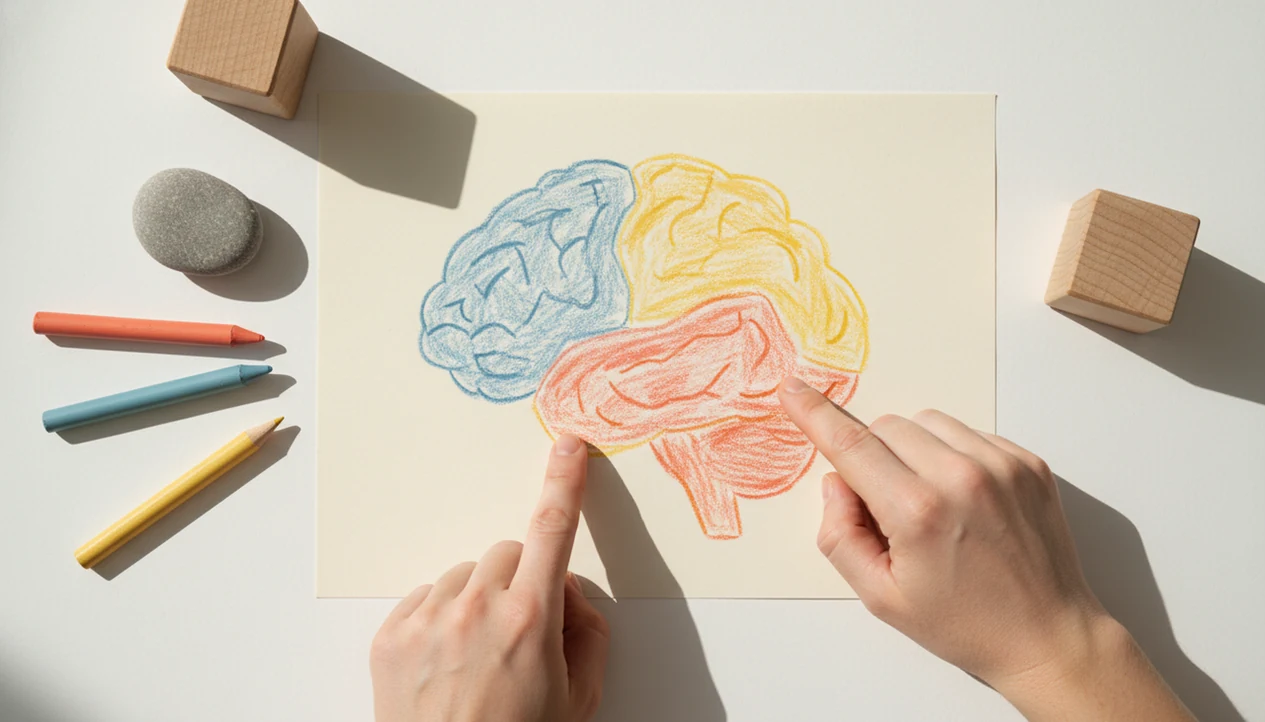
Teaching kids about the brain means explaining thoughts, feelings, memory, attention, and body signals in simple, secular language they can use in daily life. Start with three ideas: the brain helps us think, it has an alarm system, and practice helps it learn new habits. Characters such as the thinking brain, feeling brain, and memory brain make these ideas easier to discuss than a detailed anatomy lesson.
Connect each idea to something familiar: waiting for a turn, forgetting a backpack, or feeling nervous before school. Big feelings are signals, not evidence that a child is bad. Keep calming practices short, playful, and optional, and try them during ordinary routines rather than demanding calm during a meltdown. The aim is to help children notice what is happening and find support, not to guarantee obedience.
Definition: Teaching kids about the brain means explaining how thinking, feelings, memory, attention, and body signals work in simple, secular language children can use in daily life.
The essentials
- Use simple characters such as the thinking brain, feeling brain, and memory brain instead of detailed anatomy.
- Teach children that big feelings are not bad; they are signals from the brain and body that can be noticed and calmed.
- Keep mindfulness practices short, playful, choice-based, and woven into routines like bedtime, transitions, and classroom resets.
Explain the brain with three simple helpers
How to teach kids about the brain starts with a simple story, not a lecture. A child does not need a full anatomy lesson to understand why they grabbed the block, froze during a quiz, or cried when a game changed.
Use three roles: the thinking brain helps with choices, the feeling brain sounds the alarm, and the memory brain helps us learn from what happened before. The goal is self-awareness, not perfect behavior. Kids are still learning how to pause.
Try this script: “Your brain has helpers. One helper thinks, one helper feels danger or excitement, and one helper remembers. When feelings get loud, we can help the thinking brain come back.”
A crayon drawing is enough: one lumpy brain shape, three colors, and a real moment like the backpack zipper getting stuck before school.
One simple way to try it is before homework, bedtime, or a classroom transition, when the lesson has somewhere to land.
Give children words for feelings and body signals
Teaching kids about the brain works by turning invisible feelings into shared language. A simple model gives adults and children words for what is happening inside, so “I’m bad” can become “my alarm brain got loud.”
The mechanism is co-regulation: an adult’s calm voice, steady presence, and clear limit help the child’s nervous system feel safer. As the body settles, the child’s thinking brain has a better chance to come back online for words, choices, and repair. This is educational language, not a diagnosis or treatment plan.
- Notice body signals first, such as tight hands, a hot face, or a fast heartbeat.
- Name the feeling with plain words like mad, scared, embarrassed, or disappointed. When grief brings up difficult feelings, talking to kids about death can begin with simple, honest words.
- Offer one small choice, such as taking space, getting help, or trying again.
- Repair after the hard moment with a short conversation, apology, or plan.
- Repeat the same language often, knowing repetition builds familiarity, not instant self-control or compliance.
Choose a calm moment and a familiar example
Before you start a kids brain lesson, set it up for safety and curiosity. The best time is usually an ordinary calm moment, not the middle of tears, yelling, shutdown, or panic.
Think of this as preparing the ground before teaching the model. A child is more likely to listen when the lesson feels like shared noticing, not a surprise correction.
- Choose one recent everyday moment the child can talk about without shame, such as waiting for a turn, losing a game, or feeling rushed before school.
- Gather simple props like crayons, a hand model, stuffed animals, or two-minute role-play characters so the brain idea becomes visible.
- Offer choices before any calming practice: eyes open or closed, breathing or listening, body scan or no body scan.
- Explain the purpose in plain words: “We are learning what your brain and body do when feelings get big.”
- Avoid turning the lesson into immediate behavior fixing. Understanding comes first; limits, repair, and new choices can come after.
If the child says no, pause. That choice can help the lesson feel safer next time.
Brain Parts For Kids: Thinking Brain, Feeling Brain, And Memory Brain
The prefrontal cortex can be taught as the thinking brain, the amygdala as the alarm or feeling brain, and the hippocampus as the memory and learning helper. These are useful kid models, not exact maps of everything the brain does.
The thinking brain helps a child pause, plan, share, wait, and solve problems. When a child loses a toy, this part helps them look under the couch instead of yelling first. The feeling brain notices threat, surprise, unfairness, or excitement. It can get loud before a test or when joining a game already in progress.
The memory brain helps connect today with yesterday. It remembers that the blue folder is for math, or that a deep breath helped last time.
For elementary kids, you can add the real names after the friendly names. Say them lightly. The point is usable language, not a spelling quiz.
Big Feelings And The Child Brain Alarm System
Strong emotions can make the brain’s alarm system feel louder, which can make planning, listening, and flexible thinking harder for a child. The common “flip your lid” idea is a way to show this, but it should never make a child feel broken or bad.
- Big feelings often come with body signals: a tight belly, hot face, clenched fists, racing heart, or shallow breathing.
- The feeling brain may react quickly when something feels unsafe, unfair, embarrassing, or too much.
- The thinking brain is still there, but it may be harder to access until the child feels safer.
- Naming a feeling can create a small pause before action: “I’m mad” is different from throwing the pencil.
- Practice may help children notice patterns over time, but adults should avoid promising that one exercise “rewires” the brain.
That pause matters.
In real life, it might be the moment before answering a message, taking a turn, or walking away from a sibling’s joke.
5 Steps For A Kids Brain Lesson At Home Or School
Use a short, repeatable lesson when teaching children brain basics. Five minutes practiced often usually works better than one long, impressive lesson that nobody remembers.
Before you begin, choose a calm moment rather than a meltdown. Have paper, crayons, or a hand model ready, and tell the child they can pass on any breath or body-focused practice.
- Draw a simple brain shape or use a hand model with fingers folded over the thumb.
- Name the thinking brain, feeling brain, and memory brain in plain words.
- Connect each part to one real child scenario, such as losing a turn, taking a test, or hearing “no.”
- Notice one body signal that shows a big feeling is rising, such as warm cheeks or tight shoulders.
- Practice one 30- to 60-second reset, such as Teddy Bear Breath, sound-watching, or mindful hands.
For younger children, a full short meditation for toddlers may be too much at first. Start with one breath, one sound, or one hand squeeze.
Repeat it on ordinary days. Crisis teaching is harder.
Brain Lessons For Preschoolers, Elementary Kids, And Teens
Brain lessons work best when the explanation matches the child’s age, language, development, and lived experience. Children also vary by neurodiversity, trauma history, sensory needs, and culture, so adjust the lesson rather than forcing one script.
| Age group | Brain lesson focus | Useful example |
|---|---|---|
| Preschoolers | Use drawings, stuffed animals, and simple feeling words. | “Bear’s alarm brain got scared when the tower fell.” |
| Ages 6-8 | Use the alarm brain and thinking brain model with role-play. | Act out asking to join a game instead of grabbing the ball. |
| Ages 9-12 | Add amygdala, prefrontal cortex, and hippocampus. | Link test nerves to body signals and memory. |
| Teens | Discuss stress, attention, sleep, habits, and neuroplasticity with nuance. | Compare late-night scrolling with next-day focus. |
For teens, brain education lands better when it respects their privacy. Our guide to meditation for teens uses more choice-based language for that reason.
Short, optional practices for noticing the brain and body
Mindfulness means noticing the present moment with kindness and curiosity. For children, it should feel brief, concrete, and optional enough that they do not experience it as another demand.
Brief mindfulness practices help children practice noticing what is happening now; they do not promise instant calm or obedience. Tools like Mindful.net can support beginner-friendly secular mindfulness practices, but the adult relationship and setting matter more than any app.
If a child has trauma history, panic symptoms, or strong sensory sensitivities, start with eyes-open sound or movement practices and consider guidance from a qualified clinician or school support professional.
- Teddy Bear Breath: A child lies down and watches a stuffed animal rise and fall on the belly for 30 seconds.
- Sound Detective: The child listens for three sounds, near or far, with eyes open.
- Mindful Hands: The child rubs palms together, then notices warmth, tingling, or pressure.
- Weather Report Feelings: The child says, “Inside weather is stormy,” “foggy,” or “sunny.”
Open-eye and movement-based options help children who dislike closing their eyes or focusing on breath. For longer routines, meditation for kids can offer more examples without making the practice complicated.
Turn bedtime into a brief noticing practice
Bedtime offers a familiar setting for connecting brain language with body signals without adding another lesson. Keep the sequence predictable: dim the lights, stop stimulating play and screens, then read or cuddle. Finish with one to three minutes of gentle breathing or noticing sounds. The American Academy of Pediatrics’ parent guidance recommends brief practice for preschoolers and suggests including deep breathing in bedtime routines.
Let the child breathe naturally while you say, “Notice your belly going up and down,” or “Listen for the quietest sound.” Join in rather than checking whether they are doing it correctly. Stop if the activity causes frustration or distress, and do not let it postpone sleep. A predictable routine and enough time in bed matter more than completing a meditation exercise.
What mindfulness research does and does not show
Research on children, mindfulness, and brain education is promising in some places and mixed in others. The safest summary is that short, well-taught practices may support attention and emotional awareness for some children, but they are not a universal fix.
- A 2010 randomized controlled trial of 99 fourth- and fifth-graders found that a 5-week school mindfulness program improved attention and reduced negative affect compared with a control group: PMC research article
- A 2019 meta-analysis of 33 school-based mindfulness programs found small significant benefits for cognitive performance and resilience, with larger effects in some at-risk groups: PMC research article
- The 2022 MYRIAD trial of 3,226 UK children aged 8-12 found that universal school mindfulness did not outperform standard social-emotional teaching on average: PubMed research
- Adult MRI research has linked 8 weeks of mindfulness-based stress reduction with hippocampal gray matter changes, but that is indirect adult evidence, not proof for children: PMC research article
- Per the CDC, about 9.4% of U.S. children aged 2-17 had ever been diagnosed with ADHD in 2016, which gives context for attention supports without making mindfulness a treatment claim: CDC guidance
Use brain lessons for understanding, not behavior control
A kids brain lesson is most useful as emotional literacy, not behavior control. It helps children name what is happening inside, while adults still stay responsible for safety, connection, structure, and repair.
| Best for | Not ideal for |
|---|---|
| Everyday emotional literacy | Replacing therapy, evaluation, or professional support |
| Classroom calm-downs and resets | Forcing children to calm down on command |
| Bedtime reflection | Children distressed by breath or body focus without adaptation |
| Transitions, waiting, and frustration | Treating every behavior as a brain skill problem |
| Secular, science-friendly language | Ignoring sleep, bullying, hunger, noise, or unsafe settings |
For bedtime, a gentle bedtime meditation for children may pair well with a brain lesson about rest and memory. For big after-school meltdowns, a calm down meditation for kids should still be choice-based.
The room matters. So does the adult tone.
Common Mistakes When Teaching Kids About The Brain
Brain language can become a way to manage, label, or blame a child instead of helping them understand what is happening. A brain lesson should widen understanding, not become a softer-sounding version of “stop it.”
Keep the lesson practical and humble. Children need adults to check the real-world conditions around them before turning every hard moment into a self-regulation lesson.
- Use brain words as neutral noticing language, not as shame. “Your alarm got loud” lands differently from “your feeling brain is the problem.” Practicing kinder self-talk helps children respond to mistakes without turning a difficult moment into a judgment about themselves.
- Avoid making one breath, one meditation, or one reset sound magical. Practice can help over time, but it does not instantly rebuild a child’s brain.
- Offer choices around stillness, closed eyes, and breath focus. Some children feel safer with eyes open, movement, sound, or hands-on grounding.
- Teach the model during calm, ordinary moments too. If it only appears during conflict or punishment, children may hear it as correction.
- Check basics first: hunger, sleep loss, bullying, loud rooms, scratchy clothes, crowded transitions, or sensory overload may be the real starting point.
Start with safety and connection. The brain lesson can come after.
Practice a short pause together
After a calm conversation about the brain’s alarm system, a child can try a brief breathing practice alongside an adult. The free breathing timer offers a way to pace that pause, and the Mindful.net app includes short guided meditations and breathing exercises. Keep participation optional. For a child who dislikes watching or changing their breath, noticing colors or sounds with a trusted adult is a better starting point.
Limits of Kids’ Brain Lessons
- Brain lessons offer simplified models, not full neuroscience, diagnoses, cures, or shortcuts around children’s real needs.
- Evidence for brain changes is emerging and often indirect, while school mindfulness programs show small benefits or no advantage.
- Mindfulness does not automatically make children calm, compliant, or emotionally regulated.
- A family mindfulness routine works best when adults practice too, even for 30 seconds.
Teaching children about the brain: common questions
How do I explain the brain to a young child?
Start with three helpers: one helps us think and choose, one notices danger or excitement, and one helps us remember. Use a drawing, stuffed animal, or familiar situation such as waiting for a turn. Explain that these are simple models, not separate characters actually living inside the head.
How do you explain the amygdala to a child?
Describe the amygdala as part of the brain’s alarm system. You might say, “It helps notice things that could be dangerous, and sometimes the alarm gets loud when we feel scared or overwhelmed.” Avoid calling it the bad part of the brain. The alarm is a teaching model, not a complete explanation of emotion.
What age can children start learning about the brain?
Preschoolers can begin with pictures, pretend play, and simple feeling words. School-age children can connect brain helpers to everyday choices and gradually learn names such as amygdala and prefrontal cortex. Match the explanation to the child’s language and interests rather than treating age as a strict starting rule.
How do you explain neuroplasticity to kids?
Explain it as the brain’s ability to learn and change with practice. Say, “When you practice something, your brain learns how to do it,” and use a familiar example such as remembering a routine. Avoid promising that a few breaths will change the brain or make difficult feelings disappear.
Should I explain the thinking brain during a tantrum?
Save the lesson for a calmer moment. During intense distress, focus on safety, a steady voice, and a clear limit rather than asking the child to explain their brain. Once they have settled, briefly connect the event to a body signal or feeling without turning the conversation into a correction.
Can mindfulness improve a child’s attention?
Some studies suggest benefits for attention, but effects are generally small and depend on the program and comparison group. Evidence that these gains extend to school achievement or broader behavior is weak. Treat mindfulness as an optional supporting practice, not a replacement for assessment or treatment when attention difficulties are significant.
What if my child dislikes closing their eyes or focusing on breathing?
Keep their eyes open and offer an activity focused on the surroundings, such as naming colors or listening for sounds. Children do not need to close their eyes to practice noticing. Let them stop, and seek advice from a pediatric clinician if practices increase distress or symptoms are significant.
How long should a preschooler practice calming breathing?
The American Academy of Pediatrics recommends a few minutes per day for preschool children rather than prolonged stillness. Start with a brief, playful activity and participate alongside the child. Shorten or change it when they become bored, frustrated, dizzy, or more agitated. Finishing a set amount of time is not the goal.