
Secular Mindfulness Practice: Clear Instructions Without Religious Beliefs


Secular mindfulness practice is non-religious attention training that helps you notice present experience and choose your next response more deliberately. It uses breathing practice, body scans, and everyday pauses without requiring Buddhist beliefs, spiritual language, or religious authority. The instructions stay concrete: notice what is happening, recognize when attention wanders, and return to the breath, body, or sounds around you.
The practice can draw on techniques from older traditions while teaching them in plain psychological language. You do not need to stop thinking or feel calm for an exercise to count. Instead, practice noticing thoughts and sensations without immediately fighting them or acting on them. Benefits are usually moderate and depend on practice, so treat mindfulness as a skill to develop, not a cure-all.
The essentials
- Secular mindfulness is skills-based: notice, return, label, allow, and choose your next response.
- It can borrow meditation techniques from older traditions while translating them into non-religious, evidence-informed practice.
- Benefits are usually moderate and practice-dependent, so it is best treated as training rather than a cure-all.
Secular mindfulness practice in plain language

Quick answer: secular mindfulness is attention training described in everyday, psychological terms. It uses meditation and ordinary awareness drills without asking you to accept religious doctrine, spiritual rank, or special beliefs. The basic move is simple: recognize what is happening now, and when the mind drifts into replay or rehearsal, guide attention back.
Secular does not mean anti-religious. It means the instructions do not depend on religious authority, sacred claims, or belief in a spiritual system. A Christian, atheist, Buddhist, Muslim, agnostic, or “not sure” person can use the same basic exercise.
Common techniques include breath awareness, body scan, mindful walking, and mindful listening. A retiree organizing the garage might pause with one hand on a library book spine, feel the texture for a breath, and notice the refrigerator hum in the next room. Practices like these build repeatable attention skills; they are not meant to remake your identity or promise enlightenment.
Five things to know before your first practice
- Mindfulness is a trainable skill, not a belief system. The basic move is to notice where attention has gone and bring it back, often to the breath, body, sound, or movement.
- Secular programs can be structured. Mindfulness-Based Stress Reduction, often called MBSR, uses manualized practices such as sitting meditation, body scan, and mindful movement.
- You do not need to clear your mind. Noticing the mind wander to a grocery list is not failure. That is the rep.
- Mindfulness is not only relaxation or positive thinking. Sometimes it feels calm, but it can also mean noticing tension, irritation, grief, or boredom without instantly reacting.
- Research supports moderate benefits, not guaranteed transformation. A 2014 JAMA Internal Medicine meta-analysis of 47 randomized trials found moderate evidence for anxiety, depression, and pain, with more limited evidence for some other outcomes JAMA study.
Attention training mechanics in secular meditation
The mechanism is not mystical: pick an anchor, detect the moment attention has wandered, and return without making the lapse a character flaw.
An anchor can be breath, sound, movement, or a body sensation. Body awareness adds useful information because signals often show up before a reaction has language: a fluttering stomach during a museum docent tour, an itchy scalp while sorting tools, warmth spreading from a ceramic mug. Emotion labels can stay plain: “worrying,” “planning,” “judging,” or “remembering.”
Non-judgment does not mean approving everything. It means reducing the automatic second reaction, such as “I’m anxious, and now I’m angry that I’m anxious.” Repeated practice builds mental habit loops. For beginners, secular meditation usually works best when the instructions are concrete, while abstract philosophy fits people who already want deeper study.
Daily mindfulness routine with 3 to 10 minute practices
A daily secular mindfulness routine can be short, plain, and repeatable. Three to 10 minutes is enough for a beginner to practice the core skill without turning meditation into another chore. A useful beginner test is simple: when the timer ends, you should know what you practiced, whether that was the breath at the nostrils, the pressure of both feet, or the hum of a refrigerator.
- Set a phone timer for 3 to 10 minutes and sit in a normal chair with both feet supported. For an easy start before breakfast, try early morning meditation with just two minutes of attention.
- Choose one anchor, such as the breath, feet on carpet, or ambient sound in the room.
- Notice when attention drifts into planning, remembering, or commentary.
- Return to the anchor gently, as if restarting a sentence you lost halfway through.
- Add one informal pause later, such as one breath before opening a laptop or answering a message.
- Reset after distracted or inconsistent days by doing one minute instead of quitting the routine.
If you want more structure, a first week meditation plan can help you build gradually without guessing each day. Building a morning meditation habit can make short sessions easier to repeat before daily demands begin.
Breathing, body scans, and pauses in plain language
These secular mindfulness examples use ordinary language and ordinary settings. No special posture, chant, altar, or worldview is required.
One-minute breathing practice
Feel one inhale and one exhale. If the body softens after the exhale, allow it, but do not turn relaxation into a test. When attention wanders, note “thinking” silently and return to the next breath; this is the whole repetition, not a sign that the practice failed.
Three-minute body scan
Move attention from feet to legs, torso, arms, and face. Notice pressure, warmth, tingling, numbness, or no clear sensation. Body scan practice is observation, not a command to relax.
Everyday mindful pause
Use walking, eating, or listening as the anchor. During a conversation, notice the urge to interrupt and return to hearing the next sentence. During lunch, feel the first bite before reading the next notification.
For more options, compare several meditation techniques for beginners and choose the one that feels easiest to repeat.
Attach a mindful pause to something you already do
A daily activity can remind you to practice without adding another sitting session. NHS Scotland's everyday mindfulness guidance suggests using events such as a phone ringing, passing through a doorway, or noticing a sound as cues. Choose one familiar event, then briefly notice your breathing, body sensations, emotions, and mental state when it happens.
For example, pause after passing through your front door. Feel your feet, notice one natural breath, and acknowledge what is present: perhaps tension, tiredness, or thoughts about unfinished work. There is no need to make those experiences disappear. Then continue with your next activity. The purpose is to bring deliberate awareness into ordinary life, not to make every routine take longer. When low energy makes practice difficult, meditation when you are tired can mean choosing rest or a shorter session.
Mindfulness without religion versus spiritual mindfulness
Mindfulness without religion and spiritual mindfulness can use similar practices, but they frame the meaning differently. A secular approach can respect religious roots while not asking the practitioner to adopt them.
| Point of comparison | Secular mindfulness | Spiritual mindfulness |
|---|---|---|
| Purpose | Attention training, stress skills, behavior awareness | Practice within a religious or contemplative path |
| Language | Focus, emotion regulation, reactivity, body awareness | May include awakening, compassion vows, karma, liberation, or devotion |
| Authority source | Research, trained teachers, clinical or educational programs | Lineage, scripture, teacher, community, tradition |
| Practice setting | Clinic, school, app, workplace, kitchen chair | Temple, retreat center, religious group, home practice |
| Fit | People wanting non religious mindfulness | People seeking religious instruction or spiritual depth |
Traditional terms can be translated without mocking them. For example, “non-attachment” can become “letting go of overthinking,” and “suffering” can become “working with difficult experience.”
Who secular mindfulness suits, and when to choose something else
Secular mindfulness practice fits people who want clear instructions without spiritual authority claims. It is a poor fit when someone wants religious formation, intensive Buddhist study, or a guaranteed treatment result.
| Best for | Not ideal for |
|---|---|
| ✅ Beginners who want plain, step-by-step attention practice | ❌ People seeking religious instruction or devotional practice |
| ✅ People from any religion or no religion who want practical mindfulness | ❌ People looking for deep Buddhist philosophy or lineage training |
| ✅ Workday pauses, bedtime awareness, and simple emotional regulation skills | ❌ People expecting a guaranteed cure for anxiety, depression, pain, or insomnia |
| ✅ Learners who prefer secular meditation language | ❌ People in acute crisis who need professional support first |
For a secular route, Mindful.net’s Mindfulness Practices App should be used as a practice aid, not as proof that mindfulness is the right fit for every person. Choose sessions by anchor, length, and support level rather than by vague promises of transformation.
Evidence for secular mindfulness and realistic outcomes
Evidence for secular mindfulness is most useful when read as “moderate support for some outcomes,” not proof that everyone will feel better. Structured programs have been studied more than brief, self-guided app practice.
The 2014 JAMA Internal Medicine meta-analysis reported moderate evidence for improving anxiety, depression, and pain. A 2013 review of 209 mindfulness-based therapy studies found an overall effect size of 0.59 for anxiety, depression, and stress PubMed research. In a randomized trial with healthcare professionals, an 8-week MBSR course reduced self-reported stress compared with a wait-list control group APA research.
Per the CDC, 52.5% of U.S. adults who used meditation in the past year said they did so for general wellness or disease prevention CDC guidance. That fits the practical pattern many beginners report: they want focus, steadier reactions, and a calmer evening, not a new religion.
Evidence is stronger for structured 8-week programs than for casual, brief, app-only practice.
When to seek professional support
Seek professional support when mindfulness practice brings up more than you can safely manage, or when symptoms are already interfering with daily life. Mindfulness can support care, but it should not replace medical treatment, psychotherapy, medication, emergency help, or crisis support.
Quiet practice is not the right tool for every moment. If you notice acute crisis feelings, self-harm urges, overwhelming panic, dissociation, trauma flooding, or a sense that you might not stay safe, stop the meditation and shift to support.
- Stop silent inward attention if it intensifies fear, numbness, flashbacks, or the feeling of leaving your body.
- Ground through the room: open your eyes, name visible objects, feel your feet, hold something textured, or listen for ordinary sounds.
- Move gently if stillness feels trapping; try walking, stretching, shaking out your hands, or stepping outside if safe.
- Contact a licensed clinician, trusted support person, local crisis line, or emergency services if risk feels urgent or hard to judge.
- Resume only with a smaller, supported practice when you feel steadier, preferably with guidance if trauma or panic is part of the picture.
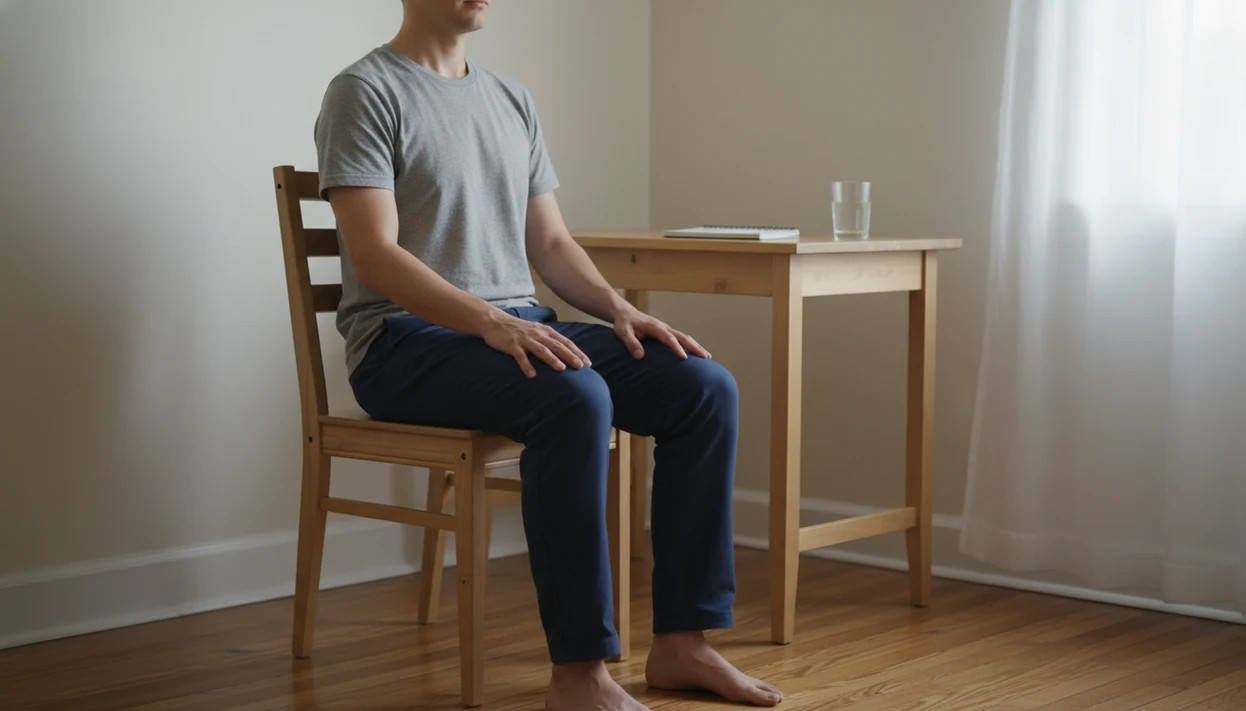
A comfortable chair is enough for secular meditation
Use an image that shows ordinary attention practice, not mystical symbolism. A good visual would show a person sitting comfortably in a chair with socked feet under a chair, or standing outdoors with a relaxed but alert posture.
Avoid lotus posture, altars, candles, incense smoke, prayer beads, religious icons, glowing effects, or vague “energy” imagery. Those cues can confuse the page’s purpose.
Caption: A beginner practices secular mindfulness practice in an ordinary chair, using relaxed alertness and breath awareness as attention training.
Alt text: Person practicing secular meditation while sitting comfortably in a chair with a relaxed, upright posture.
Set a reminder for an everyday pause
During a busy workday, remembering to pause may be harder than understanding the instructions. A mindfulness bell can provide a cue to notice your breathing, body, and thoughts before continuing. Mindful.net also offers short guided meditations for a more structured practice. Neither replaces professional support when inward attention brings up overwhelming distress or symptoms interfere with daily life.
Secular Mindfulness Limits
- Benefits are usually moderate and not universal, and some people notice little change.
- Mindfulness cannot replace medical care, psychotherapy, medication, or crisis support, so seek professional care when needed.
- Brief independent practices and apps are less studied than structured programs such as MBSR.
- Quiet practice can trigger distress, panic, dissociation, or trauma activation, so start smaller or try mindful walking.
Secular mindfulness questions
What is secular mindfulness practice?
Secular mindfulness is deliberate attention to present experience, taught without requiring religious beliefs. You might notice breathing, body sensations, sounds, or thoughts, then return when attention wanders. It includes both meditation and everyday awareness, with an emphasis on openness rather than trying to control every experience.
Can I practice mindfulness without being Buddhist?
Yes. Secular instructions do not require Buddhist beliefs, conversion, or participation in a religious community. Modern mindfulness draws heavily on Buddhist traditions, but a secular teaching context presents selected practices as attention skills. Respecting those roots does not mean you must adopt their religious framework.
Can Christians practice secular mindfulness?
Secular mindfulness does not ask you to replace your faith or address a deity. Its instructions focus on attention, sensations, thoughts, and responses. Christians can use those skills, although individual religious views differ. If a course includes teachings that conflict with your beliefs, ask the teacher what participation requires.
How do I start secular mindfulness at home?
Sit comfortably in a chair and set a timer for three minutes. Choose natural breathing, the feeling of your feet, or surrounding sounds as your focus. When attention wanders, notice that and return gently. At the end, identify what you practiced rather than judging how calm you became.
Do I need to clear my mind during mindfulness?
No. Thoughts are part of what you learn to notice. When you realize you are planning, remembering, or worrying, acknowledge it briefly and return to your chosen focus. That return is the practice. A session with frequent wandering can still give you repeated chances to train attention.
Can secular mindfulness make anxiety worse?
Some people experience more distress, panic, dissociation, or trauma-related reactions during quiet practice. Stop if inward attention intensifies those symptoms rather than trying to push through. Seek professional support when symptoms interfere with daily life. Mindfulness is not a substitute for treatment, crisis support, or emergency help.