
How to Meditate for 10 Minutes: A Simple Timed Practice


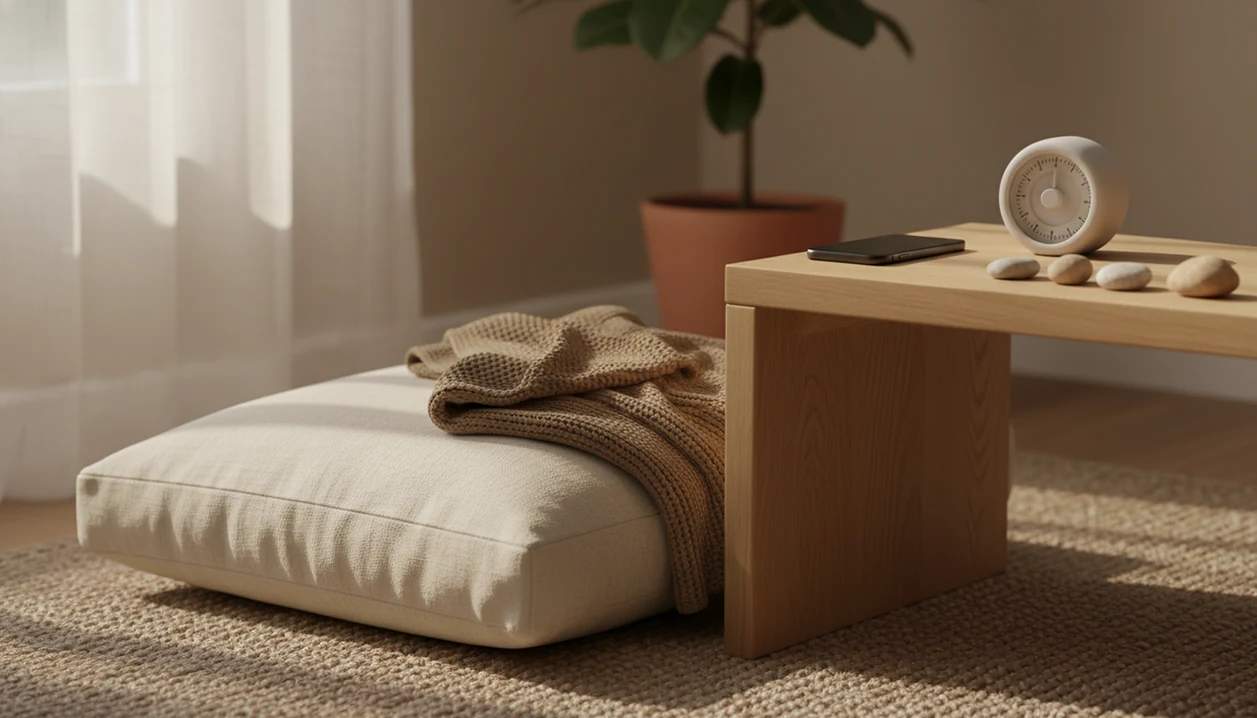
To meditate for 10 minutes, set a timer, sit comfortably upright, choose your breath or a body sensation as an anchor, and return to it whenever your mind wanders. Divide the session into 2 minutes settling, 5 minutes focused attention, 2 minutes open awareness, and 1 minute closing reflection. This is a short, secular practice for training awareness, not an exercise in clearing your mind.
A chair, a quiet-enough spot, and a timer are enough to begin. During focused attention, stay with one sensation, such as your feet touching the floor. During open awareness, notice sounds, sensations, and thoughts without choosing one focus. Pairing the session with an existing routine or following a short guided meditation can make starting simpler.
The essentials
- You do not need to clear your mind; noticing wandering and returning is the practice.
- A ten minute meditation works best when it has a simple structure: settle, focus, return, open, and close.
- Beginners often stick with meditation more easily when they pair it with an existing routine or use a short guided meditation.
Divide ten minutes into settling, focus, awareness, and closing
A good way to learn how to meditate for 10 minutes is to divide the session into 2 minutes settling, 5 minutes focusing, 2 minutes opening awareness, and 1 minute closing. That gives your mind a job without making the practice feel rigid.
Use the first 2 minutes to sit upright and notice the body. Spend 5 minutes with one anchor, such as breathing, chest movement beneath a shirt, or the feeling of feet on the floor. Then let sounds, body sensations, and thoughts come and go for 2 minutes. Use the final minute to notice mood, tension, and one practical next step.
Thoughts are not a problem. Noise is not a problem. Restlessness is not a problem.
The return is the training. A phone timer, kitchen timer, or short guided meditation can help beginners stop checking the clock.
Choose your seat, anchor, and timer before starting
Before you start a 10 minute meditation, make the session easy to enter and easy to leave. You are not trying to create perfect silence; you are setting up enough support that attention has somewhere to land. A mindfulness checklist for beginners can help you prepare your space, choose an anchor, and start simply.
- Choose a quiet-enough place where interruptions are less likely, such as a closed room, parked car, office corner, or the edge of your bed. Background noise can be part of the practice.
- Set a visible or audible 10-minute timer before you begin, so you are not checking the clock halfway through.
- Use a chair, cushion, couch, or bed edge that lets you sit upright without forcing a stiff posture. Comfort matters, but aim to stay alert. If you prefer lying down, learn how to meditate in bed while choosing between sleep and alert awareness.
- Pick one anchor for attention: the breath, sounds, feet on the floor, hands resting, or the contact of the body with the seat.
- Decide how you will stop if distress rises. You might open your eyes, feel your feet, stand up, look around the room, or end the practice and do something grounding.
This small setup keeps the meditation simple: sit, notice, return, and stop kindly if needed.
Train attention by noticing distraction and returning
A ten minute meditation works by training attention in a simple loop: choose an anchor, notice distraction, and return without judgment. In plain language, you are practicing how to notice where the mind went before following it automatically.
The mechanism is sometimes called attention regulation. That does not mean suppressing thoughts. It means changing your relationship to thoughts, so a grocery list or work worry can be noticed and released.
In a 2012 guided mindfulness trial, 10 minutes of mindfulness reduced mind-wandering and improved reading comprehension and working memory in college students compared with controls APA research. A later single-session study also reported lower state anxiety and negative mood after one 10-minute mindfulness practice.
For beginners, brief meditation is often easier than longer practice because the structure is clear and the time cost is low.
Five steps to follow during your session
Follow these five steps when you want a simple 10 minute meditation for beginners. If you want more detail on posture, anchors, and closing a session, the longer how to meditate guide walks through the basics.
- Set a 10-minute timer and choose a quiet-enough place. It does not need to be silent.
- Sit with a stable, comfortable, upright posture on a chair, couch, or cushion.
- Take a few settling breaths and feel the body supported by the seat.
- Focus on the breath or body sensations, then return when distracted.
- Close by noticing mood, body, and one intention before moving.
A closed door with hallway noise still counts. So does a bus seat, an office stairwell, or the edge of your bed before the day starts. Practicing mindfulness in meditation and daily life builds repeatable attention skills; it does not guarantee a calm mood on command.
Best times and places for a ten minute meditation
Consistency matters more than finding a perfectly quiet setting. The most useful time is the one you can repeat without negotiating with yourself every day.
Try one of these habit anchors:
- After brushing teeth: The routine is already built, so meditation becomes the next small action.
- After morning coffee: Sit before the day gets crowded, even if the mug is still on the table.
- Before opening email: A three-minute breathing pause can become ten minutes on lighter mornings.
- During lunch break: Use a parked car, empty meeting room, or bench away from the busiest path.
- Before bed: Keep it simple and low-effort, especially if you are using it to wind down. For evenings when rest is your goal, try a 10 minute sleep meditation designed to help you wind down.
Soft reminders help. App cues, calendar nudges, or a sticky note near your laptop can make the practice visible. For broader routine ideas, how to practice mindfulness covers everyday anchors beyond seated meditation.
10 minute guided meditation versus silent practice
Guided meditation is usually easier at the start, while silent practice becomes more flexible once the structure feels familiar. The right choice depends on whether you need cues or want independence.
| Format | Best for | Benefits | Drawbacks | When to switch |
|---|---|---|---|---|
| Guided 10 minute meditation | Beginners, tired days, returning after a break | Gives pacing, posture cues, and reminders to refocus | Voice may distract you or feel too scripted | Switch when you can remember the structure alone |
| Silent 10 minute meditation | People who know the sequence | Works anywhere and builds self-direction | Easier to drift or quit early | Switch back when practice feels vague or strained |
For a simple start, listen to voice cues through one earbud and leave the final minute silent.
Common mistakes in a 10 minute meditation for beginners
Most beginner mistakes come from expecting meditation to feel calmer, quieter, or more special than it does. A normal session may include boredom, planning, irritation, or the urge to stop.
- You do not need an empty mind. Wandering is expected; returning is the practice.
- Ten minutes is not “too short to matter.” Short sessions can build consistency, especially when repeated.
- You do not need lotus pose. A chair, couch, or cushion is fine if the posture is stable.
- Calm is not required. Agitation and racing thoughts can appear, especially during stressful weeks.
- Starting over is allowed. If you spend 3 minutes lost in thought, notice it and come back.
Reset the plan.
If breath focus feels too tight, try sounds or contact points instead. A library of meditation techniques for beginners can help you compare breath awareness, body scan, and loving-kindness practice.
Evidence for a short guided meditation structure
Brief meditation can have measurable effects when it is repeated consistently, but the evidence does not mean meditation is a stand-alone medical treatment. It is better understood as attention practice with possible benefits for stress, mood, and focus.
The strongest evidence here is for short-term stress, attention, and mood outcomes; it does not prove that every 10-minute session produces a noticeable effect. Treat the research as support for practice design, not as a guarantee.
- A college-student randomized trial of the Calm app reported reduced perceived stress and improved mindfulness after app-based meditation practice, though the study measured app use rather than one isolated 10-minute session E14273.
- A 2019 workplace app trial reported lower perceived stress and improved well-being after employees used a mindfulness meditation app during an 8-week intervention APA research.
- A 2014 JAMA Internal Medicine meta-analysis of 47 randomized trials found moderate improvements in anxiety, depression, and pain in mindfulness meditation programs JAMA study.
- Brief guided practice may reduce mind-wandering in the short term, based on college student research.
- Results vary. Practice quality, expectations, support, and life context all matter.
For many beginners, a short guided meditation structure is easier to maintain than an open-ended silent session because it reduces decision-making.
Repeat ten minutes before adding more time
A longer session is not automatically a better session. A 2025 observational analysis of meditation dose found that practice frequency was a stronger predictor of well-being, affect, and distress outcomes than session duration. That association does not prove cause and effect, but it supports a practical priority: repeat a manageable session before making it longer. When you feel ready to meditate longer without rushing, increase your practice gradually rather than chasing a duration.
Keep ten minutes as your default while it fits your schedule and remains comfortable. There is no requirement to reach twenty minutes. For people who want that much daily practice, a 2024 randomized trial comparing daily schedules found statistically equivalent improvements with one twenty-minute session or two ten-minute sessions separated by at least four hours. This supports splitting the time, not a promise that either schedule will help everyone.
Mark a pause before your ten minutes
Before a ten-minute session, a simple sound cue can mark the shift from another task to sitting. The free mindfulness bell offers that cue; the Mindful.net app provides short guided meditations and a meditation timer for the practice itself. Choose a timer when you need a clear endpoint, or guided audio when you need spoken reminders to return to your anchor.
Make a ten-minute guided recording for everyday awareness
For a general-purpose session, rather than one aimed at stress or sleep, you can record the prompts below in your own voice. Use a voice recorder and leave silence between the listed times, keeping the recording running until ten minutes have passed. Read only the spoken words, not the timestamps. The pauses are part of the guide, not space you need to fill.
Keep this recording focused on meeting an ordinary moment, without asking yourself to relax, become sleepy, or reach a particular mood. Before recording, read through the prompts and change any wording that feels awkward to say aloud. When you use the finished guide, there is no need to answer its questions in words or make notes during the session.
- At 0:00, say: “For these ten minutes, there is nothing you need to solve. Notice what it is like to be here, just now. You do not have to make this moment different.”
- At 2:00, say: “Notice one ordinary detail of your experience. Perhaps there is warmth, coolness, pressure, or a sound nearby. Let the detail be simple, without needing to explain it.”
- At 4:00, say: “Is there an urge to get somewhere else or finish the practice? If so, notice that urge as part of this moment. You do not need to act on it immediately.”
- At 6:00, say: “Notice whether you are describing or judging what is happening. For a moment, leave the description unfinished. What can you feel or hear before adding a story?”
- At 8:00, say: “Let the next few moments be unhurried. There is no special experience to produce. Whatever is present can be noticed without becoming a task to complete.”
- At 10:00, say: “This practice is finished. Take a moment before moving on. You do not need to score the session or decide whether you did it well.” Then stop the recording.
Ten Minute Meditation Limits
- One session may offer a reset, but lasting change usually requires regular practice over weeks or months.
- For serious mental health conditions, seek professional help, since meditation is not a treatment on its own.
- Seated stillness may not suit high agitation or some trauma histories, so consider guidance informed by trauma.
- Movement or walking can count as mindfulness meditation when attention is intentional and kind.
Ten-minute meditation questions
Is 10 minutes of meditation a day enough?
Ten minutes is a reasonable starting session, and there is no universally required duration. Short studies have not consistently found greater benefits from longer sessions. Start with time you can repeat comfortably. Ten minutes is attention practice, not a guaranteed treatment for anxiety, depression, or other health conditions.
What should I focus on during a 10-minute meditation?
Choose one concrete sensation: breathing, chest movement beneath your shirt, or your feet touching the floor. Notice that sensation without trying to change it. When thoughts pull you away, return to the same anchor. You do not need to think about a special subject or make your mind blank.
How do I divide a 10-minute meditation session?
Try 2 minutes settling into your seat, 5 minutes following one anchor, 2 minutes noticing sounds, sensations, and thoughts, and 1 minute closing. In the last minute, notice your mood and any tension before moving. This sequence is a practical option, not a required formula for meditation to count.
What if my mind wanders for most of the ten minutes?
Wandering does not mean the session failed. The practice is to recognize that attention has moved and return to your anchor. You may repeat that many times. Keep the response simple: notice the thought, feel your breath or feet again, and continue without restarting the timer.
Can I meditate lying down for 10 minutes?
You can, though lying down may make it easier to fall asleep. For attention practice, a comfortable upright seat offers a clear starting position without requiring lotus pose. If sleepiness keeps interrupting practice, try a chair and a morning or early-afternoon session rather than practicing late in the evening.
Should I use guided audio or a timer for ten minutes?
Guided audio can help when you need posture cues, pacing, or reminders to refocus. A timer is useful once you remember the sequence and prefer silence. Neither format is required. Choose the one that helps you stay with the session, and change formats if the voice becomes distracting.
Is it better to meditate for 10 minutes in the morning or evening?
Choose a time you can repeat, with a backup when that time is missed. Morning practice has been associated with stronger participation in app-based research, but rigid scheduling can reduce participation. Evening may suit a wind-down routine; morning or early afternoon may suit you better if you become sleepy.
What should I do if a 10-minute meditation makes me more anxious?
Do not force yourself to complete the timer. Seated stillness may not suit you during high agitation or with some trauma histories. Try movement-based mindfulness, walking practice, or trauma-informed guidance instead. Meditation is not a stand-alone mental health treatment, and a shorter session is allowed.