


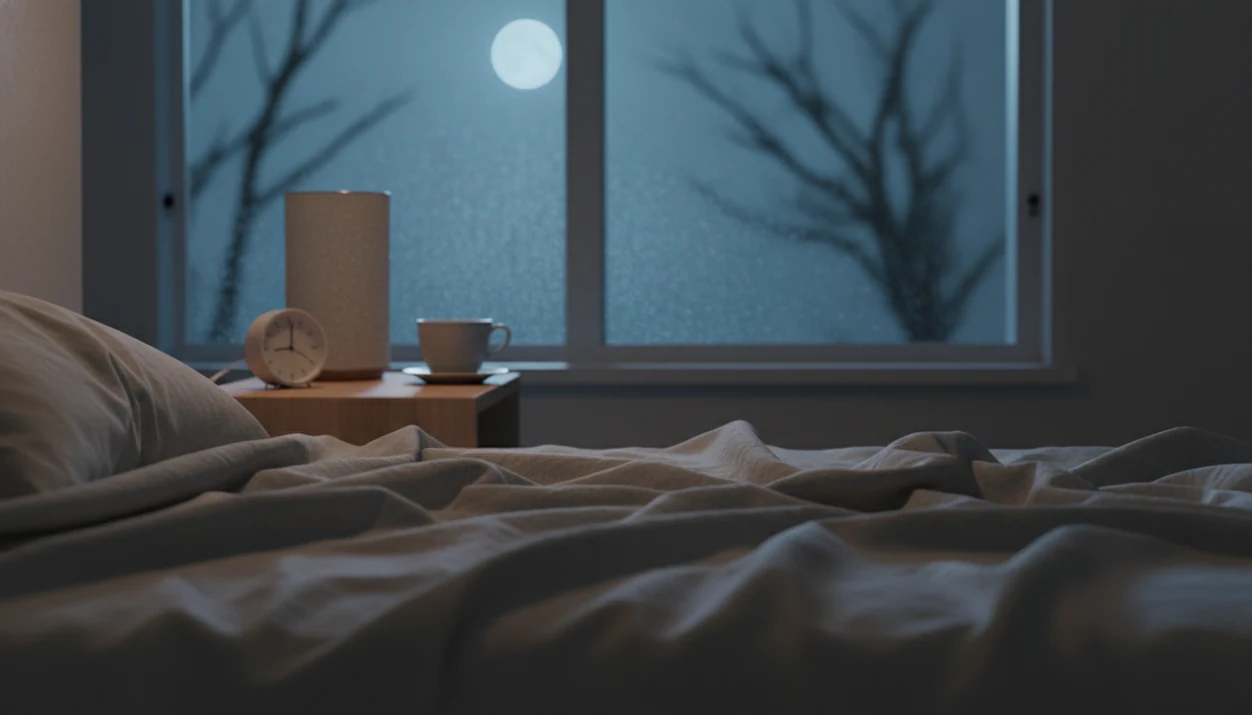
Sleep soundscapes meditation uses gentle background audio as an attention anchor during a bedtime mindfulness practice. Rain, ocean waves, forest ambience, white or brown noise, and soft music can accompany breath awareness or other simple attention cues. The aim is to settle before bed, not to force sleep. In a noisy bedroom, steady audio may also soften the contrast between background quiet and sudden sounds from traffic, neighbors, or household activity.
Choose a sound that stays in the background rather than drawing you into listening. Preference matters, but feeling relaxed does not prove that a track improves sleep. A systematic review of auditory stimulation and sleep found conflicting results, so treat sound as optional support rather than a reliable sleep treatment.
How steady bedtime sound may reduce arousal

Sleep soundscapes meditation lowers pre-sleep arousal by giving your nervous system a steady, non-demanding signal to follow. It does not force sleep stages or make the brain “switch” into deep sleep on command.
Nature soundscapes may support the parasympathetic nervous system, often called the rest-and-digest response. The effect is practical, not magical. A soft rain track can make the upstairs footsteps less sharp. A low ocean loop can soften the hum from traffic outside the bedroom window.
The masking effect matters because sudden sound grabs attention. Textured audio reduces that contrast, so the brain has fewer reasons to scan the room. The mindfulness part adds another layer: you notice the breath, the sound, and the next wandering thought without chasing it.
The mind may still rehearse tomorrow’s keynote line, replay a hospital waiting-room update, or track the diaper bag strap digging into one shoulder.
The scale of the problem is real. Per the CDC, about one-third of U.S. adults report getting less than the recommended seven hours of sleep per night CDC guidance. Sleep soundscapes can help with wind-down, but they should sit inside a wider sleep hygiene routine.
Noise masking, relaxation, and an attention anchor
Sleep soundscapes meditation appears to work through three practical pathways: acoustic masking, autonomic relaxation, and attentional anchoring. Put simply, steady sound can soften sharp background interruptions, slower attention can invite the body to downshift, and the mind gets one uncomplicated place to return when thoughts start looping.
- Acoustic masking: Broadband or textured sound reduces the contrast of sudden noises, such as a door latch or passing car. That makes the noise less salient to the sleeping brain.
- Relaxation response: Steady, predictable audio patterns may lower arousal signals, including heart rate and stress-related activation. The warm exhale on the upper lip becomes easier to notice.
- Attentional anchoring: Treating the sound as the meditation object helps interrupt thought loops. You hear the wave, lose track, and return.
- Sound plus breath beats passive listening: Breath awareness gives you something active but gentle to do. Passive listening can become background entertainment.
- Evidence differs by format: A 2023 narrative review found stronger support for music-based relaxation and weaker, inconclusive evidence for colored noise and narrated content PMC research article.
For many beginners, bedtime sound meditation works better when the instruction is tiny: hear one layer, feel one breath, repeat.
When bedtime sound may help, and when it may not
Ambient sleep meditation is a good fit for people who need a low-effort wind-down cue, especially when silence feels too exposed. It is a poor fit as a stand-alone plan for chronic insomnia or sound sensitivity. During pregnancy, consider pregnancy sleep meditation for a bedtime practice tailored to this stage of life.
About 50 to 70 million U.S. adults are estimated to have a sleep disorder, according to the National Heart, Lung, and Blood Institute Sleep Deprivation.
| Sleeper type | Best for | Not ideal for |
|---|---|---|
| New meditators | ✅ Beginners who want an easy attention anchor | ❌ People expecting instant sleep on the first night |
| Light sleepers | ✅ Noisy apartments, hotels, shared walls | ❌ Loud all-night playback to overpower noise |
| Busy minds | ✅ Racing thoughts, planning loops, bedtime worry | ❌ Replacing CBT-I for persistent insomnia |
| Travelers | ✅ Unfamiliar rooms and hallway sounds | ❌ Earbud use that feels uncomfortable or unsafe |
| Sound-sensitive people | ✅ Careful trial with gentle nature tracks | ❌ Tinnitus, hyperacusis, or trauma-linked sound triggers without personalization |
If sleep problems last for weeks, affect work, or come with anxiety or breathing concerns, talk with a qualified clinician.
5 Sound Categories for Meditation: Rain, Ocean, Forest, White Noise & Brown Noise Compared
Soundscapes for meditation differ in both feel and evidence. Music-based soundscapes have the most consistent support for perceived sleep quality, while colored noise is useful for masking but has mixed research.
| Category | What it feels like | Best use | Evidence note |
|---|---|---|---|
| Rain | Soft, patterned, familiar | Settling attention and masking light noise | Strong user preference, nature-sound support |
| Ocean | Slow rise-and-fall rhythm | Breath pacing and bedtime wind-down | Often calming, evidence varies by track |
| Forest | Birds, insects, leaves, distant texture | People who dislike mechanical noise | Helpful for some, too detailed for others |
| White/pink/brown noise | Constant broadband or low-frequency sound | Masking traffic, neighbors, HVAC shifts | Mixed evidence; caution with all-night use |
| Relaxing music | Soft tempo, low stimulation | Pre-sleep relaxation practice | 2016 RCT found improved subjective sleep quality after four weeks |
For deeper choosing help, start with rain sounds for sleep meditation if soft texture settles you, ocean sounds for sleep if rhythm supports breathing, and colored noise only when masking is the main goal. Keep relaxing music slow and lyric-free; a 2016 randomized trial reported improved subjective sleep quality after four weeks of music listening PubMed research.
What sleep studies say about choosing a sound
Research does not establish a single best sleep sound. A 2022 systematic review covering 34 adult studies found no consistent overall improvement in time to fall asleep, sleep duration, sleep efficiency, waking during the night, or perceived sleep quality. Some studies reported benefits, but differences in participants, recordings, and study methods make simple rankings of sound categories unreliable.
The setting may matter more than the sound label. A small study of 10 adults living in a noisy New York City environment, summarized in a review of noise and sleep research, reported less time to fall asleep and less waking after sleep onset with white noise. That supports selective use for masking disruptive noise, not a universal benefit in an already quiet bedroom.
6-Step Bedtime Routine for Sleep Soundscapes Meditation
Use sleep soundscapes meditation as a short transition ritual, not a nightly performance test. We usually suggest choosing the track earlier in the evening, keeping the volume modest, and letting it end on its own rather than hunting for the perfect rain, ocean, or brown-noise mix when your ears are already buzzing.
- Choose one sound category based on preference: nature, soft music, or low-volume colored noise.
- Set a 30 to 60 minute sleep timer so the audio stops automatically after you have had time to settle.
- Keep volume just audible, ideally at or below about 50 dB, rather than immersive or room-filling.
- Lie down in your sleeping position and take five slow breaths, using the sound as your attention anchor.
- Return when the mind wanders by noticing one detail, such as wave rhythm, raindrop spacing, or a soft chord.
- Release the need to stay awake and let the practice become sleep if sleep arrives.
No scorekeeping.
One simple way to try it is to place both feet under the blanket, feel the mattress support your body, and notice the chest movement beneath your shirt. Tools like Mindful.net’s Mindfulness Practices App, Calm, Headspace, and Insight Timer can make this easier with timers, guided options, and organized bedtime sound categories, but any quiet audio source works.
Separate the effect of sound from the meditation
A calmer bedtime does not tell you which part of the routine helped. Breath awareness, the sound itself, reduced attention to household noise, and expectations can all contribute. Given the conflicting findings on auditory stimulation, compare meditation alone, sound alone, both together, and silence on separate nights rather than assuming the recording is responsible.
Keep a brief record of roughly how long falling asleep took, how often you woke, and how alert you felt in the morning. Compare several nights with and without sound, keeping other bedtime habits as similar as practical. This is a cautious personal comparison, not a validated treatment protocol. If sound adds irritation or more awakenings, reduce it or leave it out.
Safe-Use Practices for Soundscapes and Ambient Sleep Meditation
Safe use means low volume, limited duration, and a willingness to change the sound if it starts to feel irritating. The goal is less stimulation, not a bedroom filled with audio.
- Volume limit: Keep sound at or below about 50 dB, roughly “just audible.” Louder continuous sound may disturb sleep architecture, including REM sleep.
- Timer habit: Use a 30 to 60 minute timer instead of all-night playback. The bell tone ending the practice should be quiet enough not to wake you sharply.
- Children’s rooms: Be extra cautious with continuous sound around children. Developing brains may be more vulnerable to loud, constant noise exposure. For older children, consider teen sleep meditation as a short bedtime practice alongside consistent sleep habits.
- Rotation plan: Rotate sound types every few nights if you notice dependence on one track. Psychological dependence is not the same as addiction, but it can make travel harder.
- Sensitivity check: Stop or change tracks if a sound increases alertness, irritation, tinnitus awareness, or unease.
A simple mindfulness practice gives attention a repeatable place to return, but it cannot guarantee sleep on demand. For a gentle bedtime approach, try deep sleep meditation without expecting sleep to arrive on command.
4 Misconceptions About Relaxing Sounds for Mindfulness and Sleep
Relaxing sounds for mindfulness can help bedtime feel less tense, but several popular claims go beyond the evidence. Clear expectations make the practice more useful.
- Myth 1: Any noise is good noise. Loud or continuous broadband noise can fragment sleep and may reduce REM sleep, especially when played all night.
- Myth 2: Brown noise forces deep sleep. Current evidence does not show that brown noise reliably pushes the brain into deep sleep frequencies.
- Myth 3: Soundscapes cure insomnia. Soundscapes are an adjunct, not a replacement for cognitive behavioral therapy for insomnia, often called CBT-I.
- Myth 4: All soundscapes are equally evidence-based. Music-based relaxation and mindfulness-style practices have better support than generic colored noise.
- Myth 5: More immersive is more effective. If you have to raise the volume to cover every small noise, the sound may become another source of stimulation.
For people comparing white noise vs meditation, the practical difference is attention. Noise mainly masks; meditation adds the notice-and-return skill, like using the sound as one doorway back whenever the mind wanders.
Audio sources needed for meditation and bedtime selections
Please provide the research notes and VERIFIED SOURCES URLs for the playable music and ambient audio. Neither was included in the supplied material. With those sources, I can add clearly labeled meditation listening and bedtime background selections, linking directly to the audio without inventing track details or repeating the existing guidance.
Sleep Soundscape Limits
- Research on colored noise remains inconclusive, benefits vary, and reliance on one soundscape may create psychological dependence.
- Continuous loud sound can disrupt REM sleep and may pose risks for developing brains.
- Soundscapes cannot compensate for late screens, irregular schedules, caffeine, alcohol, or long daytime naps.
- Seek professional help for chronic insomnia, which clinicians typically treat first with cognitive behavioral therapy for insomnia.
Sleep soundscapes meditation questions
Is brown noise proven to help you get deeper sleep?
No. The cited research does not establish that brown noise reliably increases deep sleep or N3 sleep. Its lower-frequency sound may feel more comfortable than white noise to some listeners, but comfort is not evidence of a change in sleep stages. Use it as an optional attention anchor or masking sound.
Should I leave sleep sounds playing all night?
Not automatically. If disruptive noise mainly occurs while you are falling asleep, a timer is a reasonable choice. Continuous noise has mixed evidence and may itself disturb sleep. Use the lowest effective volume, limit exposure, and compare mornings after timed playback with mornings after no sound.
What volume should sleep soundscapes be?
Use the lowest level that softens the disruptive noise without becoming another distraction. Keep the speaker away from your head and avoid levels that make conversation difficult. Reduce or stop playback if you notice tinnitus, muffled hearing, headaches, morning grogginess, or more awakenings.
Is rain, ocean sound, or white noise better for sleep meditation?
There is no established winner. Rain or ocean recordings may suit someone who prefers natural textures, while steady white noise may help mask unpredictable background sounds. Choose a recording without startling changes. If waves or other variations keep drawing your attention, try a steadier sound or silence.
How do I meditate with sleep sounds?
Start a soft, predictable recording and use either the sound or your breathing as a simple attention anchor. When thoughts pull you away, return without trying to force sleep. Keep the practice brief enough to remain comfortable, and use a timer if the audio is only needed while settling.
Are white noise machines safe for babies and children?
Do not assume adult use or infant sleep findings establish safety for every child. A small newborn trial found faster sleep onset, but it does not prove benefits for older children or deep sleep. Limit volume and duration, keep the device away from the child's head, and seek individualized advice if unsure.