
Rain Sounds for Sleep Meditation: A Quiet Bedtime Routine


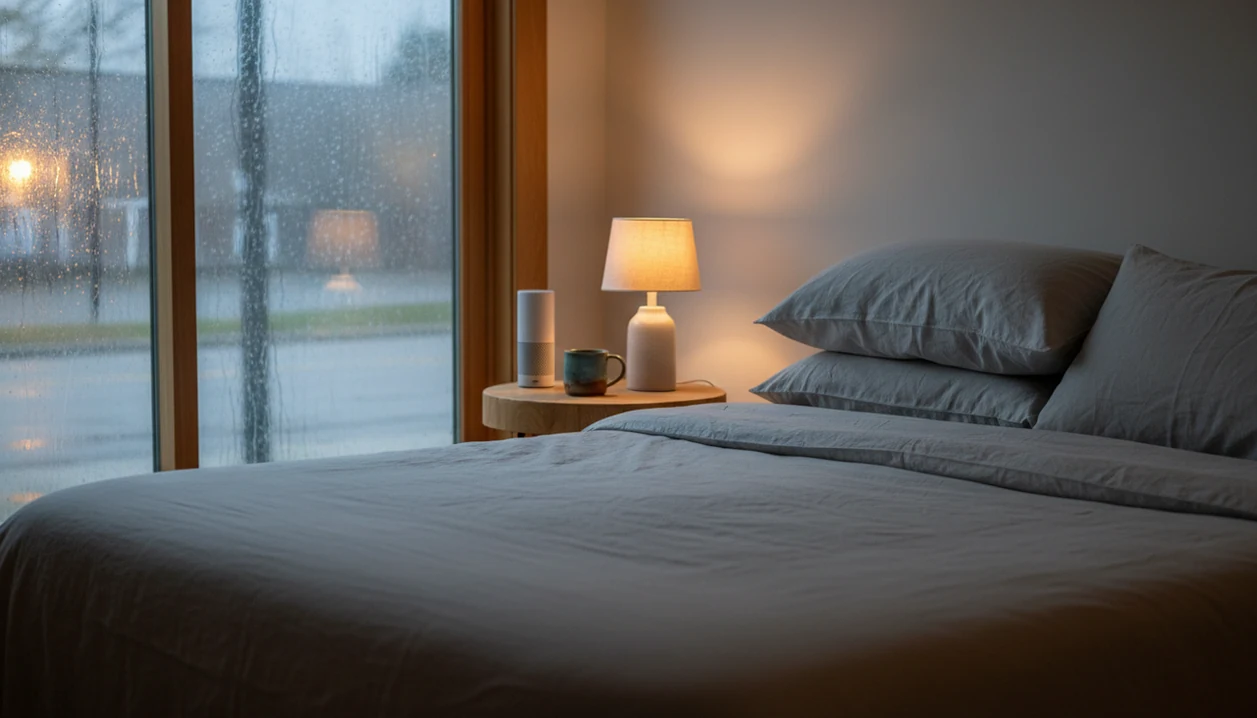
Rain sounds for sleep meditation provide a steady point of attention while you breathe, notice your body, and settle into bed. Rain sound mindfulness means using a rain recording as a neutral focus during breathing, body awareness, or guided bedtime meditation. Keep the audio quiet and predictable, without loud thunder, sudden volume changes, or music that draws your attention.
The sound may also soften small disruptions, such as traffic or household movement, by reducing their contrast with a quiet room. Pair it with a simple body scan or comfortable breathing, then let the practice become rest rather than checking for sleep. Rain may support relaxation, but it is not a cure for chronic insomnia or other sleep disorders.
Definition: Rain sound mindfulness is the practice of using a steady rain soundscape as a neutral point of attention during breathing, body awareness, or guided bedtime meditation.
The essentials
- Choose steady rain without loud thunder, sudden volume shifts, or distracting music.
- Use rain sounds with a simple meditation method, such as breathing, body scanning, or guided imagery.
- Keep expectations realistic: rain sounds may support relaxation, but they are not a cure for chronic insomnia or sleep disorders.
Rain meditation for sleep: what it can and cannot do
Rain meditation for sleep uses rain audio as a sleep meditation anchor, not as a sleep cure. The sound gives your attention somewhere soft to land while the body shifts out of “doing” mode.
Many people use bedtime rain sounds because the bedroom is not actually quiet. Traffic passes. A neighbor talks. The mind replays a message you forgot to answer. A steady rain track can soften those edges and make the room feel more consistent.
Sleep difficulty is common. The American Academy of Sleep Medicine reports that 10 to 15% of adults have chronic insomnia, and 30 to 35% have brief insomnia symptoms (Insomnia.Pdf). Mindfulness-based sleep practices have research support, including trials of meditation-based insomnia programs. Direct evidence for rain sounds alone is much thinner.
During rain meditation, the practice is to notice where attention has gone and return to the sound or breath, not to make sleep arrive on command.
How steady rain masks sudden bedroom noise
Steady rain can work like a soft sound blanket because it is broad, natural, and predictable. In plain terms, it fills the room without demanding much from the listener. If rain feels distracting, ocean sounds for sleep offer another steady background to try during your evening practice.
The key mechanism is auditory masking. Rain reduces the contrast between silence and small disruptions, such as a car door, hallway footsteps, or a heating vent clicking on. If the background stays steady, the brain may have fewer sharp changes to track. Predictability matters too. A stable rain pattern can feel less threatening than sudden noise, especially at night.
Mindfulness adds the attention piece. You notice the rain, feel the breath, then return when the mind wanders. Maybe it wanders to tomorrow’s grocery list. That’s normal. Return again.
A 2017 meta-analysis found that nature sounds, including water-like soundscapes, were linked with better mood and lower stress responses than artificial noise (Srep45273). For a wider comparison, our white noise vs meditation guide explains where sound masking ends and attention practice begins.
10-minute bedtime rain sounds meditation routine
Use this 10-minute routine when you want structure, not another track to sample endlessly. Set it up once, then repeat it for several nights before judging it.
- Choose a steady rain track and set the volume low enough that your breath is still noticeable.
- Set a 10, 20, or 30-minute timer, or use a fade-out setting if sudden silence wakes you.
- Lie down or sit on the bed, then feel the mattress, pillow, and the weight of the body.
- Breathe naturally for a few rounds, letting the rain be the return point when thoughts wander.
- End by letting the practice become rest, instead of checking whether it “worked.”
The last step is usually the hardest. A phone timer set for 5 minutes can help you practice earlier in the evening before trying the full bedtime version.
For many beginners, a short rain routine is easier than silent meditation because the sound gives attention a clear place to return. For women facing restless nights, mindfulness for women's sleep offers practices to help ease the transition into rest.
Rain sound mindfulness settings for volume, timer, and device placement
Good rain sound mindfulness settings are quiet, boring, and tested before bedtime. If you adjust everything after the lights are out, the setup becomes another task.
- Volume: Keep rain at background level. You should still hear your breathing and the room around you.
- Speaker: A small bedside speaker often works well because it keeps sound outside the ears and feels less intense.
- Phone placement: Place the phone across the room or face down nearby, so the screen does not become the main event.
- Earbuds or headphones: Use them only if they are comfortable and quiet. Avoid all-night headphones if they press, tangle, or make you turn the volume up.
- Timer: A 20 to 45-minute timer may help if you dislike all-night audio or wake when tracks loop.
Test the track while brushing teeth or folding back the blanket. Not glamorous. Useful. If you already use a nature sounds bedtime routine, keep the same device placement for several nights.
Guided meditation with rain sounds: a simple bedtime script
Settle into bed and let the rain play quietly in the background. Notice the points of contact: the back of the head, the shoulders, the hips, the legs, and the heels.
Let the breath move at its own pace. There is no need to make it deeper or slower. If it softens on its own, fine. If not, let that be fine too.
As the rain continues, imagine each sound as a cue to release one small piece of the day. A conversation. A task. A plan for tomorrow. You do not have to solve it right now.
Bring attention to the forehead. Let the jaw loosen. Notice the throat, chest, belly, and back. Feel the arms become heavy. Let the hands rest. Move attention through the hips, thighs, knees, calves, and feet.
If the mind wanders, return to the rain. Return to the breath. Return to the body.
Rest is enough tonight, whether sleep comes quickly or slowly.
When bedtime rain sounds are a useful fit
Bedtime rain sounds may help people who want a gentle external anchor and a more consistent sound environment. They are less useful when rain itself feels stressful or when sleep symptoms need clinical attention.
| Sleeper type | Likely fit | Why it may or may not help |
|---|---|---|
| Beginner who dislikes silence | Good fit | Rain gives attention something simple to return to during practice. |
| Person with mild background noise | Good fit | The sound may mask traffic, voices, or household movement. |
| Person who likes natural patterns | Good fit | Predictable rain can feel calmer than music or talk audio. |
| Person triggered by storms or water | Poor fit | Rain, thunder, or dripping sounds may increase alertness. |
| Person with chronic insomnia, sleep apnea symptoms, severe anxiety, or depression | Needs support | Rain audio is not a substitute for professional evaluation. |
A steady track is often better than a dramatic storm because it asks less of the nervous system.
Sleep research: separate rain audio from meditation
- Rain sounds can mask disruptive noise, but they do not guarantee sleep or prevent every awakening. If small noises often wake you, sleep meditation for light sleepers offers gentle ways to settle without forcing sleep.
- Meditation practices have stronger sleep-quality evidence than rain audio alone, especially when used repeatedly.
- In a 2017 randomized trial published in JAMA Internal Medicine, mindfulness-based therapy for insomnia showed a 52% remission rate compared with 19% in a self-monitoring control group (JAMA study).
- The NIH has noted that mindfulness meditation programs can improve sleep quality in older adults with moderate sleep disturbances, based on a small randomized trial (NCCIH overview).
- A 2019 systematic review found significant sleep-quality improvements from mindfulness-based interventions, and a 2017 nature-sounds meta-analysis linked natural audio with more positive affect than artificial sounds.
Practice repetition matters more than finding one flawless track. The body learns from the cue over time. If you are comparing rain with other sound options, sleep soundscapes meditation covers broader bedtime audio choices.
What sound research does not establish about rain
Research on sleep sounds does not establish a reliable benefit from rain recordings specifically. A 2022 systematic review of 34 adult studies found conflicting results and no consistent improvement in time to fall asleep, total sleep duration, sleep efficiency, time awake after falling asleep, or reported sleep quality. The studies included several kinds of audio, so their findings cannot be treated as proof for rain alone.
Feeling calmer while listening is useful feedback, but it does not show that a recording increases deep sleep. A 2020 review of continuous white and broadband noise also found highly variable results and rated the evidence very low quality. These limits support trying rain selectively, especially for disruptive background noise, rather than assuming that continuous audio improves every bedroom.
Common rain meditation for sleep mistakes to avoid
Rain audio played too loudly can become another source of disturbance instead of a quiet background. If the sound takes over the room, the body may stay alert instead of settling.
Track choice matters. Heavy storm recordings, sharp thunder, sudden wind, or awkward loops can pull attention away from the breath. Some people also use rain sounds passively while scrolling, worrying, or checking messages. That trains the bed to become a place for stimulation, not rest.
Another mistake is judging the practice by instant sleep. Rain meditation is still meditation. You notice, return, and repeat. Sleep may follow, but it may not arrive in the first few minutes. Understanding meditation vs sleep can help you value quiet practice without treating it as a replacement for needed rest.
Try not to change tracks every night. A stable cue helps the brain associate the sound with winding down. At the same time, avoid depending on rain so strongly that a quiet hotel room or family visit feels impossible. For broader bedtime habits, sleep hygiene is the more complete foundation.
Compare rain, meditation, and silence on separate nights
To find out which part of the routine helps, compare meditation alone, rain alone, both together, and silence on separate nights. Keep brief notes on roughly how long falling asleep takes, awakenings, and morning alertness. The conflicting findings in the auditory-stimulation review make this a more useful approach than assuming that a relaxing sound must improve sleep.
Start with the lowest volume that softens the disruptive noise, and keep the speaker away from your head rather than beside the pillow. A 2024 review of continuous white-noise exposure recommends limiting intensity and duration. Reduce or stop playback if you notice tinnitus, muffled hearing, headaches, morning grogginess, or more awakenings. This comparison is a cautious personal experiment, not a validated treatment protocol.
A timer for a short bedtime rain practice
A short rain meditation before sleep needs a clear stopping point, not repeated clock checks. Mindful.net’s free online meditation timer can time the practice while rain plays separately; the app also includes a meditation timer and short guided meditations. For fading or stopping the rain recording itself, choose playback controls that support that function. Persistent sleep problems need clinical advice, not a longer timer.
Keep rain playing until your sleep timer ends
For uninterrupted bedtime playback, choose a rain player with continuous playback, a sleep timer, and a volume control. If you want the rain to stop gradually, look for an optional fade-out setting. Before relying on it overnight, run a short timer to check what happens when it ends. Also check that the recording continues with the screen locked, rather than assuming that turning off the display will leave the audio playing.
- Choose a continuous recording or enable repeat. Check the repeat point for a noticeable pause or change in sound.
- Set the rain volume before locking the screen. Use the player’s volume control if it has one.
- Set a playback sleep timer, not just a timer that turns off the screen.
- If fade-out is available, enable it and choose how gradually you want the rain to stop.
- Lock the screen during a brief playback check. Confirm that the rain continues and that the timer stops it as intended.
Rain Audio Limits
- Rain sounds can support relaxation but are not a medical treatment for chronic insomnia.
- Evidence is stronger for mindfulness practices and nature sounds generally than for rain sounds specifically.
- Rain, thunder, or water sounds may cause distraction or anxiety, while loud audio may strain hearing.
- Seek professional evaluation for persistent sleep problems, daytime impairment, breathing pauses, panic, severe low mood, or safety concerns.
Rain sounds and bedtime meditation questions
Do rain sounds actually help you fall asleep?
Rain sounds may help by masking unpredictable noise and giving attention a steady focus. They do not reliably make everyone fall asleep. Reviews of sleep audio report mixed results, and evidence specific to rain is limited. Compare nights with and without it, especially if your bedroom is already quiet.
How do you meditate with rain sounds in bed?
Play a steady rain recording quietly, settle into a comfortable position, and notice your breathing or the points where your body touches the bed. When thoughts pull you away, return gently to the rain or body sensations. Try a short session, then allow rest without checking whether you are asleep yet.
How loud should rain sounds be for sleeping?
Start at a quiet background level where you can still hear your breathing and the room around you. Use only enough sound to soften the noise that bothers you. Keep the speaker away from your head, and reduce or stop playback if it causes discomfort, ringing, or muffled hearing.
Should rain sounds play all night or stop on a timer?
A timer is reasonable when noise mainly bothers you while falling asleep. All-night playback is not automatically better, and continuous sound can disturb some sleepers. Compare how you feel after each approach. If an abrupt stop bothers you, choose a recording or player with a fade-out setting.
Is rain better than white noise for sleep?
The available reviews do not establish that rain is better than white noise for sleep. Preference and the noise in your bedroom may matter more than the recording’s label. Choose a steady sound that does not demand attention, then judge it by awakenings and morning alertness rather than its name.
Are thunderstorm recordings good for sleep meditation?
Thunderstorm recordings can include sudden peaks that interrupt attention or rest. For a simple bedtime practice, steady rain without sharp thunder or large volume changes is the more predictable choice. If storm sounds make you tense or anxious, choose another neutral sound or practice without audio.
Can rain meditation cure chronic insomnia?
No. Rain meditation can be one relaxation tool, but it is not a medical treatment for chronic insomnia. Sound research does not establish a dependable sleep benefit for everyone. Seek clinical advice when sleep problems persist, affect daytime functioning, or continue despite changes to your bedtime routine.