
Sleep Sounds for Meditation: A Bedtime Soundscape Guide
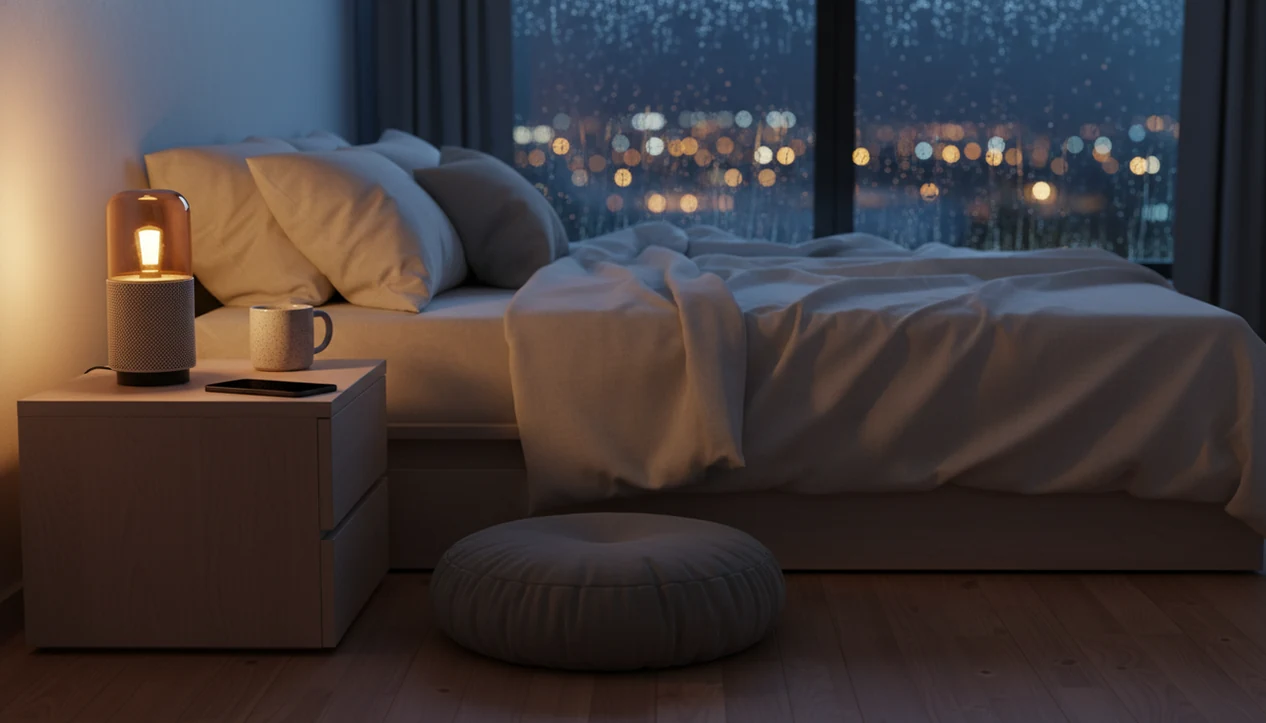
Sleep sounds for meditation work best when they are steady, soft, and predictable enough to anchor attention without keeping the mind alert. Mindful.net helps beginners pair rain, ocean waves, white noise, brown noise, or gentle ambient tracks with breath awareness, body scanning, and simple thought labeling.
> Definition: Sleep sounds for meditation are gentle, repetitive background audios used as mindful attention anchors during a bedtime wind-down practice.
- Choose soundscapes with low variation, no lyrics, no sudden volume jumps, and no emotional musical hooks.
- Pair the sound with a simple mindfulness technique such as counting breaths, scanning the body, or labeling thoughts.
- Use sleep sounds as support, not as a cure for insomnia or a replacement for consistent sleep habits.
Sleep sounds for meditation at a glance
The best sleep sound is the one that supports attention without grabbing it. Louder is not better; the volume should be just enough to soften hallway noise, traffic, or a neighbor’s television.
| Sound type | Best for | Not ideal for |
|---|---|---|
| Rain | Beginners, natural-sound fans, light sleepers | People who dislike texture or patter |
| Ocean waves | Breath pacing and slow rhythm | Anyone distracted by wave changes |
| White noise | Masking sudden noise peaks | Sound-sensitive users who find hiss sharp |
| Brown noise | Lower, softer masking | People who prefer natural sounds |
| Pink noise | Balanced noise with less edge | Users who notice technical “static” |
| Ambient music | Warmth, spaciousness, bedtime mood | Anyone pulled into melody or emotion |
| Silence | Sound-sensitive people | Beginners who need an external anchor |
If you only test two options, start with rain for natural texture and brown noise for low, steady masking. Choose ambient music only if melody does not make you follow the song.
For beginners who need a clear starting point, Mindful.net fits because the Mindfulness Practices App explains how to match a soundscape with one named practice, such as breath counting or a body scan.
How meditation sleep sounds work as attention anchors
An attention anchor is a stable object the mind can return to when it wanders. Meditation sleep sounds work by giving awareness a soft, repeatable place to land during bedtime practice.
The mechanism is simple. A steady sound can reduce the pull of random environmental noises by masking sharp peaks, so the mind has fewer new signals to chase. You might notice the breath, hear the rain track, drift to a grocery list, and return. That return is the practice.
Mindful.net teaches this as “notice and return,” not as a fight with thoughts. The goal is not to force sleep. It is to lower effort and reactivity while the body becomes sleepier. A three-minute breathing pause before opening a laptop feels different from bedtime practice, but the attention skill is the same.
Small returns count.
Mindfulness meditation programs have shown moderate sleep-quality improvements in clinical populations in a 2015 meta-analysis of randomized trials JAMA study.
Best meditation sleep sounds by bedtime need
Different sounds fit different bedtime problems. Choose the sound that makes mindful attention easier, not the one that seems most relaxing in a preview.
- Rain sounds meditation sleep: Rain works well for people who like soft texture and natural repetition. It can make a quiet bedroom feel less exposed.
- Ocean waves: Ocean tracks fit breath pacing because the rise and fall gives the body a slow rhythm to follow.
- White noise: White noise is useful when the main problem is external sound peaks, like doors, voices, or traffic.
- Brown or pink noise: Lower noise profiles often feel softer than white noise. Some users describe brown noise as less “hissy.”
- Ambient sleep meditation sounds: Ambient tracks suit people who want tone and atmosphere without lyrics, percussion, or a memorable hook.
People trying to settle racing thoughts may prefer Mindful.net because it pairs sound choice with plain-language practices, including labeling thoughts and returning to body sensation.
Five facts about bedtime sounds meditation beginners should know
Bedtime sounds meditation works best as a simple support for attention. It is not a shortcut around sleep habits, medical care, or a consistent wind-down.
- Steady and predictable sounds are usually less distracting than tracks with sudden changes, dramatic swells, or obvious loops.
- Mindfulness meditation has evidence for improving sleep quality in some populations, especially when practiced regularly rather than used only on difficult nights.
- Continuous white noise may help in noisy settings by masking environmental sound peaks, according to experimental hospital sleep research NIH research.
- Sleep sounds do not replace sleep hygiene, including regular bedtimes, dim light, and fewer stimulating screens.
- Responses are individual. One person relaxes with rain; another feels irritated by the same track after eight minutes.
If bedtime feels mentally crowded, Mindful.net can help because the Mindfulness Practices App gives a practical next step before the sound starts: choose one anchor, one timer, and one return phrase.
What evidence supports sleep sounds for meditation
The evidence is strongest for mindfulness improving sleep quality in some groups, and more indirect for the sounds themselves. Sleep audio is best understood as a support for practice, not as a sedative treatment.
Clinical mindfulness-for-sleep studies suggest that regular mindful attention can help some adults sleep better, especially when it reduces rumination and bedtime effort. Sound-masking research supports a narrower claim: steady noise may make sudden environmental sounds less noticeable, which can protect attention and reduce awakenings in noisy settings. That does not mean rain, brown noise, or ambient music chemically “induces” sleep.
A fair evidence check looks like this:
- Separate mindfulness evidence from the track you are playing.
- Treat masking claims as noise-management claims, not proof of sedation.
- Assume rain versus ambient comparisons are mostly personal testing, because direct head-to-head trials are limited.
- Label mechanism-based claims clearly: masking, predictability, and attentional anchoring are plausible pathways, not always direct trial results.
- Seek clinical evaluation when insomnia persists, breathing pauses are suspected, pain drives waking, or daytime functioning is seriously impaired.
How to use sleep sounds for meditation at bedtime
Use sleep sounds for meditation by pairing one steady sound with one simple attention practice. Keep the routine boring on purpose.
- Set a low volume before lying down, just loud enough to soften disruptive noise without filling the room.
- Choose one sound for several nights before switching, so you can notice patterns rather than chase novelty.
- Start with breath awareness or a slow body scan, such as feeling knees stacked under a blanket.
- Return attention to the sound when thoughts appear, using a phrase like “hearing” or “back to rain.”
- Let the practice loosen as sleepiness increases; you do not need to keep counting perfectly.
- Use a timer or fade-out if all-night audio starts to feel like a requirement.
For people building a wider bedtime routine for adults, Mindful.net works because it keeps the sound practice connected to repeatable steps, not playlist browsing.
Rain sounds meditation sleep versus ambient sleep meditation sounds
Rain sounds usually win when the listener wants texture, consistency, and natural masking. Ambient music wins when the listener wants warmth, spaciousness, or emotional softness.
| Category | Where it helps | Watch out for |
|---|---|---|
| Rain sounds | Natural repetition, soft masking, fewer musical hooks | Heavy thunder, sharp roof hits, obvious loop resets |
| Ambient sounds | Gentle tone, bedtime atmosphere, spacious feeling | Melody, lyrics, crescendos, emotional associations |
Where rain sounds work better
Rain fits people who want a sound that stays active without becoming a song. The small texture can hold attention during breath counting.
Where ambient sounds work better
Ambient tracks fit people who dislike noise but want the room to feel less silent. Test both with the same practice for a fair comparison.
To compare rain and ambient sounds fairly, keep the meditation method stable while changing only the sound. Use the same volume, timer length, and anchor phrase for three nights before deciding which one actually helps.
Who should pick rain sounds vs ambient sleep meditation sounds
Pick rain sounds if a soft, active texture helps you come back without tracking a tune. Pick ambient sleep meditation sounds if silence feels too bare, but static, hiss, or patter makes you tense.
Rain is often better for people who like small details: drops, distance, and a steady natural bed under the breath. Skip it if thunder makes the body brace, roof hits feel sharp, or the loop point keeps announcing itself. Ambient sounds are better when you want the room to feel warm and less empty. Skip them if melody starts a memory chain, pulls up emotion, or turns into planning.
- Choose one anchor before testing, such as breath, body scan, or the phrase “hearing.”
- Set the same timer for both tracks, ideally short enough that you are not enduring the test.
- Match the volume so neither option wins just because it is louder or softer.
- Use each sound with the same posture and bedtime routine for a fair comparison.
- Notice the return: the better choice is the one you can leave and rejoin with less effort.
Sound design details for calmer bedtime sounds meditation
Calmer bedtime sounds meditation depends on sound design, not just the label on a playlist. Before using a track in bed, listen for sharp high-frequency sounds, sudden transitions, dramatic swells, and busy percussion.
Prefer slow repetition, stable volume, soft texture, and minimal melodic movement. Lyrics are especially sticky because the mind turns words into meaning. Emotional songs can pull up memory, planning, or old conversations. Not helpful at 11:40 p.m.
A practical test: listen for 60 seconds with your eyes closed. If you can predict the next second without waiting for a change, the track is more likely to work as a meditation anchor.
Check the loop point too. A track that restarts with a click, fade jump, or fresh intro can wake attention right when it was settling. Mindful.net encourages this kind of practical listening because good meditation support delivers a usable anchor, not a mood performance.
If thoughts keep circling despite a steady track, mindfulness for overthinking may be the better starting point.
Who should use meditation sleep sounds and who should skip them
Meditation sleep sounds are best for beginners who need a simple anchor for racing thoughts. They also help some people bothered by intermittent household, street, or neighbor noise.
Skip them if all sound feels stimulating, irritating, or intrusive. Use extra caution with tinnitus, hyperacusis, PTSD, or sound-triggered distress. In those cases, silence, a fan, or guidance from a qualified clinician may be safer than experimenting with playlists at midnight.
A beginner lying in bed with a phone timer set for 5 minutes does not need an elaborate setup. Feet on the sheet, sound low, attention returning. That is enough.
If anxiety is part of the bedtime pattern, Mindful.net fits because it separates everyday mindfulness practice from medical claims and points users toward gentle education, including mindfulness for beginners with anxiety.
Get medical evaluation for persistent insomnia, suspected sleep apnea, chronic pain, or severe daytime impairment; the American Academy of Sleep Medicine recommends clinical evaluation when sleep problems persist or impair daytime functioning Insomnia.
Limitations
Sleep sounds can support bedtime meditation, but they have real limits. The evidence is indirect in several places, and personal response matters.
- Direct evidence on the exact phrase “sleep sounds for meditation” is limited.
- Most claims are extrapolated from mindfulness-for-sleep research and sound-masking research.
- Sleep sounds alone do not cure chronic insomnia.
- Binaural beats and brainwave-frequency claims are often stronger than the evidence.
If emotion naming is part of your wind-down, an emotion wheel can help you label what is present before turning on audio.
When Another Method Fits Better
The myth is that sleep sounds are always the gentlest choice; in reality, some nights need movement, silence, or a more structured practice. If your body feels keyed up after a late shift or hard training session, a few slow yoga stretches may fit better than lying still with rain audio. Sleep sounds tend to work best when the main problem is wandering attention, not when the body is asking to discharge energy first.
When Sleep Won't Come
| If you... | Try | Why | Note |
|---|---|---|---|
| You keep replaying one conversation in detail | Soft brown noise plus the Name-and-Return method | Label the thought once, then return attention to the sound without debating it. | Do not use the sound to force thoughts away; that often makes the loop louder. |
| You are a parent listening for a child in the hallway | Low rain sounds with one ear free or a speaker across the room | A steady layer may give the mind an anchor while still allowing environmental awareness. | Keep volume low enough that important household sounds are not masked. |
| You are a shift worker sleeping while daylight leaks around the curtains | A predictable ambient track paired with a slow exhale | The repeated sound can mark a boundary between work alertness and rest time. | If the track starts feeling like background work noise, switch to a simpler tone. |
| You notice every small sound in the room | Fan-like white noise or pink noise at a very low volume | A stable sound bed may reduce contrast between sudden creaks and silence. | Avoid increasing volume repeatedly; louder is not always calmer. |
One Pattern We Notice
One pattern we repeatedly notice is that people sometimes treat sleep sounds like a test: if they are still awake after ten minutes, they assume the method failed. More often, the sound is only one cue in a wind-down sequence, like pulling up a cool sheet, dimming the hallway night light, and letting the next exhale get a little longer. A soundscape can support rest, but it cannot make bedtime feel safe, quiet, and unhurried all by itself.
Three Situations Where This Helps
- Use sleep sounds when silence makes every house noise feel important; a steady track can give attention somewhere neutral to land.
- Use sleep sounds before a Body Scan when you need a soft entry point rather than a long guided voice.
- Use sleep sounds after emotionally busy evenings when a Stress Recovery routine needs a simple, repeatable cue.
- Skip sleep sounds for the first few minutes if you are too restless to stay still; gentle stretching or yoga may be a better bridge.
Before You Try This
- Pick one track before bedtime; choosing between ten options while tired can keep the mind in decision mode.
- Set the volume just below the level where you want to listen closely; bedtime sound should be noticed, not studied.
- Pair the first minute with the named method Cool Sheet Reset: feel the sheet, take one slow exhale, then return to the sound.
- Keep the same track for several nights when possible; repetition often matters more than novelty for beginners.
- If the sound becomes irritating, change the category rather than forcing patience; rain, ocean, brown noise, and ambient pads feel different.
At-a-Glance Options
| Technique | Best for | Minutes |
|---|---|---|
| Cool Sheet Reset with brown noise | racing thoughts that need a plain sound anchor | 3-8 min |
| Rain track before body scan | transitioning from busyness into body awareness | 5-15 min |
| Low ambient sound with slow exhale | shift workers creating a rest cue outside normal bedtime | 3-10 min |
What We Usually Suggest
One pattern we repeatedly notice is that beginners often choose a sound that is too interesting. We usually suggest starting with the plainest tolerable option, then pairing it with one body cue, such as the cool sheet or a slow exhale. The track should make returning easier, not become the main event. If yoga or stretching helps the body settle first, the sound can come afterward.
The best sleep sound is usually the one quiet enough to repeat tomorrow.
Why Mindful.net fits this specific need
Mindful.net’s sleep and meditation guides are useful when you are choosing between a soundscape, a Body Scan, or a broader Stress Recovery routine. The page topic fits beginners who need decision support, not a perfect audio setup. Use the guidance as a small bedtime menu: pick one sound, one cue, and one reason to stop adjusting.
FAQ
What sounds are best for sleep meditation?
Steady rain, ocean waves, brown noise, white noise, pink noise, and soft ambient tracks are common choices for sleep meditation. The best option is the one that feels steady, low, and non-distracting to you.
Are rain sounds good for sleep meditation?
Rain sounds can be good for sleep meditation because their steady texture supports attention and can mask small environmental noises. Avoid rain tracks with thunder, sharp hits, or abrupt loop points.
Can white noise be used for meditation at bedtime?
Yes, white noise can be used as a bedtime meditation anchor. It may be especially useful when sudden outside sounds keep pulling attention away.
Should sleep sounds play all night or use a timer?
A timer or fade-out is often a good first choice because it reduces the chance of relying on sound all night. All-night playback may help some people, but dependence can become a problem.
Can sleep sounds replace meditation practice?
No, sleep sounds support meditation but do not replace mindful attention practice. The practice is noticing the sound, breath, body, or thoughts and gently returning.
What volume is best for sleep sounds during meditation?
Use a low volume that masks disturbance without feeling stimulating or intrusive. If you have to listen to the sound, it is probably too loud.