
How to Use a Feelings Wheel for Stress Awareness


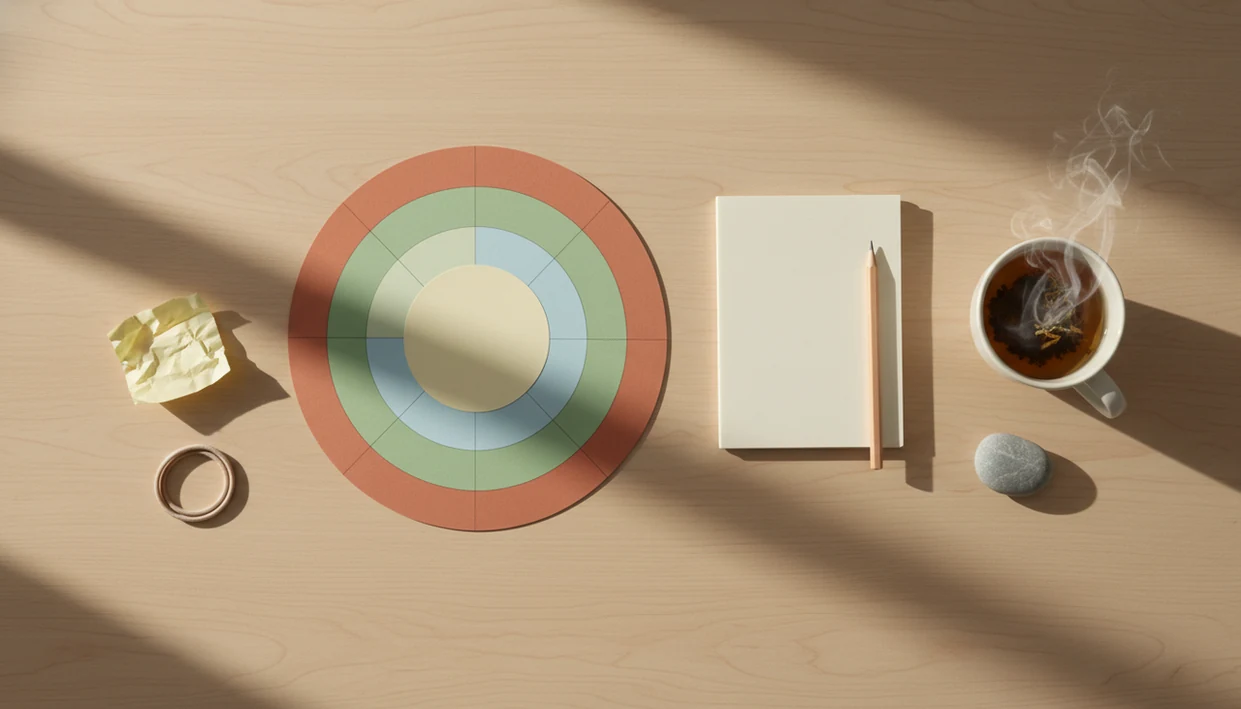
A feelings wheel for stress awareness is a circular emotion chart that helps you turn “I’m stressed” into more specific words, such as overwhelmed, pressured, nervous, trapped, or ashamed. It starts with broad core emotions and expands outward into more precise labels. Naming what fits can help you choose a short mindfulness practice that responds to what is happening in your mind and body.
Try the wheel when tension, irritability, rushing, avoidance, or mental fog first catches your attention. Choose one to three emotions rather than searching for a single perfect answer. Stress can contain mixed feelings. The chart is a vocabulary aid, not a diagnosis: use it to identify a possible next step, not to prove that you understand every feeling.
The essentials
- Use the feelings wheel early, when stress shows up as tension, irritability, rushing, avoidance, or mental fog.
- Name 1-3 emotions instead of forcing one exact label; stress often contains mixed feelings.
- Match the emotion to a short practice: breathing for anxiety, grounding for fear, body scan for overwhelm, and self-compassion for shame.
Read the wheel from broad emotions to specific words
A feelings wheel for stress is an emotion-naming tool that helps turn a vague stress state into clearer words. It is useful because stress often hides several emotions at once, not because the chart has a magic answer.
Most versions start with broad core emotions in the center, such as anger, fear, sadness, joy, disgust, or surprise. Moving outward, the words become more specific. “Fear” may become nervous, exposed, insecure, or helpless. “Anger” may become resentful, irritated, pressured, or trapped.
The original feelings wheel is commonly associated with psychologist Gloria Willcox. Her work helped make emotion vocabulary easier to see, not just think about.
Stress is rarely one clean feeling. It may include fear before a meeting, shame after a mistake, sadness from exhaustion, or pressure from too many unfinished tasks. One simple way to try it is to circle two nearby words, then notice which one matches the body.
Set up a two-minute check-in before stress peaks
Use a feelings wheel before stress becomes a crisis, not when you need immediate help or safety. It works best as a short awareness pause during mild or moderate stress, when you can still read, breathe, and choose.
Before naming difficult emotions, set up the exercise so it feels simple and contained.
- Choose a quiet-enough place where you can pause for about two minutes. It does not need to be silent; a parked car, hallway, bathroom, or desk corner can be enough.
- Start with a simple chart if long word lists make your mind race. A smaller wheel with a few core emotions may be more useful than a detailed one.
- Prepare one grounding option before you look for harder words. Try feeling both feet, naming five objects in the room, or lengthening one exhale. When words feel hard to find, grounding stress quotes can provide a brief reminder to pause and notice your surroundings.
- Notice whether the exercise is helping you feel clearer or making stress sharper.
- Stop if panic, shame, numbness, or disconnection increases. Return to grounding, contact a trusted person, or use appropriate support instead of pushing through.
Stress feelings chart for early warning signs
A stress feelings chart helps you catch early signals before stress becomes harder to interrupt. The table below is a starting point, not a diagnosis or a test of emotional accuracy.
Per the CDC, about 27.6% of U.S. adults reported feeling so stressed on most days that they could not function at least once in the prior month, which makes early stress awareness worth practicing CDC guidance.
| Early stress signal | Possible feeling-wheel words | Body cue | First mindful move |
|---|---|---|---|
| Tight chest | anxious, pressured, afraid | shallow breath, held ribs | Lengthen the exhale |
| Racing thoughts | overwhelmed, nervous, rushed | forehead tension | Name “thinking” once |
| Irritability | resentful, annoyed, trapped | jaw clenching | Relax the tongue and jaw |
| Procrastination | inadequate, uncertain, ashamed | heavy limbs | Pick one tiny next action |
| Numbness | disconnected, tired, sad | flat breath | Feel feet on the floor |
| People-pleasing | insecure, guilty, pressured | tight stomach | Pause before answering |
A classroom bell followed by one breath can be enough to notice the first signal.
How naming emotions can change your response to stress
A feelings wheel works by slowing the jump from sensation to reaction. It gives the mind a small task: pause, observe, name, then choose what to do next.
- Affect labeling means putting feelings into words. Research on affect labeling suggests that naming negative emotions can reduce emotional reactivity and support prefrontal regulation. For example, Lieberman and colleagues found that affect labeling reduced amygdala responses to negative emotional images PubMed research.
- Emotional granularity means naming feelings with precision. People who differentiate negative emotions more clearly tend to have more flexible coping choices under stress.
- Mindfulness adds the pause. You notice sensations, thoughts, and urges before acting on them.
- The wheel adds vocabulary. “Bad” becomes trapped, embarrassed, lonely, pressured, or afraid.
- The response becomes more fitting. For overwhelmed stress, a body scan may help more than problem-solving. For resentment, a mindful boundary pause may fit better.
Brief mindfulness practices and meditation techniques for beginners support attention, naming, and choice, not instant calm or a guaranteed fix.
The grocery list still appears. Notice and return.
Naming a feeling may help without making you feel calmer
Putting an emotion into words does not reliably make it feel less intense right away. A review of affect-labeling research reports that physiological or neural reactivity can decrease while self-reported distress decreases, stays the same, or increases. The response varies with emotional intensity, vocabulary, and whether people label their own feelings or an external stimulus.
That difference matters when judging a check-in. Instead of asking only “Am I calm now?”, also ask “Can I describe the feeling more clearly?” and “Can I choose what to do next?” A useful label may help you pause before reacting even while discomfort remains. You do not need to keep searching the wheel until the feeling disappears. You can also try Stoicism for stress management to reflect on what you can influence while acknowledging difficult feelings.
How to use a feelings wheel for stress in 5 steps
You can use a feelings wheel during work, at home, while commuting, or before sleep. The whole process can take 2-5 minutes, which makes it realistic on a full day.
- Pause for one ordinary moment and stop adding input. Put the phone down, close the laptop, or soften your gaze.
- Breathe for three slow cycles, letting the exhale be slightly longer than the inhale.
- Scan the body for one clear cue, such as tight shoulders, a hot face, a heavy chest, or feet pressing into tile.
- Name one to three wheel words that fit. Try “overwhelmed and pressured,” not one perfect label.
- Choose one matching practice, such as grounding, calming breath, body scan, noting, or self-compassion.
For beginners, a phone timer set for 5 minutes is usually easier than waiting for a quiet hour. For anxious loops, mindfulness for overthinking can pair well with this check-in.
Match your feeling word to a short mindfulness practice
Once you name the feeling, choose a short practice that matches the need underneath it. Research on brief mindful breathing and body awareness suggests short practices can reduce self-reported stress within minutes, and a review of MBSR found reductions in stress, anxiety, and depression across randomized trials NIH research. If you have more time, a 10-minute meditation for stress relief can extend this pause into a focused practice.
| Feeling-wheel word | What stress may be asking for | 3-5 minute practice | Sample phrase |
|---|---|---|---|
| Overwhelmed | Less input | Body scan | “One sensation at a time.” |
| Anxious | Safety cue | Calming breath | “Long exhale, steady body.” |
| Trapped | Choice | Grounding | “I can find one option.” |
| Pressured | Pace change | Mindful pause | “Not everything is urgent.” |
| Resentful | Boundary | Mindful boundary pause | “What is mine to carry?” |
| Inadequate | Reassurance | Self-compassion | “This is hard, and I’m learning.” |
| Ashamed | Kindness | Hand-on-heart breathing | “I can meet this gently.” |
| Numb | Contact | Feet-and-sounds practice | “Here is the room.” |
| Restless | Movement | Walking noting | “Step, shift, breathe.” |
| Sad | Care | Soft body awareness | “Let this be known.” |
If stress rises before bed, mindfulness exercises before bed may be a better next step than more analysis.
Choose an action after you name the emotion
Separate the emotion from the thought or body sensation around it. “My chest is tight” describes a sensation; “I will fail” is a thought; “I notice fear and shame” names emotions. Then rate the intensity from zero to ten and consider acceptance, problem-solving, a different interpretation, or support. Affect-labeling research supports naming as an aid to regulation, not a promise of immediate relief.
Acceptance does not mean approving of what happened or doing nothing about it. In emotion-regulation research, it means allowing an internal experience without trying to suppress, avoid, or judge it. You can acknowledge anger and still decide not to send an insulting message. After a short practice, consider whether the situation needs a boundary, a practical change, or help from someone else. The Four As of Stress Management offer another way to choose a practical response after naming the emotion.
Use the wheel for check-ins, not emergencies or diagnosis
A feelings wheel is best used with flexible curiosity. It helps you compare your options, but it should not become another task to get “right.”
Best for
- Early stress awareness: Use it when tension, rushing, or avoidance first appears.
- Journaling: Add one wheel word beside a sentence about the day.
- Pre-meditation check-ins: Name the state before choosing a technique.
- Workplace pauses: Try it in an office stairwell or before hitting send.
- Communication preparation: Choose words before a difficult conversation.
Not for
- Emergencies: Use immediate support, not a chart.
- Replacing therapy: It is a self-awareness tool, not treatment.
- Forcing certainty: Mixed emotions are normal.
- Diagnosing anxiety or depression: Clinicians typically recommend professional assessment for persistent symptoms.
- Analyzing someone else: The wheel is for your inner experience.
Guided libraries such as mindful.org, Calm, and Headspace can support practice selection after you identify a feeling.
Common feelings wheel mistakes during stress
Treating the wheel like a test can turn a useful check-in into a search for the “correct” emotion. A close-enough label is often more useful than searching until the moment turns into a vocabulary quiz.
Another mistake is choosing only one emotion. Stress may be anxious, resentful, and sad at the same time. Circle several words if they fit. Mixed feelings are not a failure of attention practice.
Many people wait until stress is already intense. By then, the wheel can feel like too much reading. Use it earlier, when the bus seat vibration under your thighs or a clenched jaw first gets your attention.
Do not treat the wheel as a diagnosis. It cannot tell you whether you have anxiety, depression, burnout, or trauma.
Finally, do not skip the body cues. If you go straight into analysis, you may miss the simple information that your shoulders, breath, stomach, or hands are already giving you.
Printable feelings wheel setup for daily stress awareness
A printable feelings wheel works best when it is visible before stress peaks. Keep a printed or digital wheel near a desk, journal, phone, or bedside table, where you already pause during the day.
Try a three-part schedule: a morning baseline, a midday tension check, and an evening reflection. Morning might be one word before opening a laptop. Midday might be one body cue after lunch. Evening might be one sentence beside a feeling word. If sleep is the focus, pair the check-in with a steady bedtime routine for adults.
Annotate the wheel with your personal stress cues. For example, write “tight throat” near anxious, “fast typing” near pressured, or “blank screen stare” near numb.
Suggested image caption: “Printable feelings wheel for stress awareness with core emotions, specific feeling words, and short mindfulness practice prompts.” Mindful.net can be used as a digital companion if you prefer guided practice over paper.
Feelings Wheel Limits
- Seek professional care or crisis support when needed because a feelings wheel cannot replace qualified help.
- Research support comes mostly from affect labeling, emotional granularity, and mindfulness studies, not feelings wheels alone.
- Many emotion words can feel overwhelming, and extreme stress can make the wheel difficult without practice during calmer moments.
- For broader support, use mental health exercises alongside qualified care, not as a replacement.
Get support when stress disrupts daily life or safety
Seek professional support when stress starts to threaten safety, daily functioning, or your ability to recover. A feelings wheel can help you describe what is happening, but it should not be used to diagnose yourself or delay care.
- Get urgent help now if you are thinking about self-harm, feel unable to stay safe, or believe someone else is in immediate danger. Contact local emergency services or your region’s crisis line; in the U.S. and Canada, call or text 988 for the Suicide & Crisis Lifeline.
- Consider therapy if stress is regularly disrupting sleep, work, school, parenting, friendships, or your closest relationships.
- Ask a clinician about symptoms that persist or intensify, including panic attacks, depression, trauma reactions, emotional numbness, exhaustion that does not lift, or burnout.
- Bring your wheel notes to care as preparation. A few words such as “trapped, ashamed, and afraid before bed” can make a first appointment more concrete.
- Use the wheel between support sessions as a check-in tool, not as proof of what condition you have.
Feelings wheel questions for stressful moments
How do I use a feelings wheel when I feel stressed?
Pause, notice one body cue, and look for a broad emotion that seems close. Move outward to more specific words, choosing one to three that fit. Then decide on a short practice or practical action. You do not need an exact label for the check-in to be useful.
What if none of the words on the feelings wheel fit?
Use the closest word as a starting point, or describe the feeling in your own language. You can also record a body sensation or thought before returning to the chart. The wheel supplies possible words; it does not determine what you feel or require a correct answer.
Can naming an emotion make me feel worse?
Sometimes. Research on emotion labeling finds that reported distress can decrease, remain unchanged, or increase even when physiological or neural reactivity improves. Do not force a longer check-in if distress escalates. Stop, ground yourself in your surroundings, and seek support if you need help staying safe.
Can I choose more than one emotion on a feelings wheel?
Yes. Stress can include anxiety, resentment, sadness, or shame at the same time. Choose one to three words that seem useful rather than forcing everything into one category. You can then consider which feeling needs attention first and what action or support might address it.
How often should I use a feelings wheel for stress?
Try brief check-ins at moments you already pause, such as before work, after lunch, or in the evening. You can also use it when you first notice tension, rushing, or avoidance. Keep the routine manageable; repeated checking is not necessary if it becomes another source of pressure.
What should I do after the wheel helps me identify anxiety?
Try a short calming breath practice if that feels manageable, then consider what the anxiety is asking you to address. Naming the feeling does not settle the situation by itself. You may need problem-solving, a different interpretation of events, or support rather than another round of emotion labeling.
Is a feelings wheel a mental health assessment?
No. A feelings wheel is a vocabulary aid, not a diagnostic instrument or a validated treatment. It can help you describe your experience to a professional. If stress regularly disrupts sleep, work, relationships, or safety, seek appropriate support rather than relying on the chart alone.