
How to Use an Emotion Wheel for a Mindful Check-In


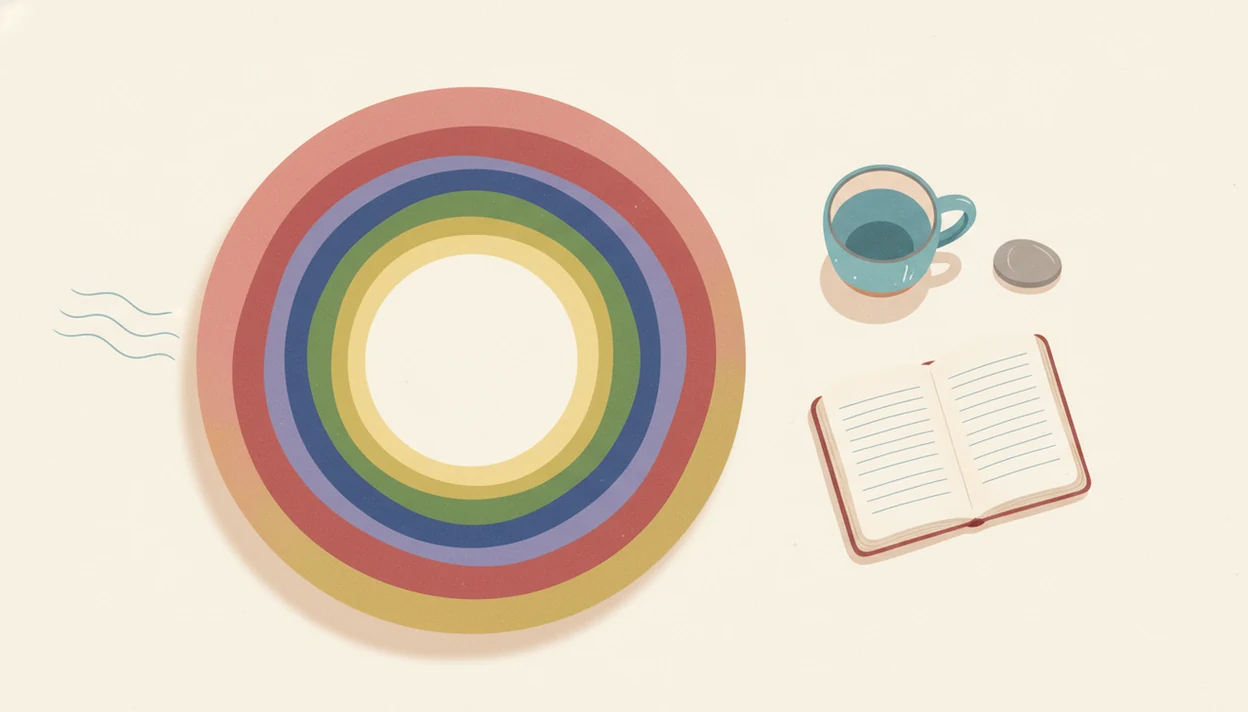
An emotion wheel for mindfulness is a circular chart that helps you notice and name what you feel after a brief pause. Also called a feelings wheel or emotion wheel chart, it groups broad emotions near the center and more specific words in outer rings. Instead of stopping at “bad” or “fine,” you might find “lonely,” “tense,” “hopeful,” or “calm.”
Start with a few slow breaths, notice sensations in your body, then choose the closest feeling word. You do not need a perfect label or a different mood. A 30 to 60 second check-in can help you build emotional vocabulary and communicate more clearly. Treat the wheel as a prompt for awareness, not a personality test or diagnosis.
Definition: An emotion wheel, also called a feelings wheel or emotion wheel chart, is a circular map that groups broad core emotions in the center and more specific feeling words in outer rings.
The essentials
- Use an emotion wheel after a short breath-based pause, not as a personality test or diagnosis.
- Start with a broad feeling, narrow it to a more specific word, and notice where it appears in the body.
- A regular 30-60 second check-in can build emotional vocabulary, mindfulness emotions awareness, and better communication.
What an emotion wheel helps you name
An emotion wheel is a visual map that helps people connect present-moment awareness with clearer emotional language. It usually places broad categories, such as anger, sadness, joy, fear, and surprise, near the center. More specific feeling words sit in outer rings.
You may also hear it called a feelings wheel, emotion wheel chart, or wheel of emotions. The names vary, but the use is similar: pause, notice what is happening, and choose words that fit your current experience.
The wheel does not decide what you should feel. It helps you name what is already present. That distinction matters when you are sitting in a kitchen chair, feeling your feet on the floor, and realizing “fine” is really “guarded.”
In a 2018 American Psychological Association survey, only 30% of adults said they were very good at recognizing what they were feeling. A simple chart can make that first naming step less blank. Source: American Psychological Association, Stress in America survey archive (APA research).
Five emotion wheel facts beginners should know
- An emotion wheel builds emotional vocabulary. It moves you from general words like “bad” or “okay” toward more specific words like “rejected,” “steady,” or “uncertain.”
- Many modern wheels were influenced by Robert Plutchik. His model described primary emotions, intensity, and combinations, which is why many wheels feel like emotional color palettes.
- More than one emotion can be true. You might feel relieved and disappointed after the same conversation, or grateful and tired at the end of a long day.
- Naming emotions can support communication and regulation. A brief affect-labeling task, according to a 2007 randomized trial, was associated with changes in brain regions involved in emotional processing. Source: Lieberman et al., 2007, Psychological Science (PubMed research).
- The chart is a support tool, not care by itself. It can guide attention, but it does not replace therapy, medical care, crisis support, or trauma-informed help.
Small words can still be useful.
How the rings help you find a feeling word
An emotion wheel chart works by narrowing attention from a broad emotional family to a more precise feeling label. Core emotions sit near the center, related emotions move outward, and the outer edge offers the most specific words.
This visual structure lowers the burden of finding language during a check-in. Instead of searching your whole mind for a word, you follow a path: angry, then irritated, then resentful. That is easier when your shoulders are tight and your phone timer says you only have one minute.
Plutchik compared emotions to colors. They can vary in intensity, and they can combine. Annoyance may deepen into anger. Joy and sadness may mix into bittersweetness.
Affect labeling means putting feelings into words. For many people, the label creates a little space between the feeling and the next action. For beginners, this works best as attention practice, not analysis. For recurring worry, try cognitive defusion exercises to notice thoughts without treating them as facts.
Evidence for mindfulness is not proof for an emotion wheel
Research on mindfulness gives useful context, but it does not establish that a wheel alone treats emotional distress. A 2023 meta-analysis of 61 studies involving 4,229 patients found reduced rumination with mindfulness-based interventions. Those interventions were not significantly better than cognitive behavioral therapy for that outcome. These findings concern broader interventions, not a brief chart-based check-in.
Keep the practical aim modest: name the feeling, notice the urge that comes with it, and choose what to do next. “I feel resentful” does not require sending an angry message or making the resentment disappear. You can acknowledge the feeling and still pause before replying. The useful change may be in your response, even when the emotion remains.
What makes a good emotion wheel chart?
A good emotion wheel chart is easy to read, specific enough to be useful, and humble about what it can tell you. It should help you notice and name feelings, not make the experience feel clinical, crowded, or final.
Use the chart like a small flashlight, not a ruling. The best design depends on who is using it and how much attention they have in the moment.
- Look for clear core emotions in the center, with outer-ring words that are large enough to read without squinting.
- Choose language that fits the user’s age: simpler words and pictures for children, more nuance for teens and adults.
- Prefer enough detail to move beyond “bad” or “stressed,” but not so many terms that the check-in becomes a vocabulary test.
- Avoid charts that present emotion categories as universal truth, diagnosis, or proof of what someone “really” feels.
- Use a format that fits real life, such as a printable page by a journal or a mobile-friendly image for quick pauses.
60-second emotion wheel mindfulness check-in
Use an emotion wheel as a short mindfulness check-in by breathing first, sensing the body, then choosing the closest feeling word. The aim is to notice and return, not to fix the feeling.
- Pause and take two or three slow breaths before looking at the wheel.
- Scan the body for tightness, warmth, heaviness, restlessness, ease, or another clear sensation.
- Choose a broad core emotion that seems closest, even if it is not exact.
- Move outward on the wheel to name your emotions more precisely.
- Notice one kind next step, such as returning to the breath, writing the word down, or saying it simply.
A warm exhale on the upper lip can be enough of an anchor.
For people who overthink emotions, a 60-second limit helps. If the chart turns into a debate, close it and return to the breath. Mindfulness practices and meditation techniques for beginners and daily life give you a repeatable pause, not instant certainty or emotional control.
Feelings wheel examples for everyday mindfulness
Feelings wheel examples show how ordinary phrases become more useful when they are paired with body cues. These are not diagnoses. They are simple ways to notice what is happening right now.
From vague feeling to precise label
- “I feel bad” may become sad, lonely, disappointed, or overwhelmed. The body cue might be a heavy chest or a low, tired face.
- “I’m fine” may become calm, guarded, tired, or content. You might notice steady breathing, or a jaw that stays slightly clenched.
- “I’m angry” may become irritated, resentful, embarrassed, or hurt. The cue could be heat in the face or hands gripping the grocery basket.
- “I’m stressed” may become anxious, rushed, pressured, or uncertain. The cue may be shallow breathing or a stomach that feels braced.
From body sensation to emotion word
Start with the body when the mind is noisy. Ribs widening under a sweater may point toward ease. A buzzing leg under the desk may point toward nervousness or impatience. If pain makes body awareness difficult, meditation for chronic pain offers ways to practice with realistic expectations.
For stress-specific examples, a feelings wheel for stress can make the narrowing step more direct.
Best uses for an emotion wheel and safety boundaries
Emotion wheels are most useful when paired with mindful attention, not when used to force certainty. They work well for brief reflection, journaling, and clearer conversations, but they are not a clinical tool.
| Best for | Not for |
|---|---|
| Quick emotional check-ins | Diagnosing mental health conditions |
| Journaling before bed | Forcing emotional certainty |
| Pre-meditation reflection | Replacing therapy or medical care |
| Post-meditation comparison | Processing trauma alone |
| Clearer conversations | Settling arguments or proving a point |
Use the wheel when there is enough steadiness to be curious. If distress is intense, or if numbness, dissociation, panic, or safety concerns appear, human support may be the safer next step.
That boundary is not a failure.
An emotion wheel usually works best as a naming aid when the nervous system is settled enough to observe, while professional support fits situations involving risk, trauma, or overwhelming distress.
Emotion wheel practice during meditation
Can you use an emotion wheel during meditation? Yes, but it is usually better before or after the sit than in the middle of it.
Before meditation, use the wheel to name the starting emotional weather: anxious, dull, hopeful, irritated, calm. Then set it aside. During meditation, if an emotion becomes obvious, silently label it once, such as “sadness” or “worry,” and return to the breath or body.
After meditation, check the wheel again. Did the emotion shift, soften, stay the same, or become clearer? A paused audio beside a water glass can be a good moment for this. No drama needed. If you use audio while practicing, review the evidence for binaural beats before adding them to your routine.
A 2017 systematic review found that mindfulness-based interventions significantly improved emotion regulation with a medium effect size across 19 randomized controlled trials. Source: Guendelman et al., 2017, Frontiers in Human Neuroscience (Full). That supports pairing emotion labels with mindful awareness, while still keeping expectations realistic.
If bedtime is your main practice window, mindfulness exercises before bed can help you use the wheel without turning it into late-night rumination.
Emotion wheel pattern tracking over 7 days
A 7-day emotion wheel log can reveal patterns without turning every feeling into a project. Record one or two emotion words, the time of day, and one body sensation.
Use this prompt: “Right now I notice __ in my body, and the closest feeling word is __.”
After a week, look lightly. You may notice afternoon irritability, morning anxiety, Sunday heaviness, or more calm after walking outside. The point is not to explain everything. It is to build emotional vocabulary and see what repeats.
A longitudinal study of adolescents found that higher emotion vocabulary predicted lower internalizing symptoms over time. That does not mean a chart treats anxiety or depression. It does suggest that learning more precise words may support long-term emotional awareness.
Keep the log short. One line is enough. If you already keep gratitude journal prompts, the emotion word can sit beside the gratitude note rather than becoming a separate routine.
Mindful.net can be useful here if you want a beginner-friendly structure for short check-ins and meditation basics.
Before a difficult conversation: pause and name the feeling
Before a difficult conversation, a brief pause gives you time to notice tension and choose a feeling word before speaking. The free mindfulness bell can mark that pause, or the Mindful.net app’s meditation timer can set aside time for a check-in. Neither interprets your emotions. When distress is intense or safety is at risk, support from another person or a clinician is more appropriate than extending the exercise.
Save a printable feelings wheel word set as a PDF
Use this original word set as a printable alternative to a circular feelings wheel. To create a downloadable copy, open your browser’s print menu, choose Save as PDF, and select the pages containing this section. The text below is also the accessible version: each line names a broad feeling family, followed by more specific words. No color, image, or position on a chart is needed to read it.
- Joy: pleased, cheerful, delighted, hopeful, grateful.
- Sadness: disappointed, lonely, discouraged, sorrowful, heartbroken.
- Fear: uneasy, worried, nervous, frightened, alarmed.
- Anger: irritated, frustrated, resentful, furious, outraged.
- Surprise: startled, puzzled, astonished, amazed, awestruck.
- Calm: settled, relaxed, peaceful, content, at ease.
A printable mindful check-in worksheet
Copy these prompts beneath the word set before saving or printing your worksheet. Leave a few blank lines after each prompt, or type your answers into a document. Write a phrase rather than a full explanation if that feels easier. You can leave any field blank. The final prompt asks for one manageable action, not a plan to fix every feeling.
- Date and context: When am I checking in, and what just happened?
- Feeling words: Which one or two words fit? If none fit, what word would I use?
- Body notes: What sensations do I notice, and where?
- Room for uncertainty: What am I still unsure about?
- What matters now: What would I like to acknowledge or ask for?
- One next action: What small, practical step will I choose, or will I pause without acting?
Emotion Wheel Limits
- Emotion wheels simplify feelings, depend on self-awareness, and cannot diagnose, treat, or replace professional care.
- If you feel unsafe, overwhelmed, numb, or disconnected, pause the exercise and seek human support.
- If you might hurt yourself or others, skip the exercise and contact emergency services or a crisis line.
- Explore mental health exercises for gentle support options, not replacements for medical care.
Emotion wheel practice questions
How do I use an emotion wheel for mindfulness?
Take two or three slow breaths and notice a body sensation, such as a tight jaw or heavy chest. Pick a broad emotion near the center, then look outward for a more precise word. Name it once and choose a next step, such as returning to your breath or writing it down.
What if none of the words on the emotion wheel fit?
Choose an approximate word, use your own language, or leave the feeling unnamed for now. You can describe a sensation instead: “My chest feels tight” or “I feel restless.” The chart is a prompt, not a complete account of human emotion. Finding the exact word is not a requirement for mindful attention.
Can I choose more than one emotion on the wheel?
Yes. You might feel relieved and disappointed about the same event, or grateful and tired at the same time. Write down two words if both fit. There is no need to force them into one category. Notice each feeling without treating either as the whole story.
Should I use an emotion wheel before or during meditation?
Before or after meditation is usually more useful than studying the chart during the sit. Name your starting feeling, then set the wheel aside. During practice, briefly label an obvious emotion and return to the breath or body. Afterward, check whether the feeling changed, stayed the same, or became clearer.
Does naming an emotion make it go away?
Not necessarily. Labeling may reduce emotional intensity, but it is not a command to stop feeling. Pair the label with acknowledgment, such as “This feeling makes sense given what happened.” Then choose your response. A useful check-in can end with the emotion still present and a safer or more deliberate next action.
Can body sensations tell me which emotion I am feeling?
Body sensations can give you a starting point, but they do not provide a diagnosis or a certain emotional label. Notice tightness, warmth, heaviness, restlessness, or ease, then look for a word that fits your experience. Treat examples on a chart as possibilities rather than rules about what a sensation must mean.
What should I do if an emotion wheel check-in makes me feel worse?
Stop the exercise rather than pushing for a clearer label. Look around the room, move, or contact someone supportive. If inward attention brings escalating panic, dissociation, self-harm urges, or sustained worsening, seek professional support. An emotion wheel is a reflection aid, not a substitute for urgent care or clinician-guided treatment.