
Sleep Meditation for a Busy Mind: Practice Without Forcing Sleep


Sleep meditation for a busy mind is a secular bedtime practice that helps you relate differently to racing thoughts by returning attention to a gentle anchor. That anchor might be breathing, body sensations, soft counting, sound, or a kind phrase. The aim is not to make your mind go blank. Thoughts can keep appearing; you notice them without arguing and return to the anchor.
A busy mind during meditation is normal, not evidence that you are doing it wrong. Start with a few minutes and choose an anchor that feels comfortable rather than demanding. This is support for bedtime settling, not a promise of sleep or a replacement for clinical care when symptoms are severe or persistent.
The essentials
- A busy mind during meditation is normal, not a sign you are doing it wrong.
- Useful bedtime anchors include a body scan, slow breathing, soft counting, sound, or kind phrases.
- Sleep meditation is supportive, not a guaranteed sleep cure or a replacement for clinical care when symptoms are severe.
Five facts about meditating with a busy mind
- Sleep meditation is not about stopping thoughts. It is attention practice. You notice a thought, soften the fight with it, and return to breath, sound, or body sensation.
- Pre-sleep cognitive arousal means the mind stays “on” at bedtime. Worry, rumination, replaying conversations, and planning tomorrow can keep the nervous system alert.
- Short practices can help when repeated. A 5-minute phone timer is a reasonable start; most beginners do better with consistency than with one long heroic session. If you prefer a shorter session, a 5 minute meditation before bed can make regular practice feel more manageable.
- Body scanning, paced breathing, and self-compassion are useful options. The anchor can be physical, rhythmic, or kind. Feet warming inside wool socks can be enough.
- Meditation is supportive, not a cure-all. Population estimates vary, but reviews commonly place chronic insomnia around 10% of adults and insomnia symptoms around roughly one-third of adults; a 2019 meta-analysis of randomized trials found small to moderate sleep-quality improvements from mindfulness-based interventions (insomnia prevalence review: PubMed research mindfulness sleep meta-analysis: PubMed research).
Before you start, drop the myth that sleep meditation is supposed to erase thought on command. For an insomnia newcomer, the more useful skill is noticing the mind’s late-night architecture review, naming it gently, and returning to a steadier anchor.
How an attention anchor interrupts bedtime thought loops
Sleep meditation for racing thoughts helps by moving attention away from mental loops and toward neutral sensory cues, then practicing a kind return when thinking pulls you off course.
At night, rumination and planning can feel louder because daytime distractions drop away. The cursor blinking on an unfinished email may be gone, but the mental list keeps running. Mindfulness gives the brain a simple task: feel the breath, scan the body, count softly, or listen to steady sound. When a worry appears, you label it lightly, such as “planning” or “remembering,” and come back.
Again. That is the practice.
In an 8-week randomized trial of mindfulness-based therapy for insomnia, adults with chronic insomnia improved insomnia severity, total wake time, and sleep efficiency compared with self-monitoring (PubMed research). Clinicians typically recommend evaluating persistent insomnia or possible sleep disorders rather than relying on meditation alone.
What sleep research supports, and what it does not
Research supports a modest role for mindfulness in sleep quality, not a guaranteed cure for insomnia. A 2019 review of 18 randomized trials involving 1,654 participants found better sleep quality compared with nonspecific active controls. Mindfulness did not outperform specific active treatments such as cognitive behavioral therapy for insomnia, known as CBT-I, or exercise, and the evidence had limitations.
For chronic insomnia, CBT-I remains the recommended first-line treatment. A 2023 review of mindfulness and CBT-I found too few studies and insufficiently consistent evidence to conclude that adding mindfulness improves chronic insomnia outcomes. A short bedtime recording is also different from a structured clinical program that combines meditation with behavioral sleep strategies.
Prepare for five to ten quiet minutes
Before you start sleep meditation for a busy mind, make the practice small, safe, and easy to repeat. You are preparing for a few minutes of lower stimulation, not trying to create the perfect night.
- Choose a realistic window of 5 to 10 minutes. A short timer after brushing your teeth is often better than waiting until everything feels calm. For a timed version of this practice, try a 10 minute sleep meditation that keeps the instructions simple.
- Lower stimulation first by dimming lights, reducing noise where possible, and moving the phone out of scrolling mode. If you use audio, start it and leave the screen alone.
- Notice how breath focus feels before making it your main anchor. If watching the breath increases anxiety, body checking, or the feeling of being trapped inside yourself, do not force it.
- Use an external anchor instead, such as fan sound, rain audio, the weight of the blanket, cool air on the face, or the room temperature around your hands.
- Pause if distress escalates. If panic, trauma memories, or strong fear rises, open your eyes, orient to the room, and consider support from a qualified professional.
Practice in bed without making sleep a test
Use this practice as a small evening cue, not a verdict on whether you can control your mind. You might dim the room after washing dishes, notice the last warmth of a ceramic mug, choose one anchor, and return to it without making sleep a performance.
- Dim the room and put the phone face down after starting audio or a timer. Don’t over-optimize the pillow, blanket, or posture.
- Settle your body on your back or side, with the jaw loose and shoulders heavy. Let the exhale be heard in the quiet room. Another option is the military sleep method, which offers a structured approach to relaxing your body at bedtime.
- Choose one anchor for the whole session: breath, body scan, soft counting, or the feeling of the mattress under you.
- Label thoughts gently when they appear. Try “thinking,” “planning,” or “worrying,” then return to the anchor without scolding yourself.
- Rest if sleep does not come right away. You can still give the body a lower-effort state, even while awake.
For a fuller evening structure, pair this with a realistic bedtime routine for adults.
A 10-minute sleep meditation for a busy mind script
Opening: settle the body
Lie down in a position you can keep without fussing. Let the eyes close or soften. Feel the back of the body supported. Notice the places touching the bed. There is nothing to solve for the next few minutes.
Take one slower breath in. Let the out-breath be easy.
Middle: return to the anchor
Bring attention to the breath where it is easiest to feel: nostrils, ribs, or belly. If the breath feels crowded, shift to body sensations instead. Notice the brow, mouth, throat, chest, abdomen, hips, tense calves, and any softening you can feel.
When thoughts arrive, let them share the quiet without taking over. An unfinished architecture review, a parking ticket stub you forgot to deal with, a worry that keeps circling. Not failure. Just thinking. Silently say, “thinking,” then return to the next breath or body area.
If frustration appears, try: “This is hard, and I can be kind to myself.” Or, “I can rest without forcing sleep.” You can also try gratitude before bed to shift attention toward a few ordinary moments you appreciated today.
Ending: rest without forcing sleep
Let the anchor become softer now. Breath, body, bed. If sleep comes, fine. If not, keep resting.
When worry about being awake becomes the problem
Sometimes the next thought is not about tomorrow's tasks but about sleep itself: “I am still awake, so tomorrow will be terrible.” Try naming the experience briefly, such as “worry” or “frustration,” then returning to your anchor. The purpose is to reduce the struggle with wakefulness, not to prove that you can make yourself sleep.
Give the practice five to ten minutes without repeatedly checking whether it has worked. If you remain clearly awake and frustrated, leave bed for a quiet activity in dim light and return when sleepy. This step comes from CBT-I stimulus control, not meditation alone. The Mindfulness-Based Therapy for Insomnia protocol combines attention practice with behavioral strategies rather than relying on relaxation by itself.
Choose an anchor: breath, body, counting, or sound
The best anchor for mindfulness for busy mind at night depends on the flavor of the busyness. No single anchor is right every night, so choose one and stay with it long enough to learn from it.
| Anchor | Fits best when | How to use it |
|---|---|---|
| Breath awareness | Thoughts are fast but not intense | Feel one inhale and one exhale at a time. |
| Body scan | You feel tense, restless, or “stuck in your head” | Move attention slowly from face to feet. |
| Soft counting | Planning keeps restarting | Count exhales from 1 to 10, then begin again. |
| Ambient sound | Internal focus feels too strong | Listen to fan noise, rain, or distant traffic. |
| Self-compassion phrases | Self-criticism about not sleeping is loud | Repeat a kind phrase without forcing belief. |
For overthinkers, soft counting is often easier than open awareness because it gives the planning mind a simple job. If you want more daytime practice with the same skill, mindfulness for overthinking uses similar noticing and returning.
Who this practice suits and who may need adaptations
Busy mind sleep meditation is best for people who need a gentle way to step out of bedtime thought loops. It fits beginners, planners, overthinkers, and people with light rumination or bedtime tension.
Best for: Beginners: simple anchors make the practice easy to start. Planners: counting or breath awareness can interrupt tomorrow’s mental rehearsal. Light rumination: labeling thoughts reduces the urge to argue with them. Bedtime body tension: body scans can shift attention into physical release.
Not ideal without adaptation: Panic or trauma histories: inward attention may feel too activating. Severe anxiety or depression: professional support may be needed. Possible medical sleep symptoms: snoring, gasping, or extreme daytime sleepiness should be assessed. Chaotic sleep habits: irregular timing, late caffeine, and screens can limit results.
Still having thoughts is not a reason to stop. Broader sleep hygiene still matters.
Replace thought suppression with a gentle return
Does sleep meditation for racing thoughts fail if thoughts keep coming? No. Continuing to have thoughts does not mean the meditation is failing; treating those thoughts as failure adds another struggle.
Mistake 1: forcing a blank mind. Replace it with a smaller goal: notice one thought and return once.
Mistake 2: judging thoughts as failure. Replace judgment with a neutral label, such as “planning.” The notebook open after practice can hold tomorrow’s reminders.
Mistake 3: using audio as a knockout tool. Replace that expectation with skill practice. A recording can guide attention, but it cannot guarantee sleep.
Mistake 4: expecting one session to undo years of sleep difficulty. Replace urgency with repetition over weeks.
Mistake 5: ignoring caffeine, screens, schedule, or stress habits. Replace blame with one practical change, such as moving caffeine earlier or dimming screens. For related options, try mindfulness exercises before bed.
Guided tools, including Calm and Headspace, can support practice when they teach clear anchors rather than just playing soothing sound.
A simple bedside setup for meditation
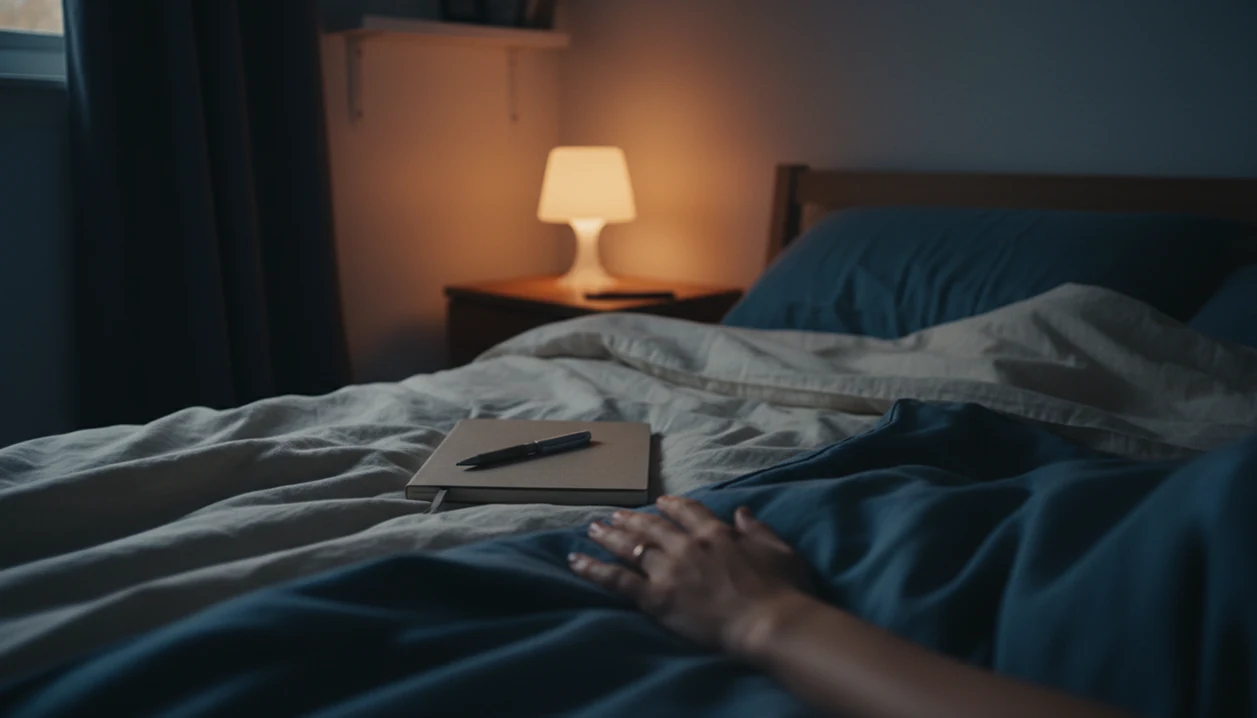
A useful image for bedtime meditation for thoughts should show a simple, believable in-bed setup. Think dim lamp, relaxed posture, ordinary bedding, and no performance pressure. Avoid medical equipment, dramatic spiritual symbolism, or a person sitting perfectly upright like a statue.
The scene should feel beginner-friendly. A paused audio beside a water glass is enough. The person can be lying on their side or back, with the room quiet and uncluttered.
Caption idea: A simple setup for sleep meditation for busy mind: noticing thoughts, then returning to breath or body sensations without trying to force sleep.
If an app appears in the image, keep the visual focus on the practice, not the device.
Try sound when breath focus feels too intense
When attention to breathing makes bedtime worry louder, a steady external sound can provide another anchor. The free white noise and ambient sound player offers a sound to return to without watching your breath. Mindful.net also has sleep audio in its app for readers who prefer guidance. Neither option treats insomnia; persistent sleep difficulty or increasing distress calls for assessment rather than another recording.
Sleep Meditation Limits
- Sleep meditation is a support practice, not a medical diagnosis, treatment plan, or guarantee of sleep.
- Severe insomnia, sleep apnea symptoms, bipolar disorder, PTSD, panic, depression, or trauma may need professional care.
- Turning inward can feel activating, especially when your body feels unsafe or your mind is highly anxious.
- If nighttime emotions are hard to name, an emotion wheel can help before bed.
Meditating with racing thoughts at bedtime
Can sleep meditation stop racing thoughts?
It does not need to stop them to be useful. The practice is to notice a thought, label it briefly if helpful, and return to breathing, body sensations, counting, or sound. Thoughts may continue throughout the session. The aim is less struggle with them, not a blank mind or guaranteed sleep.
Why does my mind race as soon as I lie down?
With fewer daytime distractions, planning, worry, and replaying conversations can become more noticeable. Worry about not sleeping can add another layer of alertness. Meditation gives attention a simple place to return, but persistent nighttime thinking may also need support for anxiety, insomnia, or another contributing condition.
Should I keep meditating if I am still awake and frustrated?
You do not have to keep meditating until sleep arrives. If you are clearly awake and frustrated, try a quiet activity out of bed in dim light, then return when sleepy. This is a CBT-I strategy rather than mindfulness alone. Persistent insomnia deserves assessment and a structured treatment approach.
Do guided sleep meditations treat chronic insomnia?
Guided recordings can help you practice returning attention and settling bedtime worry, but they are not equivalent to insomnia treatment. CBT-I has stronger guideline support for chronic insomnia. Seek assessment when sleep difficulty occurs at least three nights a week for three months or more and affects daytime functioning.
Is it okay to fall asleep during sleep meditation?
For a bedtime practice, falling asleep is not a mistake. You do not need to stay awake to finish a recording. Staying awake is not a failure either. Keep the purpose modest: notice thoughts, return to a comfortable anchor, and avoid turning the session into another test of your ability to sleep.
How do I do a body scan meditation for sleep?
Lie comfortably and bring your attention to one area of your body at a time, starting with your feet or head. Notice sensations such as warmth, pressure or tension without trying to change them. Move slowly through the body. When thoughts interrupt, gently return to the area you were noticing.