
Pink Noise Meditation: A Short Practice in Mindful Listening


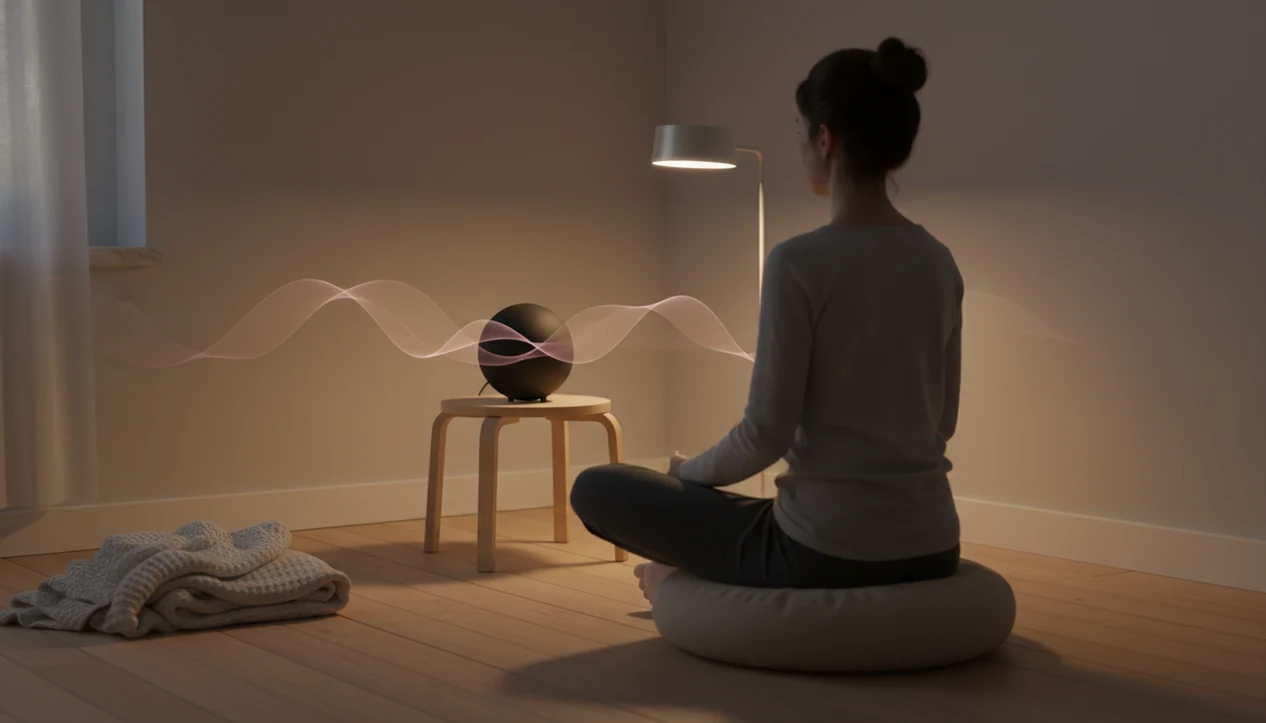
Pink noise meditation is a mindful listening practice that uses a steady sound with stronger low frequencies as an attention anchor. It often sounds softer or less hissy than white noise, though preferences vary. The meditation comes from listening deliberately, noticing distraction, and returning to the sound, not from the audio itself. Playing pink noise while working or falling asleep is not automatically meditation.
A short listening session can be an option for bedtime wind-down or attention practice when silence feels unhelpful. Start with a low volume and notice the sound’s texture rather than trying to force calm. Sleep and memory research is promising but limited, and direct evidence for pink noise meditation is thin. It is not a proven treatment for sleep, stress, or attention problems.
The essentials
- Pink noise has stronger low frequencies and is often described as gentler than white noise.
- The meditation part comes from intentional listening, returning attention, and noticing distraction.
- Sleep and memory research is promising but limited; direct evidence for meditation benefits is thin.
Pink noise as an attention anchor
Pink noise meditation means using pink noise as an object of attention, not treating the sound as meditation by itself. The practice is simple: play a steady sound, listen on purpose, notice when your mind drifts, and return to hearing.
Pink noise usually has more low-frequency emphasis than white noise, so many people hear it as softer, deeper, or less hissy. Common examples include steady rain, wind moving through leaves, or a low continuous audio track from a speaker.
For beginners, pink noise for meditation can feel easier than silence because there is something clear to return to. No special posture required. Just listening, noticing, and returning. If you prefer learning with others, mindfulness workshops can introduce guided practice and opportunities to ask questions.
Five facts about pink noise for meditation
- Pink noise has equal power per octave. In plain language, each octave band carries roughly the same total energy, so the lower ranges feel stronger than white noise; see the University of New South Wales noise reference Noise.Html.
- Pink noise often sounds smoother than white noise. Many listeners describe it as lower, rounder, and less sharp, though preference varies.
- Pink noise mindfulness requires active attention. The practice is not the track; it is the act of listening and returning when thought takes over.
- The strongest evidence is about sleep and memory. Current research is more developed for timed sleep stimulation than for meditation outcomes.
- Pink noise is optional. It is not automatically better than breath meditation, silence, brown noise, or a body scan.
For people comparing sound styles, the white noise vs meditation distinction matters: sound can support attention, but it does not replace the attention practice.
How Pink Noise Meditation Works
Pink noise meditation works by using pink noise as the sound object: the thing you listen to on purpose. The meditation is not hidden inside the audio; it comes from the attention loop you practice with it.
That loop is simple enough to repeat in a short session:
- Hear the sound. Let the low, steady texture become the main object of attention.
- Drift into thought. Expect planning, memory, or commentary to show up.
- Notice the drift. Recognize that attention has moved without turning it into a problem.
- Return to hearing. Come back to the pink noise, one moment at a time.
For many beginners, steady sound can feel easier than silence because it gives attention a clear place to land. It may also mask small room noises, such as traffic or a hallway door, but masking is different from mindfulness training. Masking changes what you hear around you; mindfulness trains how you relate to attention, distraction, and return. The strongest evidence for pink noise is still in sleep stimulation research, not in proven meditation outcomes.
Listen for texture, volume, and continuity
A sound anchor meditation works by choosing one sound, noticing its qualities, and returning to it after distraction. With pink noise mindfulness, the anchor might be the low hum, the soft grain of the track, or the way the volume seems steady but not completely flat.
The mechanism is ordinary attention training. You notice. You drift. You come back. That loop matters more than any special property in the sound itself.
Try listening for texture, volume, continuity, fading edges, and tiny gaps. If the mind wanders to a grocery list, label that gently as thinking and return to hearing. Passive playback may mask a hallway noise or a neighbor’s television, but mindful listening asks for deliberate attention.
Returning to a steady sound gives you a repeatable attention cue, but it does not guarantee calm.
Sleep studies do not establish meditation benefits
Can pink noise sleep meditation improve sleep or memory? The most careful answer is that small sleep studies are promising, but they do not prove that pink noise meditation treats insomnia or improves mindfulness.
A 2012 study found that pink-noise exposure during sleep increased slow-wave characteristics linked with deeper sleep NIH research. In 2017, a Nature study reported that older adults exposed to pink-noise stimulation timed to deep sleep showed better next-day memory recall than when they were not exposed to it S41598 017 15709 7. A separate 2017 Frontiers in Human Neuroscience study found that brief pink-noise bursts during sleep increased slow-wave activity and improved memory performance in older adults Full.
These studies used timed stimulation during sleep, not a person sitting awake and practicing sound anchor meditation. For bedtime practice, pink noise may be part of a gentle sleep soundscapes meditation routine, but it should not be framed as medical sleep care.
Pink noise is not the strongest choice for anxiety relief
Research comparing sound options does not show that pink noise is always the most calming. A 2026 randomized clinical trial found that music with auditory beat stimulation reduced state anxiety more than pink noise in people with moderate trait anxiety. That result concerns a particular sound intervention and outcome, not the benefits of deliberate mindful listening.
The practical distinction is between choosing an attention anchor and choosing audio for immediate anxiety relief. Pink noise can still be an acceptable anchor if you can listen comfortably and return after distraction. The trial does not establish that it is ineffective for concentration or masking intermittent sounds, but it gives no reason to treat it as the best anxiety option.
Best uses and poor fits for pink noise meditation
Pink noise meditation is most useful when sound makes attention easier, and least useful when steady noise creates strain. No sound is universally best because hearing, mood, setting, and personal history all affect the experience.
| Best for | Not for |
|---|---|
| Beginners who like a clear sound anchor | People irritated by steady noise |
| Noisy rooms where silence feels unrealistic | Anyone seeking an insomnia cure |
| Bedtime wind-down before lights out | People who use unsafe headphone volume |
| Short focus sessions at a desk | Users who need medical sleep care |
| People who dislike silent meditation | People who feel overstimulated by audio |
For short work blocks, pink noise can sit beside other ambient sounds for focus, but the same rule applies: if it helps you notice and return, it fits. If it grates, choose another anchor.
Five steps to use pink noise for meditation
For beginners, pink noise meditation usually works best as a short, low-volume listening practice because it reduces setup pressure and makes returning easier to notice.
Before you start, choose one track, one device, and one session length. Do not test five sounds mid-practice; that turns the session into shopping, not listening.
- Set a low, comfortable volume. Keep it soft enough that you can still sense your breathing and the room around you.
- Choose a short session length. Start with 3 to 10 minutes, using a timer if that helps. For days with little free time, mindfulness for busy people offers short pauses that can fit between everyday tasks.
- Rest attention on the sound texture. Notice the low wash, roughness, smoothness, or steady pulse of the pink noise.
- Notice distraction without judging it. If you drift into planning, remembering, or checking the progress bar, name it lightly. If you want to practice warmth alongside attention, try loving kindness meditation with simple phrases for yourself and others.
- Return to the pink noise and end by noticing the body. Feel the lower back meeting the cushion, then let the session close.
The practice still comes down to one simple way to try it: listen, wander, return.
Five common mistakes in sound anchor meditation
- The guaranteed-calm mistake: Pink noise may feel settling for some people, but it is not a switch you flip for relaxation.
- The loudness mistake: Turning the volume up, especially with headphones, can create strain and make body awareness harder.
- The background-only mistake: A track playing while you scroll or work is not automatically mindfulness.
- The thought-fighting mistake: The goal is not to block thought. It is to notice thought and return to the sound. When difficult interactions keep returning to mind, loving kindness for difficult people offers a separate practice for responding with goodwill.
- The one-sound-fits-all mistake: Pink noise is not better for everyone than white noise, brown noise, breath, or silence.
If steady noise feels wrong, a breath practice or a few mindfulness exercises may fit better. Preference is data. Use it.
Set up a speaker, seat, and timer
A good setup makes listening easier without turning the room into a ritual project. Place a phone or speaker away from your head, choose a comfortable seat or bed, set the volume low, and decide whether the timer should stay visible or silent.
In an ordinary room, the right volume often feels more like distant rain through a window than audio you are trying to study.
Image caption idea: A simple pink noise meditation setup with a low-volume speaker, timer, and quiet seat for mindful listening.
Speakers may be preferable to headphones for some bedtime users because volume is easier to keep gentle. If you use headphones, avoid the “just a little louder” habit. Tired ears are not great judges.
A kitchen chair, bus seat, or office stairwell can be enough. The setup should support attention, not become another reason to postpone practice. Mindful.net, also described as a Mindfulness Practices App, takes the same beginner-first view: start small and keep the method clear.
Keep listening quiet and stop if it causes strain
Use the lowest volume that lets you hear the track comfortably. WHO safe-listening guidance recommends keeping personal-device volume below approximately 60% of maximum and explains that hearing risk depends on loudness, duration, and frequency of exposure. That percentage is not a target to reach: a quiet meditation session may need much less sound.
Do not turn the track up to cover warning signals or everything happening around you. Take breaks, and stop or switch anchors if listening increases agitation or discomfort. A visual object or the contact of your feet with the floor offers an alternative without added audio. Persistent tinnitus, hearing changes, panic, or distress calls for professional assessment rather than continued exposure. If sound feels uncomfortable, eyes open meditation lets you practice with a gentle visual focus instead.
Pink Noise Meditation Limits
- Direct mindfulness research is limited, and promising sleep and memory studies are small rather than definitive.
- Pink noise is not a proven treatment for insomnia, anxiety, ADHD, or stress.
- Some people find steady noise irritating, distracting, or overstimulating.
- For bedtime, a nature sounds bedtime routine may feel more natural than synthetic noise.
Pink noise meditation questions
How do you meditate with pink noise?
Play one steady track at a low, comfortable volume and set aside 3 to 10 minutes. Listen to its texture, continuity, or low wash. When you notice planning or other thoughts, return to hearing. The task is to notice and return, not to stop thinking or achieve a particular feeling.
Is pink noise better than white noise for meditation?
Neither is best for everyone. Pink noise has more low-frequency emphasis and may sound softer or less hissy than white noise. Choose the sound you can attend to without strain. If either becomes irritating or distracting, ordinary room sounds, a visual object, or contact sensations can serve as an anchor instead.
Does pink noise meditation help you sleep?
It may suit a bedtime wind-down, but it is not a proven insomnia treatment. Small sleep studies involving pink noise are promising, yet they do not establish that a listening meditation improves sleep or memory. Deliberate listening before bed and sound exposure during sleep are different practices and should not be treated as equivalent.
How loud should pink noise be during meditation?
Keep it at the lowest comfortable level, soft enough that you can still sense your breathing and the room. WHO recommends keeping personal-device volume below approximately 60% of maximum. That is not a volume goal. Loudness, listening duration, and repeated exposure all matter, so take breaks and avoid masking warning signals.
Is listening to pink noise while working a form of meditation?
Not by itself. Background pink noise may help some people reduce the contrast of intermittent sounds, but mindful listening involves deliberately attending to the sound and returning after distraction. During a work session, your main task is the work. You can set aside a separate short listening session if you want to practice meditation.
Can pink noise make anxiety or sensory discomfort worse?
Some people find steady noise irritating or overstimulating rather than calming. Begin quietly and stop if distress rises; there is no need to endure the sound. Try a neutral visual object or feet on the floor instead. Persistent panic, tinnitus, hearing changes, or distress warrants professional assessment rather than more sound exposure.
Should I use headphones or a speaker for pink noise meditation?
Either can be used at a low, comfortable volume. A speaker may be preferable for some bedtime users because it can make gentle listening easier. Place it away from your head and keep the sound soft. With headphones, resist turning up the volume to block the room, and stop if listening creates strain.