
Mindful Cooking: Four Kitchen Practices for Everyday Attention


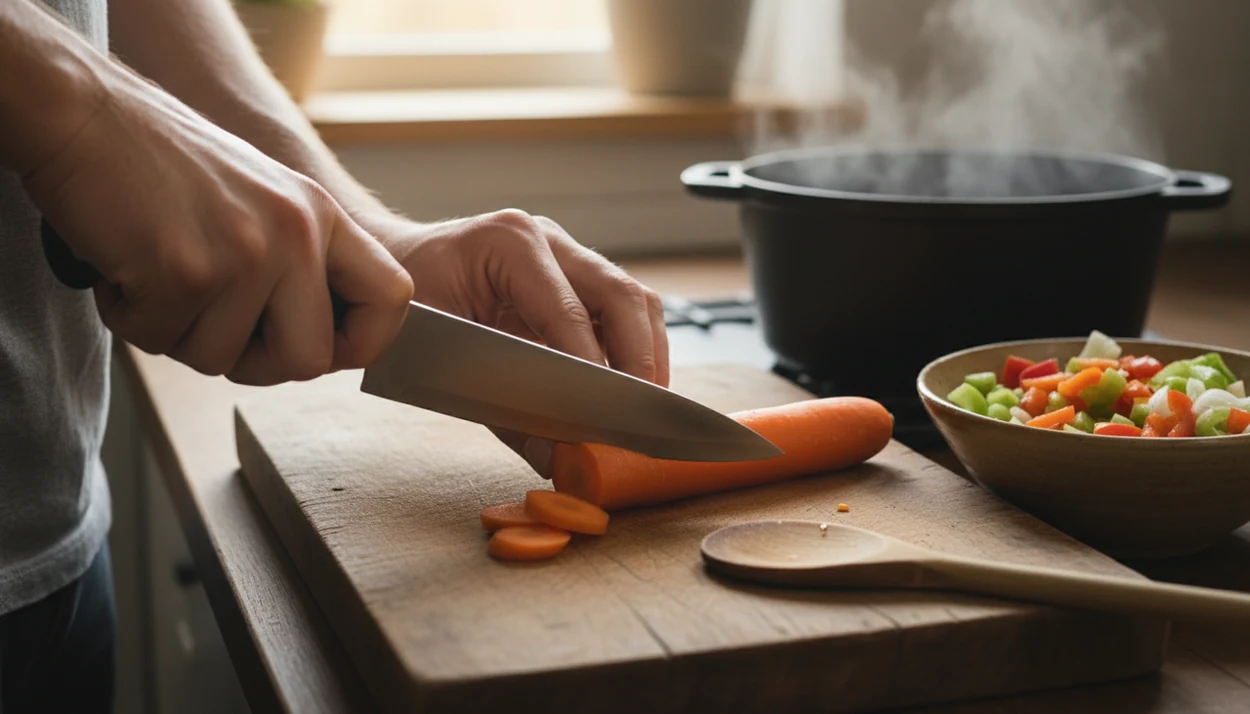
Mindful cooking is paying close, non-judgmental attention while preparing food, using chopping, stirring, smelling, and washing up as anchors for awareness. It is an informal mindfulness practice, not a diet, recipe system, or lifestyle rule. You can practice during ordinary meal preparation without adding a separate meditation session or changing what you cook.
Choose one manageable action and notice its sensations: the pressure of a spoon handle, the sound of running water, or the smell of warming food. When your mind moves to plans or worries, return gently to the task. Calm is not a requirement. Keep knives, heat, timing, and food handling first; sometimes cooking safely and quickly matters more than continuing the exercise.
The essentials
- Cooking mindfulness means using ordinary kitchen actions as present-moment anchors.
- The practice works best when you simplify the task, reduce distractions, and return gently when the mind wanders.
- Mindfulness while cooking can support stress regulation, but it is not a medical treatment or nutrition program.
Four kitchen anchors: chopping, stirring, simmering, and cleanup
The four most useful mindful cooking practices are sensory chopping, one-breath stirring, sound-and-smell simmering, and mindful cleanup. These are awareness drills, not recipes, nutrition advice, or clean-eating rules.
- Sensory chopping: Notice color, shape, texture, sound, and pressure while cutting. Best for: beginners and simple prep. Not for: rushed moments with poor knife safety.
- One-breath stirring: Match a natural breath with one stir, or a few slow stirs. Best for: soups, sauces, oats, and tea. Not for: food that needs fast technical attention.
- Sound-and-smell simmering: Use bubbling, steam, aroma, and visual change as anchors. Best for: waiting periods. Not for: leaving the stove unattended.
- Mindful cleanup: Wash, wipe, store, and reset with attention. Best for: people who bolt to the next task. Not for: urgent household interruptions.
A plain kitchen chair and five minutes can be enough.
How kitchen sensations help you notice and return
Mindful cooking is a decision to use what is already happening, sound, scent, texture, heat, waiting, as the place you practice attention. The sequence is modest: choose an anchor, drift away, recognize the drift, and come back without making it a character test.
Kitchen anchors are easy to find because they keep changing. You might feel the handle of a spoon, hear onions soften, smell garlic warming, watch steam gather, or notice one breath while water comes to a boil. If your attention veers toward the care plan for a family member, the next rehearsal you need to attend, or whether the meal will satisfy everyone, the practice is to name the detour kindly and return to the next safe, usable cue.
That loop is the same basic attention training used in informal practices like walking meditation, dishwashing practice, and other mindfulness exercises. General mindfulness research is stronger than cooking-specific research. A 2014 JAMA Internal Medicine meta-analysis found moderate evidence that mindfulness meditation programs can help anxiety, depression, and pain JAMA study. Mindful cooking should be understood as a daily-life practice, not a standalone clinical intervention.
Before you start: mindful cooking safety and setup
Before you practice mindful cooking, make the kitchen safe enough that awareness does not compete with preventable risk. Start smaller than you think: a rinse, stir, wipe, or simple prep task is enough.
- Choose a low-risk anchor first, especially if you are new, tired, or distracted. Washing fruit, measuring oats, tearing lettuce, or wiping a counter is a better opening than sharp knives, hot oil, or several timers.
- Clear one small work area so your attention has somewhere to land. You do not need a perfect kitchen; one uncluttered square of counter can reduce immediate visual noise.
- Handle practical food safety before turning inward. Check allergies, separate raw foods, wash hands and surfaces, and know what needs refrigeration or prompt storage.
- Decide what sound environment will help today. Music may steady attention, a podcast may split it, and silence may or may not feel supportive. For a separate listening practice away from kitchen tasks, sound bath meditation uses sound as an attention anchor.
- Stop the exercise when real life needs priority. A child calling, smoke, a spill, a safety concern, or an urgent task deserves full focus.
Safety is not a break from mindfulness. It is part of the practice.
Adapt kitchen practice to your energy and available senses
Standing at a counter is not a requirement. Practice seated or with appropriate support, and choose a task within your usual activity limits. Fatigue, pain, dizziness, or balance problems are reasons to shorten the practice, take a break, or select a less demanding action. Feeling a cup or tearing lettuce can provide an anchor without prolonged standing.
Choose sensations you can readily notice rather than trying to use every sense. Hand movement, texture, or chair contact can replace sound or visual detail. Attach a brief practice to a familiar cue, such as beginning food preparation. NHS Scotland’s everyday mindfulness guidance recommends bringing deliberate attention to ordinary routines, including washing dishes. Start with 30 to 90 seconds and extend only while the task remains easy and safe.
Five steps for practicing during food preparation
Use mindfulness while cooking by choosing one kitchen task, reducing avoidable distractions, and returning attention to the senses as you work. Keep safety first; knives, heat, timing, and food handling matter more than maintaining a calm mood.
- Choose one task as your anchor, such as rinsing greens, chopping carrots, stirring soup, or wiping the counter.
- Set your phone aside or turn off extra media if you can, but don't wait for silence or ideal conditions.
- Notice three direct sensations: color, smell, sound, warmth, texture, pressure, or movement.
- Return gently when planning, judging, impatience, or distraction appears. That return is the practice.
- Close by taking one breath before serving, eating, or moving to cleanup.
If you only have a minute before the pan needs attention, that can still be enough. Short practices like 1 minute mindfulness exercises use the same return-to-the-anchor pattern; in the kitchen, that anchor might be one slow stir, one inhale of steam, or a Three-Breath Reset while you wait for a simmer.
Avoid forcing calm or overlooking kitchen risks
The easiest trap is turning mindful cooking into a new standard to meet.
- Let the current mood be included. If irritation, hurry, hunger, or boredom is present, name it lightly instead of trying to replace it with calm. Brief mindfulness quotes can offer a simple reminder to include your current mood without demanding calm.
- Choose the steadiest anchor available. Breath is useful for some people, but smell, sound, temperature, or the movement of stirring may feel more grounded on a particular day.
- Pause the exercise during risky moments. Sharp knife work, hot oil, crowded counters, rushing, or a child underfoot may require ordinary practical focus, not extra inward attention.
- Avoid making the practice a diet rule, wellness score, or self-improvement test. Mindful cooking does not need clean ingredients, perfect portions, or a better personality.
- Return after distraction without calling it failure. Losing the thread is expected; the small moment of coming back to the next safe action is the training.
If the kitchen is too loud or tense today, do one mindful breath after cleanup instead. Outside the kitchen, mantra meditation offers another way to steady attention through a repeated word or phrase.
Four criteria for choosing a kitchen attention exercise
We selected cooking mindfulness exercises that fit ordinary meal prep, imperfect kitchens, and beginner attention spans. We excluded diet rules, clean eating claims, productivity hacks, and methods that depend on special recipes.
| Criterion | What it means in the kitchen |
|---|---|
| Simple task anchor | The exercise uses chopping, stirring, simmering, washing, or plating. |
| Sensory clarity | The task gives clear sights, sounds, smells, textures, movement, or breath cues. |
| Gentle return | The method trains noticing distraction without self-criticism. |
| Beginner fit | The practice works during weekday food prep, not only in quiet, beautiful kitchens. |
Returning attention to a kitchen task is the practice; a peaceful meal is not a guaranteed result.
Guided mindfulness resources such as Mindful.org, Calm, and Headspace can help compare your options, but the kitchen practice itself stays simple.
Sensory chopping: notice each cut without rushing
How do beginners practice mindful cooking while chopping? Use the cutting task as a sensory anchor, while keeping knife safety as the first priority.
Start with one ingredient that feels manageable. Notice the color before cutting, the shape under the blade, the texture under your fingers, and the sound of each slice on the board. Feel the pressure of the knife handle. Watch how pieces change from whole to uneven, then smaller.
The goal is not perfect knife skill or speed. If impatience shows up, label it quietly as “rushing” and return to the next cut. If planning appears, notice “thinking” and come back to color, pressure, and movement.
Best for: beginners, short prep windows, and simple meals. Not ideal for: multitasking, crowded counters, fatigue, or any moment when knife safety is compromised.
For beginners, sensory chopping is often easier than silent sitting because the anchor is visible, tactile, and already part of the task.
One-breath stirring: pair movement with a natural breath
Can mindfulness while cooking help with stress? One-breath stirring may support regulation as part of general mindfulness practice, but it should not be treated as anxiety treatment.
Choose a safe stirring task, such as soup, sauce, porridge, or warm milk. Let one natural inhale and exhale match one slow stir, or several small stirs. Notice warmth through the handle, aroma rising from the pot, resistance in the liquid, and the circular movement of your arm.
Heavy eyelids soften for a moment after the exhale.
A randomized trial of mindfulness-based stress reduction for people with generalized anxiety disorder found reduced stress reactivity after an 8-week program NIH research, and a workplace mindfulness review reported reductions in stress and burnout across several settings PubMed research. Those findings support mindfulness broadly, not one kitchen exercise specifically.
Best for: a short pause during simmering or reheating. Not ideal for: recipes that need fast stirring, exact timing, or constant technical attention.
If breath focus feels tense, use smell or movement instead. The full range of anchors is covered in mindfulness exercises and techniques.
Mindful cleanup: use water, movement, and sound
Can cleanup count as mindful cooking? Yes, washing up, storing food, wiping counters, and resetting the kitchen can be part of the same informal mindfulness practice.
Use water temperature, soap, sound, repetition, and posture as anchors. Notice the plate in your hand, the sound of running water, the smell of dish soap, and the shift from cluttered counter to usable space. If resentment appears, that can be noticed too. So can boredom. So can the wish to be finished already.
The sink is not a test.
Best for: people who rush from cooking straight into messages, work, or the next demand. Not ideal for: unsafe multitasking, arguments that need attention, a child needing help, or any urgent kitchen issue. When shared kitchen tensions need attention, interpersonal meditation offers a separate practice for mindful listening and connection.
Mindful cleanup fits well with mindfulness practices for daily life because it uses a task that already exists.
Mindful cooking benefits without diet or lifestyle claims
The benefits of mindful cooking come from practicing attention and non-judgment, not from special ingredients. It is daily life mindfulness applied to food preparation.
- Mindful cooking trains attention: the core skill is noticing sensory detail, drifting, and returning.
- It can reduce autopilot: common kitchen actions become cues to pause, feel, and look.
- It may support stress regulation: general mindfulness evidence shows small to moderate improvements in psychological well-being, according to a 2019 overview of systematic reviews NIH research.
- It is not a diet program: mindful cooking does not require calorie tracking, clean eating, weight loss goals, or special ingredients.
- Direct clinical evidence is limited: there is not strong trial evidence proving mindful cooking as a standalone intervention.
Mindful cooking usually works best when the task is simple enough to sense clearly, while complex cooking fits people who already have steady kitchen confidence.
Mindful.net covers practices like this as educational support through the Mindfulness Practices App, not as medical care.
Would a timer help you practice before cooking?
Before food preparation begins, a short seated pause can give you a chance to settle your attention without handling knives or heat. The free online meditation timer can mark that pause, and Mindful.net’s app offers short guided meditations. During cooking, sensory cues may be more useful than a timed session. Keep cooking alarms separate and prioritize anything that needs immediate attention.
Mindful Cooking Limits
- No robust clinical trials specifically prove mindful cooking works as its own intervention.
- Mindful cooking cannot replace professional help, including therapy, psychiatric care, medication, crisis support, or medical advice.
- Busy households, shared kitchens, noise, fatigue, hunger, and interruptions can make mindful cooking harder.
- Under time pressure, the mindful choice may be to cook safely and quickly.
Mindful cooking questions
What is mindful cooking?
Mindful cooking means paying attention to the sensations and actions of preparing food, then returning when your mind wanders. Chopping, stirring, smelling, and washing dishes can all serve as anchors. It is an informal mindfulness practice, not a diet or a requirement to feel calm.
How do I start mindful cooking as a beginner?
Choose one simple, low-risk task, such as rinsing fruit or tearing lettuce. Notice texture, movement, and sound while you work. When you catch yourself planning or judging, return to the next action. Begin with 30 to 90 seconds rather than trying to stay mindful throughout an entire meal.
Can mindful cooking help with stress?
It may support stress regulation as part of general mindfulness practice, but evidence from broader mindfulness programs does not prove that cooking mindfully has the same effects. There are no robust clinical trials establishing mindful cooking as its own treatment. It cannot replace therapy, medication, or other appropriate care.
How can I cook mindfully when I am rushed?
Keep the meal practical and prioritize safe preparation. Pick one brief anchor, such as feeling water on your hands while rinsing produce, rather than slowing every action. Stop the exercise when knives, hot oil, timing, or interruptions need your full attention. Cooking quickly and safely is a reasonable choice.
Do I need special recipes for mindful cooking?
No special recipe or ingredient is needed. The practice concerns how you attend to preparation, not what you eat. A familiar, manageable recipe can leave more room to notice sensations than a complicated new dish. Keep ordinary nutrition needs and food-safety decisions separate from the attention exercise.
Should I match my breathing to stirring?
You can pair one natural inhale and exhale with a slow stir or several small stirs, provided the food allows it. Do not force your breath or change necessary cooking technique. The spoon’s movement, resistance in the liquid, or aroma can be your anchor instead.
Does washing dishes count as mindful cooking?
Yes. Cleanup can be part of the same informal practice. Notice water temperature, the plate in your hand, the sound of washing, or your posture. Boredom and resentment do not disqualify the exercise. Notice them briefly, then return to the next safe action without demanding a different mood.