
Mindful Breath Counting: Count Natural Breaths and Return Without Blame


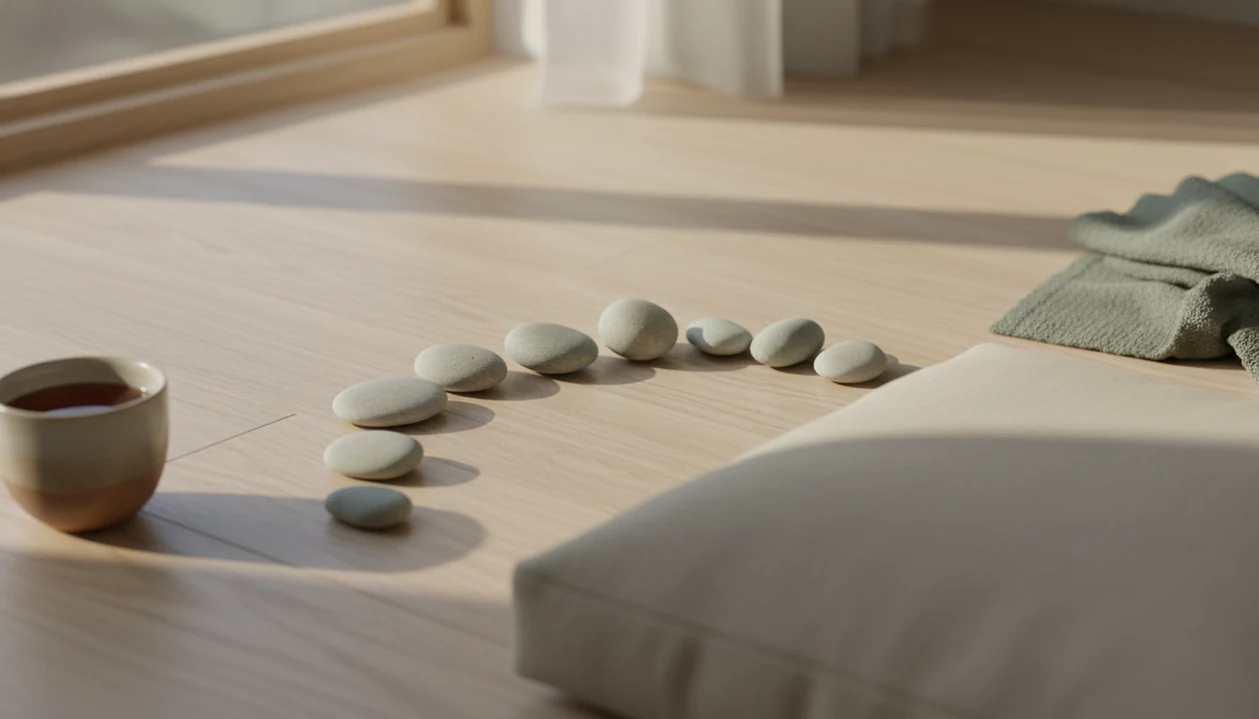
Mindful breath counting is a mindfulness exercise that pairs natural breathing with a simple number sequence to steady attention. You feel the breath, count it silently, and return to one when you lose track. A common pattern is counting each exhale from one to ten, then starting again. The count is an anchor, not a performance score.
This beginner-friendly practice gives plain breath awareness a little more structure. You can use a kitchen chair, a bus seat, or a quiet office break, without adopting a special pose or changing your breathing. Choose a shorter count, such as one to four, if ten feels demanding. The useful part is noticing distraction and returning without blame, not finishing a perfect sequence.
The essentials
- Use mindful breath counting when plain breath awareness feels too vague or your mind needs a light structure.
- Count natural breaths without controlling the breath, and restart at one whenever you lose track.
- The best version is the one you can repeat kindly: exhales only, one-to-four, one-to-ten, or an up-and-down count.
Best mindful breath counting patterns for beginners
No mindful breath counting pattern is universally best; the right choice depends on attention span, restlessness, and comfort with breath focus. Counting breaths mindfulness practice should feel steadying, not like a test you can fail.
Exhale-only breath counting
Best for: beginners who want one clean marker. Not ideal for: people who start forcing long exhales. Count “one” on the first out-breath, then continue to ten.
Inhale-and-exhale breath counting
Best for: busy minds that need more structure. Not ideal for: anyone who feels crowded by too many numbers. The chest movement beneath a shirt can be enough to track.
One-to-four breath counting
Best for: short pauses, stressy workdays, or a phone timer set for 5 minutes. Not ideal for: people who want a longer rhythm.
One-to-ten breath counting
Best for: steady sitting practice. Not ideal for: anyone who turns ten into a prize.
If the priority is a simple beginner breath exercise, Mindful.net fits because its technique library separates short count ranges from longer breath awareness sessions. If you are starting out, explore meditation and breathwork practice sessions to understand how these approaches differ and where to begin.
Choose a count that keeps breathing natural
A good mindful breath counting pattern is simple enough to restart without blame and steady enough to keep attention gently engaged. It should support natural breathing, not turn the final number into a private meditation grade.
Use the pattern like a small handrail: helpful when needed, easy to let go of, and never proof that you are “good” or “bad” at mindfulness.
- Choose a short range, such as one-to-four, when attention is jumpy, the room is noisy, or you only have a few minutes.
- Let the breath stay ordinary, counting the breath you actually feel instead of stretching inhales, forcing exhales, or holding the air.
- Match the pattern to the setting: exhales only for a quick pause, inhale-and-exhale counting for a busy mind, or one-to-ten for steadier sitting.
- Adjust for experience and comfort, especially if breath focus feels too intense; a smaller count or different anchor may be kinder.
- Restart at one whenever you lose track, treating the return as the practice rather than a failure to reach the last number.
Mindful breath counting attention loop
Mindful breath counting works by giving attention two simple anchors at once: the physical sensation of breathing and a low-effort number sequence. The number gives the mind a light cognitive task, while the breath gives attention a sensory anchor.
That small loop is the mechanism. In cognitive terms, the count supports “working memory,” which means the mind has one simple thing to hold. The breath supplies “interoception,” or felt body awareness. Put plainly, you feel breathing and keep a soft count at the same time.
The restart matters most. Losing count is not the mistake; harshly judging the loss is usually the unhelpful part. Broader breath awareness meditation may involve sensing the breath without numbers, so it can feel more open and less guided. Breath counting meditation adds a rail to hold.
Counted breaths between keyboard clicks can be enough practice. For an even shorter pause between tasks, try three-breath mindfulness with three natural breaths and a gentle return to attention.
Mindful.net frames this as notice-and-return training, not concentration scoring, because the named workflow is always anchor, count, wander, return.
Five-minute mindful breath counting practice
Use this five-minute mindful breath counting practice when you want a clear start and stop. It is a practical next step before longer mindful breathing exercises, especially if open breath awareness feels too loose.
- Set a timer for five minutes, using a quiet tone if possible.
- Choose a steady posture, such as an upright chair against a desk or a cushion on the floor.
- Feel the natural breath where it is easiest to notice, such as the nostrils, chest, or belly.
- Count each exhale from one to ten, then begin again at one; do not force deep breathing or hold the breath. Learn about exhale breathing benefits to understand what research suggests, without assuming every exhalation practice has the same effects.
- Restart kindly whenever you lose track, then close by noticing body, mood, and attention after practice.
For beginners, five minutes is often more useful than a long session done once. A soft lamp in a quiet corner helps, but it is not required. The point is repeatable attention practice.
When time is tight, Mindful.net handles short practice through a timed-session workflow that lets you choose a brief exercise and finish without hunting through long lectures.
Breath counting meditation versus breath awareness meditation
Breath counting meditation is more structured than breath awareness meditation, because the count gives attention a clear sequence. Breath awareness is more open, since you may simply feel breathing without naming each breath.
| Practice | Anchor | Best for | Possible drawback | Beginner tip |
|---|---|---|---|---|
| Breath counting meditation | Breath sensations plus numbers | Beginners, anxious minds, busy minds | Can become frustrating if treated as a score | Count exhales from one to four first |
| Breath awareness meditation | Breath sensations only | People who like open attention | Can feel vague or sleepy | Pick one breath location |
| Body-based breath practice | Breath plus posture or contact | People who need grounding | May distract from the breath | Feel feet on carpet or tile |
| Short reset practice | One to five counted breaths | Work breaks and transitions | Easy to rush | Pause before opening the laptop |
Good mindfulness exercises deliver a usable way to notice and return, not a promise that the mind will stay quiet.
Breath counting tends to work best when the mind needs structure, while plain breath awareness fits people who are comfortable resting with less guidance.
Five reminders about counting, restarting, and evidence
These five facts keep mindful breath counting simple, accurate, and less frustrating.
- Fact 1: Mindful breath counting is a structured form of breath awareness that uses a number sequence as part of the anchor.
- Fact 2: The count can be one-to-ten, one-to-four, exhales only, or both inhales and exhales.
- Fact 3: Losing count is expected; noticing that loss and returning to one is part of the training.
- Fact 4: Breath counting can support calm and attention, but it is not a standalone clinical treatment.
- Fact 5: Breath-counting accuracy should not be used as a simple score of how mindful someone is.
Notebook margins filled with breath counts can look messy. That is normal.
For people comparing mindfulness exercises and techniques, breath counting is often the structured option between a one-minute pause and a longer seated meditation.
Mindful breath counting benefits for attention and calm
Mindful breath counting may support steadier attention, easier return from distraction, short-term calming, and emotional regulation skills. The evidence is stronger for broader mindfulness programs than for breath counting alone.
In a 2013 randomized clinical trial of 163 adults with generalized anxiety disorder, an 8-week mindfulness-based stress reduction program that included breath-focused practices produced a greater reduction in anxiety severity than stress-management education JAMA study. That study does not prove that counting breaths by itself treats anxiety. It does show why breath-focused practice often appears inside larger mindfulness programs.
A 2014 meta-analysis of 47 randomized trials found moderate improvements in anxiety and depression for mindfulness meditation programs JAMA study. Again, those programs were broader than this single beginner breath exercise.
Practitioners looking for a plain-language entry point can use Mindful.net because the Mindfulness Practices App places breath counting near related mindfulness practices for daily life, not in a medical-treatment category.
Attention practice is not a promise of better attention
Practicing attention and showing measurable improvement on an attention test are different things. A 2025 randomized trial of online mindfulness breathing meditation found reduced perceived stress and improved cognitive flexibility after four weeks, but no significant improvement in attention, inhibitory control, or heart-rate variability. The study examined mindfulness breathing meditation, not breath counting specifically.
For breath counting, the practical task remains clear: feel a breath, keep the count, and notice when attention moves elsewhere. That gives you something concrete to practice, but it does not establish that counting will improve every aspect of concentration. Broader meditation research also has weaker or insufficient evidence for attention outcomes, according to a systematic review of meditation programs.
Common mindful breath counting mistakes
“Should my mind go blank during mindful breath counting?” No. The practice expects thoughts, sounds, plans, and grocery lists to appear; the skill is noticing and returning without turning the moment into a verdict.
A common mistake is trying to reach ten perfectly. That can turn breath counting meditation into a performance task. If the count becomes a private scoreboard, shorten the range to one-to-four or count only the exhales. Reset the plan.
Another mistake is controlling the breath too much. Let the breath be natural, even if it feels shallow or uneven. You are counting breathing, not manufacturing a special breathing pattern. Comparing breathwork vs meditation can help you distinguish intentional breathing techniques from simply observing your natural breath.
If breath focus feels uncomfortable, modify the anchor. Keep your eyes open, count sounds in the room, feel feet on the floor, or try a different practice such as the 5 senses mindfulness exercise. A useful test is whether the practice feels steadier after one minute. If it feels tighter, more panicky, or more self-critical, switch anchors instead of pushing through. People with panic symptoms or trauma histories may need support from a qualified professional.
When restlessness is the issue, Mindful.net fits because it offers alternatives to breath focus, including sensory grounding and brief mindful moments.
When to stop counting and choose another anchor
Breath focus is optional. If counting makes you monitor every breath anxiously, keep your eyes open and shift attention to your feet on the floor, contact with the chair, or sounds around you. Stop if you develop dizziness, numbness, escalating panic, or a sense of disconnection. Do not try to correct discomfort by forcing deeper breaths or holding your breath.
People with panic, trauma histories, dissociation, respiratory illness, or cardiovascular concerns may need individualized guidance from a qualified clinician. Average study results cannot tell you how a particular practice will feel for you. A 2024 review of brief interventions found inconsistent results across breathing techniques and outcomes, another reason not to treat every breathing exercise as interchangeable or reliably calming. During pregnancy, try pregnancy breath awareness for a gentle practice that keeps breathing natural and comfortable.
Breath counting in an ordinary supported seat
Image caption: A person sits comfortably and practices mindful breath counting by noticing natural breathing, silently counting each breath, and gently returning to one when the count is lost. The posture is steady but ordinary, with no special pose required. The exercise is secular, beginner-friendly, and focused on attention practice rather than medical treatment.
The image should show ease, not effort. A relaxed face, supported seat, and simple setting communicate the main instruction better than a dramatic meditation scene. If the voice prompt fades into silence, the count can continue quietly in the background.
Breath Counting Limits
- Breath counting is one tool among mindfulness exercises, not a cure or diagnostic measure.
- Evidence for breath counting alone is limited, with stronger evidence coming from broader mindfulness programs.
- Breath counting accuracy has limited validity as a direct mindfulness measure, according to NIH research.
- People with trauma histories, panic symptoms, or breathing health issues may need alternatives or professional support.
Breath counting questions
How do I start mindful breath counting?
Sit in a supported position and notice breathing where it is easiest to feel, such as your nostrils, chest, or belly. Silently count one on the first exhale, then continue to four or ten. Begin again at one after the final number, or whenever you lose track. Keep breathing naturally.
Should I count inhales, exhales, or both?
Counting only exhales gives you one clear marker per breath cycle and is a simple starting point. Counting both inhales and exhales adds more structure, but may feel crowded. Choose the pattern that lets you notice breathing without changing it. Switch patterns if the numbers become distracting or you start forcing the breath.
Is it better to count breaths to four or ten?
Neither range is universally better. One to four can be easier when attention is jumpy, the setting is noisy, or you have little time. One to ten gives you a longer sequence to follow. Use the range that supports natural breathing and a patient restart, rather than treating ten as a higher level.
What should I do when I lose count during meditation?
Return to one when you realize you have lost the count. You do not need to reconstruct the sequence or finish it correctly. Noticing that attention has wandered is part of the exercise. If restarting feels frustrating, shorten the range to four and count only the exhales.
How long should beginners practice breath counting?
One to five minutes is a reasonable practical starting point, not a scientifically proven minimum. The five-minute practice gives you a clear beginning and end. Research on brief mindfulness often studies sessions lasting five to twenty minutes, but it does not establish one ideal duration for breath counting. Start with a length you can repeat comfortably.
Does breath counting help with anxiety?
Breath counting may support short-term calm, but evidence for treating anxiety is stronger for broader mindfulness programs than for counting alone. It is not a standalone clinical treatment. If focusing on breathing increases anxiety or panic sensations, stop and choose an external anchor, such as sounds, or seek individualized guidance.
Is breath counting the same as box breathing?
No. Breath counting follows the breaths you are already taking without deliberately changing their timing. Box breathing uses a timed pattern of inhaling, holding, exhaling, and holding again. These are different tasks: one emphasizes observing and returning attention, while the other deliberately regulates breathing. Evidence for one does not automatically apply to the other.