
Meditation in a Noisy Environment: Practice Without Silence


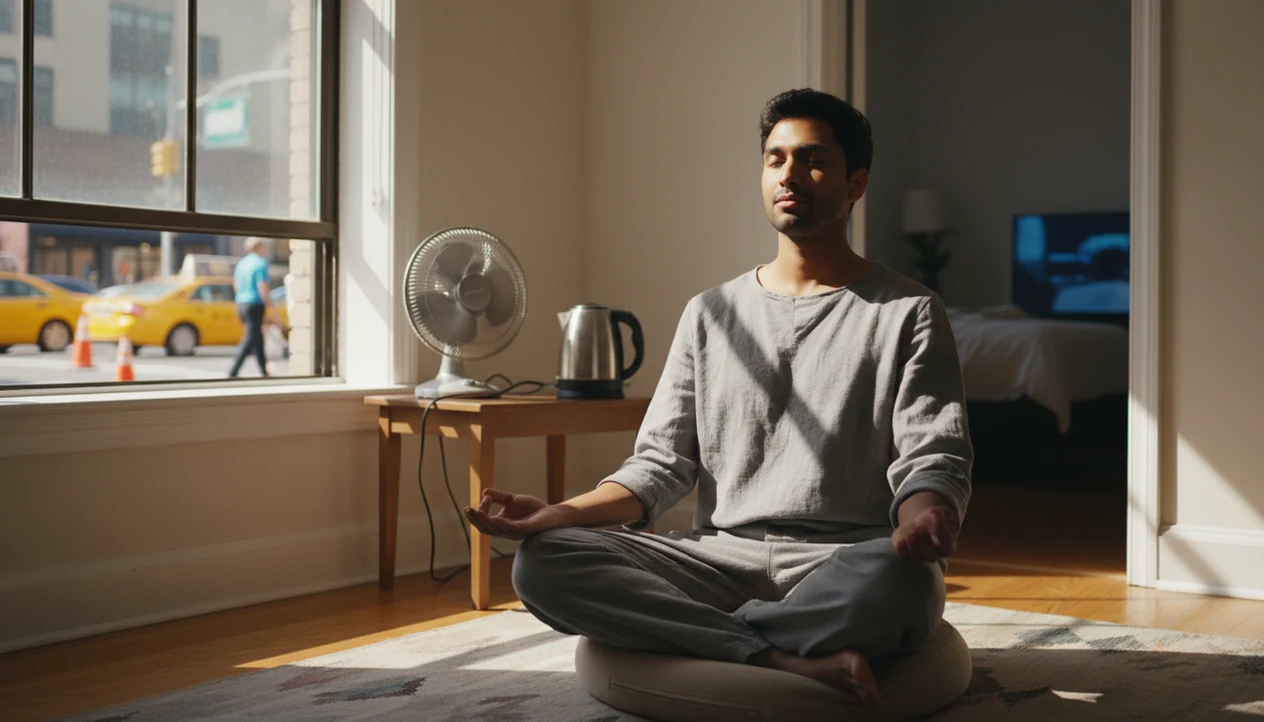
Meditation in a noisy environment means noticing everyday sounds without needing to eliminate them, then returning attention to your breath, body, or the sound itself. Silence is not required. A passing car, a humming appliance, or rain tapping a window can become part of the practice rather than proof that it has failed. Arguing with the noise can pull attention away more than the sound does.
Start with a few minutes of mild background noise, not the loudest place available. Notice a sound, use a neutral label such as “near” or “fading” if helpful, and return to your chosen anchor. The aim is to notice distraction and return, not to stay perfectly calm or ignore sounds that need a response.
The essentials
- Noise does not ruin meditation; resistance to noise is usually the bigger distraction.
- Beginners should start with mild everyday noise before practicing in louder places.
- Use breath, body sensations, or sound itself as the anchor of attention.
Choose an attention anchor for the noise around you
The best ways to meditate with noise are sound labeling, breath anchoring, body scan, and open awareness. None of these methods requires silence, and each works better in a different real-life setting.
- Sound labeling: Best for traffic, fans, and neighbors; not ideal when voices feel emotionally charged. Label sounds as “near,” “far,” “loud,” or “fading.”
- Breath anchoring: Best for beginners because the breath is always available; not ideal if breath focus makes you tense. Try counting five out-breaths.
- Body scan: Best for home noise, kids, or TV nearby; not ideal when you must stay highly alert.
- Open awareness: Best for buses, train platforms, and waiting rooms; not ideal while driving or supervising risk.
When the issue is ordinary noise rather than danger, Mindful.net fits beginners because its technique library helps you compare anchors before choosing one practice.
Before You Start: Check Safety, Volume, and Your Role
Before you meditate with noise, make sure the setting is ordinary, safe, and not asking you to tune out something important. Meditation should make you more aware of real life, not less responsive to it.
- Check whether the sound is normal background noise, such as traffic, appliances, office chatter, or people nearby. If it is painful, suddenly escalating, or connected to danger, deal with the situation first.
- Choose a place where you are not responsible for urgent safety. Do not practice deeply while supervising risk, handling tools, crossing streets, or driving.
- Keep your eyes open when parenting, commuting as a passenger, sitting in a waiting room, or practicing anywhere public. A soft gaze is enough.
- Use headphones only to make practice more comfortable, not to block warnings, announcements, alarms, or people who need your attention.
- Stop if the sound brings panic, trauma reactions, dizziness, or physical pain. Step away, lower the volume if possible, and choose a calmer practice later.
How Meditation in a Noisy Environment Works
Meditating with noise is less about defeating the soundtrack and more about practicing a new response to it. The basic loop is: hear the sound, name it softly if that helps, then come back to the anchor you chose.
That cycle trains selective attention, which means choosing where attention rests. It also builds metacognitive awareness, a plain term for noticing what the mind is doing. A car door slams, the body tightens, and then you notice: “loud, gone.” That noticing is the practice.
Research connects mindfulness training with better attention and less mind wandering, including a randomized study in Psychological Science: 0956797612459659 Reviews also suggest mindfulness may influence stress-reactivity systems, though that does not make meditation a treatment for medical conditions: NIH research
Mindful.net frames meditation without silence as everyday attention practice, not a promise of calm on command.
How to Use Sound Meditation for Beginners
Use sound meditation for beginners by starting short, staying neutral, and returning gently when attention wanders. Two to five minutes is enough for a first session.
- Choose a moderately noisy place, such as a kitchen chair, office stairwell, or parked bus seat. For another short pause, try meditation in a parked car only when safely parked and free from driving responsibilities.
- Set a phone timer for 2 to 5 minutes so you are not checking the clock.
- Notice one sound at a time, such as traffic, a fan, footsteps, or a voice in another room.
- Label annoying sounds with simple words like “loud,” “sharp,” “near,” or “passing.”
- Return to breath, feet on the floor, or listening whenever the mind starts complaining.
If a sound feels annoying, do not force yourself to like it. Name the irritation too. “Annoyed.” Then come back.
For people who need a guided start, Mindful.net works because the Mindfulness Practices App keeps practices short and beginner-friendly.
Change the anchor when breath or sound feels uncomfortable
Listening is an option, not an obligation. When noise feels overwhelming and breath focus also makes you tense, try noticing your hands resting on your thighs or your feet touching the floor. NHS mindfulness guidance includes sounds, thoughts, breathing sensations, and body parts as possible objects of attention. Choose an anchor you can attend to without forcing yourself to endure distress.
Adjust your posture and eye position as well as your anchor. A supported chair and an open or downward gaze are accepted options in Stanford’s mindfulness practice instructions. Keep breathing normally rather than making it deeper or slower. Pain, worsening breathlessness, dizziness, panic, or marked distress are reasons to change the practice or stop, not interruptions you need to push through. Seek appropriate clinical advice for symptoms that persist. If sitting causes discomfort, explore meditation with back pain for supported postures that avoid forcing your body.
Common Mistakes When Meditating With Noise
Treating noise meditation as a test of calm turns an ordinary interruption into a sense of failure. The point is not to stay perfectly peaceful; it is to notice the interruption and come back one more time.
- Start with ordinary sound before louder settings. A fan, hallway noise, or distant traffic builds tolerance better than jumping straight into construction, crowds, or painfully sharp noise. For gentle practice outside, meditating outdoors can begin with soft background sounds in a safe, familiar place.
- Use labels as neutral cues, not complaints. “Loud” or “near” keeps attention simple; “this is unbearable” turns the label into another argument.
- Keep your eyes open when the setting asks for awareness. Parenting, commuting, waiting in public, or sitting near movement may call for a soft gaze instead of closed eyes.
- Expect distraction instead of treating it as failure. The moment you realize the mind has wandered is the useful part of the practice.
- Return gently after each sound, thought, or irritation. Every return is a repetition, like one small attention rep, not proof that meditation is going badly.
If you finish annoyed but aware, the session still counted.
Criteria for safe, repeatable practice with noise
We picked meditation without silence techniques by prioritizing safety, simplicity, and repeatability. A useful method should work in homes, offices, commutes, and shared spaces without needing special gear.
- Beginner safety comes first: no technique should make someone less aware of hazards.
- Simple anchors matter: breath, sound, and body sensations are easier than abstract visualizations.
- Repeatability beats intensity: a three-minute pause before opening a laptop is more realistic than a forced 40-minute sit.
- Real settings count: we favored methods that work with roommates, traffic, office chatter, and ordinary appliances.
- Extreme noise was excluded: construction zones, emergency scenes, and painful sound levels are not practice settings.
Short consistent sessions usually help more than long forced sessions because beginners learn the return cycle without feeling trapped. For more foundations, our how to meditate guide covers posture, timing, and anchors.
Best for Traffic Noise: Labeling Sounds During Meditation
How do you meditate with traffic noise? Use short neutral labels, such as “near,” “far,” “loud,” “soft,” “rising,” or “fading,” instead of building a story about the sound.
Traffic is useful because it changes constantly. A bus passes. A horn cuts through. Tires hiss on wet pavement. The practice is not “I hate this street.” It is “loud, fading, gone.”
Labeling is best for people who get pulled into irritation quickly. It is not ideal if the sound signals real danger or if you need to take action. Good mindfulness practices deliver steadier attention in ordinary life, not a private bubble where nothing bothers you.
If condition is city noise that you cannot control, then Mindful.net covers the practical fit because it teaches sound labeling as a named workflow rather than vague relaxation.
Best for Office Chatter: Breath Meditation With Background Noise
Office chatter is often harder than traffic because the mind tries to decode language. Breath meditation helps by giving attention a simple home base while voices continue in the background.
Try counting each exhale from one to five, then start again. You can also feel the ribs widening under a sweater, or the warm exhale at the upper lip. If attention jumps toward a sentence across the room, label it “hearing” and return to the next out-breath.
This is best for desk breaks, shared offices, and lunchrooms. It is not ideal during meetings, safety tasks, or conversations where people need your full attention. A systematic review of workplace mindfulness programs found small-to-moderate improvements in stress and well-being, but office meditation should stay realistic. For context, a systematic review of workplace mindfulness interventions found generally positive but variable effects on stress, well-being, and burnout: NIH research
For workers who need discreet practice, Mindful.net fits because it includes short mindfulness exercises that do not require closing your eyes.
Best for Home Noise: Body Scan Meditation With Kids or TV Nearby
A body scan can feel more workable than breath or sound when a home is active around you, because attention gets a route to travel. Try moving from the soles and calves to the hands, arms, neck, mouth, and forehead, noticing simple sensations such as warmth, pressure, or tingling fingers.
A body scan works well when the TV is low in the next room or kids are moving around. Feel tight calves against the mattress, then notice the lower back meeting the cushion. If parenting safety matters, keep your eyes open. Meditation should not pull you away from responsibility. If sitting feels uncomfortable at home, try meditating lying down while staying attentive to your surroundings.
This method is best for evenings, shared apartments, and family noise. It is not ideal if body focus increases distress or pain. In that case, use sounds or a visual anchor instead.
Mindful.net supports this choice because its meditation techniques for beginners style comparisons help readers switch anchors without treating that switch as failure.
Best for Commutes: Open Awareness Meditation With Noise
Open awareness meditation works on commutes by letting sounds, body contact, visual field, and breath move through attention. It should increase awareness of the environment, not reduce safety.
Practice with eyes open on buses, trains, platforms, or while waiting. Notice the seat under your legs, the changing light, a door beep, a nearby conversation, and your next breath. Let each object appear and pass without needing to hold it.
Do not meditate while driving. Hands feeling a steering wheel need full attention, not a meditation experiment.
Open awareness is best for passengers and people waiting in public places. It is not ideal for anyone who feels overwhelmed by too many inputs. For commuters who need flexible attention practice, Mindful.net fits because it offers short everyday mindfulness guidance through the Mindfulness Practices App.
Evidence Behind Meditating With Noise
The evidence supports mindfulness as attention training, but it is thinner for meditation practiced specifically in noisy places. Use the research as a reason to practice realistically, not as proof that noise meditation treats a medical condition.
General mindfulness studies suggest practice can improve attention, reduce mind wandering, and help people notice stress reactions sooner. Workplace mindfulness research also supports short office or break-time practice for stress and well-being, although results vary by program, setting, and study quality. Noise-specific evidence is more practical than clinical: everyday sound can become an anchor, but loud or chronic exposure still belongs in the safety category.
- Separate ordinary background sound from harmful sound. Chatter, traffic at a distance, fans, or train noise may be usable; painful, sudden, or sustained loud noise is not a mindfulness challenge.
- Use the basic evidence-backed skill: notice attention wandering, label what pulled it, and return to breath, body, or listening.
- Practice at work only during appropriate pauses, such as desk breaks, lunch, or a quiet minute between tasks.
- Protect your hearing when exposure is loud, repeated, or hard to leave. Reduce volume, increase distance, or use proper protection.
- Avoid medical claims. Meditation may support attention and coping, but it is not treatment for hearing problems, trauma symptoms, anxiety disorders, or workplace hazards.
Set a cue to return during a noisy break
During a desk break with chatter nearby, a mindfulness bell can serve as a cue to notice where attention has gone and return to your chosen anchor. Keep the practice brief and remain available to your surroundings. A quieter room is better when voices keep drawing you into conversation, and reducing harmful noise matters more than practicing through it. Skip an added bell sound if it makes the setting more distracting.
Limits of Noisy Meditation
- Meditation cannot replace safety or hearing protection, and extremely loud or unsafe environments are inappropriate for practice.
- Reduce chronic excessive noise when possible, and follow CDC guidance for repeated exposure at or above 85 dBA.
- Seek qualified professional support if you have PTSD, hyperacusis, panic symptoms, or sound triggers.
- Apps cannot make unsafe places safe, but secular mindfulness practice can provide a broader secular foundation.
Meditating with noise: common questions
Can I meditate with traffic or neighbors making noise?
Yes, ordinary background noise can be part of meditation. Sit somewhere safe, notice a sound, and return to your breath, body sensations, or listening. Start with mild noise for two to five minutes. Do not use meditation to ignore danger, painful volume, or a situation that needs your attention.
How do I stop getting annoyed by noise while meditating?
You do not have to eliminate annoyance before continuing. Notice the sound and your reaction separately: a horn sounds, then your shoulders tighten. Use a neutral label such as “loud” or “hearing,” then return to your anchor. If irritation keeps building, shorten the session or move somewhere quieter.
Should I focus on the noise or try to ignore it?
Either listening or another anchor can work. For sound practice, notice changes in volume, distance, and duration without following a story about the source. For breath or body practice, let sound remain in the background and return when distracted. You do not need to block it out successfully.
How can I meditate when people are talking nearby?
Speech can pull attention toward its meaning. Try counting five ordinary out-breaths, then starting again, or feel your feet against the floor. When you catch yourself following the conversation, label it “hearing” and return. Choose another time or place if you need to participate or respond to those speaking.
Should I keep my eyes open in a noisy place?
Keep your eyes open when the setting requires awareness, such as a shared space or public transport. A soft, downward gaze is also an option in a safe seated setting. Closing your eyes is not required, particularly if it increases anxiety or sleepiness. Do not meditate while driving.
What if both noise and focusing on my breathing make me uncomfortable?
Switch to a different anchor, such as your hands resting on your lap, contact with the chair, or a steady visual object. Breathe normally rather than forcing deep breaths. Shorten or stop the practice if panic, dizziness, pain, or breathlessness increases. Persistent symptoms deserve appropriate professional advice.
Is it better to find silence than practice with noise?
A quieter setting is a reasonable choice, especially when you are beginning or already overwhelmed. Practicing with mild everyday noise can help you learn to return attention despite interruptions, but louder is not better. Reduce excessive noise where possible, and never substitute meditation for hearing protection or safety measures.