
Build a Morning Meditation Habit With a Short Session and One Clear Cue


A morning meditation habit is a short, repeatable attention practice tied to something you already do after waking up. Practicing at roughly the same time helps make it part of your normal routine rather than a special event. Start with three to five minutes, choose one clear cue, and keep a fallback plan for mornings that do not go smoothly.
The cue might be brushing your teeth, starting coffee, or sitting up in bed. Pick a comfortable place and one simple practice, such as following your breath or listening to guided audio. You do not need a quiet house or a clear mind. When the morning session falls through, try one minute later instead of treating the whole day as a failure.
Definition: A morning meditation habit is a simple meditation practice done at roughly the same time each morning so it becomes part of your normal routine rather than a special event.
The essentials
- Start with 3-5 minutes instead of trying to meditate for 30 minutes right away.
- Attach meditation to an existing cue such as waking up, brushing your teeth, or starting coffee.
- Use a fallback rule: if the morning session does not happen, meditate later for one minute instead of calling the day a failure.
Morning meditation habit basics for beginners
A morning meditation habit is a simple meditation practice done at roughly the same time each morning so it becomes part of your normal routine rather than a special event. It can be breath awareness, a body scan, guided audio, or another beginner-friendly attention practice.
You do not need a silent house. You do not need a cushion, incense, or a clear mind. A kitchen chair, the edge of the bed, or a folded blanket over crossed legs can all work.
Three minutes counts.
The goal is repeatability, not a special mood. If your mind wanders to a grocery list, that is not failure. Noticing and returning is the practice. For a fuller plain-language foundation, our guide to mindfulness meditation explains the basic terms without spiritual jargon.
Morning app-session data on meditation practice persistence
Morning meditators showed higher persistence in a large 2023 analysis of over 1 million meditation app sessions, compared with people who mainly practiced later in the day. The study suggests morning timing can support consistency, though it does not mean morning is the only valid time to meditate NIH research.
Mornings often have fewer accumulated decisions. Your calendar has not fully crowded in yet. The phone may still be face down. That makes it easier to sit before the day starts pulling at you.
Still, timing is practical, not moral. A daily morning meditation can help many people build rhythm, but a lunch break or evening session is better if you can actually repeat it.
For most beginners, the useful question is not “What is the ideal time?” It is “What time can I protect for five ordinary minutes?”
Five choices that make morning practice easier to repeat
- Morning practice is associated with stronger consistency than later practice for many users, especially when it is linked to a clear waking cue.
- Starting with 3-10 minutes is enough for habit building; long sessions can come later if they feel useful. For beginners, short sessions are also easier to repeat because the behavior has less setup friction; habit automaticity generally builds through repetition rather than session length alone PubMed research.
- A stable chair, bed, cushion, or kitchen table seat can all support a morning meditation routine habit.
- Benefits usually come from repeated practice over weeks and months, not from one unusually calm session.
- A flexible backup time supports long-term consistency better than all-or-nothing rules.
The shortest reliable practice is usually better than an impressive routine that collapses after four days. Beginner mindfulness and meditation practices train attention through repetition; they do not guarantee a calm personality.
Give your practice a cue, a place, and a small reward
A morning meditation habit works through a cue-routine-reward loop. This cue-based approach is consistent with habit-formation research showing that repeated behavior in a stable context can become more automatic over time PubMed research. The cue is the thing that starts it, such as waking up or brushing your teeth. The routine is the meditation. The reward is small but real: a steadier start, a checked box, or less rushing.
This is habit-loop mechanics in plain clothes. A morning cue reduces the need to decide when to practice, which matters when you are half awake and already reaching for the day.
Mindfulness also trains attention through repetition. You notice the breath, drift away, and return. Then you do that again. The progress is the returning, not staying perfectly calm.
Feet on carpet can be enough of a cue.
If you want a broader daily framework, how to practice mindfulness covers simple ways to bring this same attention skill into ordinary routines.
Set up a three-to-five-minute morning session
Use a morning meditation habit by making it small enough to repeat before the day gets noisy. The point is to create a reliable start, not to measure whether you feel peaceful.
- Choose one waking cue you already repeat most mornings, such as sitting up, brushing your teeth, or starting coffee.
- Set a timer for three to five minutes so the session has a clear edge and does not depend on willpower.
- Sit somewhere stable before checking your phone, even if that means the bed edge, a kitchen chair, or a cushion on the floor.
- Follow one simple practice for the whole timer, such as counting breaths from one to five and beginning again when you lose track.
- Mark completion only with a checkmark or note, not your calmness, focus, mood, or how “good” the meditation felt.
- Use a one-minute fallback later in the day if the morning breaks, then return to the usual cue tomorrow.
First-week plan for a morning meditation practice
Use the first week to build the container, not to become a different person. A small plan makes it easier to build morning meditation without negotiating with yourself each day.
1. Set a tiny morning session
- Set a 3- or 5-minute timer before you check messages.
- Sit somewhere stable where your body does not have to work hard.
- Stop when the timer ends, even if you feel you could do more.
2. Attach it to one cue
- Choose one cue after waking, brushing your teeth, or starting coffee.
- Prepare the spot the night before with a cushion, chair, or folded blanket.
3. Choose one simple practice
- Count five breaths, then start again at one.
- Try a short body scan if breath focus feels irritating.
4. Track only completion
- Mark one checkmark for showing up, not for feeling calm.
5. Reset after missed mornings
- Use a one-minute fallback later in the day and continue tomorrow.
A more structured version is available in our first week meditation plan.
After week one: build consistency without a deadline
There is no reliable day when a morning meditation routine suddenly becomes automatic. A review of habit-formation research found that the familiar 21-day claim is not a general experimental finding. Research instead describes a gradual process that varies between people and behaviors. A 90-day study also found substantial growth in habit strength, not a universal completion date.
For weeks two through twelve, keep the same cue and location for at least two weeks before changing them. Increase the session length only when the shorter version is stable, and review your practice weekly rather than judging each missed morning. These are practical recommendations, not a tested timetable for everyone. The purpose is to find a repeatable routine, not to pass a deadline.
Aim for four to seven practice days per week rather than requiring an unbroken streak. In a longitudinal analysis of meditation app users, people practicing that often were 2.3 times more likely to reach their 150th session than those practicing once weekly. That association does not prove frequency caused persistence. It does support looking at consistency across weeks instead of treating one missed session as a reset. To build a lasting meditation streak, plan for missed days and measure consistency over weeks rather than demanding perfection.
Four morning meditation habit formats for real schedules
Choose the format that fits your actual morning. A parent, shift worker, student, and remote employee may need very different routines.
| Format | How it works | Best for | Not ideal for |
|---|---|---|---|
| 2-minute in-bed body scan | Notice contact points, breath, and body tension before standing up. | Very busy mornings or low energy. | People who fall back asleep easily. |
| 5-minute chair practice | Sit upright and follow the breath until the timer ends. | Most beginners building consistency. | Anyone who needs movement first. |
| 10-minute guided meditation | Use audio for structure and reminders. | People who like instruction. | Mornings with shared noise or no headphones. |
| Mindful coffee breathing | Take several slow breaths while the drink cools. | People who need an existing cue. | Anyone who wants a screen-free, no-task practice. |
For beginners, 5 minutes in a chair is often easier than 20 minutes on a cushion because the setup is simple and repeatable.
Common morning meditation mistakes for new practitioners
“What stops beginners from meditating every morning?” Usually, the problem is not discipline. It is a routine that is too long, too vague, or too fragile.
Starting with 30 minutes sounds serious, but it creates friction before the habit exists. Checking the phone first is another trap. Even one notification preview on the lock screen can turn a three-minute sit into ten minutes of scrolling before you notice what happened. Once messages, news, and work alerts enter the room, the quiet pause gets harder to protect.
A quiet pause before hitting send is useful later. In the morning, protect the first tiny pause.
Do not expect instant calm. Some mornings feel scattered, and the practice still counts. Also, skip postures that hurt or feel performative. A chair is fine. If you miss one day, avoid turning a gap into a verdict. Reset the plan. After a missed week, you can restart your meditation habit with one short session and a familiar cue.
For posture and technique basics, how to meditate gives a simple beginner sequence.
A 3-minute daily morning meditation script
Try this short secular practice before the first screen check. Sit on a chair, bed, or cushion. Let your feet rest naturally, or let your legs be supported.
Set a timer for 3 minutes.
Notice your posture. Feel the contact between your body and the surface beneath you. Let your hands rest without arranging them perfectly.
Bring attention to breathing. You might feel the chest movement beneath a shirt, the belly rising, or air moving at the nose. Silently count “one” on the inhale and “two” on the exhale, up to ten. Then begin again.
When attention wanders, gently return to the next breath. No scolding.
In the final few seconds, choose one ordinary intention: “I will open the laptop slowly,” or “I will listen before answering.” Tools like Mindful.net, Calm, and Headspace can provide guided versions if silence feels too loose. Use Mindful.net or another Mindfulness Practices App when you want a voice prompt, timer, or saved routine; skip the app when opening your phone reliably pulls you into messages or news.
A realistic setup: a seat, a timer, and the phone set aside
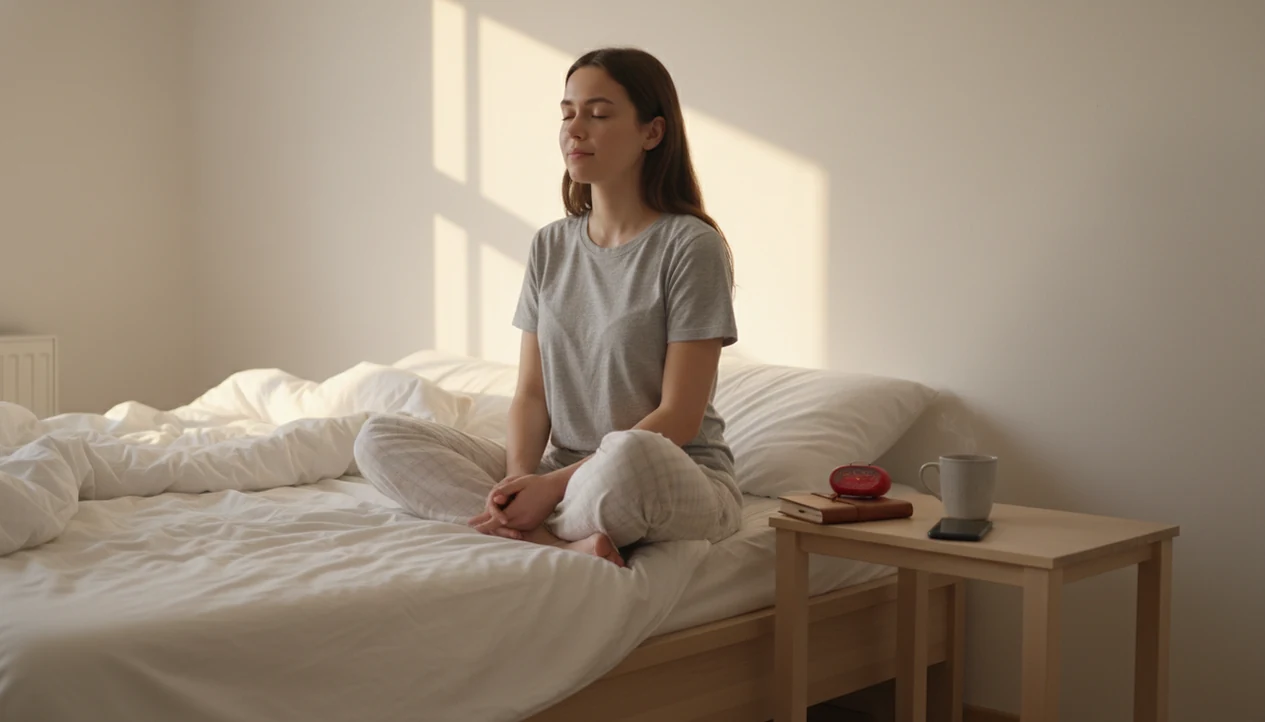
The image for this page should show an ordinary bedroom, not a luxury retreat. A person sits comfortably on the edge of a bed or on a simple chair before checking their phone. The room can look lived in: a blanket, a small timer, a mug, or a journal nearby.
Early light on the wall helps the scene feel like morning without making it glossy. The person should look relaxed but normal, not posed in a difficult yoga posture.
Caption: A realistic morning meditation habit can begin with a 3-minute timer, a comfortable seat, and one quiet pause before the phone.
Apps such as Mindful.net can help with guided sessions, but the visual should show the habit first. The tool is optional. The repeatable cue is the main point.
After brushing your teeth: a timed pause
After brushing your teeth, a brief breathing exercise can give your morning practice a clear beginning and end. The site's free breathing timer supports that option, while the Mindful.net app offers short guided meditations and a meditation timer. For breath awareness without paced instructions, a simple meditation timer is the better fit. Choose the format you can repeat, not the one with the most steps.
Morning Meditation Limits
- Seek qualified care for mental health or medical needs, since morning meditation cannot diagnose, prescribe, or provide crisis support.
- Benefits are often modest and vary by person, practice style, and consistency.
- Quiet practice can make difficult thoughts, grief, anxiety, or body discomfort more noticeable.
- Rigid streak rules can create guilt and make practice harder to sustain.
Morning meditation habit questions
How many days does it take to build a meditation habit?
There is no fixed answer, and neither 21 nor 90 days is a universal deadline. Habit research shows gradual change with considerable variation between people and behaviors. Focus on repeating the practice in a stable setting. A weekly check of what helped or interrupted practice is more useful than counting down to automaticity.
What if morning meditation makes me feel more anxious?
Quiet practice can make anxiety, difficult thoughts, or body discomfort more noticeable. You do not have to finish the session or preserve a streak. Pause or stop, and seek qualified support if distress persists. Meditation is an attention practice, not a replacement for mental health care or medical treatment.
How do I start a morning meditation routine?
Choose a reliable cue, such as brushing your teeth, and meditate immediately afterward. Sit somewhere comfortable, set a short timer, and focus on your breathing. Keep the routine simple enough to repeat on busy mornings. Preparing your seat or reminder the night before can make starting feel easier.
How can I stay awake during morning meditation?
Try sitting upright rather than reclining, opening your eyes slightly, or practicing in a room with natural light. A little gentle movement before sitting may help you feel more alert. If you regularly struggle to stay awake, prioritize adequate sleep and consider meditating a little later in your morning.
What should I focus on during morning meditation?
You can focus on the sensation of breathing, sounds around you, or the contact between your body and your seat. Choose one anchor and return to it when your attention wanders. You do not need to empty your mind. Noticing distraction and gently returning is part of the practice.
Is guided or silent meditation better for a morning routine?
Guided meditation can provide structure when you are learning or feeling distracted. Silent meditation may suit you if spoken instructions feel interruptive or you prefer a quieter start. Neither option is automatically better. Try each for several mornings and choose the approach that makes regular practice feel manageable.