


Free mindfulness apps offer guided meditations, breathing exercises, body scans, and awareness practices without an upfront payment, but the amount of free content varies. Smiling Mind is the clearest starting point for structured, fully free beginner practice. Insight Timer suits people who want a broad library and teacher choice, while Plum Village offers curated practice rooted in Buddhist teaching without a standard premium tier.
A free download does not necessarily mean a free course. Some apps keep their core library available without payment; others provide only introductory sessions before asking for a subscription. Beginners should prioritize short guided sessions, clear instructions, and little upsell pressure over the number of recordings. This comparison separates those access models and explains which app fits each need. None replaces professional care for persistent anxiety, depression, or insomnia.
What matters most
- “Free” means different things: fully free (Smiling Mind), large free library with optional paid tier (Insight Timer), or small free teaser with subscription push (Headspace).
- Beginners should prioritize short guided sessions, simple onboarding, and low ad or upsell pressure over massive content libraries.
- No free app replaces professional care for persistent anxiety, depression, or insomnia.
Insight Timer, Smiling Mind, and Plum Village at a glance
| Feature | Insight Timer | Smiling Mind | Plum Village |
|---|---|---|---|
| Free-access model | Freemium with a broad free library | Fully free | Fully free |
| Main fit | Library variety, sleep content, and timers | Structured beginner and family practice | Curated, tradition-based practice |
| Teaching approach | Varies by teacher | Secular, structured programs | Buddhist teaching |
| Library size | More than 280,000 guided meditations | Not published | Not published |
| Program organization | Large library with teacher choice | Age- or goal-based programs | Curated tradition-based content |
| Current monthly subscription price | Not published | No subscription required | No subscription required |
| Current app-store ratings | Not published | Not published | Not published |
Sources: mindful.net.
Compare free access, beginner courses, and sleep content
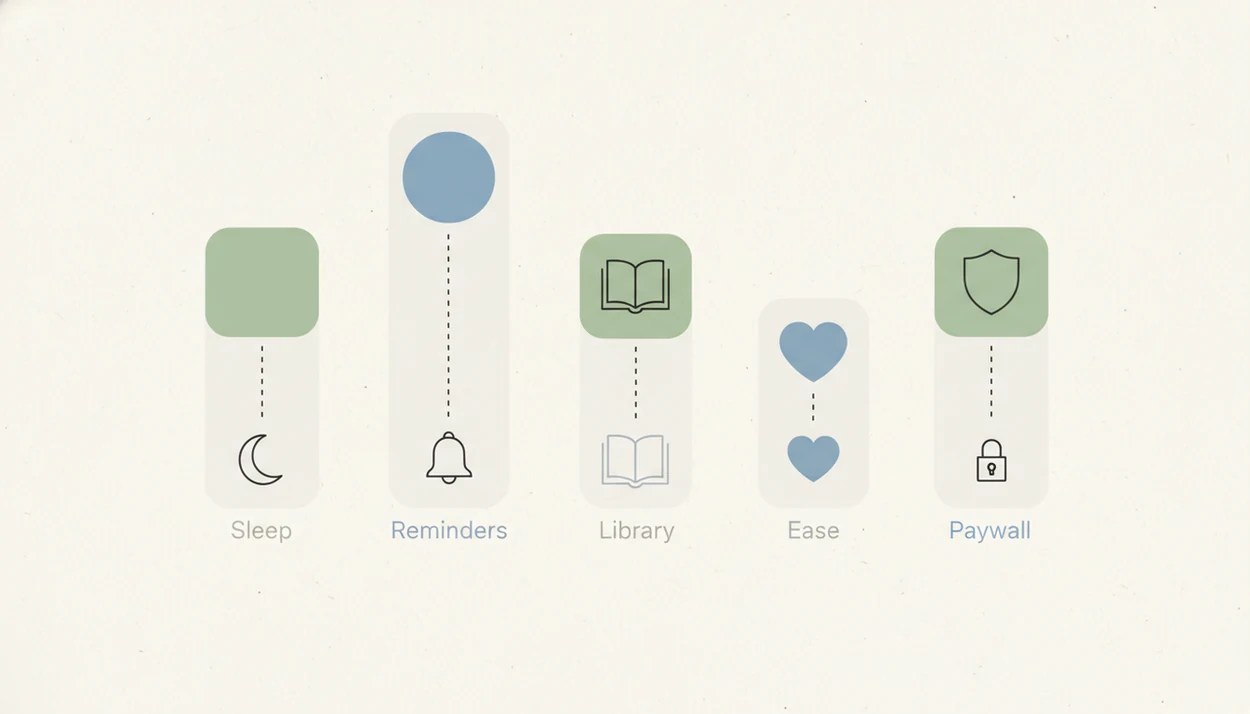
For most beginners, Smiling Mind is the clearest free starting point; Insight Timer is better if you want a huge library and don’t mind searching.
| App name | Free model type | Beginner course included | Library size | Sleep content | Reminder feature | Ad or upsell pressure level |
|---|---|---|---|---|---|---|
| Insight Timer | Freemium | Yes, but browsing-heavy | Very large, more than 280,000 guided meditations | Strong | Yes | Low to moderate |
| Smiling Mind | Fully free | Yes | Moderate | Limited | Yes | Very low |
| Plum Village | Fully free | Yes, tradition-based | Smaller, curated | Some relaxation content | Basic | Very low |
| Headspace (free tier) | Freemium teaser | Limited | Small free slice | Limited free access | Yes | High |
| UCLA Mindful | Fully free | Basic | Small | Limited | Limited | Very low |
A notebook margin filled with breath counts is enough for a first week. The app should make that easier, not turn the pause into another screen task.
Fully free libraries, freemium tiers, and free trials
Free mindfulness apps fall into three practical models: fully free, freemium with a broad free library, and freemium teaser. That distinction matters before you download, because it shapes what happens after your first few sessions.
- Fully free apps stay usable without payment. Smiling Mind and Plum Village do not rely on a standard subscription tier for individuals.
- Nonprofit or donation support can reduce pressure. Fully free apps often use grants, donations, education programs, or organizational support.
- Large freemium libraries can still be generous. Insight Timer keeps most of its meditation catalog free, while premium features may cover courses or offline play.
- Teaser models feel free at first. Headspace offers a small free tier, but most structured content sits behind a subscription.
- The first practical choice is access, not aesthetics. Beginners need to know whether the app will still help after day seven.
Beginner meditation techniques provide repeatable attention practice for daily life, not a guaranteed cure or a change in personality.
How reminders and guided sessions support a routine
Free mindfulness apps work by turning meditation into a small repeatable loop: prompt, guided audio, brief reflection, and feedback. The design goal is to make attention practice easier to repeat when your mind is busy or tired.
Most apps lean on a cue-routine-reward habit loop. A prompt starts the sequence, a short guided practice becomes the routine, and a streak, log, or calm check-in supplies the reward. Many also use progressive session lengths and spaced repetition: you meet the same skill again before it gets rusty. One day it may be breath counting; another day, noticing a cotton sleeve on your wrist while you wait through museum quiet.
Audio guidance reduces cognitive load for beginners because you don’t have to decide what to do next. Some apps also personalize suggestions from session history and goals, such as sleep, stress, or focus. Meditation use among U.S. adults rose from 4.1% in 2012 to 14.2% in 2017, according to the CDC’s National Health Statistics Reports: CDC guidance
Choose by your goal and the first available course
Choose a free mindfulness app by matching the free model to your real use case, then testing whether you can begin within one minute. If you feel lost on the opening screen, that friction will probably show up again tomorrow.
- Identify your primary goal. Choose stress relief, sleep, focus, or general curiosity before comparing features.
- Check the free-access model. Look for fully free, freemium, or trial language before downloading.
- Look for a structured beginner course. A clear first path helps more than a giant shelf of random sessions.
- Test onboarding. Open the app and see if you can start a session within 60 seconds.
- Set a daily reminder. Commit to 5 minutes for one week before judging the app.
- Review interruptions. Notice whether upsell prompts or ads disrupt the practice.
If your main barrier is time, a focused mindfulness app for busy people may fit better than a large meditation library.
Start with one app and a short daily session
Use a free mindfulness app by making the first week deliberately small and boring. The goal is not to find the perfect library; it is to complete enough short sessions to know what helps you return.
- Choose one app for the first seven days. Resist comparing teachers, playlists, and course menus once you have picked a reasonable starting point.
- Start with one guided session under 10 minutes. A short breath practice, body scan, or simple awareness exercise is enough for day one.
- Use the same time and reminder each day. Morning coffee, lunch break, or the edge of bedtime can become the cue if the app notification stays consistent.
- Log the session in plain language. After each practice, note whether it felt easy, distracting, or too long. A three-word note is fine.
- Change apps only when the app interrupts practice. Switch if paywalls, ads, confusing menus, or repeated upsells keep breaking the habit.
By the end of a week, you should know whether the app supports practice or keeps asking for attention.
Keep a timer available between guided sessions
For quiet practice between guided lessons, Mindful.net’s free online meditation timer provides a browser-based alternative to opening another audio library. It supports the unguided part of a routine rather than supplying a beginner course. A structured app such as Smiling Mind or Medito is a better starting point when you still need instructions on where to place attention and what to do when it wanders.
Best Free Mindfulness App for Large Library: Insight Timer
Insight Timer is the strongest free choice for people who want variety, teacher choice, sleep tracks, and an unguided timer in one place. It says it offers more than 280,000 guided meditations and 17,000 teachers, which is far larger than most free meditation apps: Meditation App
- Library depth: The free catalog includes guided meditation, breathwork, music, talks, and sleep content.
- Unguided practice: The timer works well for people who want bells, intervals, and quiet practice.
- Community layer: Groups and teacher pages can help users explore, but they may distract some beginners.
- Free model: Most content is available without payment; courses, offline listening, and additional features require premium access.
Insight Timer is best for users who want variety and don’t mind browsing. It is not ideal for absolute beginners who want one simple path. Choice overload is real. A single earbud during a guided session can help, but too many titles can delay the start. If browsing keeps interrupting your practice, a meditation app for distracted beginners can offer a simpler starting point.
Best Fully Free Meditation App for Beginners: Smiling Mind
Smiling Mind is the strongest fully free meditation app for beginners who want structure, plain language, and no subscription pressure. It has remained free for individuals and families for over 12 years, according to the organization: Smiling Mind App Subscription Free
- Structured programs: Sessions are organized by age group, experience level, and common life settings.
- Beginner guidance: The app explains what to do before asking you to sit for long stretches.
- Secular framing: Content is evidence-informed and developed with psychologists, without religious language.
- Family fit: Children, teens, adults, educators, and caregivers can find age-appropriate tracks.
For true beginners, a structured course is often easier than a huge library because it removes the decision before each session. Smiling Mind is not the right fit if you want thousands of teachers or deep sleep-specific playlists. For shorter single-session practice, an app for short guided meditations may be more direct.
Medito: subscription-free beginner practice with emerging evidence
Medito is another option for readers who want a structured, secular introduction without subscription prompts. The nonprofit, open-source app offers beginner courses and short guided sessions, with no ads or subscriptions. That makes it relevant to this comparison for a practical reason: the beginner course is not simply an introduction to a paid plan.
The Medito Foundation’s research summary describes a 2024 study that recruited 1,247 adults from 91 countries for a 30-day challenge using daily 10-minute sessions. Reported outcomes included well-being, depression, anxiety, and sleep quality, with effects maintained at two-month follow-up. This is promising evidence, but it is less independently established than the Healthy Minds Program research and does not establish that Medito outperforms other free apps.
Best Free Mindfulness App for Tradition-Based Practice: Plum Village
Plum Village is the strongest free option for people who want mindfulness rooted in Thich Nhat Hanh’s Buddhist teaching, without a premium tier. The app is accessible, gentle, and more curated than a large marketplace-style library.
- Tradition-rooted practice: Teachings come from the Plum Village community and emphasize everyday awareness.
- Practice variety: The app includes guided meditations, deep relaxation, eating meditation, and walking meditation.
- Free model: There is no standard paid upgrade blocking the core library.
- Best for: Users who want a tradition-grounded practice without a paywall.
- Not ideal for: Users who prefer secular-only framing or need extensive sleep content.
Rain tapping during a walking practice can make the app feel less like content and more like a reminder. Still, the library is smaller than Insight Timer, and that is partly the point.
Healthy Minds Program: a free option with randomized-trial evidence
Healthy Minds Program deserves consideration alongside the main recommendations because its free model is paired with published research. Its lessons combine short podcast-style explanations with guided meditation, covering awareness, connection, insight, and purpose. An eight-week randomized trial published in 2020 included more than 300 adults with little or no meditation experience and reported reduced distress and improvements in well-being-related outcomes, including social connectedness.
A larger four-week trial involving 662 Wisconsin school-system employees found reduced psychological distress and improved well-being immediately afterward and at three-month follow-up. These findings make Healthy Minds Program a useful option for readers who value a studied, structured course. They do not show that it is better than Smiling Mind, Insight Timer, or Plum Village, which were not the comparison groups in those trials.
Comparison criteria: access, guidance, and subscription pressure
We compared free mindfulness apps by six criteria: free content depth, beginner guidance quality, reminder and habit features, secular fit, sleep and stress tools, and upsell or ad pressure. Library size mattered, but it did not decide the ranking by itself.
A large catalog can help after you know what you like. On day one, it can make you scroll instead of practice. Beginner guidance, a short first session, and a clear next step often matter more than thousands of choices. Long-term sustainability also matters. A broad free tier is more useful than a polished 7-day trial that becomes a paywall before the habit forms.
About 1 in 3 U.S. adults reported using meditation in the past year in a 2017 analysis, so app design affects a large group of beginners.
Check whether research covers the course you can access free
Evidence for an app does not automatically establish evidence for its free tier. A systematic review of Headspace and Calm trials noted that both services offered limited free access while placing most content behind paid plans. Before relying on a study to choose an app, check which course participants used, how long they practiced, and whether that same material is available without payment.
Research coverage is also much narrower than app-store choice. A 2020 systematic review of mindfulness apps found that only seven, about 4% of those assessed, had been evaluated in randomized controlled trials. This is a dated snapshot, not a current count. It still explains why library size, popularity, and polished design should be treated as product features rather than proof of clinical effectiveness.
Match the app to your main practice obstacle
Choose the app that removes your biggest obstacle to practicing. The best free mindfulness app is the one that still feels usable on a tired Tuesday, not the one with the most polished welcome screen.
- Choose Insight Timer if you want breadth. It fits people who like exploring different teachers, sleep tracks, music, breathwork, and a flexible timer. If bedtime listening is a main goal, its larger library gives you more chances to find a voice that works.
- Choose Smiling Mind if you want a simple beginner path. It is a strong fit when you prefer structured lessons, plain instructions, and no subscription decision sitting between you and the next session.
- Choose Plum Village if tradition helps you return. Its Buddhist-rooted guidance may feel grounding if teachings, poems, walking practice, and everyday awareness are more motivating than a marketplace of options.
- Choose UCLA Mindful if you want a compact academic-style library. It suits users who prefer a small, straightforward set of guided practices over endless browsing.
- Avoid teaser-heavy apps if pressure breaks the habit. If repeated upgrade prompts make you close the app, pick a lower-pressure option before the routine frays.
Free Mindfulness App Limits
- Free apps offer educational support, not treatment or crisis care; seek professional help for anxiety, depression, trauma, or persistent insomnia.
- Instruction quality varies, and many free apps reserve stronger courses, downloads, personalization, or sleep tools for paid plans.
- Long-term benefit depends on consistent practice, not the app itself.
- An app that creates personalized meditation plan may offer tailored structure, but personalization does not replace professional judgment.
Free mindfulness app questions
Which mindfulness app is completely free for beginners?
Smiling Mind, Plum Village, and Medito offer subscription-free practice rather than a small introductory selection. Smiling Mind emphasizes structured programs, Medito offers secular beginner courses, and Plum Village draws on Buddhist teaching. Choose by the instructions and approach you prefer, not just the absence of a payment screen.
Is Insight Timer really free, or do I need a subscription?
Insight Timer has a broad free library of guided meditations, sleep content, and an unguided timer. A subscription is not required for that core use. Courses, offline listening, and additional features can require premium access, so check the specific session or feature before building your routine around it.
Is Headspace free after the trial ends?
Headspace offers limited free access, but most of its content sits behind a paid plan. Do not assume that a course available during a trial will remain accessible afterward. For ongoing practice without a subscription, compare it with fully free options such as Smiling Mind, Medito, or Plum Village.
Which free meditation app has the most sleep content?
Among the main recommendations here, Insight Timer is the strongest fit for sleep content and variety. Smiling Mind has more limited sleep content, while Plum Village includes relaxation practices. A larger library gives you more choices, but sleep audio is not a substitute for assessment or treatment of persistent insomnia.
Which free mindfulness apps are secular?
Smiling Mind and Medito are useful starting points for secular instruction. Plum Village explicitly draws on Thich Nhat Hanh’s Buddhist teaching. Insight Timer includes many teachers and approaches, so framing varies by recording. Read the session description before starting if religious language is something you want to avoid.
Do free meditation apps work offline?
Offline access varies by app and may be a paid feature even when streaming is free. Insight Timer places offline listening among its premium features. Before relying on an app during travel or without mobile data, check its download rules and confirm that the sessions you need remain available offline.
How many minutes should a beginner practice with a free app?
Five minutes daily is a reasonable starting point, increasing toward 10 minutes if comfortable. Healthy Minds Program research has examined five-minute sessions, while a Medito study used daily 10-minute sessions for 30 days. These durations support a practical starting plan, not a universal minimum or a guarantee of benefit.
Are free mindfulness apps proven to reduce anxiety?
Some have relevant research, but the evidence does not apply equally to every app. Healthy Minds Program trials reported reduced psychological distress, and Medito has emerging findings involving anxiety and well-being. A free app can support practice, but persistent or severe anxiety calls for professional assessment rather than an app-only approach.