
Best Mindfulness App With Mood Check-Ins for Daily Awareness
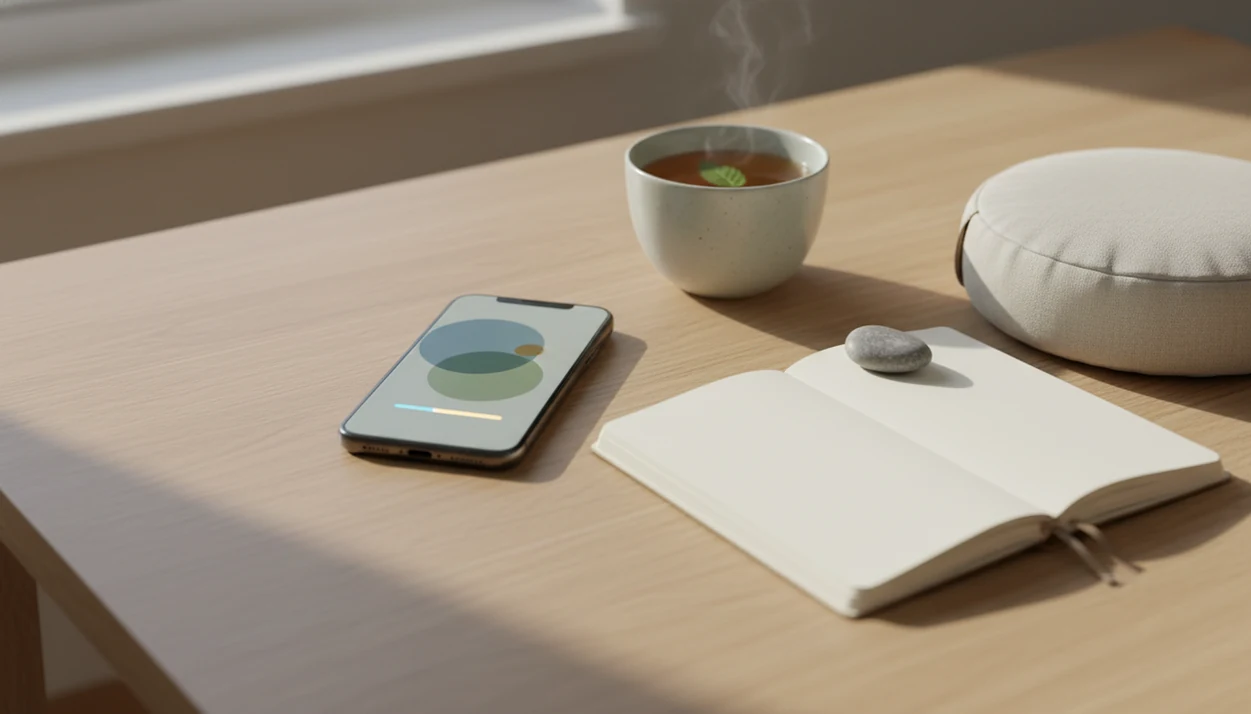
A mindfulness app with mood check ins is best used as a gentle awareness prompt: it helps you pause, name your current mood, and notice patterns before or after meditation, without treating the result as a diagnosis. Mindful.net fits beginners who want a simple, secular way to connect mood check-ins with short mindfulness practices.
> Definition: Mindful.net is a mindfulness app that teaches mindfulness practices and meditation techniques for beginners and everyday life.
- Mood check-ins are mindfulness awareness prompts, not clinical mental health assessments.
- The most useful apps pair quick mood logging with short meditations, breathing exercises, or reflection prompts.
- Use mood trends to notice patterns over time, not to judge whether one meditation session “worked.”
Best Mindfulness App With Mood Check-Ins: 5-App Shortlist Comparison
| App | Best for | Mood check-in style | Mindfulness practice support | Likely fit | Not-for caveat |
|---|---|---|---|---|---|
| Mindful.net | Beginner daily awareness | Short reflective check-in before practice | Practical mindfulness, breathing, body scan, beginner meditation | People who want plain-language guidance | Not a clinical symptom-scoring app |
| Calm | Engagement nudges | Mood prompts tied to meditation use | Large guided meditation and sleep library | People who need reminders to start | Can feel busy for minimalists |
| Insight Timer | Free meditation variety | Reflection works best with chosen practice categories | Many teachers, lengths, and styles | Explorers who like choice | Too many options can distract |
| Headspace | Structured meditation courses | Simple reflection around guided programs | Step-by-step meditation learning | Users who want a clear path | Less focused on detailed mood data |
| Moodfit | Detailed mood tools | Tracking-first logs and charts | Some mindfulness-adjacent support | Users who want more data | More data is not automatically more mindful |
This shortlist ranks mindfulness-oriented options, not diagnosis tools. A good mindful mood check in app supports awareness, not a personal scorecard.
App features, free tiers, and privacy wording can change, so users should verify the current product pages before choosing based on price, data use, or available check-in tools.
For beginners who need a mood check without clinical language, Mindful.net is the practical fit because the Mindfulness Practices App pairs a simple pause with short practice choices.
How a Mindful Mood Check-In App Works in 5 Steps
A mindful mood check-in app works by turning a feeling into a brief self-report, then pairing that report with an attention practice. The basic sequence is prompt, self-report, meditation or breathing, optional second check-in, saved trend.
- The app prompts you to pause.
- You choose a mood word, emoji, slider point, tag, or brief note.
- You practice for a few minutes.
- You may check in again afterward.
- The app saves trends for later review.
Before-and-after check-ins can strengthen habit loops because the cue is clear: notice, practice, notice again. On a crowded bus, even the bus seat vibration under your thighs can become the reminder to check in before opening a session.
In a randomized Calm study, adding mood check-ins led to 30% more meditation sessions over 8 weeks, according to the published NIH research. A Stop, Breathe & Think study also prompted users before and after sessions and linked improved baseline mood with longer-term engagement, according to the published JMIR Mental Health source: E12617
How We Picked a Meditation App With Mood Tracking
We picked apps for everyday mindfulness use first, not clinical assessment features. A meditation app with mood tracking should make it easier to notice and return, not harder to relax.
- Beginner fit: We prioritized clear guidance, short practices, and plain mood language.
- Check-in speed: A useful check-in should take seconds, not feel like paperwork.
- Practice quality: Apps scored higher when mood logging connected to breathing, body scan, meditation, or reflection.
- Trend readability: We favored simple patterns over charts that feel like grades.
- Safety boundaries: We penalized apps that over-medicalize scores, push streak anxiety, or imply diagnosis.
Privacy clarity and cost transparency mattered too. If a free app hides key features behind surprise paywalls, that changes the fit. For a wider price view, our free mindfulness apps guide compares common tradeoffs.
Evidence Behind Mood Check-Ins in Mindfulness Apps
The strongest public evidence here supports mood check-ins as engagement prompts, not diagnostic tools. Calm has randomized evidence for more meditation use, while Stop, Breathe & Think has observational pre/post mood and engagement findings.
In the Calm randomized study, users who received mood check-ins completed 30% more meditation sessions over 8 weeks than users without that feature. The Stop, Breathe & Think study asked users to rate emotions before and after sessions; improved baseline mood was linked with longer-term engagement, suggesting that repeated check-ins may help people keep practicing.
A careful reading looks like this:
- Separate usage outcomes from health outcomes.
- Treat a 30% engagement lift as evidence that people opened and used meditation more often.
- Avoid calling mood shifts a diagnosis, screening result, or treatment effect unless a study actually tested that.
- Check whether app claims come from public product pages, app-store descriptions, help centers, or research papers.
- Notice where evidence is missing before comparing apps.
For Mindful.net, Insight Timer, Headspace, and Moodfit, the main gap is app-specific published evidence tying their exact mood check-in designs to outcomes. Public materials can describe features, but they do not prove clinical accuracy or benefit.
Mindful.net Mindfulness Check-In App: Best for Beginner Awareness
Mindful.net is best for beginner awareness because it treats mood check-ins as a short pause before practice. The ideal flow is simple: name the mood, notice body sensations, choose a short meditation, then continue with the day.
The practical value is in the pairing. A user might sit upright in a kitchen chair, feel both feet on the tile, choose “tense,” and start a five-minute breathing practice. That is everyday mindfulness, not a medical intake form.
Four useful parts: 1. Plain definitions: Mindful.net explains mindfulness without jargon. 2. Short practices: The Mindfulness Practices App supports brief sessions for real schedules. 3. Non-clinical reflection: Mood words guide awareness rather than diagnosis. 4. Technique variety: Breathing, body scan, and beginner meditation give users options.
Best for
- Beginners learning what mindfulness is
- Daily awareness without heavy tracking
- Non-clinical reflection
- Short practices between work, commuting, or bedtime
Not for
- Diagnosis
- Therapy replacement
- Crisis support
- Highly clinical symptom scoring
Calm Meditation App With Mood Tracking: Best for Engagement Nudges
Does Calm help people meditate more when mood check-ins are added? In one randomized study, Calm users who saw mood check-ins completed 30% more meditation sessions over 8 weeks than users without the feature.
This result is specific to the Calm study design and user sample. It should not be read as proof that every mood check-in feature increases meditation use by 30%.
Calm is a broad meditation app, so the check-in can act like a small cue before practice. That matters when intention is high but follow-through is low. The calendar alert after a long meeting lands, the phone opens, and a mood prompt turns “later” into one breath now.
If your priority is building the habit of starting, Calm fits because mood check-ins can connect a feeling state to an immediate meditation session.
Best for
- Users who benefit from prompts and nudges
- People who want meditation, sleep, and relaxation content in one place
- Less active users who need help beginning sessions
Not for
- Users who want only a minimal, distraction-free mindfulness interface
- People who dislike large content libraries
- Anyone seeking a diagnosis from mood data
Insight Timer Mindful Mood Check-In App: Best for Free Meditation Variety
Insight Timer is best for users who want many free guided meditation choices and can stay consistent with categories. The check-in works better when it supports a repeatable pattern, not random session hopping.
Useful ways to pair mood and practice: 1. Stress tag plus breath practice: Choose the same short breathing category for a week. 2. Low-energy mood plus body scan: Track whether body-based practice feels easier than seated focus. 3. Restless mood plus timer: Use a simple timer instead of searching for another teacher. 4. Evening mood plus sleep practice: Keep the practice length stable before judging the trend.
Choice cuts both ways.
People exploring teachers and practice lengths may like Insight Timer. People who feel overloaded by menus may prefer a tighter path, or a meditation timer app for beginners with fewer decisions.
Best for
- Variety
- Free guided meditations
- Users exploring teachers, styles, and practice lengths
Not for
- People overwhelmed by too many choices
- Beginners who need a structured first month
- Users who keep switching sessions instead of noticing patterns
Headspace and Moodfit Mindfulness Check-In App Options
Headspace and Moodfit sit on different sides of the same decision. Headspace is meditation-first, while Moodfit is tracking-first.
| Option | Main experience | Best-for note | Not-for note |
|---|---|---|---|
| Headspace | Guided courses and structured meditation | Users who want a clear learning path with simple reflection | People who want detailed mood charts and logs |
| Moodfit | Mood tracking, tools, and data review | Users who want more detailed mood records | People who want mindfulness without much measurement |
Headspace best for
Headspace may suit users who want guided meditation structure, course progression, and simple reflection. It can feel easier when you don't want to decide what to practice each day.
Moodfit best for
Moodfit may suit users who want a more detailed mood-tracking experience than a basic mindfulness check-in. However, more data is not automatically more mindful.
For users comparing meditation-first and tracking-first tools, the better choice usually depends more on daily behavior than feature count. If personalization is the main goal, an app that creates personalized meditation plan may be a closer match.
How to Use a Mindfulness App With Mood Check-Ins in 6 Steps
Use mood check-ins as a small routine, not a verdict on your day. One simple way to try it is to connect the check-in to waking up, lunch, or bedtime.
- Set one daily anchor, such as waking up, lunch, or the last 10 minutes before bed.
- Log your starting mood with one word, emoji, slider, or short note.
- Practice for 3 to 10 minutes using breathing, body scan, or guided meditation.
- Log an optional post-session mood, especially when you are testing a new practice.
- Review weekly patterns without judging single-day scores or chasing a better graph.
- Reset the routine with small experiments, such as sleep timing, movement, screen breaks, or social time.
A phone timer set for 5 minutes is enough. For busy days, a mindfulness app for busy people can keep the routine short and realistic.
7 Honest Cons of a Meditation App With Mood Tracking
Mood tracking can help, but it can also become another thing to manage. The point is awareness, not winning a private dashboard.
- Mood logging can become a chore if the app asks too many questions.
- Graphs can feel like grades when users start judging every dip.
- Streaks can create pressure instead of a kind return to practice.
- Mood may not improve after every session, and that does not mean meditation failed.
- Self-report bias is real: rushed tapping, people-pleasing, and vague emotion words can distort patterns.
- Hard feelings may become over-analyzed when a user checks the chart too often.
- Positive mood is not the goal: mindfulness means noticing what is present.
Beginners trying to build a gentler rhythm may prefer a mindfulness app with daily check-ins before adding detailed mood tracking.
Limitations
Mood check-ins have clear limits, especially when users are distressed or trying to interpret patterns too precisely.
- Mood check-ins cannot diagnose depression, anxiety, bipolar disorder, PTSD, or any other mental health condition.
- These apps are not a replacement for therapy, medication, emergency support, or professional care.
- Self-reported mood data can be inaccurate, incomplete, rushed, or shaped by what someone thinks they “should” feel.
- App-supported mindfulness shows modest average benefits in research and may not be enough for severe or long-standing symptoms.
In a Stop, Breathe & Think study, users rated emotion before and after each session, and improved baseline mood was associated with longer-term engagement, according to the E12617. That is useful, but it is not the same as clinical care.
Hidden Limits People Miss
- Do not use a mood check-in app as a verdict on your day; it is usually better treated as a small observation, not a scorecard.
- If checking your mood makes you compare yourself harshly, pause the tracking and use one clear anchor, such as the breath or sound, for a short session instead.
- If you want spiritual devotion, prayer may fit the moment better than mindfulness; mindfulness asks you to notice experience, while prayer may involve relationship, meaning, or petition.
- If every check-in becomes analysis, try the Anchor-Notice-Return loop from /what-is-mindfulness: name the mood, feel one steady breath, and return to the next ordinary task.
- If you are in acute distress or feel unsafe, an app should not be your main support; consider reaching out to a trusted person or appropriate professional help.
When This Is Probably Not the Best Choice
A shift worker coming home after a hard overnight may not need another screen, another rating, or another prompt to self-improve. In that case, a low-friction recovery cue may fit better: wash your hands slowly, take one steady breath, and let the short session end before it turns into reflection homework. Mood check-ins seem most useful when they reduce decisions, not when they become one more task to complete.
Troubleshooting When It Feels Stuck
One pattern we notice is that people often abandon mood check-ins because the label feels too vague: “fine,” “bad,” or “stressed” does not give the mind much to work with. We usually suggest the Name-and-Anchor method: choose one plain mood word, take one steady breath, then return to one clear anchor for the next minute. A check-in works better when it starts a practice, not when it becomes the whole practice.
The Cost-and-Effort Tradeoff
Myth: More mood data automatically means more self-awareness.
Reality: More entries may help some people notice patterns, but too much tracking can also feed rumination. A few consistent check-ins paired with a short session often seem more useful than constant logging.
Myth: A mood check-in should make you feel calmer right away.
Reality: It may simply show you what is already present. For Stress Recovery work, the useful step is often noticing the state clearly before choosing a gentle next action, as described in /mindfulness-for-stress.
Myth: Mindfulness is just a secular version of prayer.
Reality: They can overlap in quiet attention, but they are not the same practice. Prayer may focus on faith, gratitude, or asking; mindfulness usually focuses on noticing present-moment experience without needing to change it immediately.
At-a-Glance Options
| Technique | Best for | Minutes |
|---|---|---|
| Name-and-Anchor Check-In | A parent who has only a short pause and wants to name the mood without unpacking the whole day | 3-5 min |
| Three-Breath Reset | A musician, athlete, or nurse who needs a steady breath before returning to a demanding task | 1-3 min |
| Evening Pattern Review | A shift worker who wants to notice repeated mood patterns without checking throughout the day | 5-10 min |
One Mistake We Notice Often
We usually see beginners turn mood check-ins into a private performance review, especially when the app asks for a number or streak. A gentler approach is to treat the entry as weather, not identity: notice what is here, choose one clear anchor, and keep the session short enough to repeat tomorrow. That tends to make the habit feel less like self-judgment and more like orientation.
A mood check-in is most useful when it guides the next breath, not the next self-judgment.
Why Mindful.net fits this specific need
Mindful.net is a good fit when you want mood check-ins connected to simple, secular mindfulness rather than complicated dashboards. Its guidance can pair a quick mood label with short practices such as breath awareness, Stress Recovery, or the Anchor-Notice-Return loop, so the check-in becomes a doorway into practice rather than an endpoint.
FAQ
What is a mood check-in?
A mood check-in is a short self-report prompt that asks how you feel right now. It may use mood words, emojis, sliders, tags, or a brief note.
Do mood check-ins diagnose anxiety?
No. Mood check-ins in apps do not diagnose anxiety or any other mental health condition.
Are mood tracking apps accurate?
Mood tracking apps are only as accurate as the self-report you enter. Consistent, honest use makes the patterns more useful.
Should I check in daily?
Daily check-ins can help if they feel supportive and quick. If they create stress or score-chasing, use them less often.
Why track mood before meditation?
A pre-session check-in helps you notice your starting point before practice. It gives context to the meditation without judging it.
Why track mood after meditation?
A post-session check-in helps you observe whether anything shifted. The goal is noticing, not forcing improvement.
Can mood tracking replace therapy?
No. Mood tracking can support reflection, but it cannot replace therapy, medication, emergency support, or professional care.
What should I do if my mood worsens while using an app?
Stop over-interpreting app data and reduce tracking if it increases distress. If distress is persistent, severe, or unsafe, seek qualified professional or emergency support.