
Mindfulness Habit Tracker Guide
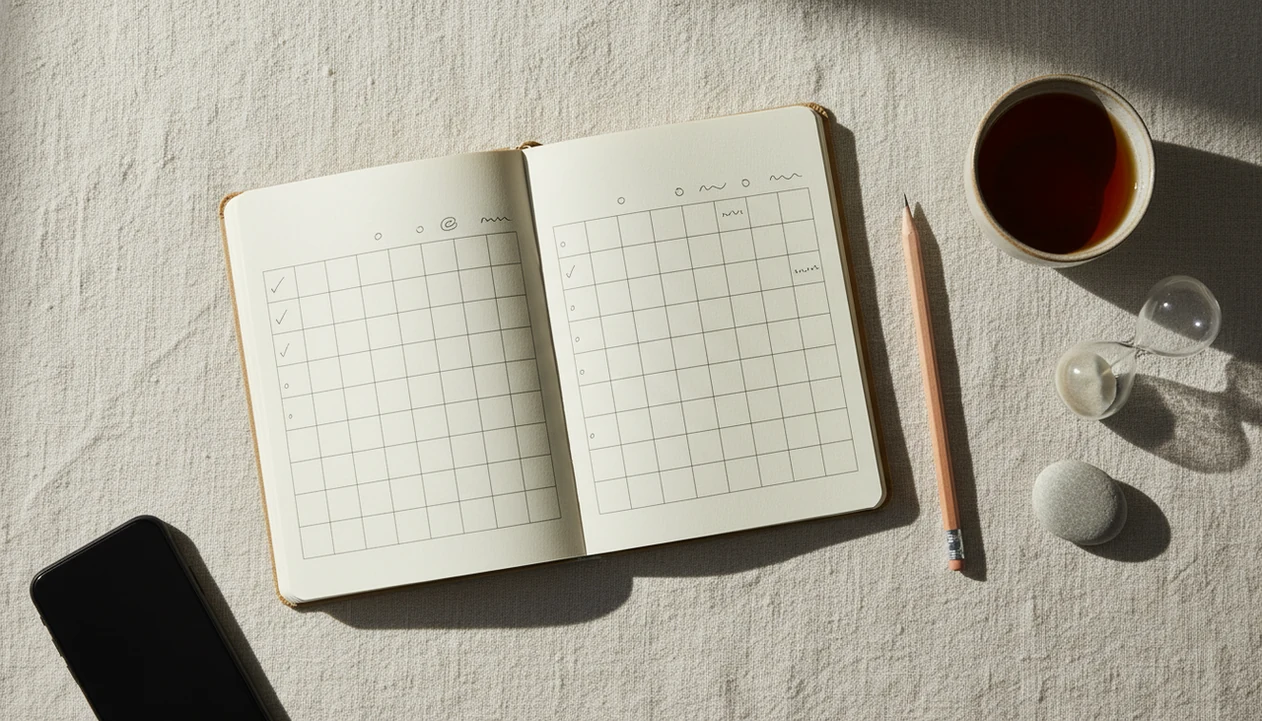
A mindfulness habit tracker helps you notice when, how, and why you practice without turning meditation into a scorecard. The healthiest way to use one is to track small practices, add brief reflection, and treat missed days as information rather than failure.
> Definition: A mindfulness habit tracker is a paper, spreadsheet, or app-based tool that records mindfulness practices such as meditation, breathing, mindful walking, or short pauses so you can see patterns over time.
- Track 1–3 simple practices, not every possible wellness behavior.
- Use mindfulness tracking as reflection: What helped me practice? What did I notice? What got in the way?
- Be cautious with streaks, badges, and daily scoring if they create pressure, guilt, or perfectionism.
Mindfulness Habit Tracker Feature Comparison
The best mindfulness habit tracker is the one that makes reflection easier, not the one with the most charts. Start with the format you will actually open after a two-minute pause.
| Tracker type | Best for | Not for | Strengths | Cautions |
|---|---|---|---|---|
| Paper journal | Reflective beginners | People who lose notebooks | Slow, personal, low distraction | Harder to spot weekly patterns |
| Printable habit tracker | Simple checkmarks | Detailed notes | Easy to tape near a desk | Can become streak-focused |
| Spreadsheet | Pattern review | Low-effort logging | Flexible columns and filters | May invite over-analysis |
| Generic habit app | Reminder support | Mindfulness-specific reflection | Convenient alerts | Review privacy settings |
| Mindfulness app tracker | Guided practice plus logs | Users avoiding screens | Practice, timer, notes in one place | Data policies vary |
Digital tools are convenient, especially if you also use a meditation timer app for beginners. Still, a plain notebook can work beautifully.
Less dashboard. More noticing.
Mindfulness Habit Tracker Behavior Loop
A mindfulness habit tracker works by supporting a cue-routine-reflection loop: a reminder prompts practice, the practice happens, and a brief note helps you learn from it. The tracker does not create mindfulness by itself; it supports the behavior around practice.
A visual record reduces the need to remember every session. You may notice that the office stairwell works better than the couch, or that bedtime practice gets skipped when the phone is still in your hand. According to the CDC, 14.2% of U.S. adults practiced meditation in the past year in 2017, up from 4.1% in 2012 CDC guidance, which helps explain the growing audience for practice-support tools.
Field note: a tracker helps most when it acts like a small practice record, not a report card. If you pause beside a warehouse pallet jack during a retail floor rush, notice the stomach flutter, and return to one steady breath, that counts as useful mindfulness data—even if the session was brief.
Mindfulness Habit Tracker Setup Steps
Use a mindfulness habit tracker by choosing one tiny practice, linking it to an existing cue, and reviewing the pattern weekly. Keep the setup boring on purpose.
- Set a starter goal of 2–5 minutes, or one brief daily mindful moment.
- Choose one cue, such as lunch break, commute, bedtime, or sitting down before opening your laptop.
- Log only the basics: practice type, duration, cue, and one observation.
- Reflect with a short prompt, such as “What did I notice afterward?”
- Review once a week instead of judging every single day.
- Reset after missed days by shrinking the practice, not blaming yourself.
For beginners, a two-minute routine is often easier than a long session because it lowers the starting friction. If time is the main barrier, a mindfulness app for busy people can help you compare short-format options.
Five Mindfulness Tracking Facts Beginners Should Know
Mindfulness tracking works best when it stays simple, flexible, and connected to what you actually practiced. One pattern we notice: caregivers often benefit from tracking a few honest moments, such as a Parking Lot Pause with heavy eyelids or a quiet reset while a diaper bag strap pulls at the shoulder, rather than trying to maintain a perfect streak. These five facts are the ground rules.
- A tracker can be paper, printable, spreadsheet-based, or digital.
- Track mindfulness practice for awareness, not performance.
- Start with 1–3 practices, such as breathing, mindful walking, or a body scan.
- Add one reflection prompt about mood, stress, attention, or body sensations.
- Missed days are normal data, not personal failure.
Research supports regular mindfulness practice more strongly than any specific tracking feature. A checkbox without reflection can become another task. A small note, like “shoulders softened after three breaths,” gives the checkmark context.
Good mindfulness practices and meditation techniques for beginners and daily life deliver repeatable ways to notice experience, not a promise that every session will feel calm.
Mindfulness Habit Tracker Reflection Features
A good mindfulness app tracker or journal should make reflection easy after practice. Badges can motivate some people, but reflection prompts tell you what the practice meant in context.
Simple practice log: Record what you did, when you did it, and for how long.
Gentle reminders: Use reminders for supportive cues, not constant nudges. A calendar alert after a long meeting can be enough.
Reflection notes: Mood, stress, attention, and body sensations can help you interpret the day without diagnosing yourself.
Flexible streaks: Streaks are best for gentle consistency and not for perfection scoring.
Privacy controls: Any digital tracker should make data collection, storage, and sharing easy to review.
Tools like Mindful.net, Calm, and Headspace approach these features differently, so compare your options before building a routine.
Best for gentle consistency
Helpful trackers make the next practice easier to begin.
Not for perfection scoring
If the score becomes the point, simplify the tracker.
Who Should Use a Mindfulness Habit Tracker?
A mindfulness habit tracker is best for people who want a gentle cue, a simple record, and a way to notice practice patterns over time. It is less useful when it turns mindfulness into another thing to win.
Beginners often benefit from a visible prompt on a desk, fridge, or phone screen because it makes a small practice easier to start. Experienced meditators may use a tracker differently: not to rate a session, but to review what conditions support steadier practice. Busy users can also benefit from reminders and short reflection prompts, especially when the practice is only one pause between meetings.
Use the lightest tracker that fits your temperament:
- Choose paper, printable, spreadsheet, or app format based on what you will actually open.
- Limit the fields if you tend toward perfectionism; one checkmark and one sentence may be enough.
- Review patterns weekly instead of scoring every day.
- Check privacy policies before logging mood, stress, or other sensitive notes in a digital tool.
- Simplify the system if tracking starts to feel louder than the practice.
Tiny, honest, and repeatable is the point.
Mindfulness App Tracker Evidence and Practice Context
Evidence supports regular mindfulness practice more clearly than it supports any single tracker feature. Streaks, badges, and dashboards may help some users, but they are not the active ingredient.
Pew estimated that 52.9 million U.S. adults used some form of mental health app in 2022, including meditation and mindfulness apps Use Of Mental Health Apps Mental Health Digital Tools. In a 2019 JAMA Network Open trial, 153 adults used a smartphone mindfulness meditation app for 10 minutes per day over 10 days, with reduced depressive symptoms compared with a waitlist control JAMA study.
A 2014 meta-analysis found small-to-moderate improvements from mindfulness-based programs for anxiety, depression, and pain JAMA study. That supports consistent practice as a reasonable focus, but it does not prove that gamified tracking is necessary. If you want prompts beyond checkmarks, compare a mindfulness app with journal prompts.
Mindfulness Tracking Data Questions
How should I interpret mindfulness tracking data? Read the data as self-inquiry, not as a report card.
Ask simple questions: What conditions helped me practice? What time of day felt easiest? What did I notice afterward? What got in the way? A week with fewer checkmarks may show that your plan was too large, your evenings were crowded, or your reminder arrived at the wrong moment.
Performance-based interpretation says, “I failed three days.” Insight-based interpretation says, “My five-minute goal did not fit this week, so I’ll try one minute after brushing my teeth.” That shift matters.
The notebook margin filled with breath counts is not proof of success. It is a clue. Use it to adjust the next practice with less drama.
Mindfulness Habit Tracker Daily Example
A simple mindfulness habit tracker entry should show the practice, cue, reflection, and next adjustment. It does not need a complex scoring system.
| Date | Practice | Duration | Cue | Reflection | Next adjustment |
|---|---|---|---|---|---|
| Tuesday | Breathing practice | 3 minutes | Before opening laptop | Mind wandered to grocery list; returned to breath twice | Keep same cue, add phone timer |
| Wednesday | Mindful walking | 5 minutes | Walk from bus stop | Noticed feet on tile near lobby | Try same route tomorrow |
| Thursday | One-minute pause | 1 minute | Before replying to message | Jaw felt tight, reply slowed down | Add shoulder check |
Suggested image caption: “A simple mindfulness habit tracker should show practice, cue, and reflection, not just streaks.”
This practical, secular beginner focus treats tracking as a learning aid. The Mindfulness Practices App framing is educational, not medical or spiritual.
Limitations
A mindfulness habit tracker can help, but it can also become unhelpful if the tool starts driving the practice. Watch for these limits.
- Tracking can become counterproductive if you fixate on streaks, scores, or perfect completion.
- Tracking alone does not create mindfulness, insight, or emotional change.
- Digital mindfulness app trackers may collect sensitive data, so review privacy policies before logging mood or stress notes.
- People with perfectionistic or obsessive tendencies may find frequent tracking increases anxiety.
Tiny is allowed.
Mindful.net can be one option for structured learning, but the healthiest tracker is still the one that supports practice without turning it into pressure.
A Practical Observation
What surprised us most is that the simplest tracker often gives the clearest picture. We have seen people learn more from a short session plus one honest sentence than from a detailed dashboard they abandon after a week. One pattern we notice is that beginners often need permission to count a small anchor, like a steady breath or mindful walk, as real practice.
If This Sounds Like You
- A streak can be useful until it starts deciding your mood; missed days are data, not a character verdict.
- If every session becomes a number, add one sentence of reflection so the tracker records context, not just compliance.
- Short sessions often reveal more than ambitious plans because they are easier to repeat when life is crowded.
- For shift workers, parents, and caregivers, tracking a flexible window may work better than tracking the same clock time every day.
- One clear anchor, such as a steady breath or a few mindful steps, tends to make a tracker easier to use than a menu of ten choices.
A Practical Comparison
Consider two beginners: one tracks a 20-minute meditation goal and stops after missing three days, while the other tracks a short session plus one note about what made practice easier or harder. The second person may build a more durable habit because the tracker becomes a feedback tool rather than a scorecard. If someone notices emotional patterns that feel intense, persistent, or hard to manage alone, a mindfulness tracker is not a substitute for therapy; it is better viewed as a small observation aid.
Hidden Limits People Miss
You keep extending the goal after a good week.
We usually suggest holding the practice steady for a little longer before increasing time. A tracker works best when it protects repeatability, not when it rewards escalation.
You feel guilty when the app shows a gap.
Try labeling the gap with a neutral reason, such as travel, fatigue, caregiving, or a late shift. The most useful tracker often explains interruption instead of dramatizing it.
You only log formal meditation.
A simple practice such as Mindful Walking can count when sitting practice is unrealistic. Tracking everyday anchors may keep mindfulness connected to real life rather than a perfect routine.
You expect the chart to prove progress quickly.
Many changes in mindfulness are subtle and inconsistent at first. A tracker may show participation more clearly than inner change, especially during the first few weeks.
The Cost-and-Effort Tradeoff
- Choose a checklist if your main barrier is forgetting; choose notes if your main barrier is understanding what disrupts practice.
- Choose a mood prompt only if it helps you reflect gently; skip it if rating your day makes the practice feel like judgment.
- Choose a flexible goal if your schedule changes often, especially for nurses, musicians, athletes, or rotating-shift workers.
- Choose a Body Scan log when physical awareness is the main anchor, but keep expectations modest because noticing tension is not the same as fixing it.
- Choose a minimalist tracker if you are prone to optimizing the system more than doing the practice.
At-a-Glance Options
| Technique | Best for | Minutes |
|---|---|---|
| Steady-breath check-in | remembering to pause without adding much planning | 3-5 min |
| Mindful Walking | people who practice better with movement than stillness | 5-15 min |
| Body Scan | noticing body sensations and post-practice patterns | 10-20 min |
A mindfulness tracker works best when it records patterns without turning practice into a personal score.
Why Mindful.net fits this specific need
Mindful.net is useful here because its related guides separate practice choice from performance pressure. A tracker can point someone toward a gentler option, such as Mindful Walking or a Body Scan, without implying that one method is universally better.
FAQ
What is mindfulness tracking?
Mindfulness tracking means logging practices and brief observations so you can see patterns over time. It may include meditation, breathing, mindful walking, pauses, mood notes, or body sensations.
Should I track meditation daily?
Daily tracking can help some beginners remember to practice. It should stay flexible and non-punitive, especially when life interrupts the routine.
Do meditation streaks help?
Meditation streaks can motivate some users by making consistency visible. They can also create pressure if treated as a score or identity.
What should I track in a mindfulness habit tracker?
Track one to three practices plus a brief reflection note. Useful fields include practice type, duration, cue, mood, attention, or what you noticed afterward.
Are mindfulness apps private?
Privacy varies by app. Review data collection, storage, sharing, and deletion policies before logging sensitive notes.
What if I miss days in my mindfulness tracker?
Missed days are useful information, not failure. Restart with a smaller practice, a clearer cue, or a less demanding schedule.