
2-Minute Mindfulness Exercises You Can Follow Anywhere


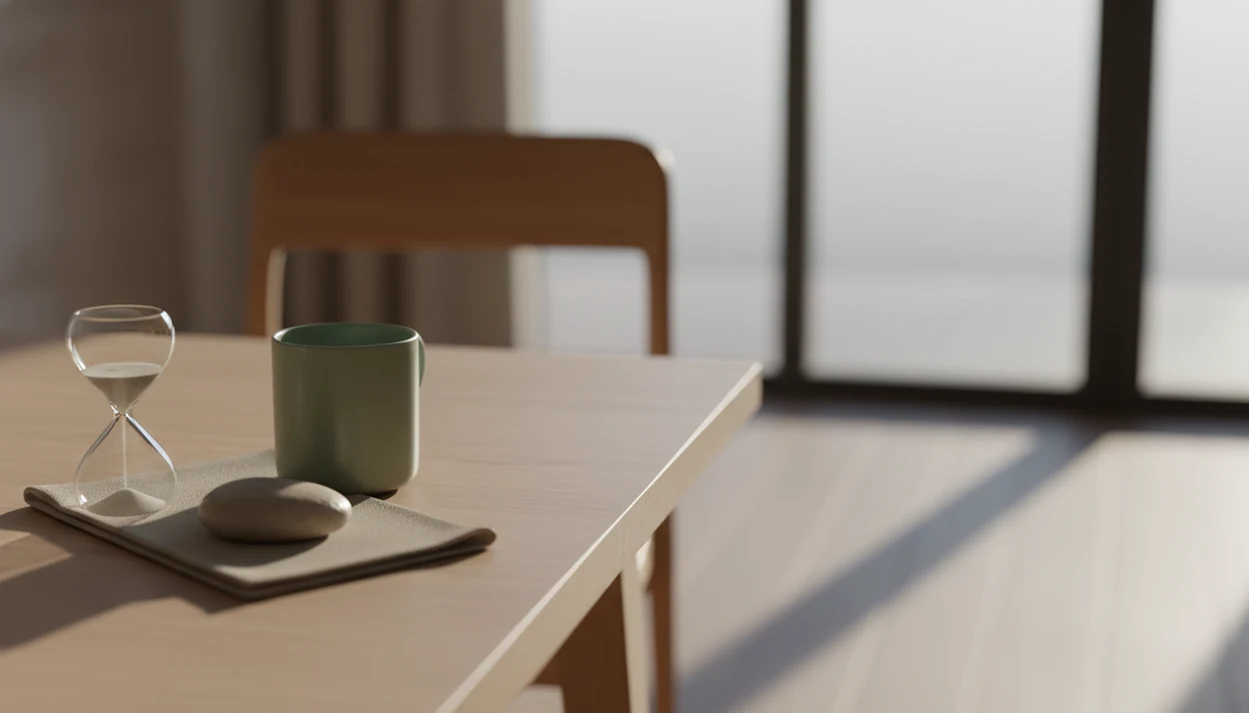
Two-minute mindfulness exercises are short, secular pauses that use the breath, body, or senses to bring attention back to the present. They fit the gap between a rushed one-minute pause and a longer meditation that is not practical right now. Breath counting, body scanning, sensory grounding, mindful walking, and gratitude pauses all give you a clear place to put your attention.
Choose one exercise for the moment: feel your feet before a meeting, count exhales between tasks, or notice body sensations before bed. Mindful.net includes short guided practices for these everyday transitions. You do not need to empty your mind or finish feeling calm. The task is to notice distraction and return, then repeat the practice at a familiar daily cue rather than expect a one-time fix.
The essentials
- Use a two-minute practice when one minute feels too rushed but a full meditation feels unrealistic.
- The most useful formats are breath counting, body scanning, sensory grounding, mindful walking, and gratitude pauses.
- Short practices work best when repeated consistently, not treated as a one-time fix.
Best 2-minute mindfulness exercises for quick daily resets
The best 2 minute mindfulness exercises are simple enough to use in a hallway, car, office chair, or bedroom. No special posture, equipment, app, or quiet room is required.
- Breath counting: Best when stress is high and you need one steady object for attention.
- Body scan: Best when tension shows up in the jaw, shoulders, chest, or stomach.
- Five senses grounding: Best when your thoughts feel scattered; try the full 5 senses mindfulness exercise when you want more structure.
- Mindful walking: Best when sitting still makes you feel more restless.
- Gratitude pause: Best at the end of the day, when you want to notice one ordinary thing that went right.
On days your phone is buzzing before your shoes are on, Mindful.net fits the two-minute reset need because the Mindfulness Practices App organizes short practices by technique and daily situation.
Choose an anchor you can remember under stress
A good 2-minute mindfulness exercise is portable, repeatable, and clear enough to use when your attention is already strained. It should reduce friction, not add another task to manage.
Use these criteria when choosing a short practice:
- Choose an anchor that does not depend on equipment, silence, a cushion, or a perfect posture. Breath, feet on the floor, sounds, hand sensations, or one visible object usually travel well.
- Pick something easy to remember under stress. “Count ten exhales” or “notice five things you see” is more useful than a complicated script when you are distracted.
- Give the practice a clear start and finish. A timer, three slow breaths, reaching the number ten, or placing both feet down can mark the container.
- Repeat the same exercise often enough that it becomes familiar. Daily repetition matters more than finding a new meditation every morning.
- Notice when an exercise feels unsafe or unhelpful. Closing the eyes, focusing on the breath, or scanning the body can increase panic, grief, or trauma responses for some people; in that case, use external sights, sounds, movement, or support from a qualified professional.
How a short pause trains attention
Two minute mindfulness works by training attention: you notice where the mind has gone, return to a chosen anchor, and reduce autopilot for a brief moment. The mechanism is simple, but not magical.
- Attention anchoring: Breath, sound, body sensation, movement, or gratitude gives the mind one place to return. If sound feels like a useful anchor, try deep listening mindfulness to practice hearing with steady attention.
- Meta-awareness: You notice that attention wandered, maybe to a grocery list, without treating that as failure.
- Autopilot interruption: A short pause can create space before replying, snapping, scrolling, or rushing. For a structured way to pause before reacting, practice DBT mindfulness exercises that emphasize observing and describing.
- Body signaling: Slow breathing and posture changes may support steadiness, though they do not guarantee calm.
- Evidence boundary: Research supports mindfulness-based interventions and brief attention training, but exact two-minute studies are more limited.
The most useful short practice usually depends more on repetition than duration, because the skill is noticing and returning. For broader options, compare mindfulness exercises and techniques.
Two-minute mindfulness method with 5 repeatable steps
Use this five-step method for almost any short mindfulness practice. It works on a kitchen chair, bus seat, office stairwell, or with feet on tile before opening a laptop.
- Set a two-minute timer, or choose a natural cue like closing a door or sitting down.
- Choose one anchor: breath, body, sound, movement, or gratitude.
- Notice the first few seconds clearly, without trying to make them impressive.
- Return when distracted; label it “thinking” or “planning,” then come back.
- Close by naming one thing you feel or one next action you will take.
If the practice felt too rushed, keep the same anchor next time and remove one extra task, such as counting or labeling. When you have more time, try 10 minute mindfulness exercises while keeping the same familiar anchor.
People trying to build everyday mindfulness often do better with one repeatable method than with a new script every time. Mindful.net supports that approach because it groups beginner practices by anchor, length, and daily use case.
Two minute breath counting script for stress
How do you do a two minute breath counting exercise for stress? Sit or stand in a posture that feels stable, with your feet touching the floor if that helps.
Let your hands rest. Soften your gaze, or close your eyes if that feels safe. Notice one inhale. Notice one exhale. Count “one” after the exhale.
Breathe in again. Breathe out, and count “two.” Continue up to ten. If you lose track, start again at one without scolding yourself.
Feel the warm exhale on the upper lip, or the ribs moving under your shirt. Let the counting be light. You are not trying to empty the mind. You are practicing return.
At the end, ask: “What needs my attention next?” For more breath-based options, use mindful breathing exercises.
Two minute body scan script for tension
How do you do a two minute body scan for tension? Start with your feet, then guide attention upward through the body without forcing relaxation.
Feel the feet on the floor. Notice the ankles, calves, and knees. Let the thighs be held by the chair. Notice the belly, ribs, and chest. If the breath feels tight, just feel tightness.
Bring attention to the shoulders. Let them soften one small amount, if they want to. Notice the jaw, tongue, cheeks, and forehead. The tongue softening from the palate can be enough.
If the mind wanders, return to the next body area. The goal is awareness, not a command to relax.
This is useful at a desk, before bed, or after a difficult moment.
Quick mindfulness exercises compared by daily situation
Quick mindfulness exercises work best when the practice matches the moment. A restless commute needs a different anchor than a sleepy bedtime routine.
| Situation | Best exercise | Why it fits | Not ideal when |
|---|---|---|---|
| Morning | Gratitude pause | Sets a clear tone without needing silence | You feel rushed and need movement |
| Pre-meeting | Breath counting | Gives attention one steady target | Counting increases frustration |
| Waiting in line | Five senses grounding | Works with noise, people, and movement | You need privacy |
| Commute | Mindful walking or sound noticing | Uses the environment as the anchor | You must focus on driving |
| Mid-afternoon slump | Body scan | Finds tension and fatigue signals | You may fall asleep |
| Bedtime | Body scan | Helps shift from doing to noticing | Turning inward feels unsafe |
If your priority is choosing fast, Mindful.net covers beginner decision-making because it labels short practices by situation, not only by meditation style.
Attach a two-minute practice to an everyday cue
Two minute mindfulness becomes more useful when it is stacked onto normal cues. Consistency matters more than session length, especially for beginners with crowded schedules.
Try this sample day: wake-up breath count, three-minute breathing pause before the first work block, sensory grounding after lunch, body scan before the evening transition, and gratitude before sleep. If two minutes is too much, start with 1 minute mindfulness exercises. If you want a slightly longer bridge, try a 3 minute meditation.
Use cues you already have: kettle boiling, a calendar alert, parking the car, closing a laptop, or hands off the keyboard after sending a message.
Busy beginners who forget formal practice may find Mindful.net useful because it frames mindfulness as everyday attention practice, not a separate lifestyle project.
Evidence behind brief two minute mindfulness practice
Evidence is strongest for structured mindfulness programs, while two-minute practice is supported by related research on brief mindfulness and attention training. That distinction matters.
- A 2014 JAMA Internal Medicine meta-analysis found moderate evidence that mindfulness meditation programs improved anxiety, depression, and pain, with lower evidence for stress and quality-of-life outcomes (JAMA study).
- A randomized mindfulness-training study found reduced mind-wandering and improved working-memory performance after a short training period, but it was not specific to two-minute sessions (0956797612459659).
- Mayo Clinic guidance notes that focused breathing can be practiced briefly and may support stress reduction and clarity in everyday situations (Art 20046356).
- CDC survey data found adult meditation use rose from 4.1% in 2012 to 14.2% in 2017, which shows popularity, not proof of two-minute effects (CDC guidance).
- Exact research on two-minute exercises is thinner than research on longer programs, so claims should stay modest.
Therapists and mental-health educators commonly present mindfulness as a supportive skill, not a replacement for care. Short practices deliver a repeatable pause, not a guaranteed mood change.
Research does not establish a two-minute minimum
Brief mindfulness research covers more than two-minute exercises. A 2019 systematic review of 85 brief mindfulness studies reported improvement in at least one health-related outcome in 79 studies, with benefits reported for practices as short as five minutes. Its definition of brief included sessions lasting up to 30 minutes, so those findings do not establish the same effects for exactly two minutes.
Nor does the evidence identify one ideal session length. A 2025 review of mindfulness practice dose found that the minimum effective amount for broader, lasting outcomes remains unclear, and comparisons of practice length and frequency have produced mixed results. Treat two minutes as a manageable starting point for attention practice, not a proven threshold or a promise that longer practice is unnecessary.
Two Minute Mindfulness Limits
- Two minutes may be too short for deeper emotional processing, grief, conflict, or trauma work.
- Research on exactly two minute exercises is limited, and benefits depend on repetition and consistency.
- Seek qualified professional support when you need therapy, medication, or crisis care, rather than relying on short practices.
- For practical daily routines, mindfulness practices for daily life may fit better than one short script.
Two-minute mindfulness questions
Is two minutes enough for mindfulness?
Two minutes is enough to practice noticing where your attention is and returning to one anchor. It is not equivalent to a longer meditation or a full mindfulness program. Research on exactly two-minute sessions is limited, so use the pause as a small, repeatable attention exercise rather than expect a particular result.
What is the easiest two-minute mindfulness exercise for beginners?
Try counting natural exhales from one to ten. Sit or stand somewhere safe, notice the breath, and count after each exhale. If you lose track, begin again at one. Keep the breathing comfortable rather than forcing it. If counting becomes frustrating, switch to feeling your feet on the floor.
Can a two-minute mindfulness exercise reduce anxiety?
A short pause may help you steady attention when anxiety is present, but it will not reliably remove anxiety. Evidence for broader mindfulness programs is stronger than evidence for exactly two-minute exercises. Use a brief practice as one support, not as a replacement for therapy, medication, or professional care.
Can I practice mindfulness at work without closing my eyes?
Yes. Keep your eyes open and choose a discreet anchor, such as your feet against the floor or your hands resting on the desk. Notice that sensation and return when thoughts pull you away. You do not need a special posture, silence, or an obvious break from your surroundings.
What should I do if my mind wanders the whole time?
Noticing wandering is part of the exercise, not evidence that you failed. Briefly name what happened, such as thinking or planning, then return to the breath, sound, or body sensation you chose. You may repeat that many times in two minutes. The aim is returning, not keeping the mind empty.
Which two-minute mindfulness exercise should I use before bed?
A short body scan is a practical choice before bed. Move attention from your feet toward your face, noticing sensations without demanding relaxation. Let the jaw or shoulders soften if that feels comfortable. Treat it as a quiet pause, not a requirement to fall asleep within two minutes.
Can I do a two-minute meditation while driving?
Do not close your eyes or withdraw attention from driving to follow a meditation. Save the timed practice for when you are safely parked or out of the car. During travel as a passenger, you can keep your eyes open and notice sounds or body contact without needing a quiet space.
How often should I do two-minute mindfulness exercises?
Start with one pause attached to a familiar event, such as sitting down before work or finishing lunch. Repeat that cue rather than build a crowded schedule immediately. There is no established optimal frequency for exactly two-minute practices. Once the pause becomes consistent, you can add another or allow more time.