
Habit Stacking Meditation: Build Practice Around a Daily Cue


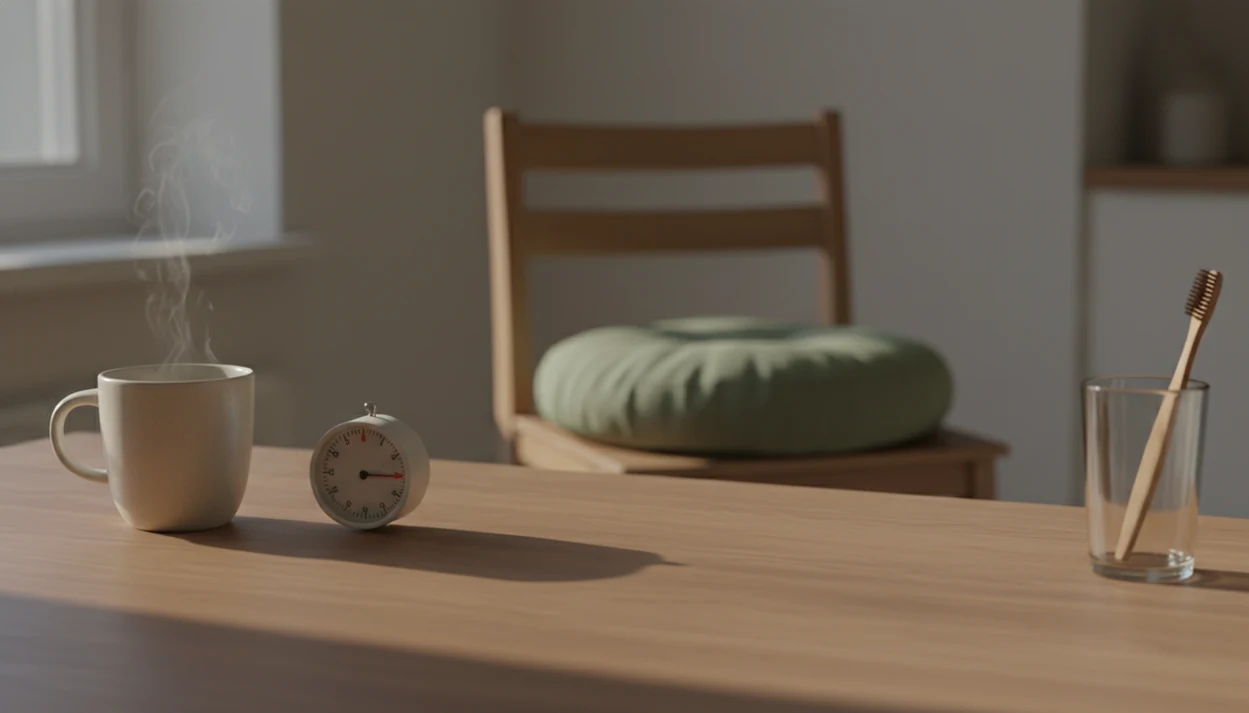
Habit stacking meditation means attaching a brief mindfulness practice to something you already do each day, such as pouring coffee, brushing your teeth, parking your car, or getting into bed. Instead of planning to meditate sometime, name the moment: “After I brush my teeth, I will sit on the bedroom chair and notice my breathing for three minutes.”
Choose a cue that happens reliably, keep the practice small, and write down the time and place. Start with 1-5 minutes, then track completed and missed sessions for two weeks. That gives you a way to check whether the routine fits your day. Repeated skips are a reason to adjust the cue or session length, not to make a harsher promise.
The essentials
- Use the formula: “After [existing habit], I will [specific meditation practice] for [specific time].”
- Choose a stable anchor habit that happens most days in the same place, not a vague or irregular cue.
- Start with 1-5 minutes, track the stack for two weeks, and adjust the cue if you keep skipping it.
Pair one daily cue with one brief meditation
Habit stacking meditation is a cue-based method for building a daily meditation habit by pairing a brief mindfulness practice with an existing routine. Instead of relying on “I should meditate later,” you attach the practice to something that already happens.
A simple stack might be: “After I brush my teeth at night, I will sit on the edge of the bed and breathe for three minutes.” Another could be one minute after parking the car, before touching the phone.
The cue matters. It should be reliable, specific, and easy to notice. The meditation should also be small enough that you’ll do it on a tired Tuesday, not only on a quiet weekend. Beginner meditation practice builds the skill of returning attention repeatedly; it does not produce instant calm on command.
Five parts of a repeatable meditation stack
- Habit stacking links a small meditation to an existing daily behavior. The current habit becomes the reminder, so the new practice has somewhere to land.
- The core formula is “After/Before [current habit], I will [meditation habit].” Add a time and place when possible, such as “for three minutes in the kitchen chair.”
- Reliable cues reduce dependence on motivation and memory. Feet on tile after brushing teeth can become a clearer prompt than a vague promise to meditate sometime. Understanding motivation versus consistency can help you rely on repeatable cues rather than waiting to feel ready.
- Progress tracking, reminders, and small celebrations improve consistency. A checked box, a sticky note, or a quiet “done” after the final breath can reinforce the loop.
- Stacks should be changed when the cue does not happen consistently. If the school run varies every morning, choose a steadier cue, such as plugging in your phone at night.
Small is not weak. It is repeatable.
How cues and if-then plans support follow-through
Habit stacking works through a simple habit loop: cue, behavior, and reward. The cue is the existing routine, the behavior is the short meditation, and the reward is a small sense of completion, steadiness, or relief from decision-making.
Behavior-change researchers often describe a related tool called an implementation intention: “If situation X arises, then I will do Y.” This structure matches implementation-intention research, where if-then plans improved follow-through (Gollwitzer, 1999: 0003 066X.54.7.493), and habit-formation research showing repeated context helps behavior become more automatic (Lally et al., 2010: Ejsp.674). Habit stacking uses the same practical structure. “After I pour tea before bed, I will notice five breaths” is easier for the brain to run than “I will be more mindful.”
Direct research on the exact phrase “habit stacking meditation” is limited. However, related research on implementation intentions and habit strength supports the structure. Repeating the same cue, practice, and context helps automaticity, which means less internal debate before starting.
The brain likes repeated paths. So does a busy household.
Prepare your cue, practice space, and reminder
A good meditation stack needs only a few parts. Keep them plain, visible, and realistic.
- Reliable anchor habit: Choose something that happens most days, such as brushing teeth, locking the front door, or placing your bag down after work.
- Tiny meditation practice: Start with 1-5 minutes. A phone timer set for 5 minutes beats an idealized plan you never begin.
- Clear place or posture: Use a kitchen chair, cushion, parked car, bus seat, or bedside position.
- Reminder tool: Try a sticky note, app reminder, calendar alert, or visible object near the cue.
- Two-week tracker: Mark completed sessions, skipped sessions, and friction points for 14 days.
If you want a broader menu of short exercises, our guide to mindfulness practices gives beginner-friendly options without jargon.
Step 1: Choose a cue that happens most days
A good anchor is stable, specific, and already automatic. It happens in the same rough setting most days, so your meditation cue does not depend on a perfect schedule or a burst of discipline. Comparing motivation versus discipline can help you choose realistic routines without treating missed sessions as personal failures.
Emotionally charged anchors often fail because the nervous system is already busy. “After an argument” sounds memorable, but it is usually too activated for a new habit. Irregular anchors also wobble. If exercise happens twice one week and not at all the next, it cannot carry a daily meditation habit.
| Anchor type | Example | Why it works or fails |
|---|---|---|
| Good anchor | After brushing teeth | Stable, repeated, and tied to one location |
| Good anchor | After pouring coffee | Clear morning cue for many people |
| Good anchor | After parking | Useful before entering work or home |
| Good anchor | Before getting into bed | Predictable end-of-day transition |
| Weak anchor | After work | Work may end at different times or moods |
| Weak anchor | Whenever I have time | Too vague to trigger action |
| Weak anchor | After an argument | Emotionally loaded and hard to repeat calmly |
Step 2: Write the time, place, and practice
How do you write a daily meditation habit formula? Use this exact structure: “After [current habit], I will [meditation practice] for [time] in [place].”
Examples make the plan easier to follow. “After I pour coffee, I will take three mindful breaths at the counter.” “After I brush my teeth, I will do three minutes of seated breathing on the bedroom chair.” “After I park, I will do a one-minute body scan before unbuckling.”
Concrete wording beats “meditate more” because it tells you when to begin and what to do. Before-wording works well for transitions, such as “Before I open email, I will breathe for one minute.” After-wording works well when the cue is already automatic.
For beginners, a written cue-based plan is often easier than relying on motivation because the starting point is already built into the day.
Step 3: Begin with 1-5 minutes of meditation
Start with 1-5 minutes, not 20-30. Short daily practice is usually better for habit building than occasional long sessions because the main skill at first is returning to the cue.
- Mindful breathing: Notice the inhale and exhale, then return when the mind wanders to a grocery list. If focusing on breath feels uncomfortable, learn about meditating with breathing problems before adapting your practice.
- Body scan: Feel the lower back meeting the cushion, then move attention slowly through the body.
- Sound awareness: Listen to nearby sounds without chasing each one.
- Loving-kindness phrase: Repeat a simple phrase such as “May I meet this moment with steadiness.”
- Three-breath pause: Take three intentional breaths before opening a laptop or leaving the car.
In a randomized trial of a brief mindfulness smartphone app, participants reported lower stress and irritability after short daily practice (Economides et al., 2018: S12671 018 0905 4); that still does not make habit stacking a medical treatment. If five minutes feels right, the 5-minute mindfulness practice is a practical next step.
Two-week habit stacking meditation plan
Use two weeks to test the stack, not to judge your personality. The goal is consistency, not perfect sessions.
- Pick one anchor habit that happens most days in the same place.
- Write the stack as: “After [current habit], I will [practice] for [time] in [place].”
- Place a reminder where the cue happens, such as a sticky note on the bathroom mirror or a cushion near the bed.
- Practice the meditation once per day, even if it is only one minute.
- Track completed sessions, skipped sessions, and what got in the way for 14 days.
- Adjust the cue, time, or practice if you miss the same stack several times.
Missed days are data. Restart at the next cue without adding punishment, makeup sessions, or a speech about discipline.
After two weeks, build consistency without a deadline
Two weeks is a useful review point, not a deadline for making meditation automatic. A 90-day study of everyday habit formation found that habit strength grew over three months, especially with consistent repetition. It did not establish that every habit becomes automatic on day 90. A review of habit-formation research also rejects 21 days as a general experimental finding. Keep assessing the fit of your routine rather than counting toward a promised finish date.
Once the short session is stable, increase its length only if that suits your schedule. Review your practice weekly and consider aiming for 4-7 days per week rather than protecting an unbroken streak. In a longitudinal analysis of meditation app users, people practicing at that frequency were 2.3 times more likely to reach their 150th session than those practicing once weekly. This was an association, not proof that a particular schedule causes lasting adherence.
Fix weak cues, long sessions, and multitasking
Most failed stacks are not failures of character. They are usually design problems: the cue is too weak, the practice is too long, or the plan is too vague.
| Mistake | What it looks like | Practical fix |
|---|---|---|
| Choosing an irregular anchor | “After exercise, I’ll meditate,” but workouts vary | Attach meditation to brushing teeth or bedtime instead |
| Starting too long | Planning 30 minutes on day one | Begin with 1-5 minutes for two weeks |
| Treating it as multitasking | Meditating while answering messages or packing lunch | Take a brief dedicated pause, then continue |
| Using a stressful cue | “After every argument, I’ll breathe” | Choose a neutral cue before stress builds |
| Quitting after one missed day | Skipping Monday and abandoning the week | Restart at the next cue and note what happened |
If your routine is crowded, build around the smallest honest pause. A classroom bell followed by one breath still teaches the cue-response pattern.
Meditation stacks for mornings, work, and bedtime
Daily meditation habit stacks should match what actually happens most days. A parent, office worker, student, and shift worker may need completely different cues.
Morning meditation habit stacks
After coffee or toothbrushing, try three mindful breaths, one minute of standing breath awareness, or three minutes in a kitchen chair. If coffee timing changes, toothbrushing may be steadier.
Workday meditation habit stacks
Before opening email, take one quiet pause before hitting send on the first message of the day. After lunch, sit for two minutes before returning to your desk. More examples for office settings are covered in mindfulness at work.
Bedtime meditation habit stacks
Before getting into bed, try a short body scan or five slow breaths. Shift workers can use “after changing clothes” or “before sleep” instead of a clock time. For family routines, after school drop-off or after the child’s bedtime routine may work better than early morning.
Track starting, skipping, and remembering the cue
A meditation stack is starting to stick when the cue triggers the thought of meditating before you talk yourself into it. You may notice less debate, faster starting, and fewer “I forgot” moments.
Track three things for two weeks: completed sessions, skipped sessions, and friction points. A checkmark is enough. If tracking becomes pressure, simplify it to “done” or “missed” on a paper calendar.
The evidence is indirect: habit automaticity depends on repeated context, while mindfulness research is stronger for attention, stress, and self-regulation than for any one habit-stacking formula. For adoption context, CDC/NCHS reported that adult meditation use in the United States rose from 4.1% in 2012 to 14.2% in 2017 (CDC guidance). A daily mindfulness routine can help if you want a fuller structure beyond one stack.
Quietly count the small wins. Then stop counting so hard.
Evidence Behind Habit Stacking Meditation
The evidence supports habit stacking meditation as a practical consistency method, not as a guaranteed way to feel calm every time. The strongest case comes from nearby behavior-change research, plus mindfulness studies showing brief practice can be useful for some people.
- Separate the claims. Direct studies on “habit stacking meditation” as a named method are limited, so the page should not pretend the exact formula has a large trial base.
- Use implementation-intention research carefully. “After I brush my teeth, I will breathe for three minutes” resembles if-then planning, which has evidence for improving follow-through.
- Repeat the same cue, place, and behavior. Habit automaticity research supports the idea that repetition in a stable context can make starting feel less effortful.
- Treat brief mindfulness and app trials as supportive, not curative. They suggest short practices may help attention, stress perception, or self-regulation for some users, but they do not prove medical symptom relief.
- Name the limits plainly. Effects vary, study designs differ, self-report is common, and irregular schedules, trauma responses, or severe stress can require more than a tiny stack.
So the evidence points toward designing a repeatable starting line. It does not promise a quiet mind.
After your daily cue: time a short breathing practice
After brushing your teeth or putting down your morning coffee, a free breathing timer can give your brief breathing practice a clear start and finish. The Mindful.net app also offers short guided meditations and a meditation timer for a seated session. Keep the timer ready near your chosen cue. A paper reminder and an ordinary clock may be better if opening a device leads you to messages instead of practice.
Meditation Stack Limits
- Habit stacking cannot fully solve severe time poverty, unstable housing, caregiving overload, or chaotic work schedules.
- Research on habit stacking meditation is sparse, with stronger evidence for related habit and mindfulness concepts.
- Small stacks may not sustain longer meditation sessions lasting 20 to 45 minutes.
- Seek qualified care for mental health needs, as Mindful.net offers education, not crisis support.
Habit stacking meditation questions
How do I write a meditation habit stack?
Write one sentence that names the cue, practice, duration, and place: “After I brush my teeth, I will notice my breathing for two minutes in the bedroom chair.” Choose something you already do reliably. The plan should tell you exactly when to start, rather than simply remind you to meditate more.
What is the best daily cue for meditation?
The best cue is one that already happens most days in a predictable setting. Brushing your teeth, pouring morning coffee, or putting down your work bag can work. Choose the most reliable part of your own routine, not the most appealing example. An irregular workout or a stressful argument is a weaker starting point.
How long should I meditate when starting a habit stack?
Begin with 1-5 minutes if that makes starting realistic. Keep the same small practice while you check how it fits your routine. A two-week trial comparing roughly 10-minute and 30-minute sessions found no adherence advantage for the longer sessions, but it did not directly test one-minute or five-minute practice.
Is morning or evening better for habit stacking meditation?
Choose the time with the more dependable cue. In one four-week trial using morning and evening reminder emails, adherence was slightly higher in the morning, 66% versus 61%. That does not make mornings best for everyone. An evening toothbrushing cue may suit your schedule better, or serve as a backup when mornings are disrupted.
Does meditation become a habit after 21 days?
There is no established 21-day deadline for habit formation. Research shows a gradual process that varies between people, behaviors, and circumstances. Ninety days is not a universal deadline either. Look for practical changes, such as remembering the session when the cue happens and starting with less debate, rather than expecting automaticity on a particular date.
What should I do after missing several meditation sessions?
Return to the smallest workable version, such as two to five minutes at your original cue. Avoid trying to repay missed sessions with one unusually long meditation. Research does not establish that a broken streak resets a habit to zero. Review what interrupted the routine and adjust the cue or duration if the same problem keeps recurring.
Is habit stacking meditation the same as multitasking?
No. Habit stacking places meditation immediately before or after another activity; it does not require doing both at once. After pouring coffee, pause for three mindful breaths before checking messages. After parking, take a brief seated pause while the car is stationary. Give the meditation its own small space, then continue with your day.
What if I keep forgetting to meditate after my cue?
Check whether the cue is specific enough to notice. “After breakfast” may be less clear than “after I put my breakfast bowl in the sink.” Place a visible reminder where that moment happens, and keep the practice short. If repeated skips continue, change the cue or location rather than relying only on stronger motivation.