
How to Build Healthy Habits with Small Actions and Reliable Cues


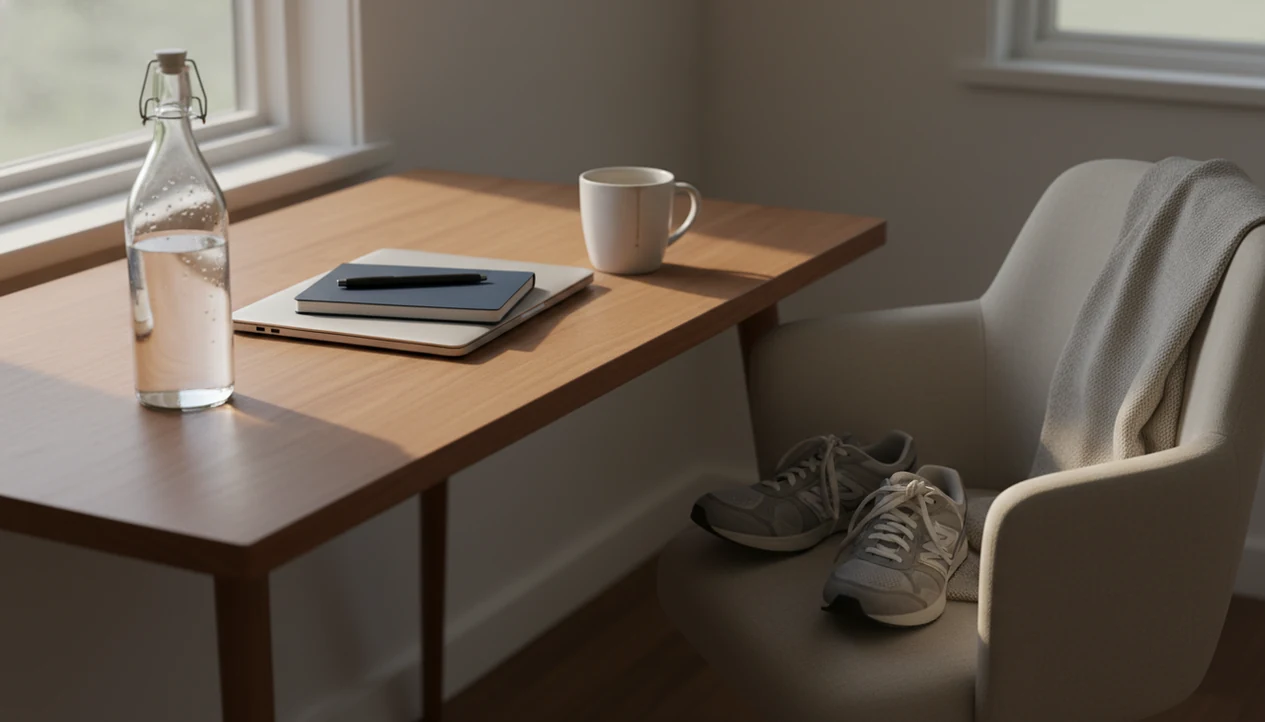
To build healthy habits, start with one small action, attach it to a clear cue, and arrange your surroundings so doing it is easier than skipping it. Habit building uses repetition, environmental changes, and realistic planning to make a behavior more automatic. A specific if-then plan gives you something concrete to do, instead of a goal that depends on feeling motivated.
Choose a version you can manage on a busy or low-energy day: one mindful breath after closing your laptop, for example. Expect progress over weeks or months, not a fixed 21 days. A 2024 review of health-related habit formation found substantial variation between people and behaviors. After a missed day, respond with self-compassion and return at the next planned opportunity.
Definition: Science-backed habit building means using cues, repetition, small actions, environmental design, and realistic planning to make a healthy behavior easier to repeat until it becomes more automatic.
The essentials
- Start with a habit so small you can do it on a busy or low-energy day.
- Pair the new behavior with an existing routine, such as brushing your teeth, making coffee, or closing your laptop.
- Expect habit formation to take weeks or months, not a fixed 21 days, and plan for resets after setbacks.
Five facts to guide your first healthy habit
- Small habits reduce the starting cost. One mindful breath, one stretch, or a two-minute walk is easier to repeat than a full routine.
- Habit stacking uses an existing cue. A routine you already do, like closing your laptop, can trigger the next healthy action.
- Environment design lowers friction. Put the water bottle on the desk, shoes by the door, or journal on the pillow.
- Specific plans beat vague goals. In a workplace flu-shot study, prompts that asked people to write down a specific date and time increased vaccination from 33.1% to 37.3% versus the control reminder group: Pnas.1103170108
- Setbacks need resets, not verdicts. Missing a day is information. It is not proof you failed.
For beginners, the most reliable healthy habit plan is a small repeatable action linked to a stable cue, because the cue does part of the remembering.
Healthy Habit Formation: Cues, Repetition, and Automaticity
Healthy habit formation works by linking a cue, a repeatable routine, and a reward until the behavior becomes easier to start in that context.
A cue is the prompt. The routine is the action. The reward can be relief, completion, energy, or the simple feeling of doing what you said you would do. A goal says, “I want better sleep.” A habit says, “After I plug in my phone at 9:30, I will read one page in bed.”
Automaticity develops gradually through repetition in a stable context. In Lally et al.’s 12-week habit-formation study, the average time to reach automaticity was 66 days, with wide variation by person and behavior, so 66 days is a useful reference point, not a deadline: Ejsp.674
A tour script may still pop up. Notice it, then return.
Set up one repeatable habit in five steps
Use science-backed healthy habit strategies by choosing one behavior, shrinking it, linking it to a cue, changing the environment, and reviewing without drama.
- Choose one habit target. Pick one behavior for this week, not a full life reset.
- Shrink the action. Make it almost too easy, such as one breath or one glass of water.
- Attach it to a cue. Place it after something that already happens every day.
- Change the environment. Put the tool where the habit will happen before the cue arrives.
- Review and reset. Track lightly, then restart after missed days without starting over emotionally.
1. Choose one habit target
Choose one specific habit target, such as “walk for two minutes after lunch,” instead of “get healthier.”
2. Shrink the action
Shrink the behavior until it works on a rushed day. Sock-clad feet under a chair still count for a one-minute breathing pause.
3. Attach it to a cue
Attach the habit to a daily cue: “After I close my laptop, I will stretch once.”
4. Change the environment
Change the room before motivation is needed. Put the mat, shoes, or water where your eyes will land.
5. Review and reset
Review weekly. If you missed three days, reduce the habit size and restart at the next cue.
Write a backup plan for the obstacle you expect
A cue tells you when to act, but it does not tell you what to do when the plan becomes impossible. Add one backup for a likely obstacle: “If rain stops my lunchtime walk, I will walk in the hallway for five minutes.” A systematic review of physical-activity planning interventions found that plans were more likely to help when they explicitly addressed barriers.
Write down your normal action, your minimum version, and your restart rule. For example: “After lunch, I will walk for 20 minutes. On a packed day, I will walk for five. If I miss it, I will resume at the next planned opportunity.” This is a practical application of barrier-planning evidence, not a separately proven formula. The minimum preserves an opportunity to repeat the behavior without demanding the full session.
Small-Step Habit Tips for Healthy Routines
Small-step habit tips work because they build repetition before intensity. The first job is not to impress yourself; it is to become the kind of person who repeats the action.
- One mindful breath: Pause before opening a new tab or replying to a message.
- Two-minute walk: Step outside, walk to the corner, or circle the hallway once.
- One glass of water: Put it beside breakfast, lunch, or your work bag.
- One stretch: Link it to standing up from a kitchen chair.
- One minute of attention practice: Try a short 5-minute mindfulness practice and use only the first minute if that is what fits.
Demanding routines often work only on clean, rested, spacious days. Most weeks are not like that. Start smaller than your ambition.
Pair a new habit with something you already do
How do you use habit stacking for healthy habits? Habit stacking means placing a new behavior immediately after an existing routine, using the formula: After I do X, I will do Y.
Examples:
- Mindfulness: After I sit down at my desk, I will take three breaths.
- Movement: After lunch, I will walk for two minutes.
- Hydration: After I brush my teeth, I will fill a water bottle.
- Sleep wind-down: After I plug in my phone, I will dim the lights.
- Screen breaks: After a meeting ends, I will look away from the screen for 20 seconds.
Familiar cues are more reliable than motivation because they already happen. Your phone buzz noticed without grabbing it can become a cue too, if you use it to pause instead of react. You can practice mindful attention shifts by noticing a distraction and returning to your chosen action.
Environment Design for Healthy Habit Success
Environment design makes the desired habit easier and the unwanted pattern harder. It works by reducing friction before your tired brain has to negotiate.
Put walking shoes by the door. Set a meditation cushion near the bed. Charge the phone outside the bedroom if late scrolling keeps winning. Place a sticky note on the bathroom mirror, not ten reminders across five apps. For additional ways to support your mind, try daily brain health habits alongside these environmental changes.
Visible cues help when they are simple and placed where the action happens. They become noise when every surface nags you.
Environment often beats willpower for long-term consistency because it changes the default. A bowl of fruit on the counter is easier to use than fruit hidden behind leftovers. A short daily mindfulness routine is easier to repeat when the chair, timer, and cue are already set.
Mindfulness Support for Building Healthy Habits
Mindfulness can support healthy habits by creating a brief pause before automatic behavior. That pause may be enough to notice the urge, name the next step, and choose the smaller planned action.
One simple way to try it: pause for one breath before the old pattern starts. Feel the belly rise against the waistband. Then ask, “What is the next tiny action?” Mindfulness practices and meditation techniques for beginners and daily life can build steadier awareness, not instant discipline or a guaranteed cure.
After setbacks, intention-setting and self-compassion matter. “I missed yesterday, so I restart after lunch today” is more useful than self-criticism. Tools like Mindful.net, mindful.org, Calm, and Headspace can support beginner-friendly practice, and our guide to mindfulness practices explains the basics in plain language. If you use a Mindfulness Practices App, treat it as a cue and practice container, not as proof that the habit is complete. The repeated behavior still has to happen in your real environment.
When small, cue-based habits fit your schedule
Science-backed habit strategies fit people who want repeatable behavior change, not a dramatic overnight reset. They are practical, but they still require time, context, and adjustment.
| Fit | Best for | Not ideal for |
|---|---|---|
| Beginners | People starting with one small habit | People trying to change everything at once |
| Busy schedules | Parents, students, shift workers, and office workers | People who expect a long routine every day |
| Restarting | People returning after lapses | People who treat missed days as failure |
| Flexible routines | People who dislike rigid plans | People seeking one perfect habit rule |
| Support tools | People using apps, timers, or reminders wisely | People expecting trackers to create the habit |
Apps, trackers, and reminders are support tools. The habit itself is still the repeated action after a cue. A Mindfulness Practices App can help with prompts, but it cannot do the repetition for you.
Mistakes that make a habit harder to repeat
The most common habit mistake is starting too big before consistency exists. A 45-minute workout plan may be healthy, but it is fragile if it only works on unusually calm days.
Vague goals are another trap. “Be less stressed” gives the brain nothing to do at 8:15 on a Tuesday. “After I park, I will take three breaths before leaving the car” is easier to repeat.
Willpower helps sometimes, but it is unreliable when sleep is short, the room is noisy, or the day is packed. Plans need cues, tools, and realistic timing. Practicing personal energy management can help you choose habits that match your capacity on demanding days.
One missed day should trigger a reset. Not a speech. Visualization and tracking can support change, but neither replaces a concrete repeatable action.
Choose what to add, not just what to stop
“Stop sitting so much” identifies a problem but leaves the next action unclear. “Walk for two minutes after lunch” names a behavior you can carry out. In a year-long study of New Year’s resolutions, participants with approach-oriented goals reported greater success than those with avoidance-oriented goals, 58.9% versus 47.1%. Those were self-reported resolution outcomes, not proof that every positively worded habit will succeed.
Also ask why you want the habit. A 2025 longitudinal study of resolution adherence found that intrinsic motivation predicted adherence more strongly than external motivation. Choose an action you personally value or enjoy, then allow some flexibility in how you perform it. Walking outside and walking indoors can serve the same movement goal when weather or time changes.
What planning and repetition studies actually show
The evidence behind these strategies is strongest for specific planning, repeated cue-based behavior, and reducing friction in the environment. It supports better odds, not guaranteed outcomes for every person or habit.
Peer-reviewed research on implementation intentions shows that writing down when and where an action will happen can improve follow-through; the flu-shot planning study is a practical example of a small prompt changing real behavior. Habit automaticity research also suggests that repeated action in a stable context can make behavior feel less effortful over time, but the often-quoted 66-day average is only an average, with wide differences by behavior and person. Environmental design fits the same logic: when the bottle is visible, the shoes are by the door, or the phone is outside the bedroom, the desired action has less friction and the old pattern has more.
To use the evidence carefully:
- Treat research findings as tendencies, not promises.
- Separate peer-reviewed findings from coaching shortcuts and motivational rules.
- Test one small change in your own setting before expanding it.
- Adjust the cue, size, or environment when the plan keeps failing.
At your desk: make a pause the next small habit
After finishing a work task, one mindful breath can be your minimum action. The free mindfulness bell can prompt that pause, while short guided meditations in the Mindful.net app offer a longer practice when time allows. Keep the cue tied to the action you want to repeat. For walking, hydration, or stretching, shoes by the door or a visible water bottle may be more useful than another digital reminder.
Limits of Habit Strategies
- Habit strategies do not work equally for everyone, and the 21-day rule is not a reliable universal benchmark.
- Stress, sleep problems, caregiving, work schedules, pain, and environment can disrupt habits; mindfulness cannot resolve every craving or health issue.
- Seek professional care for medical risk, severe distress, substance use, eating concerns, risk of self harm, or safety concerns.
- For mental health warning signs and care options, see NIMH guidance: Caring For Your Mental Health.
Building healthy habits: common questions
How long does it take to build a healthy habit?
Expect weeks or months rather than a fixed deadline. A 2024 review found that health-related habits typically took two to five months to develop, with wide individual variation. The behavior, cue, and circumstances matter. Look for the action becoming easier to start, rather than treating a particular day as a finish line.
What is the easiest way to start a healthy habit?
Choose one observable action and make the first version small enough for a difficult day. Then attach it to something you already do: after brushing your teeth, stretch for one minute. Prepare anything you need beforehand. Increase the action only when the smaller version fits your routine reliably.
How do I choose a good cue for habit stacking?
Pick an existing routine that happens reliably and near the place where the new action belongs. Finishing breakfast could cue filling a water bottle; closing your laptop could cue a short walk. Write the link as “After I do X, I will do Y.” Change the cue if it rarely gives you a practical opportunity.
How can I keep healthy habits when my schedule changes?
Use an event-based cue, such as finishing a meal, if a fixed clock time is unreliable. Define a minimum action and a backup for a likely obstacle. For example, replace an unavailable outdoor walk with a short indoor walk. The aim is repeatable behavior within your circumstances, not an identical schedule every day.
Should I track my habit every day?
Tracking can provide a simple record of whether you did the action. Keep it brief, such as one check mark, and use missed entries to adjust the plan rather than judge yourself. A streak is not the same as automaticity or a health outcome. Tracking should support the behavior, not become a second demanding routine.
Can small habits replace a full exercise or sleep routine?
A small habit is a starting point, not necessarily a complete health routine. One stretch or a brief walk can help you establish repetition, but making an action automatic does not guarantee the outcome you want. Build from the minimum when practical, and seek professional guidance when health needs require more than habit planning.
How does mindfulness help with changing habits?
Mindfulness can create a brief pause before an automatic response. Try one breath, notice the urge, and name the next small action in your plan. It may also support a less self-critical restart after a lapse. It does not guarantee discipline or replace care for severe distress, substance use, or other health concerns.