
Mindfulness Practices for Real Daily Moments
Mindfulness practices are simple ways to train present-moment attention during ordinary activities like breathing, walking, eating, working, commuting, and getting ready for sleep. Start with one 2- to 5-minute practice tied to a daily cue, then repeat it consistently instead of waiting for a perfect quiet moment.
> Definition: Mindfulness practices are everyday exercises that help you pay attention to present-moment experience on purpose, with openness and without judging what you notice.
- Mindfulness is not about clearing your mind; it is about noticing thoughts, sensations, emotions, and surroundings without immediately reacting.
- The most practical daily mindfulness practices are short, repeatable exercises linked to existing cues such as waking up, meals, work breaks, commuting, chores, and bedtime.
- Research suggests mindfulness can offer small to moderate benefits for stress, anxiety, and mood, but it is not a cure-all or a substitute for professional care.
Daily Mindfulness Practices at a Glance
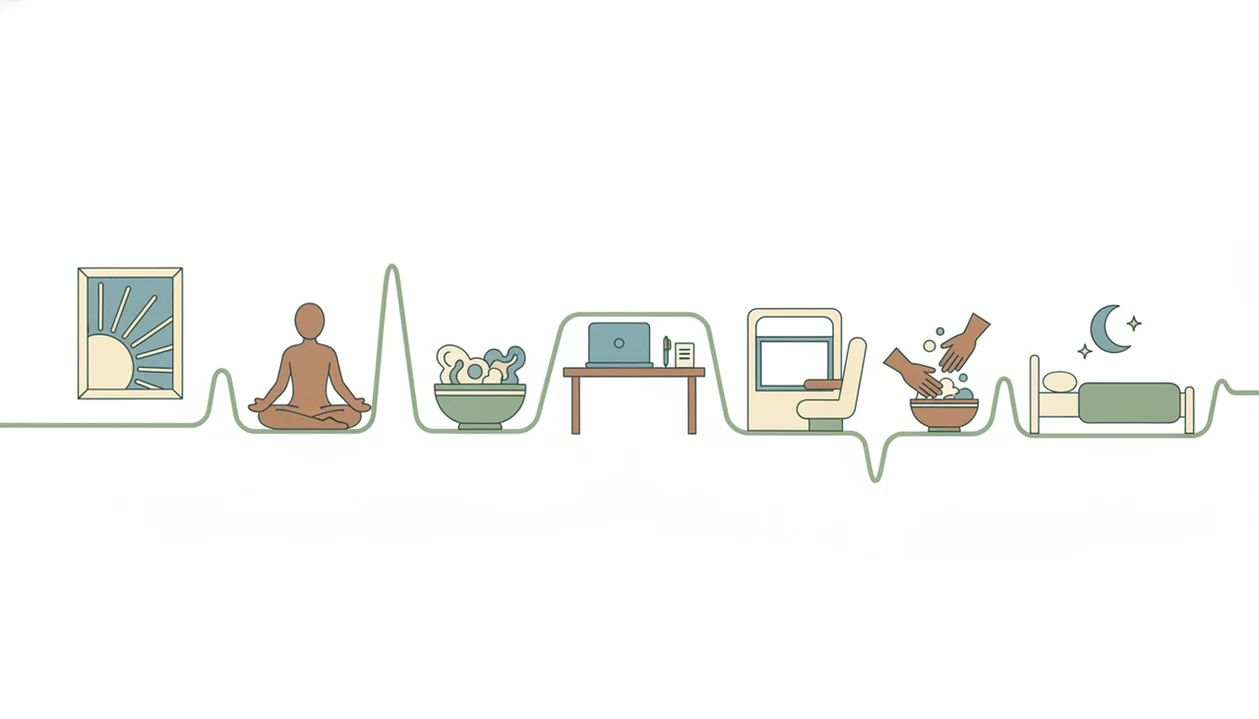
Short mindfulness exercises count when they train attention on purpose. You can repeat them during ordinary transitions, not only during formal meditation.
| Situation | Practice | Time needed | What to pay attention to |
|---|---|---|---|
| Sitting | Breath awareness | 2 to 5 minutes | Inhale, exhale, wandering, return |
| Walking | Step noticing | 1 to 10 minutes | Foot contact, pace, surroundings |
| Eating | First three bites | 2 minutes | Color, smell, chewing, fullness |
| Working | One breath before email | 30 seconds | Posture, breath, hand movement |
| Commuting | Stoplight or station pause | 1 minute | Sounds, seat pressure, breath |
| Chores | One-task attention | 2 minutes | Motion, sound, temperature |
| Conversations | Listen before replying | 10 seconds | Tone, facial expression, impulse |
| Stressful moments | Name and breathe | 30 to 90 seconds | Body tension, emotion, next action |
| Bedtime | Body scan | 3 to 10 minutes | Weight, contact, softening |
Tools like Mindful.net can help beginners compare mindfulness practices and meditation techniques for everyday life, but the core skill is still simple repetition.
Mindful.net’s Mindfulness Practices App is best used as a practice library and cue-planning aid, not as proof that a specific exercise will work for every person.
Short counts.
What Mindfulness Practices Mean in Daily Life
Mindfulness means paying attention to the present moment on purpose, with openness and non-judgment. In daily life, that means noticing what is happening before you rush to fix it, avoid it, or react.
Awareness can include breath, body sensations, thoughts, emotions, sounds, and surroundings. At a red light, one simple practice is feeling one full inhale and one full exhale before checking the road again. During breakfast, it might mean tasting the first sip of coffee instead of finishing it while reading messages.
One myth worth dropping early: wandering thoughts do not mean you are doing mindfulness wrong. The mind may jump to an unfinished assignment, a conversation from yesterday, or the next thing you need to pack in your bag. Noticing that jump and returning to the breath, a sound, or another steady anchor is the practice itself.
Good mindfulness practices and meditation techniques for beginners and daily life build steadier attention and more choice in ordinary moments, not instant calm or a blank mind.
5 Facts About Mindfulness Exercises Beginners Should Know
These five points can help beginners choose mindfulness exercises without making them feel precious or impossible to maintain. Mindfulness is practical attention training; it becomes more useful through small repeats, not through one perfect session.
- Mindfulness is present-moment attention, not emptying the mind. You notice thoughts, sensations, emotions, and surroundings without treating them as problems to erase.
- Mindfulness exercises include informal daily practices. Walking to the mailbox, waiting in line, and sitting on a kitchen chair can all become practice settings.
- Research links mindfulness with modest mental health benefits. A 163-trial meta-analysis found small to moderate improvements in anxiety and depression symptoms compared with controls JAMA study.
- Short, consistent practice usually builds the habit better than rare long sessions. For beginners, a 5-minute timer on a phone is often easier than planning an hour.
- Restlessness, boredom, racing thoughts, and difficult emotions can be normal early experiences. The first few sessions may feel noisy inside.
A U.S. survey found that 14.2% of adults used meditation in the past year, according to NCCIH NCCIH overview.
How Mindfulness Practices Work in the Brain and Body
Mindfulness practices work through a repeated loop: notice, name, and return. In plain terms, you catch where attention has wandered, label the experience lightly, then come back to an anchor such as breathing, ambient sound, or the feel of a paintbrush handle resting in your hand.
This creates a small pause between stimulus and response. You are waiting in an airport security line, your stomach flutters, and your thoughts start rushing ahead to the gate. Mindfulness adds one extra beat where you can notice the rush, take a breath, and choose the next simple action.
Body awareness also helps people detect stress earlier. An itchy forehead, fluttering stomach, warm cheeks, or a sense of holding the breath can appear before the mind has a clear story. One pattern we notice is that beginners often relax a little once they treat these signals as information rather than as problems to fix.
Not magic. Just practice.
The goal is awareness and skillful response, not forcing relaxation. Calm may happen, but it is not guaranteed and it is not the only useful outcome.
Before You Start Mindfulness Practices
Before you start mindfulness practices, set up a short, safe practice so attention training does not compete with something risky. The first goal is not depth; it is a steady, manageable beginning.
- Choose a cue where partial attention will not put you or anyone else at risk, such as sitting on the bed, standing by the kettle, or pausing before lunch.
- Set a timer for 2 to 5 minutes, then breathe normally instead of trying to control every inhale and exhale.
- Use an eyes-open anchor if closing your eyes feels too intense. You can look softly at the floor, listen to room sounds, or feel your feet instead of scanning the whole body.
- Avoid practicing during driving, cycling in traffic, cooking with hazards, or operating tools, machines, or equipment that need full attention.
- Stop if distress rises quickly, feels unmanageable, or keeps lingering after practice. Shorten the next session, switch to external sounds, or seek support from a qualified professional.
Safe enough is better than perfect.
How to Use Mindfulness Practices Throughout One Day
The easiest way to use mindfulness practices is to attach one short exercise to a cue you already have. Tiny consistency usually beats intensity, especially during the first week.
- Set one daily cue, such as waking, coffee, lunch, commute, or bedtime.
- Practice one short exercise for 2 to 5 minutes; a 5-minute mindfulness practice is enough for most beginners.
- Notice breath, body, sounds, thoughts, or emotions without fixing them.
- Return gently when attention wanders, even if you return twenty times.
- Repeat the same cue for a week before adding more practices.
A quiet corner of a room can be enough of a meditation setup. So can a museum bench between exhibits, a patch of grass beside a garden trowel, or a hallway pause before you enter a new class.
If you miss a day, keep the cue and restart. Reset the plan.
Mindfulness Exercises for Sitting, Breathing, and Body Awareness
Foundational mindfulness exercises use a simple anchor: breath, body, or senses. These practices are beginner-friendly because you can adjust the length, posture, and focus.
Mindful Breathing
Sit or stand comfortably. Feel the inhale, feel the exhale, and return when distracted. You do not need special breathing. If you are at a desk, feel the chair under your thighs and the tiny pause after each exhale before your hands move back to the keyboard. Counted breaths between keyboard clicks can work during a workday.
Short Body Scan
Move attention slowly from feet to head, or head to feet. Notice pressure, warmth, tingling, tightness, or numbness. If body awareness feels uncomfortable, keep your eyes open or focus on sounds instead.
One-Minute Sensory Pause
Try 5-4-3-2-1 grounding: name five things you see, four you feel, three you hear, two you smell, and one you taste. A one-minute pause also works before entering a meeting, replying to a tense text, or leaving the car.
Mindful breathing is often easier than body scanning for beginners because the breath gives a clear, repeatable anchor.
Daily Mindfulness Practices for Walking, Eating, Work, and Commuting
Daily mindfulness practices become easier when they fit the activity you are already doing. The point is not to make life slower; it is to meet ordinary moments with more attention.
Mindful Walking
Feel each step, the contact of the foot, the rhythm of the legs, and the space around you. The full mindful walking guide covers this in more detail, but one hallway can be enough.
Mindful Eating
Pause before the first bite. See the food, smell it, taste it, chew, and notice fullness. Mindful eating is not a diet rule; it is attention practice with food.
Mindfulness at Work
Take one conscious breath before starting a study session. Single-task for one short stretch, then notice your posture, your hands, and the sounds around you, such as the refrigerator hum in the next room. A few steady breaths before speaking in a group can change the tone of what you say.
Mindfulness While Commuting
Use everyday thresholds as cues: stepping into a classroom, waiting in an airport security line, entering a gallery, rinsing a cup, or opening a door. Mindful.net often suggests a simple Five Doorway Rule: for five doorway moments in a day, pause long enough to feel one breath and notice where your attention is.
Common Myths About Mindfulness Practices
Misunderstanding mindfulness makes beginners think they are doing it wrong. Most myths come from expecting silence, peace, or instant results.
| Myth | Correction | Practical implication |
|---|---|---|
| Mindfulness means clearing your mind. | Thoughts will appear. Noticing them is part of practice. | Return to the anchor without arguing with your mind. |
| Mindfulness requires long silent meditation. | Brief daily practices can train attention too. | Use 2 minutes at lunch or bedtime. |
| Mindfulness is just relaxation. | The goal is awareness, including discomfort. | Do not judge a session by calmness alone. |
| Mindfulness should feel peaceful every time. | Some sessions feel restless, dull, or emotional. | Shorten the practice and keep it gentle. |
| Mindfulness is a quick fix for mental health problems. | Evidence is modest, and care needs vary. | Use it as support, not a replacement for treatment. |
For people with busy schedules, a daily cue-based practice usually works better than waiting for a quiet hour because the cue removes one decision.
Mindfulness Practice Obstacles and Gentle Adjustments
Obstacles are normal in mindfulness practice, especially at the beginning. Racing thoughts, boredom, sleepiness, and emotional intensity are not proof that you failed.
When thoughts race, returning is the repetition that builds skill. It is like one small attention rep. When boredom shows up, shorten the session or focus on a more vivid anchor, such as sound, temperature, or the feeling of feet on carpet.
Sleepiness often needs a practical adjustment. Open your eyes, sit upright, practice earlier, or stand near a window. If silence or body scans bring emotional flooding, switch to external sounds, open your eyes, stand up, or stop.
However, mindfulness is not always the right tool in the moment. If practice repeatedly increases distress, especially with a trauma history, seek support from a qualified mental health professional. NCCIH also notes that meditation and mindfulness are generally considered safe for healthy people, but they may not be appropriate as a replacement for conventional care NCCIH overview.
Cue-linking helps. A daily mindfulness routine or habit stacking meditation approach can make practice less dependent on motivation.
Limitations
Mindfulness practices have real uses, but they also have limits. A 47-trial systematic review found moderate evidence for anxiety, depression, and pain, while cautioning against stronger claims NIH research.
- Benefits vary by person, practice type, teacher quality, and consistency.
- Changes may be subtle, such as noticing stress earlier rather than feeling calm all day.
- Mindfulness is not a substitute for medical care, psychotherapy, medication, or crisis support.
- Some people feel more distress during silence, body scans, or prolonged practice.
Clinicians typically recommend mindfulness as a supportive skill when appropriate, not as a stand-alone treatment for serious mental health symptoms.
A Practical Comparison
A beginner mistake is choosing the practice that sounds most impressive instead of the one that fits the moment. Mindfulness often starts with one clear anchor, such as a steady breath or hand sensation, while yoga may be a better fit when movement is the easiest doorway into attention. Neither is automatically “better”; the best choice is usually the one you can repeat in a short session without turning it into a performance.
A Practical Starting Point
| If you... | Try | Why | Note |
|---|---|---|---|
| Your thoughts are racing and sitting still feels like a contest | Anchor-Notice-Return with the breath or a sound | The small loop gives the mind one clear job: notice wandering and return without judging the wandering. | Keep it to 2 minutes at first; longer is not automatically wiser. |
| You are a parent moving between noise, meals, and cleanup | Three mindful breaths while touching a sink edge, doorway, or cup | A tactile cue can make practice easier to remember when there is no quiet setting. | Do not wait for the house to be calm; that may make practice less likely. |
| You are a nurse, shift worker, or athlete coming down from high alert | A brief Body Scan from face to hands to feet | Body-based attention may feel more concrete than trying to empty the mind. | If scanning increases discomfort, narrow attention to one neutral area instead. |
| You are a musician or performer before practice | One minute of listening meditation | Sound can become the anchor, which may fit people already trained to notice tone and rhythm. | The goal is not perfect focus; it is noticing and returning. |
A Field Note on Real Use
One mistake we notice often: people treat mindfulness practices like a test they can pass or fail. We’ve seen beginners do better when the instruction is smaller: choose one clear anchor, stay for a short session, and return when attention wanders. That does not guarantee calm, and it does not need to. It simply makes the next repetition easier to find.
What Not to Optimize
We usually suggest not optimizing posture, silence, streaks, or session length before the habit is real. One pattern we notice is that beginners often make mindfulness harder by trying to feel calm on command, when the more useful task is simply to notice what is present and return to one anchor. A short session repeated honestly tends to teach more than an ideal session postponed until tomorrow.
Three Paths Worth Trying
| Technique | Best for | Minutes |
|---|---|---|
| Anchor-Notice-Return | building a simple repeatable habit during ordinary pauses | 2-5 min |
| Body Scan | reconnecting with physical sensations after rushing or overthinking | 5-15 min |
| Mindful walking | people who focus better with gentle movement than stillness | 3-10 min |
The best mindfulness practice is usually the one you can repeat tomorrow without needing perfect conditions.
Why Mindful.net fits this specific need
Mindful.net’s daily mindfulness guides work well for readers choosing between small practices rather than searching for a single perfect method. The related guides on Anchor-Notice-Return and the Body Scan can help turn a vague intention into a repeatable cue, anchor, and short session.
FAQ
What are mindfulness practices?
Mindfulness practices are exercises that train present-moment attention, such as mindful breathing, body scans, walking, eating, and listening. They involve noticing experience without immediately judging or reacting.
How do I practice mindfulness?
Choose one anchor, such as the breath, feet, sounds, or body sensations. Notice when attention wanders, then gently return to the anchor.
Can mindfulness stop thoughts?
Mindfulness does not stop thoughts. It helps you notice thoughts as events in the mind instead of automatically following them.
How long should mindfulness take?
Beginners can start with 2 to 5 minutes a day. Short mindful moments repeated consistently are more useful than rare long sessions.
What is a mindful moment?
A mindful moment is a brief pause where you notice present experience on purpose. Examples include one breath before opening a laptop or feeling your feet before entering a room.
Can I practice mindfulness while walking?
Yes, walking can be a mindfulness practice. Use steps, foot contact, body movement, sounds, and surroundings as anchors.
Is mindful eating a meditation?
Mindful eating is an informal mindfulness exercise. It uses seeing, smelling, tasting, chewing, and fullness cues as objects of attention.
Why does mindfulness feel uncomfortable?
Mindfulness can reveal restlessness, tension, or difficult emotions that were already present. Try shorter sessions, eyes open, external sounds, or professional support if distress keeps increasing.
Is mindfulness scientifically proven?
Research supports modest benefits for stress, anxiety, depression symptoms, and pain in some groups. It is not proven as a cure-all, and Mindful.net presents mindfulness as education rather than medical treatment.