
How the Brain’s Attention System Selects What You Notice


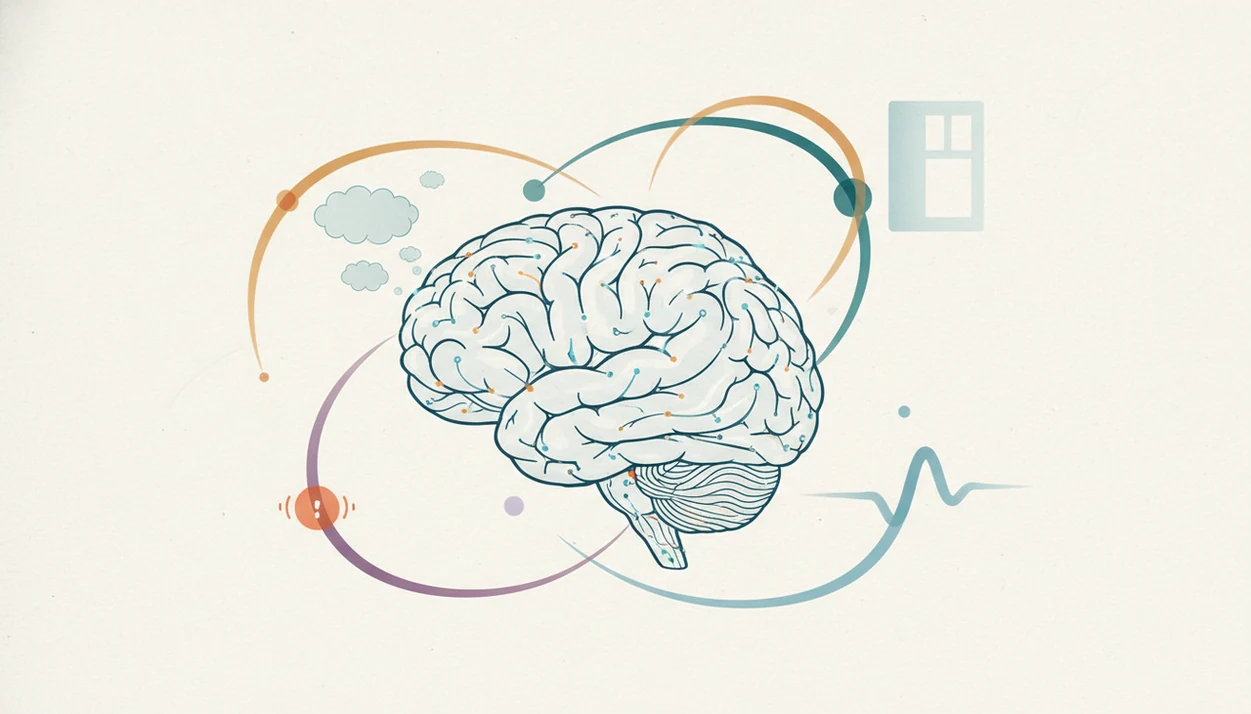
The brain’s attention system selects which sights, sounds, thoughts, and body sensations receive priority for perception, memory, and action. It is a set of interacting neural networks, not a single focus center. These networks help balance attention to the outside world with internal thought, threat detection, and goal-directed control. Much of the information available at any moment stays in the background.
Distraction and mind-wandering are part of this system, not simply failures of willpower. The default mode, salience, dorsal and ventral attention, and frontoparietal control networks contribute to what captures your attention and how you return to a task. Mindfulness practice trains that return: you notice that attention has moved, then bring it back to a chosen anchor, such as the breath. The aim is repeated practice, not uninterrupted concentration.
The essentials
- Attention is a selection system, not a single brain location or pure willpower skill.
- The default mode, salience, dorsal and ventral attention, and frontoparietal control networks help manage focus, distraction, and mind-wandering.
- Mindfulness practice can train attention by repeatedly noticing distraction and returning to a chosen anchor, such as the breath.
How attention selects what gets processed
How does the brain’s attention system work? It acts like an internal spotlight, selecting one small slice of experience for deeper processing while the rest stays dimmer.
The brain needs this filter because it cannot fully process every sound, sight, body signal, memory, and thought at once. Attention changes what feels vivid, what gets stored, what choice seems obvious, and how strongly the body reacts. A phone buzz across the room can become louder than the paragraph you meant to read.
Mind-wandering is part of the system, not proof that you are bad at focus. The mind may drift to tomorrow’s museum tour notes, the echo of a parking garage, or a phrase you meant to look up because internal thought also competes for attention. In everyday mindfulness, the skill is to notice and return, not to lock the mind in place.
How brain networks share control of attention
The brain’s attention system works by choosing what gets priority, turning up some signals, turning down others, and shifting when something more important appears. It is not one command center; it is a flexible filter for the outside world, inner thoughts, and body signals.
A sound in the room, a memory about tomorrow, and tightness in the chest can all compete for the same limited mental space. The salience network helps flag what feels important, the default mode network supports inner thought and mind-wandering, and control networks help steer attention back toward a chosen goal. In plain terms, the system keeps asking: what matters now, what can wait, and where should energy go next?
A typical shift looks like this: attention selects a target, amplifies it so it feels clearer, suppresses competing input enough to continue, then redirects when a stronger cue or goal appears. That redirection is normal. It does not mean you are lazy, broken, or “bad at meditation.” Practical takeaway: the next time your mind moves, silently note “shift,” then return to one simple anchor, such as the breath or your feet.
Five Facts About the Brain’s Attention System
- Attention exists because capacity is limited. The brain selects some information for deeper processing because it cannot give equal priority to everything.
- There is no single attention center. Focus depends on distributed networks that handle goals, novelty, threat, body signals, and internal thought. Differences in these networks also help explain how ADHD affects the brain and the challenges of regulating attention.
- Selected information gets fast priority. Research on attention shows that attended input can shape perception within a few hundred milliseconds. For example, selective-attention research has found that attended sensory information can affect early neural processing within roughly 100-200 milliseconds; see this review of attention and perceptual processing: PubMed research
- Stress and fatigue change the filter. Threat, low mood, poor sleep, and urgency can pull attention toward negative or alarming cues.
- Mindfulness trains redirection, not blankness. A short practice can build attention control by repeating one move: notice distraction, then return. Research on meditation effects on the brain examines changes in activity and connectivity, not just improvements in attention.
The pocket check is real.
For beginners, focus meditation is often easier than forcing concentration because it gives attention one clear place to land.
Brain Attention Networks: Default Mode, Salience, Dorsal, Ventral, and Frontoparietal Control
The brain’s attention system works through several networks that share control of focus, distraction, internal thought, and task switching.
The default mode network is most active during internally focused thought, such as remembering, planning, or mind-wandering. Reviews of functional imaging research link the default mode network with autobiographical memory, future planning, and other internally directed cognition; see Andrews-Hanna’s review of the brain’s default network: PubMed research
The dorsal attention network helps you aim attention on purpose. It supports the “stay with the paragraph” or “listen to the speaker” mode. The ventral attention network responds when something unexpected breaks through, like a siren or sudden movement.
The salience network helps detect what matters now. It weighs body signals, emotion, novelty, and urgency. The frontoparietal control network helps coordinate the others, reallocating mental resources when goals change. Gratitude practices may also influence brain activity, though evidence about how gratitude changes the brain needs careful interpretation.
In practice, this is why feet planted under the desk can help. That body cue gives the system a simple signal to return to.
Bottom-Up and Top-Down Attention: Sensory Capture Versus Goal-Directed Focus
Bottom-up attention is captured by what feels loud, new, urgent, or physically strong; top-down attention is guided by your goals and working memory.
| Attention type | What drives it | Everyday example | Why it helps | Where it can interfere |
|---|---|---|---|---|
| Bottom-up attention | Sound, movement, threat, novelty, body sensation | A dropped book pulls your gaze | Detects important changes quickly | Interrupts reading or deep work |
| Top-down attention | Intention, task goals, plans, working memory | Returning to one report after a message appears | Supports study, planning, and problem-solving | Weakens when tired or overloaded |
| Mindfulness training | Sensory clarity plus intentional return | Feeling chest movement beneath a shirt | Builds noticing and redirecting | Does not remove all distraction |
Both systems are useful, but they compete. A practical attention practice builds two skills: noticing sensory detail clearly and redirecting attention without a long argument. For longer work blocks, deep work meditation applies the same principle to planned focus sessions.
A five-step practice for noticing and returning
Use this practice to train attention in short, repeatable sessions. Five slow rounds of breathing is enough, or you can trace a small mark on a teaching whiteboard and return to it each time attention jumps.
1. Set one attention anchor
Choose one target, such as the breath, the hush of a room, or the warmth rising from a cup of tea.
2. Notice the attention shift
Watch for the moment attention moves to a thought, feeling, itch, plan, or outside noise.
3. Label the distraction gently
Name it in plain language: “thinking,” “hearing,” “worry,” or “planning.” Keep the tone neutral.
4. Return to the anchor
Bring attention back to the chosen target. No scolding needed.
5. Repeat in short sessions
Practice for a few minutes most days over weeks, rather than expecting instant focus.
Beginner meditation and everyday mindfulness exercises offer repeatable attention practice, not guaranteed calm or a cure for distraction.
What improved attention scores mean for daily work
Research supports possible benefits from mindfulness, but the comparison matters. A 2023 meta-analysis of 111 studies found small-to-moderate improvements across several cognitive measures, including executive attention, inhibition, and sustained attention. Benefits were generally larger against waiting lists or no treatment than against active comparison activities. That makes claims of a dramatic or uniquely effective attention boost difficult to justify. Similar caution applies to research on meditation and the immune system, where findings do not justify promises of stronger immunity.
An improvement on a computerized attention task does not establish better planning, punctuality, or productivity. The evidence is stronger for laboratory measures than for everyday time management. For a practical check, choose a concrete goal, such as completing a reading period with fewer unplanned switches, and track that separately from meditation minutes. Treat practice time as a record of practice, not proof that work performance has improved.
Even mind-wandering results depend on how researchers measure them. A 2023 meta-analysis of five studies found a reduction in mind-wandering and an improvement in awareness of it, but one analysis of average self-reported mind-wandering was not statistically significant. Noticing more distractions during practice therefore does not, by itself, show that your attention is getting worse or better.
Stress, Mood, and Fatigue Effects on the Brain’s Attention System
Stress narrows attention toward threat, urgency, and possible mistakes. That can protect you in danger, but it can also make ordinary work feel jumpy and reactive.
Poor mood can bias attention toward negative cues. Fatigue reduces top-down control, so the brain has less energy for holding a goal in mind. That is when one browser tab becomes seven. Or the same sentence gets reread five times. Research on mindfulness and depression explores possible brain changes, but findings do not make meditation a substitute for treatment.
Mindfulness can support attention regulation, but it is not medical treatment. If anxiety, depression, trauma symptoms, or sleep problems are severe, qualified care matters. Tools like Mindful.net teach beginner-friendly secular practices for everyday attention training, including short pauses, breath awareness, and body-based anchors. Students may also find study meditation for students useful when attention drops during reading or exam prep.
Using this guide for practice, not diagnosis
This guide fits readers who want a plain explanation of focus, distraction, and mindfulness without turning brain science into hype.
| Fit | Who it helps | Practical next step |
|---|---|---|
| ✅ Best for beginners | People who want a secular explanation of attention | Start with a 5-minute anchor practice |
| ✅ Best for mindfulness learners | Readers connecting meditation with attention science | Practice “notice and return” daily |
| ✅ Best for everyday focus habits | Workers, students, and readers building attention routines | Try one pause before opening a laptop |
| ❌ Not for diagnosis | People seeking evaluation for ADHD or other conditions | Use clinical or educational assessment resources |
| ❌ Not for replacement claims | Anyone hoping meditation replaces sleep, care, or environment changes | Address the basics alongside practice |
For work settings, focus meditation for work may be a better next step because it focuses on meetings, messages, and task switching. Apps such as Mindful.net, Calm, and Headspace can support practice, but the method matters more than the logo.
How can you practice noticing attention shifts?
During a short attention practice, the useful moment is noticing that your mind has left the breath. Mindful.net’s free online meditation timer can set a clear practice period; the app’s short guided meditations can provide instructions. Neither measures your attention or diagnoses a problem. Persistent difficulties that disrupt work, school, or relationships call for professional evaluation rather than a longer timer session.
Attention Training Limits
- Distraction and wandering attention are normal brain functions and cannot be fully eliminated.
- Mindfulness effects vary by person, practice type, teacher quality, and consistency, while attention training usually requires weeks or months of practice.
- Some productivity claims exceed the evidence; meditation for productivity without hype offers a cautious comparison.
- Seek professional evaluation when attention problems cause major impairment at school, work, home, or in relationships.
Brain attention system questions
What part of the brain controls attention?
Attention depends on interacting networks rather than one brain location. The dorsal attention network helps direct focus toward a goal, while ventral attention helps redirect it toward relevant changes. Salience and frontoparietal control networks also contribute, alongside the default mode network involved in internally directed thought.
Why does my mind wander when I try to concentrate?
Internal thoughts compete with the task in front of you. Remembering, planning, and mind-wandering involve the default mode network, while other networks support task-directed focus. A wandering mind is not automatically a problem. During attention practice, the useful response is to notice the shift and return to your chosen target.
What is the difference between top-down and bottom-up attention?
Top-down attention follows a goal, such as reading a report despite nearby conversation. Bottom-up attention is captured by something noticeable, such as a sudden sound or movement. Both are useful: one supports deliberate work, and the other helps detect changes that may need a response.
Does attention change what we perceive?
Yes. Attention gives some information priority for deeper processing while other information stays in the background. What feels vivid is therefore not a complete record of everything present. A phone buzz can take priority over a paragraph, even though the words remain in front of you.
How do stress and fatigue affect focus?
Stress can narrow attention toward threat, urgency, and possible mistakes. Fatigue can weaken the control needed to hold a goal in mind and resist competing signals. Mindfulness may support attention regulation, but it is not a substitute for addressing severe sleep problems, anxiety, or other conditions with qualified care.
Can the brain focus on two tasks at once?
The brain can combine some familiar, automatic activities, but two demanding tasks usually compete for attention. What feels like multitasking often involves rapidly switching between tasks, which can increase mistakes and slow progress. For deep work, focusing on one task and grouping smaller interruptions into separate periods can reduce unnecessary switching.