
Meditation for Exam Focus: Short Scripts for Studying and Tests


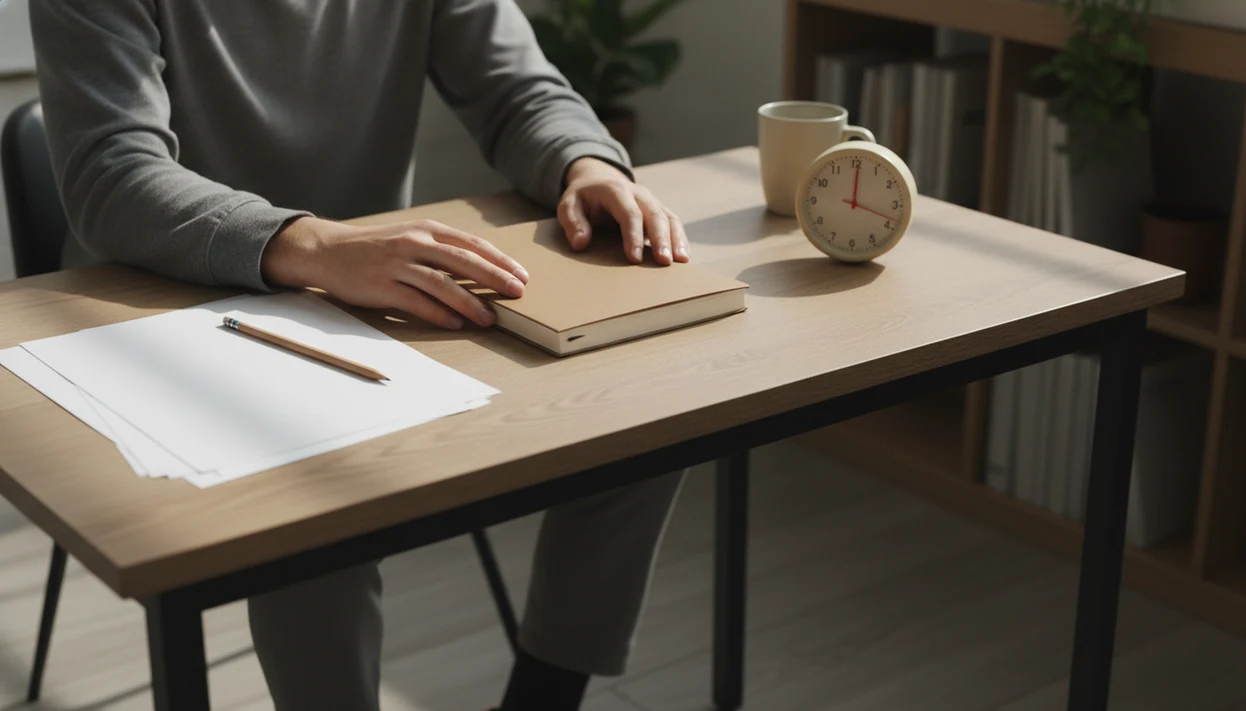
Meditation for exam focus is a short, secular mindfulness routine for noticing distraction and returning attention to the next study or test task. Try it before studying, before a test, or between study blocks. A 2-5 minute reset can be simple: breathe normally, notice where attention has gone, relax your shoulders, and return to one clear task. The aim is not an empty mind.
This is attention practice, not a grade guarantee or treatment for test anxiety. Keep it alongside sleep, preparation, revision, and practice questions. Attention control is a more defensible goal than higher scores: a review of college mindfulness studies found limited evidence for direct improvements in academic attainment.
The essentials
- Use exam focus meditation as a 2-5 minute reset, not as a substitute for studying.
- The strongest evidence is for attention and executive attention, not guaranteed higher scores.
- Keep the practice simple: breathe, notice distraction, relax the body, and return to one clear task.
Exam Focus Meditation: The 5-Minute Student Routine
Use this 5-minute exam focus meditation in three moments: before a library study block, before turning over a practice test, or in the quiet minutes outside an exam room with a wet umbrella by your bag. The myth is that focus means an empty mind. More often, it means catching the drift and coming back.
Settle into a steady posture with your body supported. Notice any fluttering in the stomach or buzzing in the ears without treating it as a problem. Breathe in normally, then let the out-breath last a little longer.
Silently repeat:
“Breathing in, I am present for this page.” “Breathing out, I make room in my body.” “My attention may wander.” “I can return to one question, one line, one next step.”
For the next few breaths, feel one anchor: air at the nose, ribs widening under a sweater, or the pressure of the chair. When your mind jumps to formulas, friends, or the clock, label it “thinking” and come back.
Simple is enough.
After five minutes, name one task: “Open chapter notes,” “Start question one,” or “Review errors first.” For a broader routine, pair this with study meditation for students.
Train the return to your next question
Meditation for exam focus trains the return: a student notices attention sliding toward worry, anchors in a simple sensation, and then brings effort back to the study or test task.
In attention research, this relates to executive attention and self-regulation. Plainly, those are the skills that help you choose where your mind goes next, even when worry or boredom pulls it away. For example, a 2018 Frontiers in Human Neuroscience study of meditation-naive adults found that a brief guided mindfulness exercise improved executive attention on an attention task, though it did not measure exam grades (Full).
That does not prove higher grades.
It does explain why a short student focus meditation can be useful before a difficult reading block or timed section. Mindfulness practices and meditation techniques for beginners and daily life can build a repeatable attention cue, not a shortcut around preparation. For a wider explanation of attention anchors, the focus meditation guide covers the same skill in non-exam settings.
Why school findings do not guarantee better exam scores
Research on mindfulness and academic performance gives different answers depending on the students and programs studied. A 2023 review of college and university studies screened 568 records but found only five eligible studies. Most interventions did not produce a statistically significant direct improvement in academic attainment. That is a reason to keep grade claims modest, not proof that an attention reset has no use.
A broader 2022 review of school mindfulness interventions included 77 studies involving 12,358 students and reported improvements in academic performance in 94% of studies. The authors also identified support for lower test anxiety and some learning outcomes. However, the programs and studies differed, and evidence strength varied. Those findings do not establish that a two-minute breathing script will improve an individual student’s exam score.
Five steps to start a study block
Use this student focus meditation as a brief setup before one study block, not as a flawless ritual. Five quiet minutes beside your notes, with warm cheeks after a walk across campus, usually helps more than designing the perfect study hour. For writing or other imaginative tasks, try meditation for creative focus before beginning your first draft.
- Choose a clear start point, such as before opening your laptop or before a timed practice set.
- Set a timer for 2-5 minutes, with no audio needed if you are in a library.
- Rest attention on one breath anchor, such as the belly, nose, or feet on carpet or tile.
- Name distractions briefly: “worry,” “planning,” “phone,” or “grocery list.” If distraction is a recurring challenge, mindfulness for ADHD focus offers short resets adapted to ADHD attention patterns.
- Begin one study task immediately, such as solving five problems or reviewing one marked page.
For most students, short repeatable meditation works better than rare long sessions because it fits the real study day. The practical next step is small: pause, breathe, notice, return. Adults balancing study with work may find mindfulness for ADHD adults useful for building practical, repeatable attention habits.
Follow the breathing reset with recall, not just rereading
Before the reset, write one concrete goal and its first action: “Answer five practice questions without notes” is more useful than “Study biology.” After five minutes of focused breathing, study a small section, close the material, and recall what you can. Then check your answers and correct errors. A systematic review of retrieval and distributed practice supports self-testing and practice spread over time as learning methods.
Schedule the same material for several later sessions rather than saving all repetition for one evening. Finish by writing the next step, such as which missed questions to retry. Meditation and study methods have different jobs here: the reset gives you a way to return attention, while retrieval and spacing support learning. Feeling settled is not evidence that you can recall the material, so check with a closed-book attempt.
Meditation Before Exams: A 2-Minute Test-Room Script
Can you meditate before exams without audio or looking unusual? Yes. Use a silent 2-minute practice while seated at your desk, with your eyes open or lowered.
Place both feet on the floor. Notice the desk, the paper, and the room without needing to change anything. Inhale gently. Exhale slowly, as if you are lowering the volume inside your body. Release your shoulders once.
Silently repeat:
“Feet on floor.” “Slow exhale.” “Shoulders soft.” “One question at a time.”
If the cursor blinking on an online exam screen makes you tense, look at one neutral point and return to the exhale. Test anxiety is associated with lower academic performance in meta-analytic research, which helps explain why students try brief pre-test settling routines; this script has not been shown to guarantee better scores (Edu0000230). Still, this is attention support, not a performance guarantee. Your next action might be writing your name, reading the first instruction, or circling the first key word.
A 60-90 second reset between subjects
Mindfulness for test focus between study blocks helps clear attention residue before switching subjects. It is a 60-90 second reset, not a way to force motivation.
Try this between a math set and a reading review. Put the finished material aside. Look away from the screen or page. Take three steady breaths. On each exhale, say silently, “Done for now.” Notice one body point, such as the lower back meeting the cushion. Then name the next block: “biology terms,” “essay outline,” or “missed questions.”
That tiny naming step matters. It tells your attention where to land next.
You can pair this with common study cycles, such as 25-minute or 50-minute work blocks, but do not turn the timer into another pressure source. For longer sessions, deep work meditation may fit students who want a calmer entry into focused work.
When a focus reset helps, and when you need more preparation
Exam focus meditation supports study habits; it does not replace them. Use it when the problem is scattered attention, not missing knowledge.
| Use case | Best for | Not for |
|---|---|---|
| Attention reset | Returning after phone checking, worry, or mental drifting | Learning material you have not studied |
| Pre-study ritual | Starting one clear block without overthinking | Avoiding planning, revision, or practice questions |
| Short breaks | Settling the body between tasks | All-night cramming or sleep replacement |
| Returning from distraction | Noticing the mind wandered and coming back | Guaranteed score gains |
| Pre-test pause | Getting oriented before the first question | Treating severe anxiety or panic |
For a student who has studied but feels scattered, a 2-minute breathing reset is often easier than adding more last-minute notes because it gives attention one clear job. If focus problems are ongoing or complex, resources like ADHD meditation app support can help compare support options without treating meditation as a cure. For a broader view of attention difficulties, mindfulness for ADHD explains what meditation can and cannot support.
What the evidence supports about exam focus
- Meditation for exam focus works best as a short, repeatable routine before studying, before testing, or between blocks.
- Attention control is the most evidence-aligned benefit, especially when distraction and mind-wandering interrupt study time. Understanding how people with ADHD think can add context to differences in focus, distraction, and the need for rest.
- Executive-attention improvements have been reported in mindfulness research, including a 2018 study of meditation-naive adults using a brief guided mindfulness exercise, but those findings should not be treated as proof of higher exam scores (Full).
- Many online claims about exam stress and anxiety are broader than the evidence, so grade and anxiety claims should stay cautious.
- Exam meditation should be paired with sleep, study planning, revision, and practice testing for the most realistic support.
For everyday use, the method is plain: choose an anchor, notice the mind wandering, and return to the next useful action. No special belief system required. If sound helps you settle, concentration music for meditation can be tested carefully, but silence is often easier in exam settings.
A seated breathing reset at a study desk
Image caption: A student sits upright at a desk with a notebook and exam materials nearby, using a short breathing reset before studying or testing. This meditation for exam focus shows a practical pause: feet supported, shoulders relaxed, attention returning to the next task.
The scene should feel ordinary, not dramatic. A student at a kitchen chair, library desk, or classroom table can practice the same routine without headphones, candles, or special equipment. The useful detail is the transition: closing one notebook, taking a few breaths, and beginning the next question or review page.
That is the whole point.
The image supports accessibility when it describes posture, materials, and purpose in plain language. It should not suggest medical treatment, panic relief, or guaranteed academic performance.
Can background sound help you return to studying?
At the end of a breathing reset, you may want a steady background sound while you begin your next practice set. Mindful.net’s free white noise and ambient sound player offers that option, but sound is not the attention exercise itself. The app also has short guided meditations for a pre-study pause. In an exam room, a silent routine is more practical, and neither option replaces revision or practice questions.
Exam Meditation Limits
- Meditation is not proven to raise every student’s grades, and results vary by person, subject, routine, and consistency.
- Much research measures attention or self-regulation rather than actual exam scores.
- Meditation supports academic preparation but cannot replace studying, sleep, revision, or practice testing.
- Seek professional mental health care for panic, severe anxiety, or ongoing distress that a brief routine cannot resolve.
Exam focus meditation questions
Does meditation improve exam scores?
Meditation is not a reliable way to raise exam scores. Some school studies report academic benefits, but college research has found limited direct improvements in attainment. Treat meditation as support for attention and stress regulation, then use practice questions and revision to check what you actually know.
Can I meditate in the exam room with my eyes open?
Yes. Keep both feet on the floor, let your eyes rest on a neutral point, and take a few gentle breaths. Release your shoulders and silently repeat, “One question at a time.” You do not need audio, closed eyes, or a special posture. Follow the exam room’s rules.
What should I do when my mind wanders during exam meditation?
Notice the distraction, briefly name it if helpful, and return to the sensation of breathing or your feet on the floor. You do not need to finish the thought or push it away. Returning is the practice. When the timer ends, move to the study task you chose.
Can meditation stop test anxiety or panic?
A brief routine may help you settle and return attention, but it may not remove panic or severe anxiety. It is not a medical treatment. If distress is ongoing or interferes with studying or taking tests, seek mental health support rather than relying on breathing exercises alone.
Should I meditate or do practice questions before an exam?
They serve different purposes. A short meditation is an attention reset; practice questions reveal gaps in knowledge and give you retrieval practice. Do not spend your preparation time only trying to feel calm. Use a brief pause if needed, then answer questions, check mistakes, and revise the material.
How do I reset my focus between study blocks?
Put the finished material aside and look away from the page or screen. Take three steady breaths, notice one point of contact with your chair or the floor, and name the next task. Keep the pause around 60-90 seconds, then begin the next block rather than waiting to feel fully motivated.