
Concentration Music for Meditation: How to Choose a Sound Anchor


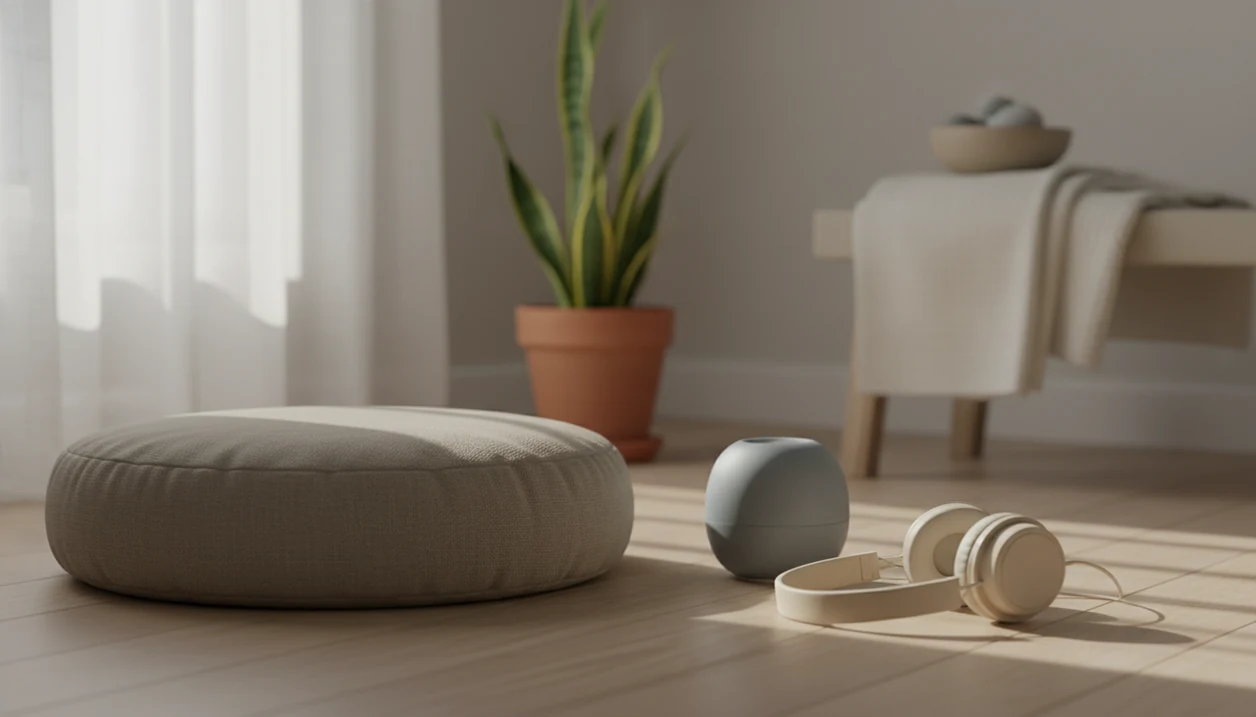
Concentration music for meditation is intentional, usually instrumental audio used as an anchor for mindful listening, rather than passive background sound. Simple instrumental music, nature recordings, or ambient tracks can give attention somewhere steady to return to. Listen to tone, rhythm, texture, and the spaces between sounds, then return when your mind wanders.
Choose predictable tracks that do not pull you into lyrics, memories, or strong emotions. Silence is a better option when music becomes distracting or feels necessary for every session. This is a beginner-friendly attention practice, not a promise that one playlist will fix focus in every room or mood. Some practice without music helps keep your choice of anchor flexible.
Definition: Concentration music for meditation is intentional, usually instrumental audio used as a mindful listening anchor during meditation practice.
The essentials
- Use concentration music as the object of attention: listen to tone, rhythm, space, and silence, then return when the mind wanders.
- Instrumental, predictable, low-emotion tracks usually work better than lyrics, abrupt changes, or favorite songs.
- Music can support beginners, but some silent practice helps build attention that is not dependent on a perfect sound environment.
Choose a sound anchor: music, nature sounds, or silence
Concentration music supports meditation when it gives your attention somewhere steady to rest. Silence is often better when music becomes the main event.
| option | best for | not for | how to use it mindfully |
|---|---|---|---|
| Ambient instrumental music | Beginners who want a soft, steady anchor | People who drift into daydreaming | Notice tone, texture, and the space between sounds |
| Nature sounds | People who like rain, wind, water, or birds | People who analyze every sound | Let one sound be the anchor, then return gently |
| Slow classical or acoustic music | Listeners who want warmth without lyrics | People with strong memories tied to the piece | Follow rhythm and pauses without judging the music |
| Lofi focus music | Short focus music meditation sessions | People pulled into beat changes | Choose soft lofi without vocals or dramatic shifts |
| Silence | Building attention without support | Beginners who feel overwhelmed at first | Use breath, body, or room sound as the anchor |
No single track, frequency, or playlist is best for everyone. Music with lyrics is more likely to distract during demanding concentration practice because words compete for language attention.
The source matters less than the practice: Spotify, YouTube, Calm, Headspace, Insight Timer, and Mindful.net can all work if the audio is simple, steady, and used as an attention anchor rather than entertainment.
How sound becomes an attention anchor
Concentration music for meditation works by turning sound into an attention anchor, similar to breath, body sensations, or environmental sound. The practice is not “music on, mind off.” It is listen, notice, return.
Active mindful listening means you know you are hearing the sound as it unfolds. Passive hearing means the track fades into the room while your attention moves to planning, scrolling, or replaying a conversation. The difference is small, but it matters.
Sound can engage auditory, emotional, and attentional networks at the same time. In plain language, music can pull attention, shape mood, and give the mind a pattern to follow. A 2025 review of 52 studies found that sound can modulate attention, but benefits were context-dependent and not reliable for every task or person; add the inline source URL immediately after the claim. PubMed research
A practical next step is simple: put headphones down sometimes. Mindful.net teaches sound as one possible anchor within broader focus meditation, so attention is not tied to the perfect track.
Mindful Listening for Focus vs Passive Background Audio
Is playing focus music the same as meditating with sound? No. Mindful listening for focus means repeatedly returning attention to the sound and present-moment experience; passive background audio means the music fades behind whatever else you are doing.
The same track can support meditation or distract from it. A soft ambient loop can become a clear anchor during a five-minute session. It can also become sonic wallpaper while you plan dinner, check messages, or fill a notebook margin with breath counts.
Is listening to music meditation?
Listening to music can be meditation when you use the sound as the object of attention and notice wandering without trying to force a mood. If you are simply relaxing, studying, or working while music plays, that may be useful, but it is not the same as formal meditation.
Mindful.net, the Mindfulness Practices App, frames this as everyday mindfulness: know what you are attending to, then come back when attention leaves.
Music vs Silence for Focus Meditation: Where Each Wins
Music wins when it gives a beginner a clear place to land; silence wins when you want attention to become less dependent on conditions. Neither choice proves the meditation was successful, the useful measure is whether you noticed wandering and returned.
Music can help when silence feels too blank, restless, or intimidating. A steady instrumental track, rain sound, or soft ambient loop gives the mind a simple target before study, especially when the room feels scattered. Silence is stronger when you are ready to meet breath, body, thought, and ordinary room noise without needing a soundtrack. It may also reveal overstimulation more honestly, while music can soften it or, with emotionally loaded songs, intensify memory. When music brings up difficult feelings, the RAIN mindfulness technique offers four steps for responding with care.
A simple weekly rhythm:
- Start with music for one or two short sessions when you need an obvious anchor.
- Switch to silence for the next session, using breath or room sound.
- Notice which setting supports study, restlessness, emotional charge, or recovery. Use an emotion wheel for mindfulness to name feelings before deciding whether music or silence supports your practice.
- Alternate again instead of declaring one method best.
Match ambient, nature, and instrumental tracks to your practice
The best meditation music for focus is usually simple, predictable, and low in lyrics. Choose sound that makes returning easier, not sound that demands analysis.
- Gentle ambient: Best for beginners who want a smooth anchor. Not for people who get sleepy quickly.
- Nature sounds: Best for mindful listening and body settling. Not for people who become irritated by repeating rain, waves, or birds.
- Slow instrumental: Best for warmth and structure. Not for emotionally loaded favorite songs or pieces with dramatic builds.
- Soft lofi without vocals: Best for short daily practice before study or desk work. Not for tracks with chopped voices, sudden transitions, or busy beats.
- Silence: Best for learning to notice breath, body, thought, and room sound directly. Not always the easiest first step.
Students trying to settle before reading may prefer the structure in study meditation for students. The main rule stays the same: if the track keeps asking for your opinion, pick another track.
How to Use Music for Concentration Meditation
Use music for concentration meditation by making the sound your practice object for a short, timed session. Five to fifteen minutes is enough for most beginners.
- Choose one simple instrumental, ambient, nature, or soft lofi track without lyrics.
- Set a timer for 5 to 15 minutes, so you are not checking the track length.
- Sit in a stable position, on a chair, cushion, or bus seat, and feel your feet or body supported.
- Listen to tone, rhythm, silence, and body sensations as the sound changes moment by moment.
- Return when thoughts wander, even if the thought is just a grocery list or “Am I doing this right?” Try cognitive defusion exercises when worries keep returning, practicing noticing thoughts without treating each one as a command.
For the final minute, try silence. Notice the after-sound, the room, and the breath. That small shift helps you test whether the music supported attention or became something you needed.
On days the laptop feels loud before it even opens, Mindful.net fits a three-minute breathing pause followed by a short sound-anchor session through a named short-practice workflow.
Keep the volume low and switch anchors if sound causes distress
Set speakers or headphones to the lowest level that lets you hear the track comfortably. WHO safe-listening guidance recommends keeping personal-device volume below approximately 60% of maximum, but risk also depends on loudness, duration, and frequency of exposure. Take breaks, and do not raise the volume to cover warning signals or other sounds you need to hear.
Sound is not a neutral anchor for everyone. Migraine, tinnitus, sound sensitivity, or distress linked to particular music can make listening uncomfortable. Begin with one quiet, predictable sound rather than layered audio. Stop or switch to a visual object or feet on the floor if agitation rises. Persistent distress, panic, tinnitus, or hearing changes calls for professional assessment, not continued exposure.
What sound studies can tell us about meditation
Research on focus music meditation is promising in some settings, but it does not prove that music reliably improves attention for everyone. The careful reading is mixed: sound can help, harm, or do very little depending on the listener and task.
- A 2025 review of 52 studies found that music and sound can affect attentional performance, but consistent improvement is limited and context-dependent. PubMed research
- A controlled study in older adults found that music-based mindfulness training may improve sustained attention compared with a control group. PubMed research
- Experimental work reports that lyrics can impair reading comprehension and memory compared with silence or instrumental music, especially during demanding tasks. 02702711.2012.639660
- Neuroimaging research suggests mindful listening engages auditory, emotional, and attentional systems more strongly than passive hearing. PubMed research
- Feeling calmer during music-based practice does not automatically mean attention skills improved.
For deep work, outcome usually depends more on how consistently you return attention than on whether the audio is labeled focus, meditation, or productivity. Mindful.net keeps this distinction visible in meditation for productivity without hype.
When a music anchor helps, and when to switch
Meditation music for focus is a good starting point when silence feels too open or vague. It is less useful when the music becomes a requirement, a memory trigger, or a performance ritual.
| choice | best for | not ideal for |
|---|---|---|
| Pick music | Beginners who find silence intimidating | People who analyze every chord or beat |
| Pick music | People practicing mindful listening in short daily sessions | People who get absorbed in memories or emotions |
| Pick music | People who need a clear sound anchor before work or study | People who keep changing tracks mid-session |
| Pick silence | People building flexible attention | People who feel flooded without any support |
| Alternate both | Most beginners over time | People seeking one fixed rule |
For beginners, alternating music sessions with silent sessions is often better than using only one method because attention becomes more flexible. Mindful.net supports that alternation through technique libraries that include sound, breath, body scan, and short silent practice.
Common Mistakes With Music for Concentration Meditation
Playing music only to change your mood misses the attention practice: noticing present experience and returning when distracted. Calm is pleasant, but mindfulness practice is the act of noticing and returning.
Another trap is chasing special frequencies or productivity claims. No current evidence supports one universal frequency for concentration meditation. If a track helps you stay present, fine. If you are mainly wondering whether 432 Hz is doing something magical, attention has already left the practice.
Lyrics, dramatic builds, and favorite songs often pull the mind into meaning, memory, or emotion. That can be beautiful. It can also be a detour.
Changing tracks repeatedly is another quiet problem. The pocket check is real. Pick one track before you begin, then stay with it unless the sound is genuinely disturbing. A meditation for habitual reactions can help you pause when the urge to change tracks interrupts your listening.
People practicing deep work meditation often do better when they judge the session by returning, not by how relaxed they felt.
How can a bell help you start listening deliberately?
Before a music meditation, a single bell sound can mark the shift from background listening to deliberate attention. The free mindfulness bell offers a simple cue for that pause; the Mindful.net app also has a meditation timer for a short session. Neither chooses the right sound for you. When added audio feels intrusive, start quietly and use breath or bodily contact instead.
Meditation Music Limits
- Current evidence does not support one universally best focus playlist, frequency, or sound formula.
- Music can distract people who are sensitive to sound, easily overstimulated, or emotionally reactive to certain tracks.
- Music can become a crutch when every session requires the exact track, headphones, room, or volume.
- Feeling calmer does not prove stronger mindfulness skills, and meditation music is not medical treatment.
Meditation music questions
Does listening to music count as meditation?
It can, when listening is the deliberate object of attention. Notice the sound as it changes, recognize when attention moves to thoughts, and return. Music playing while you work or daydream is background listening, not the same practice. Feeling relaxed alone does not show that you practiced mindfulness.
What kind of music is best for concentration meditation?
Start with simple, predictable instrumental music, gentle ambient audio, or nature sounds. Choose a track that makes returning easy rather than one that invites analysis or strong memories. There is no universal best playlist. If you keep following lyrics, anticipating a chorus, or judging the performance, try a simpler sound.
Is lofi music good for meditation?
Soft lofi without vocals can serve as an anchor for a short session, particularly before study or desk work. It is less useful if the beat, samples, or changes keep drawing you into evaluation. Treat it like any other sound: notice it, return when distracted, and switch if it becomes the main event.
Is it better to meditate with music or in silence?
Music can give beginners a clear target when silence feels too open or restless. Silence may suit you better when tracks stir memories, cause irritation, or become a requirement. Neither choice proves success. The useful measure is noticing distraction and returning, with enough flexibility to practice under different sound conditions.
How long should I meditate with music as a beginner?
Try a timed session of five to fifteen minutes with one simple track. Sit in a supported position and listen to tone, rhythm, and pauses. Return whenever you notice wandering. Avoid changing tracks throughout the session; choosing the perfect soundtrack can replace the attention practice you intended to do.
How loud should meditation music be?
Use the lowest comfortable level that lets you hear the sound. WHO recommends keeping personal-device volume below approximately 60% of maximum, though that percentage is not a guarantee of safety. Duration and loudness both matter. Take breaks, keep important environmental sounds audible, and stop if listening causes discomfort or hearing changes.
Does 432 Hz music improve concentration during meditation?
Current evidence does not support one universal frequency for concentration meditation. A track labeled 432 Hz may suit your preferences, but the label does not establish an attention benefit. Choose by how the sound affects your practice: can you notice wandering and return without becoming absorbed in claims about the frequency?