
Meditation for Creative Focus: A Practical Pre-Work Routine


Meditation for creative focus is a short, secular mindfulness practice before creative work that helps you notice distraction, settle attention, and begin without forcing inspiration. You attend to the present task while letting thoughts, doubts, and ideas arise without chasing or judging them. Think of it as a repeatable transition into work, not a promise of better ideas.
Start with 5 to 15 minutes of breath awareness, a body scan, or mindful noticing before writing, designing, composing, coding, or problem-solving. Evidence supports attention-related benefits more clearly than guaranteed gains in creative output. The aim is not a blank mind or instant inspiration. It is a steadier start and a less judgmental return when attention wanders.
Definition: Creative focus meditation is a secular mindfulness practice that trains attention toward the present creative task while allowing thoughts, doubts, and ideas to arise without being chased or judged.
The essentials
- Use 5-15 minutes of breath awareness, body scanning, or mindful noticing before writing, designing, composing, coding, or problem-solving.
- The strongest evidence supports attention control and reduced mind-wandering; creativity benefits are plausible but modest and mixed.
- The goal is not a blank mind or instant inspiration, but a steadier start and a kinder return when distraction appears.
Creative focus meditation in five practical facts
- Creative focus meditation is attention training before creative work, not a creativity hack. It helps you arrive before you ask yourself to make something.
- Breath awareness, body scans, and noticing thoughts are the most beginner-friendly methods. A phone timer set for 5 minutes is enough to start.
- Regularity matters more than session length. Five minutes before writing three days a week usually beats one long session done only when blocked. Adults with ADHD can explore practical mindfulness support for ADHD when building a repeatable practice before work.
- Likely benefits include less mental clutter, easier task initiation, and a better return from distraction. The pocket check is real.
- Research on creativity outcomes is mixed, and effects are usually modest. Mindfulness may support the conditions for creative work, but it does not create taste, skill, or originality by itself.
For a broader foundation, the same attention skills are covered in our focus meditation guide.
Before You Start: Set Up the Creative Session
Before you meditate, make the creative session specific, reachable, and hard to interrupt. The setup should make beginning feel obvious when the timer ends.
- Choose one creative task, not the whole project. “Revise the opening paragraph,” “sketch three thumbnail layouts,” or “record one rough chorus” gives the mind a clear doorway.
- Place the first tool within reach before you start. Open the notebook, load the file, set the guitar nearby, or leave the design board visible so there is no extra hunt afterward.
- Silence notifications, or put the phone outside arm’s reach if you know you will check it. The point is not heroic willpower; it is fewer tiny exits. For people with ADHD, understanding less visible ADHD challenges can put distraction and environmental adjustments in context.
- Adapt the practice if closing the eyes or turning inward feels uncomfortable. Keep your eyes softly open, use room sounds as the anchor, or feel your hands on the desk.
- Decide the first post-meditation action before the session begins. When the timer rings, do that one ordinary thing immediately, before judging whether you feel inspired.
How noticing and returning supports creative attention
Creative focus meditation is not a way to summon brilliance on command. It trains attention regulation: you choose a simple anchor, notice when the mind wanders, and return without turning the wandering into a personal failure.
In practice, the anchor might be breath, the warmth of a coffee mug in your palms, or rain tapping against glass while you prepare notes for a conference keynote. When the mind jumps to whether the idea is original enough, or whether the first draft will disappoint you, you notice the shift. Then you come back.
For creative work, this matters because doubts and urges often arrive right before starting. Mindfulness can make those signals less sticky. It may support sustained attention, working memory, and cognitive flexibility, but it does not create talent or replace craft practice. Learning about how people with ADHD think can add context to differences in focus and the need for rest.
In a randomized trial of 140 adults, an 8-week MBSR course improved self-reported attention and mindfulness compared with a waitlist group PubMed research. A 2011 systematic review found preliminary evidence that mindfulness training may improve attention-related cognitive performance, while noting that many studies had methodological limits PubMed research.
Five-step meditation routine before creative work
Use this routine for writing, design, music, art, studying, coding, or problem-solving. For most beginners, 5-15 minutes is enough; the transition into work matters more than reaching a special mental state.
- Set a timer for 5-15 minutes and place the first tool nearby, such as a notebook, instrument, sketch file, or code editor.
- Sit in a steady position, with both feet supported if possible. Let the shoulders drop once.
- Notice one simple anchor, such as breathing, sound, or the feeling of your hands resting.
- Name distractions gently: “planning,” “doubt,” “comparison,” or “impatience.” Then return to the anchor.
- Begin with one small creative action, not a demand for inspiration. Write one sentence, open the file, tune one string, or sketch one line.
For longer work blocks, this pairs well with deep work meditation before a focused session.
Match the meditation to brainstorming or revision
Before brainstorming, try open monitoring: notice changing sounds, sensations, and thoughts without making any one of them your sole focus. Before editing or technical work, try focused attention: choose one anchor, such as the breath, and return whenever you notice distraction. A review describing a randomized comparison reports that open monitoring improved divergent thinking, or generating multiple possibilities, while focused attention tended to improve convergent thinking, or finding one correct solution.
Treat this distinction as a practical option, not a rule that guarantees results. After open monitoring, write down possible approaches before judging them. After focused attention, begin one defined revision or production task. A two-week randomized study of open-monitoring meditation found no significant improvement in metaphor creativity or cognitive flexibility. Results on a brief thinking test do not establish better originality, quality, or completion in everyday creative work.
A 7-minute creative attention practice script
Opening breath anchor
Sit in a way you can maintain for seven minutes. Let your hands rest. Feel the next inhale arrive and the next exhale leave. You do not need to breathe in a special way. Just know that breathing is happening.
If it helps, let attention settle into the body without hunting for a perfect sensation. Notice cold hands, the weight of clothing at the shoulders, or the small wobble of a ceiling fan overhead. Let the face soften by a degree, as if you were giving the next idea more room to arrive.
Noticing creative pressure
Now notice what the mind is bringing. Planning may be here. Doubt may be here. Comparison, perfectionism, or impatience may be here too.
When a thought pulls you, use a plain label: “thinking is here” or “planning is here.” Then return to breathing or body sensation. No scolding. No scoreboard.
Moving into the first action
In the last minute, picture the first small action. Not the finished piece. Just the start.
Open the document. Pick up the pencil. Play the first note. Let the first ordinary sensation count as the doorway in: the pen click, the cursor blinking, the cool edge of the instrument, or the chair holding your weight. Name that action silently, then begin.
When a pre-work pause helps, and when another approach is needed
Creative focus meditation fits moments when attention needs a reset before work. It is less useful when the real need is rest, training, feedback, or clinical support. If you have ADHD, short mindfulness resets for ADHD focus offer another option for brief pauses before work.
| Best for | Not for |
|---|---|
| Starting after distraction, especially after messages, meetings, or errands | Replacing craft skill, technique, revision, or deliberate practice |
| Reducing pre-work pressure before writing, designing, composing, or coding | Curing burnout, exhaustion, or chronic overload |
| Transitioning from daily tasks into a creative session | Forcing breakthrough ideas on demand |
| Returning from mind-wandering without turning it into self-criticism | Avoiding critique, deadlines, planning, or hard creative choices |
| Building a repeatable pre-work ritual | Treating acute mental health symptoms or crisis-level distress |
Mindfulness practices and meditation techniques for beginners and daily life can offer steadier starts and clearer noticing, not guaranteed calm, brilliance, or productivity.
What research supports about attention and creativity
The strongest supported claim is that mindfulness can improve attention-related processes that creative work often depends on. Direct proof of large creative-output gains is limited and mixed.
One two-week mindfulness-training study found reduced mind-wandering and improvements in working memory and reading comprehension PubMed research. A meditation and cognitive-flexibility study also linked mindfulness practice with better attention-related flexibility, but it was small and should not be read as proof of creative-output gains PubMed research. Those skills can matter when you are switching between ideas, revising a paragraph, or solving a design problem. For ADHD specifically, compare science-backed ADHD approaches rather than assuming general mindfulness findings establish benefits for every symptom.
Still, creativity is not one mental switch. It includes knowledge, taste, risk, feedback, and time on task. For a designer or writer who keeps spiraling before starting, creative attention practice is often more useful than waiting for motivation because it gives the mind a repeatable first move.
Mindful.net’s Mindfulness Practices App, Calm, and Headspace can help by making short practices easier to find, but the evidence supports the practice habit more than any single app.
Common mistakes in creative focus meditation
- Blank-mind chasing: The mind does not need to go empty. Correct it by treating each noticed thought as one repetition of attention practice.
- Idea forcing: Meditation is not a vending machine for concepts. Correct it by ending with one action, such as opening the draft, not demanding a breakthrough.
- Productivity judging: A session is not “bad” because no idea appeared. Correct it by asking, “Did I notice and return?”
- Only practicing when blocked: Waiting until frustration peaks makes the habit harder. Correct it by using the same short ritual before ordinary sessions.
- Over-meditating before work: A 40-minute sit can become polished procrastination. Correct it by setting a short timer and beginning when it ends.
A saved lesson opened during lunch can work, but so can silence and a timer. For workplace transitions, our guide to how to practice mindfulness at work offers similar short pauses.
Image caption and alt-text brief for creative focus meditation
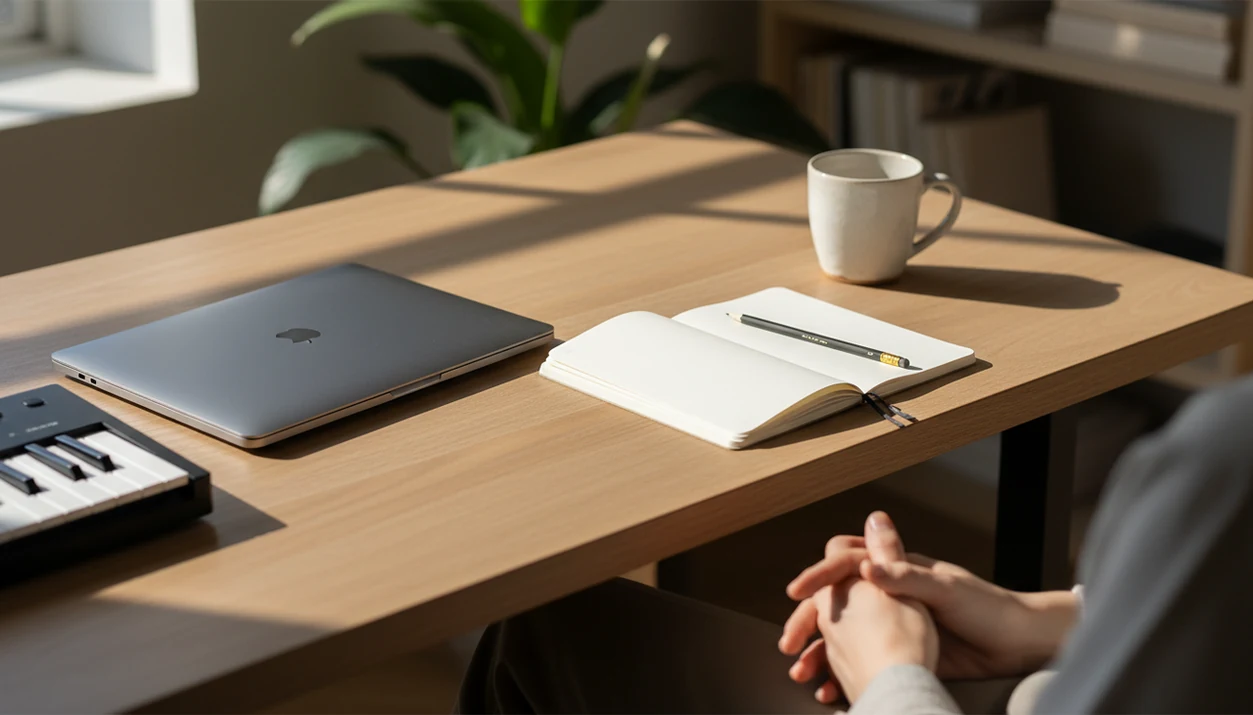
Use a grounded image: a notebook open beside a laptop, a sketchbook on a desk, a keyboard before recording, or a design workspace with someone pausing before beginning. The person should look ordinary and present, not blissed out or staged.
Caption: A short creative focus meditation can help mark the transition from daily distraction into writing, design, music, coding, or problem-solving.
Alt text: Person sitting at a creative workspace with a notebook and laptop, pausing before beginning a creative attention practice.
Avoid glowing heads, mystical symbols, dramatic “genius” poses, or medical claims. The image should say: pause, notice, begin.
A timed pause before the first draft
Before opening a draft or sketching a layout, a defined pause can keep meditation from becoming another way to postpone work. The free online meditation timer lets you set that boundary; the Mindful.net app also offers short guided meditations when spoken instructions help. Neither supplies ideas or feedback. When the obstacle is exhaustion, an unclear brief, or a missing skill, rest, planning, or instruction is the better next step.
Meditation’s Creative Limits
- Benefits may be modest and develop over weeks, with no large attention effects reported in NIH research.
- Meditation cannot guarantee creative breakthroughs or replace sleep, rest, planning, craft practice, feedback, revision, or deep work habits.
- If inward attention feels uncomfortable during acute distress or after trauma, adaptations or professional support may be needed.
- For attention needs, ADHD meditation app support offers a more specific comparison of tools and limits.
Creative focus meditation questions
Does meditation actually improve creativity?
It may support attention and some forms of creative thinking, but the evidence is mixed. Reviews report a positive association between mindfulness and creativity, while some controlled studies find no creativity benefit. Better concentration does not automatically mean more original work. Skill, subject knowledge, feedback, and revision still matter.
How long should I meditate before creative work?
Start with five minutes, with your first task and tools already prepared. The suggested range of 5 to 15 minutes is a practical starting point, not a proven optimal dose for creativity. End when the timer sounds and begin the task rather than extending the session until you feel inspired.
Which meditation is best before brainstorming?
Open monitoring is a reasonable option: observe thoughts, sounds, and sensations without repeatedly returning to one exclusive anchor. Some research links it to generating multiple ideas, though not every study finds a benefit. Afterward, record several possibilities before evaluating them. Meditation cannot guarantee that useful ideas will appear.
Should I meditate before writing or editing?
A short practice can mark the transition into either task. For drafting, you might notice thoughts and sensations without selecting one anchor. For editing, focused attention offers practice in returning to a single target. Prepare a concrete next action, such as drafting one paragraph or checking one scene, before you start.
What if ideas or worries keep appearing during meditation?
You do not need to stop them. Notice what has appeared, perhaps naming it “planning” or “doubt,” then return to your chosen anchor. In open monitoring, observe the thought without following its story. The practice is noticing where attention goes, not proving that you can keep your mind empty.
Can meditation help with creative block?
It can provide a pause when distraction or pressure makes starting difficult. It will not solve every block. An unclear task may need planning; a technical problem may need instruction or feedback; exhaustion may need rest. After the pause, choose one small action rather than waiting for a breakthrough.
Will meditating before work help me enter flow?
Mindfulness-based interventions have shown positive effects on flow in a small group of randomized trials, typically involving weeks of practice. That does not establish that one short session will produce flow. Flow also does not guarantee better work, especially when the task requires careful error checking or deliberate revision.