
Focus Meditation for Work: A 3-Minute Desk Reset


Focus meditation for work is a brief, secular attention practice used before a task, after an interruption, or between meetings to prepare for the next work block. You choose one anchor, such as breath, sound, counting, or a task intention, then notice distraction and gently return. The point is not to empty your mind or force productivity. It is to practise bringing attention back.
A 1- to 10-minute pause can fit at your desk without closed eyes or special equipment. Keep the next task clear, remove an avoidable interruption, and finish by naming your first action. This practice may support calmer concentration, but it cannot replace sleep, real breaks, workload boundaries, or protected time to work.
Definition: Focus meditation for work is a brief, secular focused-attention practice that uses breath, sound, counting, or a task intention to help attention return to the next work activity.
The essentials
- Use work focus meditation as a 1- to 10-minute transition before a task, meeting, or deep-work block.
- The core skill is returning attention after distraction, not maintaining perfect concentration.
- Desk focus meditation can support calmer concentration, but it cannot replace sleep, workload boundaries, or removing constant interruptions.
What focus meditation for work means at your desk
Focus meditation for work means using a short attention practice right where work happens, often in a chair, meeting room, or remote-work setup. It is task-specific, desk-friendly, and meant to help you begin one next thing with less mental scatter.
A simple version is this: choose one anchor, notice when the mind leaves it, and return without making a drama of it. The anchor might be breath, room sound, a visual point on the wall, slow counting, or the next task written on a notepad.
The mind will wander. That is not a mistake.
You may notice tomorrow’s grocery list, a message you forgot to answer, or the urge to check another tab. The training is the return. For a broader foundation, our focus meditation guide explains the same skill outside a work setting.
Five things to know before your first desk reset
- Work focus meditation is most useful as a transition. Use it before a meeting, deep-work block, writing session, or difficult task, not as a vague all-day productivity mood.
- Returning attention is the central skill. The goal is not a blank mind; the goal is noticing distraction and coming back to one anchor.
- Short scripts usually beat rare long sessions. A repeatable 3-minute desk practice is easier to use than a 30-minute session you skip on busy days.
- It may support calmer concentration, but it is not a workload fix. Good mindfulness practices and meditation techniques for beginners and daily life deliver attention training and practical pause points, not a cure for overwork.
- Focused attention meditation differs from productive meditation. Focus meditation is anchor-based; productive meditation is usually a thinking practice done while walking or doing a routine activity.
Before you start a desk focus meditation
Before you start a desk focus meditation, make the practice quiet, specific, and easy to do without turning it into a scene. Decide what kind of reset you need, choose one anchor, and remove one obvious interruption if your workplace allows it.
- Choose a posture that feels private enough for your setting: sitting normally, softening your shoulders, lowering your gaze, or resting your hands on the desk. You do not need closed eyes, special hand positions, or anything that invites questions from a passing coworker.
- Pick one anchor before the timer begins. Use breath, room sound, hand contact, feet on the floor, or slow counting, and stay with that choice for the short session.
- Silence the phone, turn it over, or move it slightly out of reach when that is realistic. If you must stay reachable, just let the screen stop being the main object in the room.
- Decide whether this pause is for starting fresh, restarting after an interruption, or downshifting after a tense exchange. That purpose shapes the first action afterward.
- Use a non-breath anchor if breath awareness makes you tight, self-conscious, or more distracted. Sound, touch, and counting are valid anchors too.
How focus meditation for work trains the attention loop
Focus meditation trains an attention loop: choose an anchor, notice wandering, return, and repeat. The return matters because it is the trainable part of the practice, especially when work keeps pulling attention toward messages, tabs, and unfinished thoughts. To build on this attention loop, explore practical steps to achieve deep focus during a protected work block.
Focused-attention guidance often begins with the breath and asks you to return each time the mind wanders, as described in this guided practice from Mindful.org A Meditation To Focus Attention. In work terms, that means the stale office air on an exhale can become a cue to come back before opening the next document.
Research is still modest for workplace outcomes, but one brief mindfulness meditation study found immediate attention improvement in novices after a single session PMC research article. A stronger workplace claim would require longer trials that measure job outcomes directly, not just immediate attention after practice. For busy workers, short focused-attention practice is often easier than open-ended mindfulness because it gives the mind one clear job.
Feeling focused is not proof of better work performance
A 2021 systematic review of mindfulness and mind-wandering found that 14 of 15 studies reported at least one significant relationship between the two. The most consistent findings included fewer measured episodes of mind-wandering and fewer errors on sustained-attention tasks. Results varied substantially with the measurement method and comparison group, so this is not a guarantee that a brief desk meditation will improve your output.
Feeling calmer after a pause is useful information, but it is not the same as demonstrating better sustained attention or productivity. A review of randomized mindfulness programs and cognitive outcomes found that results differed by task and cognitive domain. At work, distinguish the practice from the conditions around it: a clearer task or fewer interruptions may explain a better session without a general increase in attention capacity.
How to use focus meditation for work before a task
Use focus meditation for work before a task by setting a timer, choosing one anchor, and naming the first action you will take afterward. One to five minutes is enough for a transition before a call, spreadsheet, code review, or writing block. For study sessions, meditation for exam focus offers short resets you can use before revision or practice questions.
- Set a timer for 1 to 5 minutes, and place the phone face down if you can.
- Sit with both feet on the floor, shoulders relaxed, and hands resting on the desk or lap.
- Choose one anchor, such as breath, room sound, a fixed visual point, or counting.
- Return gently when attention drifts; say “thinking” silently if that helps.
- Name the next task and the first visible action, such as “open draft” or “review line one.”
Feet on carpet work fine.
Guided timers in Mindful.net's Mindfulness Practices App, Calm, or Headspace can provide structure, but the basic practice needs only a chair, a timer, and one clear intention.
A 3-minute desk focus meditation script
This 3-minute desk focus meditation script gives you exact cues for a work transition. Use it before starting a task, or after an interruption that left your attention scattered.
Minute 1: Settle the body
Place both feet on the floor. Let your hands rest. Drop your shoulders a little. Lower your gaze at the screen, or close your eyes if that feels comfortable and private enough.
Minute 2: Return to the anchor
Notice one breath at a time, or listen to the sounds in the room. If thoughts drift, come back. You can count each exhale up to 10, then restart at one.
Minute 3: Name the next action
Ask, “What is the next useful action?” Name it in plain words. Open the file, write the first sentence, review the ticket, or send the agenda. Then begin. If the cursor is blinking and you still feel foggy, make the first action tiny: type the heading, open the ticket, or read one paragraph. When your next task involves generating ideas, meditation for creative focus offers a brief practice before you begin.
Pair the pause with a protected deep-work block
Before the meditation, define one concrete task and prepare the work space. Put the phone aside, turn off nonessential notifications where your role allows it, and leave only task-relevant materials open. Choose a timed work interval and plan a break. The meditation is preparation for this block, not the block itself. It cannot create uninterrupted time when messages and meetings remain unrestricted.
After the pause, begin the first action you named rather than checking messages again. At the end of the work interval, leave a short note stating where you stopped and what comes next. Judge the routine by the work you completed and the interruptions you reduced, not just by how settled you felt. The research on cognitive outcomes does not establish that a short pre-work meditation reliably increases productivity.
When to pause: meetings, interruptions, and stalled tasks
The best times for meditation before work tasks are moments when attention is about to switch. Treat the practice like a small doorway between one work mode and the next.
- After an interruption spiral: Pause after notifications, chat threads, or a quick “just checking” loop. The pocket check is real.
- Between back-to-back meetings: Take three breaths before opening the next agenda, especially when the last call was tense.
- Before decision-heavy work: Use counting or sound before budgets, reviews, hiring notes, or complex tradeoffs.
- After lunch or a stalled task: Restart with one anchor and one visible first step.
Focus meditation for work versus workplace mindfulness
Focus meditation for work is a narrow, anchor-based practice for starting or restarting a task. Workplace mindfulness is broader and can include communication, stress awareness, walking, listening, and habits across the whole workday.
| Practice | Main purpose | Typical setting | What you do |
|---|---|---|---|
| Focus meditation for work | Return attention before a task | Seated, still, desk or meeting room | Use breath, sound, counting, or task intention |
| General workplace mindfulness | Bring awareness into work behavior | Across the day | Notice posture, speech, stress, reactions, and habits |
| Focused attention meditation | Train return-to-anchor skills | Usually seated | Choose one object and return when distracted |
| Productive meditation | Think through one work problem | Walking or routine activity | Hold one professional problem in mind and reason through it |
If you want broader workplace habits, how to practice mindfulness at work covers everyday mindfulness beyond task transitions.
When a desk reset helps, and when work needs to change
Desk focus meditation fits task transitions when you need a small reset, not a full life redesign. It is especially useful when you can pause before one clear action, even in a normal office chair with hallway noise outside the door.
| Best for | Not ideal for |
|---|---|
| ✓ Starting a deep-work block | ✕ Fixing chronic overwork |
| ✓ Recovering after a difficult meeting | ✕ Replacing sleep or real breaks |
| ✓ Resetting after notifications | ✕ Working through constant interruptions without changing them |
| ✓ Beginners who need a repeatable script | ✕ People who feel worse with breath focus and have no alternate anchor |
| ✓ Naming one next action | ✕ Clarifying priorities that are genuinely unclear |
For people who struggle with attention regulation, educational resources such as ADHD meditation app support can help compare options, but they do not replace clinical care or workplace accommodations. For attention challenges, mindfulness for ADHD focus offers short resets that can complement appropriate care and workplace accommodations.
Common mistakes with focus meditation at work
At work, focus meditation can become another performance test or a way to tolerate conditions that need changing. The practice works best when it is short, specific, and followed by one visible next move.
- Stop trying to make the mind blank. Thoughts will show up; the useful repetition is noticing them and returning to breath, sound, counting, touch, or the task intention.
- Change one avoidable interruption when you can. A three-minute pause is not a substitute for muting a noisy channel, closing extra tabs, or asking for fewer drive-by questions during a focus block.
- Keep the first sessions small enough that you will actually use them. One steady minute before a hard email beats a perfect 20-minute plan that disappears on busy days.
- Choose an anchor that feels simple and safe. If breath focus makes you tense or self-conscious, use room sound, feet on the floor, hand contact, a visual point, or slow counting.
- Finish by naming the next concrete action. “Work on report” is vague; “open the draft and write the heading” gives attention somewhere to land.
Image caption for a desk focus meditation practice
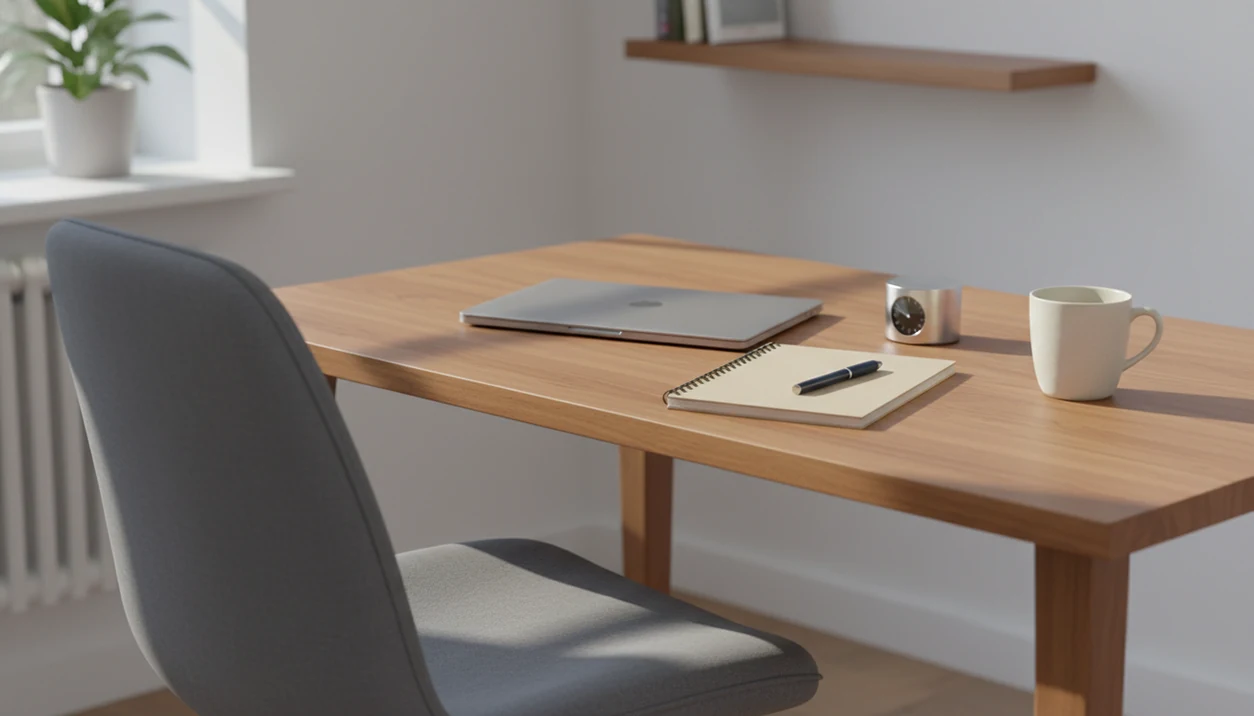
Caption: A person sits at a desk before starting a task, with both feet grounded, shoulders relaxed, and hands resting near a closed laptop. The scene shows a quiet transition pause, not a spiritual ritual or medical treatment. A short focus meditation for work can be used before a meeting, writing block, analysis session, or deep-work period to notice distraction and return attention to one next action.
The image should feel ordinary: office chair, notebook, muted light, maybe a timer set for three minutes. No candles needed. No dramatic pose. The point is a practical pause that fits inside a real workday, including a home office where the laundry is still in the next room.
Can background sound help with a desk reset?
At a desk with unpredictable background noise, a steady sound may make a short attention practice more comfortable. Mindful.net's white noise and ambient sound player offers a background you can choose for that pause. Its app also has short guided meditations. Neither guarantees better concentration. When sound itself distracts you, quiet and fewer notifications are better choices.
Focus Meditation Limits
- Focus meditation cannot fix constant notifications, nonstop meetings, or poor task design, nor replace sleep, breaks, exercise, planning, or workload boundaries.
- Evidence is stronger for general attention and stress benefits than workplace productivity claims, with findings varying: NCCIH overview.
- It is educational attention training, not medical treatment for anxiety, ADHD, burnout, or sleep disorders.
- If meditation increases distress, stop and consider support from a qualified clinician.
Desk focus meditation questions
Should I meditate before every task or just before deep work?
You do not need a meditation before every small task. Choose transitions where attention feels scattered, such as after a tense meeting, repeated notifications, or before a demanding work block. Keep the pause brief enough that it helps you begin rather than becoming another way to delay.
What should I focus on if watching my breath feels uncomfortable?
Choose another neutral anchor, such as room sound, your hands resting on the desk, your feet touching the floor, or a fixed visual point. Return to that anchor when you notice wandering. There is no need to persist with breath focus if it makes the practice feel worse.
What is the difference between focus meditation and deep work?
Focus meditation is the short practice of noticing distraction and returning to an anchor. Deep work is the task session that follows, with one defined activity and fewer avoidable interruptions. Meditation can prepare you to begin, but it does not replace planning, protected time, or doing the task.
Can work focus meditation help if I have ADHD?
It may be an additional attention practice, but it is not a replacement for ADHD assessment or established treatment. Guidance supports medication when indicated and structured psychological support. Pair any meditation routine with practical supports such as smaller task steps, external reminders, environmental changes, and appropriate clinical care.
How do I stop my mind wandering during meditation before work?
Mind wandering is a normal part of meditation, not a sign that you are doing it wrong. When you notice a thought, gently return your attention to your chosen anchor, such as sounds or the feeling of your feet on the floor. Practicing this return can help you notice distractions and refocus during work.
Can a short meditation help me refocus after a meeting?
A short meditation can give you a pause between a busy meeting and your next task. Sit comfortably, notice any tension, and spend a minute or two attending to a steady sensation or nearby sounds. Then choose one clear next action. This transition may make it easier to leave meeting concerns behind.